BUILDon loses 15% as Futures activity cools down — Another decline incoming?

ambcryptoPubblicato 2026-07-24Pubblicato ultima volta 2026-07-24

Introduzione

BUILDon's price fell 15% to around $0.2068 as trading volume dropped 35% and market capitalization declined to $206.87 million. Despite the sell-off, buyers defended the key $0.20 support level. Futures market activity cooled significantly, with Open Interest dropping 17.75% to $35.94 million, indicating traders reduced leveraged positions rather than opening new speculative bets. The OI-Weighted Funding Rate remained positive but declined, showing weakening bullish conviction. The RSI held above neutral at 53.39, suggesting buyers retain a slight edge. For a rebound, participation needs to improve. If $0.20 support holds, price could retest $0.2534 resistance; a break below may target $0.10.

BUILDon’s price dropped 15% over the last 24 hours to trade at around $0.2068, placing recent bullish sentiment under pressure. Trading activity also weakened as daily volume fell 35.37% to $11.46 million, indicating that fewer participants supported the latest price action. That decline in participation accompanied a fall in market capitalization to $206.87 million too.

Even so, it’s worth pointing out that the price stayed above the $0.20 support zone, despite the heavy selling pressure.

Buyers still defended that level during the session, although they failed to reclaim higher resistance immediately.

Why did leveraged traders reduce exposure on BUILDon?

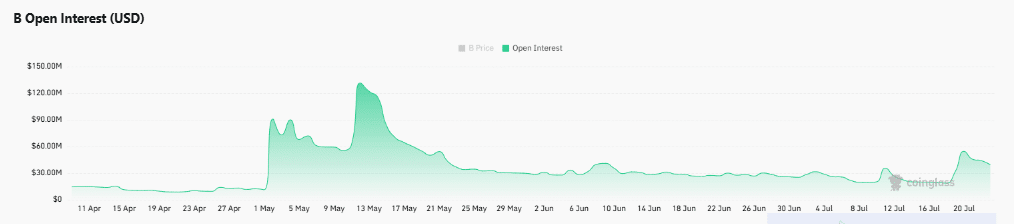
Derivatives traders reduced risk aggressively during the sell-off. Open Interest declined by 17.75%, falling to $35.94 million — Evidence that traders closed positions instead of opening fresh leveraged bets.

This behavior implied that liquidation and profit-taking dominated the session rather than aggressive speculative buying.

Unlike a decline accompanied by a hike in Open Interest, the latest move hinted at capital leaving the Futures market. As a result, leveraged participation weakened alongside spot activity instead of reinforcing a rebound.

However, the fall in Open Interest also reduced excessive leverage across the market. This could lower the probability of another sharp liquidation event.

Fresh upside would likely require Open Interest to stabilize before increasing alongside renewed buying demand.
Source: CoinGlass

Are bulls beginning to lose conviction?

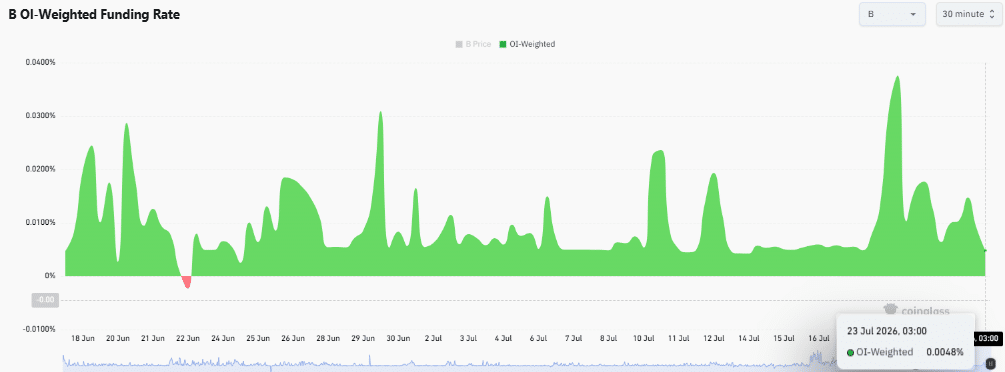
At the time of writing, funding conditions still favored long traders, although bullish conviction did weaken throughout the session. For instance, the OI-Weighted Funding Rate remained positive — Indicating that long positions continued paying a premium to maintain exposure.

However, the funding rate gradually declined from its recent peaks and settled near 0.0048%, revealing that traders became less willing to maintain aggressive bullish positioning.

The shift aligned closely with the decline in Open Interest instead of contradicting it.

Rather than expanding leveraged exposure, market participants reduced risk while keeping a modest long bias intact. If funding stabilizes and begins climbing again, bullish confidence could strengthen.

Otherwise, further cooling in funding would likely reinforce cautious positioning across the derivatives market.
Source: CoinGlass

Can the $0.20 support hold next?

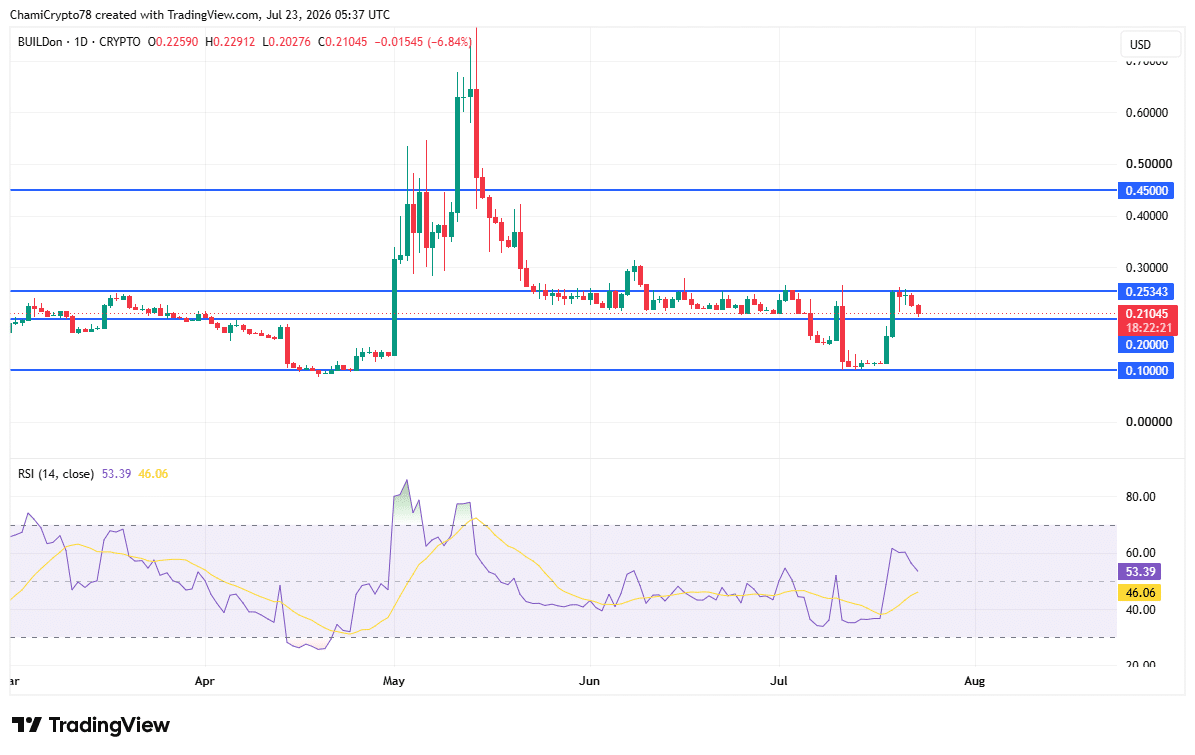
BUILDon’s [B] price retreated after failing to sustain its recent advance towards the $0.2534-resistance level. However, buyers defended the $0.20-support once again, preventing a deeper breakdown during the latest session.

The RSI also remained constructive despite the correction, holding around 53.39, while staying above its moving average near 46.06.

This relationship suggested buyers still retained a slight advantage even after the pullback. However, RSI also turned lower from recent highs, reflecting slowing buying strength rather than renewed acceleration.

If bulls continue defending $0.20, BUILDon could revisit $0.2534 before targeting the higher $0.45-resistance. On the other hand, losing $0.20 would likely expose the psychological $0.10-support, where buyers previously returned.
Source: TradingView

To sum up, BUILDon’s correction hinted at weakening participation across both the spot and derivatives markets, instead of aggressive fresh selling. Open Interest and funding rates both cooled down too, while trading volume also fell noticeably.

Even so, buyers preserved the crucial $0.20-support and RSI remained above neutral.

If participation improves and derivatives activity stabilizes, the altcoin could challenge its higher resistance again.


Final Summary

  • BUILDon held above its key support, despite falling volume and weaker Futures participation.
  • A cooldown in funding and a fall in Open Interest suggested that bullish conviction has continued to fade.


Domande pertinenti

QAccording to the article, what were the main reasons for the 15% price decline in BUILDon over the last 24 hours?

AThe main reasons were a cooling of activity in both spot and futures markets. Trading volume fell significantly, indicating weaker participation. More importantly, derivatives traders reduced their exposure, as shown by a 17.75% drop in Open Interest, suggesting capital leaving the futures market due to liquidation and profit-taking rather than aggressive speculative buying.

QWhat key support level did BUILDon's price manage to hold above, and why is it important?

ABUILDon's price held above the $0.20 support level. This is important because its defense by buyers during the sell-off prevented a deeper price breakdown. The article states that holding this level could allow a price recovery to challenge the $0.2534 resistance, while losing it would risk a drop to the $0.10 support.

QHow did the behavior of futures traders (Open Interest and Funding Rate) change, and what did it signal about market sentiment?

AOpen Interest declined sharply by 17.75%, showing traders closed positions and reduced leveraged exposure. The OI-Weighted Funding Rate remained positive but declined from recent peaks. Together, this signaled that bullish conviction was weakening. Traders were reducing risk and becoming less willing to pay a high premium to maintain long positions, indicating a cautious rather than aggressively bullish sentiment.

QWhat does the article suggest is needed for BUILDon to stage a fresh price upside move?

AThe article suggests that for a fresh upside move, participation needs to improve and derivatives activity must stabilize. Specifically, Open Interest would need to stop declining and begin increasing again alongside renewed buying demand. A stabilization and subsequent rise in the funding rate would also indicate strengthening bullish confidence.

QWhat is the significance of the RSI (Relative Strength Index) level mentioned in the context of BUILDon's price action?

AThe RSI held at around 53.39, which is above its moving average (46.06) and above the neutral 50 level. This suggests that buyers still retained a slight technical advantage despite the price correction. However, the fact that the RSI had turned lower from recent highs reflected slowing buying momentum rather than renewed strength.

Letture associate

The Verdict in Choi Tae-won's Divorce Case: Revealing the Inheritance Undercurrent Behind SK Hynix's Trillion-Won Empire

SK Group Chairman Chey Tae-won's high-profile divorce case, involving a record 1.38 trillion won settlement, has drawn attention to the succession plans for Korea's second-largest conglomerate, especially its crown jewel, SK hynix. Unlike traditional chaebol scripts centered on the eldest son, Chey's three children from his marriage to former President Roh Tae-woo's daughter, Roh Soh-yeong, are carving distinct, non-traditional paths. Eldest daughter Chey Yun-jung (b. 1989) is seen as the most evident successor. With a scientific and consulting background, she holds executive roles at SK bioscience and SK Inc.'s growth support department, focusing on future strategy and biopharma. Her marriage is to an AI infrastructure entrepreneur, not a traditional business alliance. Second daughter Chey Min-jung (b. 1991) took a unique route, voluntarily serving as a South Korean naval officer, including an anti-piracy deployment. She later worked on policy and strategy for SK hynix in Washington D.C. before co-founding an AI-driven healthcare startup. She married a former U.S. Marine Corps officer, connecting her to U.S. defense and policy circles—networks crucial for a global semiconductor giant. The only son, Chey In-geun (b. 1995), who studied physics like his father, worked briefly at SK E&S before joining McKinsey. Despite fitting the traditional "heir" profile as the eldest son, he remains silent and holds no public position or shares in SK, suggesting the old succession playbook is obsolete. As SK hynix's valuation soars, becoming a geopolitical asset in the AI era, the heirs' legitimacy is no longer automatic. They must prove themselves in fields like AI biotech, global policy, and strategic consulting. Their marriages also reflect new elite networks in tech and defense, not old political alliances. Their inheritance is the complex challenge of navigating a globalized, tech-driven world, not just a corporate throne.

marsbit6 h fa

The Verdict in Choi Tae-won's Divorce Case: Revealing the Inheritance Undercurrent Behind SK Hynix's Trillion-Won Empire

marsbit6 h fa

From OpenSea to OpenRouter: Is Alex Atallah Repeating His 'Exit at the Peak' Playbook?

From OpenSea to OpenRouter: Is Alex Atallah Repeating His "Exit at the Peak" Playbook? According to the Wall Street Journal, payments giant Stripe is in talks to acquire the AI model aggregation platform OpenRouter in a potential deal valuing the company near $100 billion. This would mark founder Alex Atallah's second creation of a company reaching a $100 billion valuation, following his co-founding of NFT marketplace OpenSea. OpenRouter, founded just over three years ago, has grown rapidly by acting as a unified gateway for developers to access over 400 AI models. It currently has about 10 million users and processes over 200 trillion tokens monthly. While the platform's annualized revenue is around $50 million, its valuation has skyrocketed from $1.3 billion in March 2026. The potential acquisition by Stripe, a company OpenRouter's founder once likened it to, represents a major expansion into AI infrastructure for the payments leader. This move echoes Atallah's previous timing with OpenSea, where he departed before the NFT market's significant downturn. For OpenRouter, selling now may be strategic. Despite its scale, its business model—charging a 5-5.5% fee on AI inference calls—faces pressure from competition, open-source models, and potential price wars among model providers, limiting its profitability narrative for an IPO. A key asset for potential acquirers like Stripe is OpenRouter's vast repository of real-world AI usage data, which offers unique insights into model performance and developer preferences that are difficult to replicate. Whether this potential deal signifies a new valuation benchmark for AI infrastructure or another market peak signal remains to be seen.

链捕手6 h fa

From OpenSea to OpenRouter: Is Alex Atallah Repeating His 'Exit at the Peak' Playbook?

链捕手6 h fa

Trading

Spot
活动图片




