你买的 Robinhood 股票代币,只是泽西岛的债务

Foresight NewsPublished on 2026-07-07Last updated on 2026-07-07

Abstract

Robinhood推出的股票代币并非真正的股权,而是由位于泽西岛的实体发行的债务证券。用户购买此类代币仅能跟踪对应股票的价格波动,不享有任何股东权利(如投票权、分红权或资产追索权)。其本质是投资者向泽西岛的空壳公司提供贷款,该公司承诺根据标的股票表现兑付收益,但用户需承担发行方的信用风险。 这种结构旨在规避美国SEC的严格监管。SEC将代币化证券分为两类:代表实际股权的原生代币,以及不附带股东权利的“关联证券”。Robinhood选择了后者,并将其包装为低门槛的结构化票据,面向美国以外的全球用户开放。 此举被认为是Robinhood对2021年GameStop事件中因交割机制导致流动性危机的回应,希望通过区块链实现即时清算,避免再次限制交易。然而,该模式依赖预言机提供价格数据,存在操控风险,且底层资产若破产,代币可能变得一文不值。 相比之下,在欧洲市场,Robinhood提供了符合MiFID II法规、真正由股票支撑的代币。同时,美国已有Ondo等平台推出完全合规、享有股东权利的原生股权代币。Robinhood的泽西岛模式被视为过渡性产品,其未来或将面临监管收紧或更合规竞品的挑战。


撰文:Thejaswini M A

编译:Luffy,Foresight News


在理发店里私下搞非法赌博,一百年以来都是违法行为。可一旦由国家出面运营,就成了合法彩票。 如果一样商品法律明令禁止直接售卖,该如何稳定变现呢?资本总会流向钻规则空子的渠道。


上周,Robinhood CEO Vlad Tene 在以「世界是平的」为主题的发布会,正式推出自家公链与股票代币。这个主题听着巧妙,可用户买到的所谓股票资产,本质上是「空中楼阁」。


你购入英伟达股票代币,只能同步跟踪英伟达股价波动,却不享有任何股东法定权益。一旦英伟达经营崩盘,你没有任何对公司资产的追索权。代币化模式本身自带这类风险,Ondo 早已向美国 SEC 递交相关备案文件,但相关监管方案至今悬而未决。


Robinhood 这套产品的真相是:你买到的并非股权,只是债务证券。


该债务证券由 Robinhood Assets (Jersey) Limited 发行。用户相当于借钱给这家坐落英吉利海峡避税小岛的空壳公司,这家空壳公司再根据对应股票的涨跌,向你兑付收益。


把时间拉回 2025 年 6 月戛纳活动,当时 Robinhood 为预热产品,免费向欧洲用户发放 OpenAI、SpaceX 私募企业股票代币引流。这类公司股权并不对外开放,普通投资者无渠道正常认购。OpenAI 官方看到冒用自身名称的代币后公开发出风险警示,声明从未授权相关资产流通;OpenAI 联合创始人埃隆・马斯克更是直接称这类代币为假货。 彼时 Robinhood CEO Tenev 也亲口承认,这类代币严格来说不是股权,仅能让用户获得价格敞口。


既然能直接做股权代币,为何非要包装成债务,还放在泽西岛空壳公司发行?答案藏在美国 SEC 的监管规则里。 股权代表持有企业所有权,享有投票、分红、资产清算追索等股东权利;债务是企业对你负有兑付义务,债权人不具备企业所有权。


Robinhood 股票代币属于 「形似股权的债务工具」,持有者并非上市公司合法股东。哪怕你买入英伟达代币,英伟达公司本身完全不知道你的存在。


你实际持有的是泽西壳公司出具的债权凭证,这家企业承诺参照苹果股价向你结算收益。苹果股价上涨 20%,这家公司就对应兑付 20% 收益; 可一旦这家泽西空壳公司破产,你只能沦为普通债权人,排队等待清算回款。空壳公司持有的真实苹果股票或许能覆盖你的债权,也可能资不抵债,最终损失全部本金,一切取决于破产清算的复杂流程。


如果苹果自身宣告破产,你的处境会更加被动:你手里没有苹果股票,仅持有一份绑定苹果股价的债权,底层标的价值归零,债权自然也一文不值。


Robinhood 不惜设计这套复杂架构,根源要追溯至公司史上最惨烈的危机:2021 年 1 月 GameStop 逼空行情。大量散户涌入做多该股,Robinhood 却直接关闭买入通道。美股 T+2 交割机制导致平台出现数十亿美元保证金缺口,无法满足清算担保要求,只能紧急限制交易。大批散户感觉被平台抛弃,国会专门传唤 Tenev 接受质询,品牌信任度自此再也没能完全修复。


时隔五年,这套代币产品被视作 Tenev 的解决方案:区块链实现秒级清算,彻底废除 T+2 交割周期,不再产生巨额保证金追缴需求,理论上永远无需关停买入按钮。自 2026 年初起,他持续对外输出这套逻辑,Robinhood 也早在 2025 年向 SEC 提交 42 页代币资产监管提案,呼吁出台专门行业规则。


2026 年 1 月,SEC 三大部门联合发布代币证券分类指引,将相关产品划分为两类:。第一类原生股权代币:企业直接将自身股票上链,持有者拥有完整股东权益; 第二类关联证券:第三方发行代币模拟股票价格,不附带任何股东法定权责。SEC 明确说明,这类产品可包装为结构化票据(债务产品),持有者将承担普通股东无需面对的额外对手方风险。一旦发行方倒闭,全部损失由投资者自行承担。
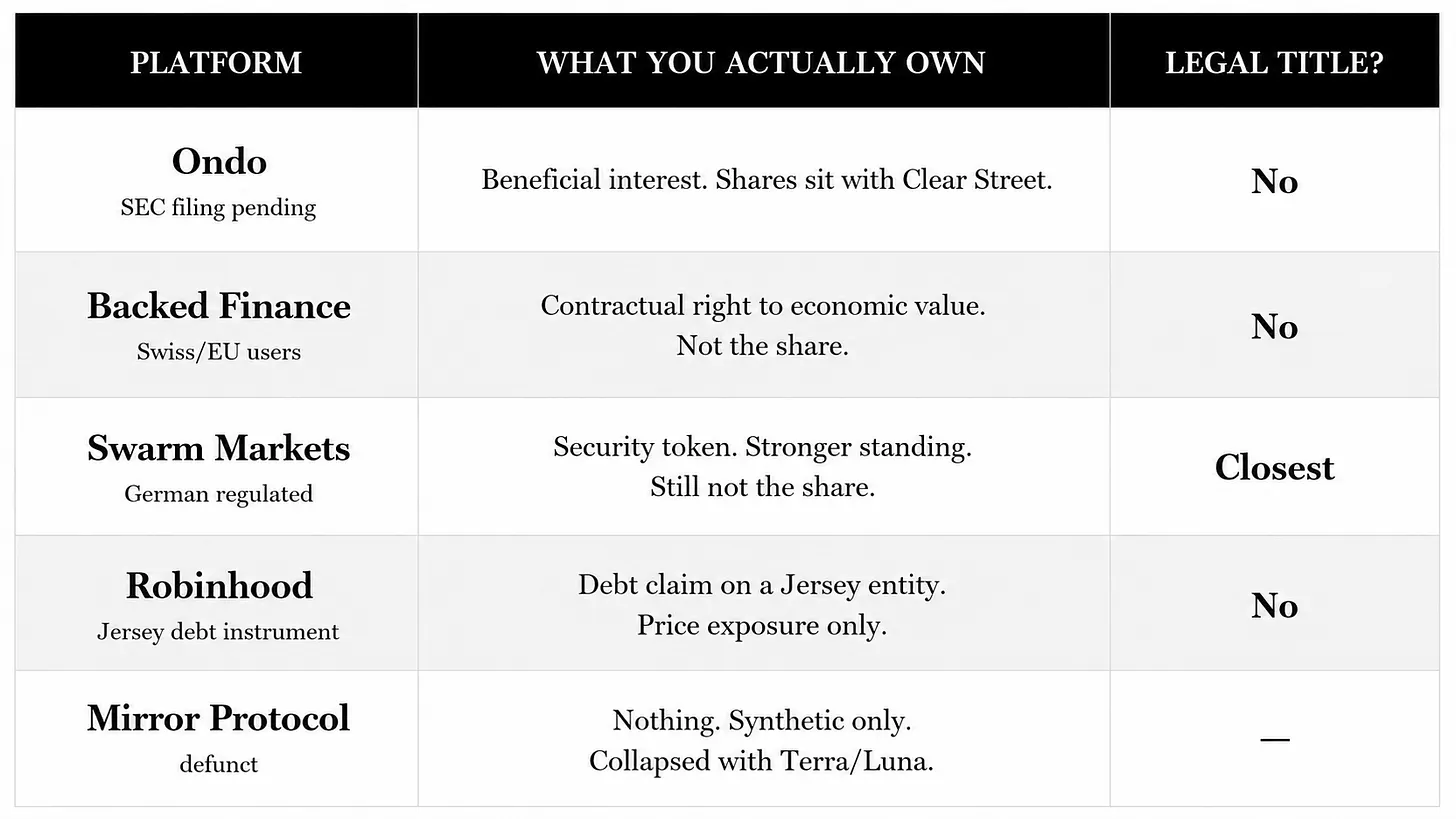


同年 3 月,SEC 与美国商品期货交易委员会 CFTC 联合公告,维持 1 月出台的分类监管框架不变。 Robinhood 刻意选择在泽西岛发行第二类关联证券,正是精准规避监管红线。


监管文件中还提到一类相似产品:证券型互换合约,本质是对标股价的场外对赌。但联邦法规严格限制,仅合格机构、高净值专业投资者才能参与,普通散户无法购买。


而债务类结构化票据没有投资者门槛限制,哪怕只有 10 美元的 19 岁年轻人也能参与。Robinhood 最终选择这套受众最广、监管阻力最小的包装模式。


与此同时,美国本土用户被完全隔绝在外。股票代币面向全球 120 多个国家开放,美国、加拿大、英国、瑞士、阿联酋均不在服务范围内。


欧洲市场采用另一套合规架构。2025 年戛纳上线的经典股票代币遵循欧盟 MiFID II 法规,由 Robinhood 欧洲主体发行,代币 1:1 对应托管的真实股票。如今标的数量从 200 只扩充至 2000 只以上,最低仅需 1 欧元即可入场。也就是说 Robinhood 在欧洲完全能做合规实股代币,泽西债务架构是主动选择。


这套模式极度依赖公开市场透明定价逻辑,只有美股这类实时交易的上市公司才有公允市价。而 Anthropic、OpenAI 这类未上市私募企业没有公开交易价格,代币估值只能依靠机构主观预估,企业无对外披露义务,风险完全不可控。


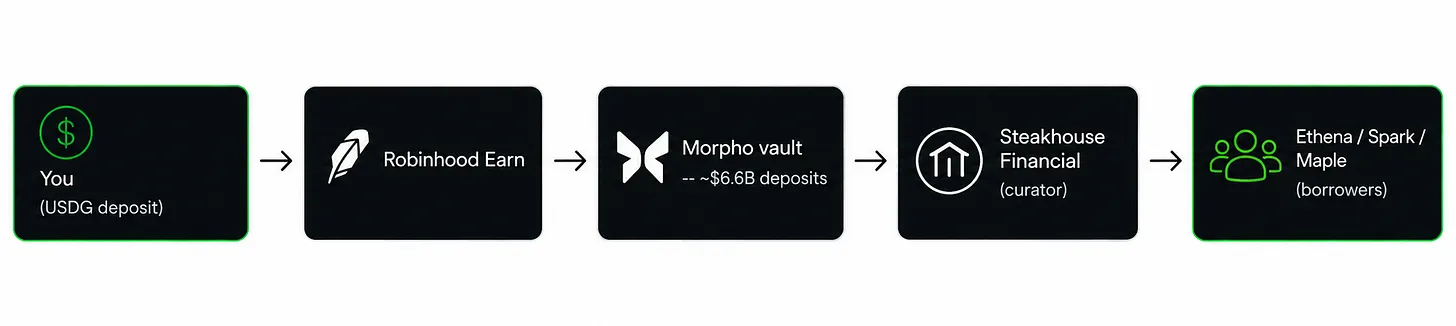
另外 Robinhood 推出的 Robinhood 生息产品独立提供 7% 年化收益,仅限美国用户参与。用户将稳定币 USDG 出借,资金先流入 Steakhouse Financial 运营的 Morpho 借贷金库,再分流至 Ethena、Maple 等各类 DeFi 协议,Morpho 金库存款规模约 66 亿美元,收益率随市场借贷需求浮动。


Robinhood 向伦敦劳合社投保智能合约被盗险,但保单不覆盖收益率归零风险。市场借贷需求萎缩时,收益会和货币基金利率同步下行。用户资金要经过 Robinhood、Steakhouse、Morpho 多层中介,一旦 USDG 脱锚、借贷人大面积违约,保险完全无法兜底,这也是这类产品本金亏损的常见诱因。


代币存储在链上,支持质押借贷,看似便捷,但智能合约无法直接读取股票价格,必须依赖预言机喂价。一旦预言机投喂虚假价格,合约会错误清算用户资产或违规放款。2024 至 2025 年,预言机价格操控是 DeFi 大额被盗的核心作案手段,数十个项目因此损失数千万美元。


整套产品体系里,唯一正统、拥有完整股东投票权的原生股权,只有在纳斯达克传统渠道交易的 Robinhood 自身股票 HOOD。平台把真正的股权留给了自己。


背后商业逻辑一目了然。每一笔代币交易 Robinhood 赚取点差;公链归属自家,海外全新业务能持续美化上市公司财报,全程不受美国本土监管约束。无实际股权的代币业务,监管成本更低、盈利更干净。


Robinhood 公链基于 Arbitrum Orbit 网络搭建,以 ETH 支付 Gas 手续费,未发行原生平台代币,规避代币炒作风险,平台也无需靠原生代币盈利。公司长远规划打造一站式结算通道,股票、ETF、稳定币、商品永续合约、未来私募股权全部实现 7×24 小时链上交易。Robinhood 原本只是订单分发中间商,若规划落地,将集交易所、清算所职能于一身。


客观来说,当下监管规则正快速迭代。美国 SEC 新任主席 Atkins 推翻过往 「先起诉后规范」 的监管思路,正在起草创新监管沙盒豁免法案,《CLARITY 法案》自 6 月起递交参议院审议。法案落地后,Robinhood 当下所处的监管灰色地带会持续收窄。


这套打法行业早已熟稔。Coinbase、Kraken 早年都是在监管空白期先行拓展业务,等监管细则完善、行业需求得到验证后再补齐合规资质。如今的泽西债务代币,更像是 Robinhood 过渡性的半成品产品。


就在 Robinhood 股票代币上线两天前,7 月 2 日 Ondo 在以太坊推出合规代币股票,通过 SEC 注册转让商发行,代币背后足额托管真实股票,持有者享有链上投票权,覆盖 250 余家企业,Coinbase 同步上架该产品,美国用户可合法交易,分红直接发放至用户账户。


美国完整合规模式运营成本更高,全程受监管机构约束,而 Robinhood 在欧洲已经承担这套合规成本。所以,泽西岛的债务架构是 Robinhood 的一种选择,未来要么法规强制升级产品,要么竞品推出美国合规实股代币抢走客户。


先抢占市场,再等待监管完善,这便是 Robinhood 的布局思路。

Trending Cryptos

Related Questions

Q根据文章,Robinhood推出的股票代币,用户购买后真正持有的是什么?

A用户购买的并非上市公司真正的股票或股权,而是由Robinhood Assets (Jersey) Limited这家位于泽西岛的空壳公司发行的债务证券。用户本质上是借钱给这家公司,它承诺根据对应股票的价格波动向用户兑付收益。

Q为什么Robinhood选择将股票代币设计为债务工具,并通过泽西岛的实体发行?

A主要目的是规避美国证券交易委员会(SEC)对股权类产品的严格监管。债务工具的法律定位和监管要求与股权不同,这种“形似股权的债务工具”可以让Robinhood在不直接发行证券(代表公司所有权)的情况下,为用户提供股票价格敞口,同时降低合规成本和监管阻力。泽西岛作为一个离岸司法管辖区,提供了更灵活的监管环境。

Q持有Robinhood股票代币的用户面临哪些主要风险?

A用户面临多重风险:1) 不具有任何股东权利,如投票权、分红权和资产清算追索权。2) 承担发行方(即泽西岛的空壳公司)的对手方风险,若该公司破产,用户作为普通债权人可能无法拿回全部本金。3) 若标的公司(如苹果)破产,代币将变得一文不值,因为底层资产价值归零。4) 依赖预言机提供链上价格,存在预言机被操控导致资产被错误清算的风险。

Q文章提到Robinhood在2021年GameStop事件中遭遇了什么问题,而新代币产品如何试图解决它?

A2021年GameStop逼空行情中,由于美股T+2的交割机制,Robinhood因无法满足清算所的巨额保证金要求,被迫临时限制用户买入相关股票,导致用户不满和信任危机。新的代币产品建立在公链上,旨在实现秒级清算,从而彻底废除T+2交割周期,理论上不再需要为满足隔夜保证金而限制交易,避免了类似危机。

Q与Robinhood的模式相比,Ondo推出的代币股票有何不同?

AOndo在美国推出的是一种合规的原生股权代币。它通过在美国SEC注册的转让商发行,代币背后是足额托管的真实股票,持有者享有完整的链上股东投票权,并能直接收到分红。这种模式运营成本更高,全程受美国监管机构约束,但为用户提供了真正的股权所有权,而不仅仅是价格敞口。这与Robinhood旨在规避监管的债务工具模式形成鲜明对比。

Related Reads

Blood Loss of $55 Million Selling 3,588 BTC, Strategy Becomes a Literal Scumbag

On July 6th, Strategy (formerly MicroStrategy) disclosed in an SEC filing that it sold 3,588 Bitcoin (BTC) between June 29th and July 5th for approximately $216 million, at an average price of ~$60,200. This marked the company's largest net sale since initiating its Bitcoin strategy in 2020 and its first institutionalized reduction of its core holding. The sale resulted in a realized loss of about $54.8 million, as the selling price was below its average cost basis of ~$75,476 per BTC. The proceeds were used to pay preferred stock dividends and replenish USD reserves. This move follows a new "Digital Credit Capital Framework" approved on June 29th, authorizing the sale of up to $1.25 billion in Bitcoin. The sale consumes roughly 17% of this authorized amount in its first week. Strategy's foundational narrative, built by founder Michael Saylor, was a commitment to "never sell" Bitcoin. The recent institutionalized selling framework and these substantial sales represent a significant shift from that original promise. While the amount sold is only 0.4% of Strategy's total holdings of 843,775 BTC, the action challenges the premium at which its stock (MSTR) trades relative to its Bitcoin holdings. Investors had priced in the "never sell" narrative. The company now faces a contradiction: it sells Bitcoin at a loss to pay dividends on the preferred stock it issued to fund Bitcoin purchases. Saylor has framed selling as a tool for future strategic purchases, but each sale erodes the credibility of the original commitment, potentially threatening the premium valuation of MSTR shares.

Foresight News30m ago

Blood Loss of $55 Million Selling 3,588 BTC, Strategy Becomes a Literal Scumbag

Foresight News30m ago

Dialogue with Yihui Capital, SoundAI Technology, Ling Universe, and Zhongbo Jili: Opportunities and Challenges in the AI Smart Hardware Track

On June 28, 2026, an event titled "New Opportunities in AI Hardware: The Battle for Interactive Entry Points Begins" was held in Beijing. It featured a report from ITJuzi and discussions with experts from SoundAI, Ling Universe, One Reed Capital, and Zhongbo Juli on the opportunities and challenges in China's AI hardware sector. Key report findings highlight the sector's intense activity: 327 out of 431 startups founded post-2023 have secured funding, with 179 investments in H1 2026 alone. The landscape is dominated by embodied intelligent robots, while wearable tech like smart rings and AI glasses shows rapid growth. Geographically, Shenzhen leads, leveraging its superior hardware supply chain, followed by Beijing and Shanghai. The overarching trend is for companies to focus on micro-innovations within specific scenarios rather than reinventing foundational technology. Industry leaders shared several critical insights: 1. **Balancing Innovation & Market Readiness**: Entrepreneurs face the "hammer looking for a nail" dilemma. Success requires balancing technical capability with user acceptance, cost control, and incremental design improvements rather than chasing disruptive innovation. 2. **Competitive Landscape**: The future interactive entry point may not be a single super-device but a mix of universal terminals and specialized, scenario-specific hardware. While large companies have ecosystem advantages, startups can win by deeply targeting vertical markets and specific user groups. 3. **Core Challenges & Business Models**: Key hurdles include deep understanding of AI models and navigating non-transparent hardware supply chains. Viable business models may involve selling hardware at cost and generating revenue through software subscriptions, but this requires tight control over both hardware BOM and model inference costs. 4. **The Road to Commercialization**: The ultimate test is market validation—achieving sales growth and sustainable cash flow. Companies must find the right application scenario, use edge computing effectively, and close the loop from technology to commercial success. 5. **The Future of Interaction**: Proactive, context-aware interaction is the next frontier, though it's currently limited by issues like model hallucinations and environmental perception. The near-term focus should be on identifying target users and creating a coherent experience in specific domains, such as health wearables. In summary, to succeed in the competitive AI hardware arena, companies must strategically choose their niche, build a team with the right geographical advantages (e.g., leveraging Shenzhen's supply chain), and most importantly, execute a flawless commercialization strategy that translates technology into market-accepted products and sustainable business growth.

marsbit1h ago

Dialogue with Yihui Capital, SoundAI Technology, Ling Universe, and Zhongbo Jili: Opportunities and Challenges in the AI Smart Hardware Track

marsbit1h ago

Trading

Spot

Hot Articles

What is DOGE M

Doge Matrix ($doge m): The New Breed of Community-Driven Cryptocurrency Introduction In the ever-evolving landscape of cryptocurrency, new projects constantly emerge, each aiming to capture the interest of investors and enthusiasts alike. One of the latest entrants to this domain is Doge Matrix, represented by the ticker symbol $doge m. This project has attracted attention thanks to its roots in the popular meme culture surrounding Dogecoin, establishing its place within the web3 space. This article aims to provide a comprehensive analysis of Doge Matrix, covering its overview, creator, investors, functionality, timeline, and notable aspects. What is Doge Matrix ($doge m)? Doge Matrix is a community-driven cryptocurrency project that seemingly builds upon the widespread appeal of Dogecoin, a digital currency known for its Shiba Inu mascot and its meme origins. While the overarching objectives of Doge Matrix are not extensively defined, it is characterized by a commitment to harnessing community involvement and support. Unlike traditional cryptocurrencies that often emphasize utility or intrinsic value through underlying technologies, Doge Matrix positions itself within a space that embraces the cultural phenomenon of cryptocurrencies, particularly appealing to those who resonate with the ethos of meme-based assets. Drawing on the strengths of the Dogecoin community, Doge Matrix operates as part of a broader ecosystem, inviting participation and engagement from users who share an interest in cryptocurrency and the digital landscape. Who is the Creator of Doge Matrix ($doge m)? The identity of the creator of Doge Matrix remains unknown. This lack of transparency is not an uncommon occurrence in the cryptocurrency space, where some projects are launched without revealing the identities of their founders. The absence of information regarding the founding team can raise questions among potential investors about the project’s accountability and direction. Who are the Investors of Doge Matrix ($doge m)? As it stands, there is no publicly available information detailing the investors or investment foundations that back Doge Matrix. The project appears to rely primarily on community support rather than institutional investment. This model aligns with the community-driven nature of the initiative, fostering an environment where the direction of the project is shaped by its participants rather than being dictated by a select few financial backers. How Does Doge Matrix ($doge m) Work? The specifics regarding the operational mechanisms of Doge Matrix are somewhat vague, reflecting a broader trend of projects in the meme coin space where innovative functionalities are not always clearly articulated. Nonetheless, Doge Matrix seems designed to tap into the existing cryptocurrency ecosystem by encouraging user participation while tapping into the familiar cultural references associated with Dogecoin. Its potentially unique characteristics derive from community interactions rather than technological advancements, emphasizing shared experiences and collaboration among token holders. While the exact innovations have not been explicitly outlined, the project appears to create a space where community members can engage, share ideas, and propel the project's potential forward. Timeline of Doge Matrix ($doge m) Reflecting on the project’s timeline reveals notable events that have defined its journey thus far: November 25, 2024: Doge Matrix reached its all-time high value, marking a significant milestone in its early history. January 1, 2025: Conversely, Doge Matrix hit its all-time low value, illustrating the volatility often associated with cryptocurrencies, especially in the early stages of a project's lifecycle. Ongoing: The project continues to be actively traded and supported by its community, although specific future milestones or objectives have yet to be disclosed. Key Points About Doge Matrix ($doge m) Community Focus At the heart of Doge Matrix is a commitment to community engagement. The project thrives on the premise of collaboration and shared objectives among its members, emphasizing the importance of collective effort. Unlike centralized projects that often have a defined leadership structure, Doge Matrix at present showcases a more fluid approach to governance, where every community member's voice matters. Volatility The cryptocurrency market is notorious for its volatility, and Doge Matrix is no exception. Its price history reflects significant fluctuations between high and low values, which is typical of many new cryptocurrencies but underscores the risks associated with investment in emerging tokens. Lack of Detailed Information One of the most striking features about Doge Matrix is the scarcity of detailed information regarding its technological underpinnings and operational mechanisms. This ambiguity necessitates that potential investors conduct thorough due diligence before engaging with the project. Conclusion In summary, Doge Matrix ($doge m) illustrates a new wave of cryptocurrency projects that lean heavily on community engagement and cultural relevance. While lacking in certain specifics—such as clear leadership, defined objectives, and detailed functionality—the project has managed to generate interest within the crypto community, leveraging the established appeal of meme culture. As with any investment in the cryptocurrency space, understanding the inherent risks and conducting comprehensive research is essential for potential participants. Doge Matrix stands as a reminder of the dynamic, sometimes unpredictable nature of the crypto industry, marked by constant evolution and enthusiasm for community-driven initiatives.

3.9k Total ViewsPublished 2025.02.03Updated 2025.02.03

What is DOGE M

What is $M

Understanding Mantis ($M): A New Era in Cross-Chain Interoperability In the continually evolving landscape of Web3 and cryptocurrency, new projects strive to offer innovative solutions aimed at enhancing the user experience and expanding functional possibilities within the decentralized financial ecosystem. One such project garnering attention is Mantis ($M), a pioneering protocol founded on the principles of cross-chain interoperability and intent-based settlements. This article delves into the essential aspects of Mantis, including its core functionality, creators, investment backing, innovative features, and critical milestones. What is Mantis ($M)? Mantis is described as a multi-domain intent settlement protocol that simplifies cross-chain interactions, enabling users to execute complex financial transactions across various blockchain platforms seamlessly. The protocol operates through three primary layers: Intent Expression: Users can articulate their transaction goals using natural language facilitated by the DISE LLM, an advanced AI language model. For instance, a user might express a desire to swap Ethereum (ETH) for Solana (SOL) with a specific slippage tolerance of 1%. Execution: This layer employs a network of solvers that compete to fulfill user intents. Transactions are executed using mechanisms such as Coincidence of Wants (CoWs) and Order Flow Auctions (OFAs), which ensure that user demands are met optimally. Settlement: Leveraging the Inter-Blockchain Communication (IBC) protocol, Mantis enables atomic cross-chain transactions, allowing users to operate across various supported chains, including Ethereum, Solana, and Cosmos. Mantis is engineered to introduce native yield generation for idle assets, employing cryptographic proofs to maintain the integrity of transactions throughout the entire process. Creators & Development Team Mantis was conceived by the Composable Foundation, a research-driven organization notable for its emphasis on blockchain interoperability solutions. This foundation collaborates with esteemed academic institutions, including Harvard University and the University of Lisbon, contributing to extensive research and development efforts that inform Mantis's architecture and functionality. The Composable Foundation’s commitment to fostering innovation in the blockchain space positions Mantis as a robust solution for the growing demand for interoperability among multiple blockchain networks. Investors & Backing While specific details about individual investors have not been publicly disclosed, Mantis enjoys substantial backing from various entities, including: Ecosystem grants from IBC-enabled chains, which support the protocol's growth and integration within decentralized finance ecosystems. Strategic partnerships with infrastructure providers that enhance Mantis's network capabilities and deployment strategies. Funding through the Composable Foundation's treasury, ensuring sustained financial support for ongoing development and operational costs. These collaborative efforts reflect a consensus among stakeholders about the importance of enhancing cross-chain functionality and the potential utility of Mantis's infrastructural innovations. Key Innovations Mantis sets itself apart through several pioneering innovations that enhance its functionality and utility: Chain-Agnostic Intents: Users can initiate transactions from any supported chain while settling on another. This flexibility empowers users, driving increased interaction among different platforms. AI-Powered Interface: The integration of DISE LLM allows users to conduct complex DeFi operations using natural language, thereby simplifying interactions and making blockchain technology accessible to a broader audience. Cross-Domain MEV Capture: Mantis creates an internal market for maximal extractable value (MEV) through competitions among solvers. This innovative approach allows for greater efficiency and value extraction in complex transactions. Modular Settlement Layer: The protocol supports various verification methods, including zero-knowledge proofs and optimistic rollups, providing a versatile framework that can adapt to emerging blockchain technologies. Historical Timeline Mantis's development is marked by several critical milestones that chart its trajectory and growth: | Year | Milestone | |————|————————————————————————-| | 2022 | Initial concept development within the Composable Foundation's research division. | | Q3 2024 | Launch of the testnet with bridging capabilities between Solana and Ethereum. | | Q1 2025 | Anticipated Token Generation Event (TGE) alongside the mainnet launch. | | Q2 2025 | Expected integration of DISE LLM and expansion of cross-chain capabilities. | | 2025 H2 | Planned support for over 15 chains through further IBC upgrades. | This timeline outlines Mantis's evolution, from conceptual discussions to active implementation and future growth phases. Ecosystem Growth Strategy Mantis's strategy for ecosystem growth includes several initiatives designed to encourage user participation and developer engagement: Credits System: Users can earn protocol credits by providing liquidity and engaging in referral programs. These credits are redeemable for incentives in the future, fostering a robust user community. Modular Software Development Kit (SDK): This toolkit empowers developers to create applications based on intent-driven models utilizing Mantis's infrastructure, thus promoting innovation within its ecosystem. Governance Model: As the protocol matures, $M token holders will have a voice in protocol governance, allowing them to vote on proposed upgrades and changes, thereby enhancing community engagement and decentralization. Mantis represents a significant advancement in the realm of cross-chain architecture. By seamlessly integrating advanced AI algorithms with a robust settlement framework, Mantis seeks to tackle the problems of fragmentation within multi-chain ecosystems. Its innovative approach prioritizes improved user experiences while adhering to the foundational principles of decentralization and security, setting a new standard for the future interoperability of blockchain technologies. As Mantis continues its journey of growth and implementation, it promises to be a project to watch closely in the competitive landscape of Web3 and decentralized finance. With its focus on crossing boundaries and elevating user engagement, Mantis is poised to be an integral part of the future developments in the cryptocurrency space.

385 Total ViewsPublished 2025.03.18Updated 2025.03.18

What is $M

How to Buy M

Welcome to HTX.com! We've made purchasing MemeCore (M) simple and convenient. Follow our step-by-step guide to embark on your crypto journey.Step 1: Create Your HTX AccountUse your email or phone number to sign up for a free account on HTX. Experience a hassle-free registration journey and unlock all features.Get My AccountStep 2: Go to Buy Crypto and Choose Your Payment MethodCredit/Debit Card: Use your Visa or Mastercard to buy MemeCore (M) instantly.Balance: Use funds from your HTX account balance to trade seamlessly.Third Parties: We've added popular payment methods such as Google Pay and Apple Pay to enhance convenience.P2P: Trade directly with other users on HTX.Over-the-Counter (OTC): We offer tailor-made services and competitive exchange rates for traders.Step 3: Store Your MemeCore (M)After purchasing your MemeCore (M), store it in your HTX account. Alternatively, you can send it elsewhere via blockchain transfer or use it to trade other cryptocurrencies.Step 4: Trade MemeCore (M)Easily trade MemeCore (M) on HTX's spot market. Simply access your account, select your trading pair, execute your trades, and monitor in real-time. We offer a user-friendly experience for both beginners and seasoned traders.

7.7k Total ViewsPublished 2025.07.02Updated 2026.06.02

How to Buy M

Discussions

Welcome to the HTX Community. Here, you can stay informed about the latest platform developments and gain access to professional market insights. Users' opinions on the price of M (M) are presented below.

活动图片