Celestia team to sell $2.03M TIA in July: Will THIS absorb the bearish pressure?

ambcryptoPubblicato 2026-07-01Pubblicato ultima volta 2026-07-01

Introduzione

The Celestia (TIA) team is scheduled to sell approximately $2.03 million worth of TIA throughout July, adding structural selling pressure to a token already facing market-wide declines. Data shows daily sales of around $67,000 for most of the month. However, analysis suggests potential for buyer absorption of this pressure. June's spot market activity showed $106.68 million in total purchases with a positive netflow. Furthermore, the positive Open-Interest Weighted Funding Rate indicates a bullish lean among perpetual traders, though positioning remains measured. A liquidity heatmap suggests deeper order clusters are above the current price, hinting at room for a rally, though current downward momentum poses a risk. The summary suggests spot demand and derivative positioning could counterbalance the team's sales.

Celestia’s [TIA] has posted steep losses over the past day, and while the drop reads like an extension of the broader crypto market slide, a closer look at the token’s supply schedule shows the asset is structurally primed for further downside.

DeFiLlama data shows that, apart from the $28,000 tranche marked for the 1st of July at press time, the team plans to offload roughly $67,000 worth of TIA every day until the month closes, pushing around $2.03 million into the market across the 31 days.


Source: DeFiLlama

The setup looks bearish on paper, yet spot-market flows suggest incoming demand could absorb the pressure, given how TIA traded through June.

Total Spot purchases have reached $106.68 million, with a netflow of roughly $4.8 million tilting the balance toward buyers.

Funding Rate holds firm even as OI bleeds

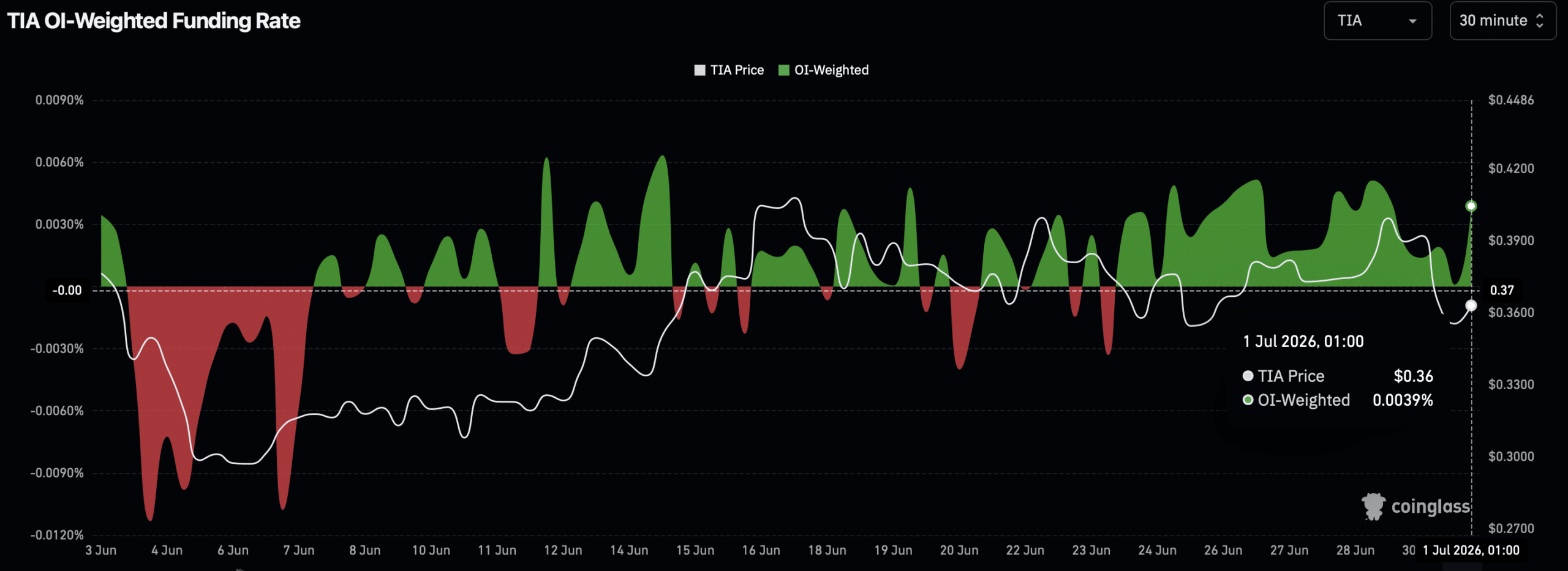
Outflows over the past few days still read as bearish sentiment working through the market. CoinGlass data showed that Open Interest—the capital committed to an asset’s perpetual contracts—fell 2%, a $1.16 million withdrawal that leaves net OI at $58 million.
Source: CoinGlass

The outflow hasn’t shifted positioning, though—the Open-Interest Weighted Funding Rate, which measures the balance of TIA’s perpetual contracts against the Funding Rate, sits positive at 0.0038%.

A positive Funding Rate set against Open Interest signals that most of the capital in the perpetual market is leaning long, positioning for TIA to push higher over the coming sessions.

The reading being only mildly bullish shows traders aren’t crowding the upside, which lowers the risk of a sharp capitulation and points to steadier, more measured positioning.

TIA liquidity heatmap tilts toward an upswing

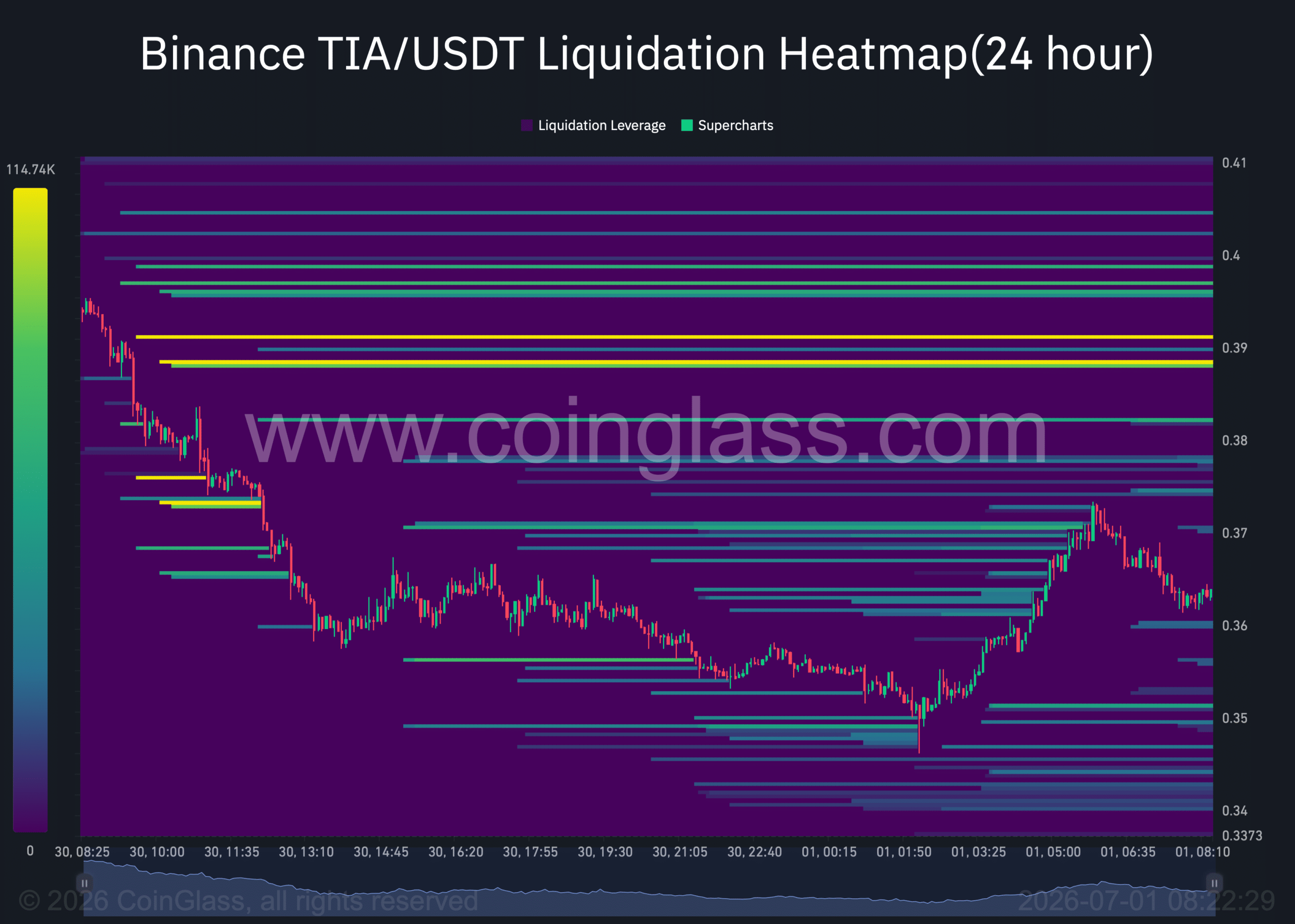
The liquidity heatmap points to room for a TIA upswing. The heatmap doesn’t lock in a direction, but it hints at one by mapping where buy and sell orders rest.

At the moment, the deeper order clusters sit above price, suggesting strong odds that TIA rallies toward those levels.
Source: CoinGlass

Momentum still works against that case, with TIA already down double digits on the day, and that weakness could drag price toward the lower clusters instead.

Those lower clusters hold resting buy orders that could seed a mid-term rally and shift the balance back in TIA’s favor.


Final Summary

  • Celestia’s team is set to sell roughly $2.03 million in TIA across the month, adding structural pressure on top of the market-wide slide.
  • Spot demand and a positive Funding Rate suggest that buyers could absorb the incoming supply, keeping an upswing in play.


Crypto di tendenza

Domande pertinenti

QHow much TIA does the Celestia team plan to sell in total during July, and what is the approximate daily selling amount?

AThe Celestia team plans to sell approximately $2.03 million worth of TIA across the month of July. On average, they intend to offload roughly $67,000 worth of TIA every day for the duration of the month.

QWhat does the positive Open-Interest Weighted Funding Rate for TIA indicate about trader positioning?

AA positive Open-Interest Weighted Funding Rate for TIA, sitting at 0.0038%, indicates that the majority of capital in the perpetual futures market is positioned long. This suggests traders are leaning bullish, expecting the price to move higher in the coming sessions, though the mild bullishness shows traders are not excessively crowding the trade, which lowers the risk of a sharp sell-off.

QAccording to the article, what is the suggested relationship between spot-market flows in June and the potential impact of the team's July TIA sales?

AThe article suggests that strong spot-market demand in June, with total spot purchases reaching $106.68 million and a netflow of roughly $4.8 million favoring buyers, indicates that incoming demand could potentially absorb the selling pressure from the team's planned $2.03 million TIA sales in July.

QWhat does the liquidity heatmap analysis imply about potential price directions for TIA?

AThe liquidity heatmap analysis implies there is room for a TIA upswing. It shows that deeper clusters of resting sell orders are positioned above the current price, suggesting a higher probability that TIA could rally towards those levels. However, it also notes that current downward momentum and lower clusters of buy orders could alternatively seed a mid-term rally.

QWhat two key opposing factors does the article highlight in its final summary regarding TIA's price outlook?

AThe final summary highlights two key opposing factors: 1) Structural bearish pressure from the Celestia team's planned sale of roughly $2.03 million in TIA during July. 2) Bullish counter-pressure from strong spot demand and a positive Funding Rate, suggesting buyers could absorb the incoming supply and keep the potential for an upswing intact.

Letture associate

MSTR Discloses Sale of 3,588 Bitcoins, Stock Price Drops Over 5% at One Point During Trading

MicroStrategy, the world's largest corporate holder of Bitcoin, has significantly shifted its business model. Between June 29 and July 5, the company sold 3,588 bitcoins for approximately $216 million to fund quarterly dividends for its preferred stock. This marks its largest-ever Bitcoin sale and signals a strategic pivot: Bitcoin is transitioning from a "buy-and-hold" reserve asset to a liquidity management tool for the company. This move follows a recent authorization allowing Bitcoin sales when equity fundraising is less attractive. The announcement contributed to a more than 5% intraday drop in MicroStrategy's stock price, while Bitcoin fell to around $61,800—below the company's average holding cost of roughly $75,700. The sale represents a major departure from MicroStrategy's long-standing "never sell" commitment, which saw its first minor breach in May with a $2.5 million sale. The latest, hundred-times-larger transaction underscores growing financial pressures. Analysts note the company faces about $1.5 billion in annual preferred dividend obligations, far exceeding cash flow from its software business. As of July 5, MicroStrategy holds 843,775 bitcoins. Its current operational logic involves buying Bitcoin during favorable financing conditions and selling portions to cover dividends when needed, creating a flexible capital management cycle amidst a challenging market environment.

华尔街日报4 h fa

MSTR Discloses Sale of 3,588 Bitcoins, Stock Price Drops Over 5% at One Point During Trading

华尔街日报4 h fa

Q-Day Countdown: Will Quantum Computing End Cryptocurrencies?

Quantum Computing's Threat to Cryptocurrency: A Countdown to Q-Day Quantum computing, specifically Shor's algorithm, poses a fundamental threat to the public-key cryptography (e.g., ECDSA, RSA) that secures blockchain networks like Bitcoin and Ethereum. This critical juncture, known as Q-Day, is estimated to occur potentially within the next 5-15 years. The core vulnerability stems from the public and immutable nature of blockchains. Assets in addresses where the public key is already exposed on-chain (e.g., spent outputs) are at direct risk, as a sufficiently powerful quantum computer could derive the private key. This threatens the very trust model of cryptocurrencies. The response lies in Post-Quantum Cryptography (PQC)—algorithms like lattice-based ML-DSA and hash-based SLH-DSA, which are resistant to quantum attacks. NIST has standardized key PQC algorithms (FIPS 203, 204, 205), providing a migration path. However, the primary challenge is not technical but socio-economic and involves complex governance: * **Bitcoin's** path is constrained by its conservative ethos. Migrating requires a soft-fork to new address types, facing hurdles like significantly larger signature sizes and, most critically, the divisive governance question of how to handle at-risk legacy UTXOs without violating core principles. * **Ethereum** is pursuing a "cryptographic agility" strategy, with a multi-layered roadmap. It leverages account abstraction for user accounts and is developing compressed hash-based signatures (e.g., leanXMSS) for its consensus layer, aiming for a full-stack upgrade over time. In conclusion, quantum computing does not spell an instant end for cryptocurrency but initiates a critical countdown. The industry has a limited "engineering comfort window" to orchestrate a coordinated, ecosystem-wide migration to PQC. The ultimate bottlenecks are the immense coordination efforts and governance decisions required for this foundational transition.

marsbit5 h fa

Q-Day Countdown: Will Quantum Computing End Cryptocurrencies?

marsbit5 h fa

Trump, the President Who Knows Best How to 'Trade Stocks'

Former US President Donald Trump reported a record-breaking $2.2 billion in personal income for 2025, the highest annual income ever disclosed by a sitting president. This figure, from a 927-page government ethics filing, represented a 3.5-fold increase from his $600 million income in 2024 and boosted his net worth to $6.5 billion. The primary drivers were cryptocurrency (64% of income, approximately $1.4 billion) and real estate (26%, approximately $575 million). His crypto earnings stemmed largely from the launch of his personal meme coin, $TRUMP, generating over $600 million in licensing fees, and substantial profits from the WLFI token and its parent company. Despite a sluggish property market, his Mar-a-Lago resort and associated golf clubs saw revenue surges of 50% and 27%, respectively, attributed to their use as venues for presidential events. Trump's financial disclosure also revealed an unprecedented level of stock market activity, with over 22,000 trades executed in 2025, averaging 87 trades per market day. Media analyses noted several instances where significant trading coincided with major policy announcements, such as proposed tariffs, raising questions about potential conflicts of interest. While the White House stated these trades were handled by a family-managed trust fund and not Trump directly, critics highlighted this as a departure from the blind trusts traditionally used by presidents post-Watergate. The report has intensified debate over the commercialization of the presidency. Supporters view it as a success story of a businessman-president, while critics argue it demonstrates an unprecedented conversion of public influence into private wealth, with policy decisions potentially linked to personal financial gains. The controversy centers on whether Trump's earnings represent innovative entrepreneurship or a fundamental conflict of interest, sparking renewed calls for stricter ethics reforms in US governance.

marsbit5 h fa

Trump, the President Who Knows Best How to 'Trade Stocks'

marsbit5 h fa

Countdown to Q-Day: Will Quantum Computing End Cryptocurrencies?

The article explores the existential threat quantum computing poses to cryptocurrencies and the urgent need for "post-quantum" migration. It outlines that quantum computers, through Shor's algorithm, could break the elliptic-curve cryptography (ECC) underlying blockchain security, potentially allowing private keys to be derived from public keys. The core challenge is not a lack of post-quantum cryptography (PQC) standards—like NIST's ML-KEM and ML-DSA—but the immense complexity of upgrading entire ecosystems before "Q-Day" (when quantum computers become capable of such attacks, estimated around 2035-2045). Key points include: * **Bitcoin's** risk is concentrated in legacy UTXOs with exposed public keys (e.g., early P2PK outputs). Migration faces massive hurdles: PQC signatures are much larger, increasing transaction size and cost, and the governance dilemma of handling un-migrated assets threatens its "code is law" ethos. * **Ethereum's** strategy focuses on "cryptographic agility," using Account Abstraction for user accounts and developing compressed hash-based signatures (like leanXMSS with SNARK aggregation) for consensus. Its migration is a complex, full-stack overhaul of execution, consensus, and data layers. * The "security debt" is enormous. The comfortable engineering window for a coordinated, ecosystem-wide upgrade is only 5-8 years. High-value infrastructure (exchanges, bridges) may face pressure before mainnet protocols. In conclusion, quantum computing is not an instant "doomsday" event but a forcing function for systemic change. Bitcoin's ultimate test is social consensus and property rights governance, while Ethereum's is technical complexity. Failure to migrate in time could lead to a fundamental re-pricing of crypto assets.

链捕手5 h fa

Countdown to Q-Day: Will Quantum Computing End Cryptocurrencies?

链捕手5 h fa

Trading

Spot

Articoli Popolari

Come comprare TIA

Benvenuto in HTX.com! Abbiamo reso l'acquisto di Celestia (TIA) semplice e conveniente. Segui la nostra guida passo passo per intraprendere il tuo viaggio nel mondo delle criptovalute.Step 1: Crea il tuo Account HTXUsa la tua email o numero di telefono per registrarti il tuo account gratuito su HTX. Vivi un'esperienza facile e sblocca tutte le funzionalità,Crea il mio accountStep 2: Vai in Acquista crypto e seleziona il tuo metodo di pagamentoCarta di credito/debito: utilizza la tua Visa o Mastercard per acquistare immediatamente CelestiaTIA.Bilancio: Usa i fondi dal bilancio del tuo account HTX per fare trading senza problemi.Terze parti: abbiamo aggiunto metodi di pagamento molto utilizzati come Google Pay e Apple Pay per maggiore comodità.P2P: Fai trading direttamente con altri utenti HTX.Over-the-Counter (OTC): Offriamo servizi su misura e tassi di cambio competitivi per i trader.Step 3: Conserva Celestia (TIA)Dopo aver acquistato Celestia (TIA), conserva nel tuo account HTX. In alternativa, puoi inviare tramite trasferimento blockchain o scambiare per altre criptovalute.Step 4: Scambia Celestia (TIA)Scambia facilmente Celestia (TIA) nel mercato spot di HTX. Accedi al tuo account, seleziona la tua coppia di trading, esegui le tue operazioni e monitora in tempo reale. Offriamo un'esperienza user-friendly sia per chi ha appena iniziato che per i trader più esperti.

145 Totale visualizzazioniPubblicato il 2024.12.10Aggiornato il 2026.06.02

Come comprare TIA

Discussioni

Benvenuto nella Community HTX. Qui puoi rimanere informato sugli ultimi sviluppi della piattaforma e accedere ad approfondimenti esperti sul mercato. Le opinioni degli utenti sul prezzo di TIA TIA sono presentate come di seguito.

活动图片