$30 Billion DeFi Capital Exodus: LayerZero Stumbles, Chainlink Feasts

marsbitPublié le 2026-05-13Dernière mise à jour le 2026-05-13

Résumé

Following the major DeFi security incident involving Kelp DAO, a significant migration of funds is underway from the cross-chain protocol LayerZero to Chainlink's CCIP (Cross-Chain Interoperability Protocol). Over $30 billion in Total Value Locked (TVL) from protocols like Kelp DAO, Solv Protocol, Re, and Tydro has moved to Chainlink in the past week, driven by security concerns. LayerZero is facing a severe trust crisis after the attack. Initially denying responsibility, LayerZero Labs has now issued a public apology, acknowledging management oversights. These include a vulnerable "1/1" single-node configuration for its Decentralized Verification Network (DVN) and past misuse of a multi-signature wallet by a team member. The protocol's weekly bridge volume has slumped to near-historic lows of around $470 million. In contrast, Chainlink is experiencing a surge in adoption and activity. Its independent active addresses recently hit multi-month highs, and whales have been accumulating LINK tokens. Beyond DeFi, Chainlink is securing partnerships with traditional finance giants like DTCC, European stock exchange operator SIX Group, and asset manager Amundi. While LayerZero has announced security upgrades—such as migrating to stronger multi-signature configurations and developing a second DVN client—and contributed to a rescue fund, the event underscores that security is becoming a decisive competitive factor as DeFi matures.

Author: Nancy, PANews

With several leading protocols stepping in to inject capital, quickly covering the funding gap and advancing on-chain recovery, the rescue efforts for the Kelp DAO attack incident have recently seen substantial progress. However, compared to the financial repairs, the harder thing to restore remains market trust.

At the center of this vortex, cross-chain leader LayerZero is facing accelerating withdrawals from many protocols and was forced to make a dramatic shift in attitude within just a few weeks—from initially shifting blame and denying responsibility to now publicly apologizing and initiating rectifications. Meanwhile, Chainlink has unexpectedly become a beneficiary of this crisis, with its CCIP protocol absorbing a large portion of migrating liquidity, showing notable growth in on-chain data.

Securing $30 Billion in Migration in a Single Week, Chainlink Reaps Security Dividends

As the largest DeFi security incident to date in 2026, the Kelp DAO attack has accelerated the migration of on-chain liquidity.

As LayerZero's security controversy continues to ferment, an increasing number of DeFi protocols are reevaluating cross-chain risks and proactively seeking more reliable havens. Over the past week, Chainlink has intensively announced multiple migration cases.

On May 9, Chainlink officially disclosed that four protocols, including Kelp DAO, Solv Protocol, Re, and Tydro, had recently abandoned their original cross-chain bridge or oracle solutions and migrated to Chainlink CCIP. The combined TVL of these related protocols exceeds $30 billion. The official even specifically added the phrase "The Great Migration" to hype this ecosystem shift, revealing strong competitive undertones.

Behind this migration wave is a realignment centered on security.

And besides DeFi protocols realigning due to security concerns, Chainlink has also been continuously gaining favor from traditional financial institutions and crypto projects in recent months.

In March of this year, Coinbase directly put its exchange market data on-chain for the first time via Chainlink's newly launched DataLink service; Europe's largest asset management firm, Amundi, collaborated with Spiko to launch a tokenized public fund based on Chainlink.

In April, OpenAssets formed a strategic partnership with Chainlink, launching an asset tokenization infrastructure solution for institutions; major European stock exchange operator SIX Group partnered with Chainlink to push Swiss and Spanish stock market data on-chain; AWS Marketplace listed Chainlink data services, connecting traditional cloud and blockchain.

In May, the US Depository Trust & Clearing Corporation (DTCC) announced the introduction of Chainlink to build a blockchain collateral management platform, aiming to achieve near-real-time settlement around the clock; Huma Finance partnered with Chainlink to introduce institutional-grade yield products into the multi-chain ecosystem.

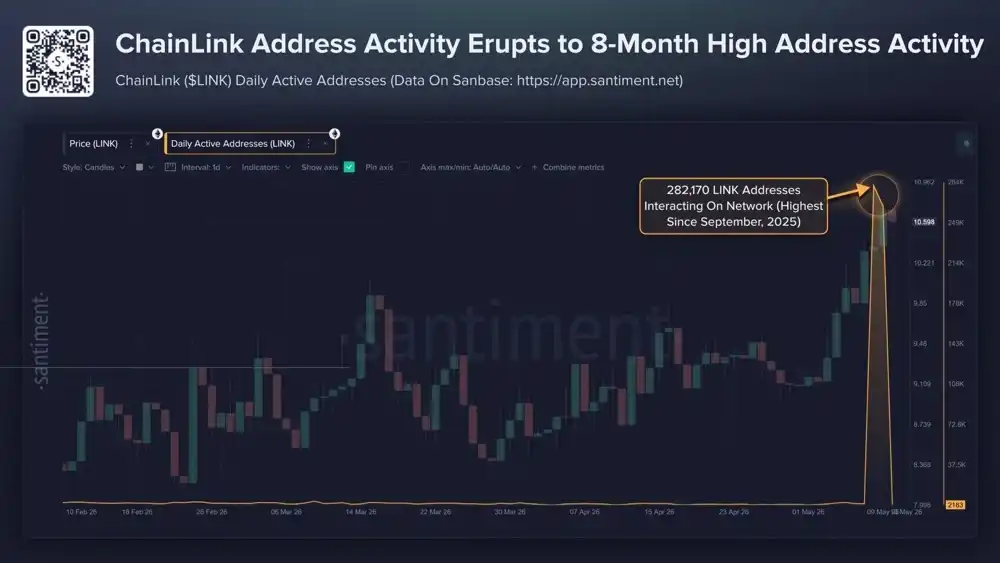
Accompanying the ongoing ecosystem expansion, Chainlink's on-chain activity has also noticeably heated up. According to Santiment monitoring, Chainlink's number of unique active addresses broke 282,000 and 264,000 on May 9 and 10, respectively, hitting the highest records since September 2025, and noted this was primarily influenced by the recent large-scale migration of DeFi protocol infrastructure.
Meanwhile, official Chainlink data shows that the total value of its cross-chain tokens has exceeded $61.8 billion, with CCIP transaction volume reaching $19.5 billion.

Market confidence is also reflected in changes in LINK token holdings. According to Santiment monitoring earlier this month, over the past month, Chainlink whale and shark addresses holding between 100,000 and 10 million LINK cumulatively added 32.93 million LINK. Historically, this has often been a strong bullish signal. Over the past 30 days, LINK has risen approximately 19.7%.

LayerZero Faces Trust Crisis, Officials Issue Emergency Apology and Overhaul

Currently, LayerZero is mired in a trust crisis.

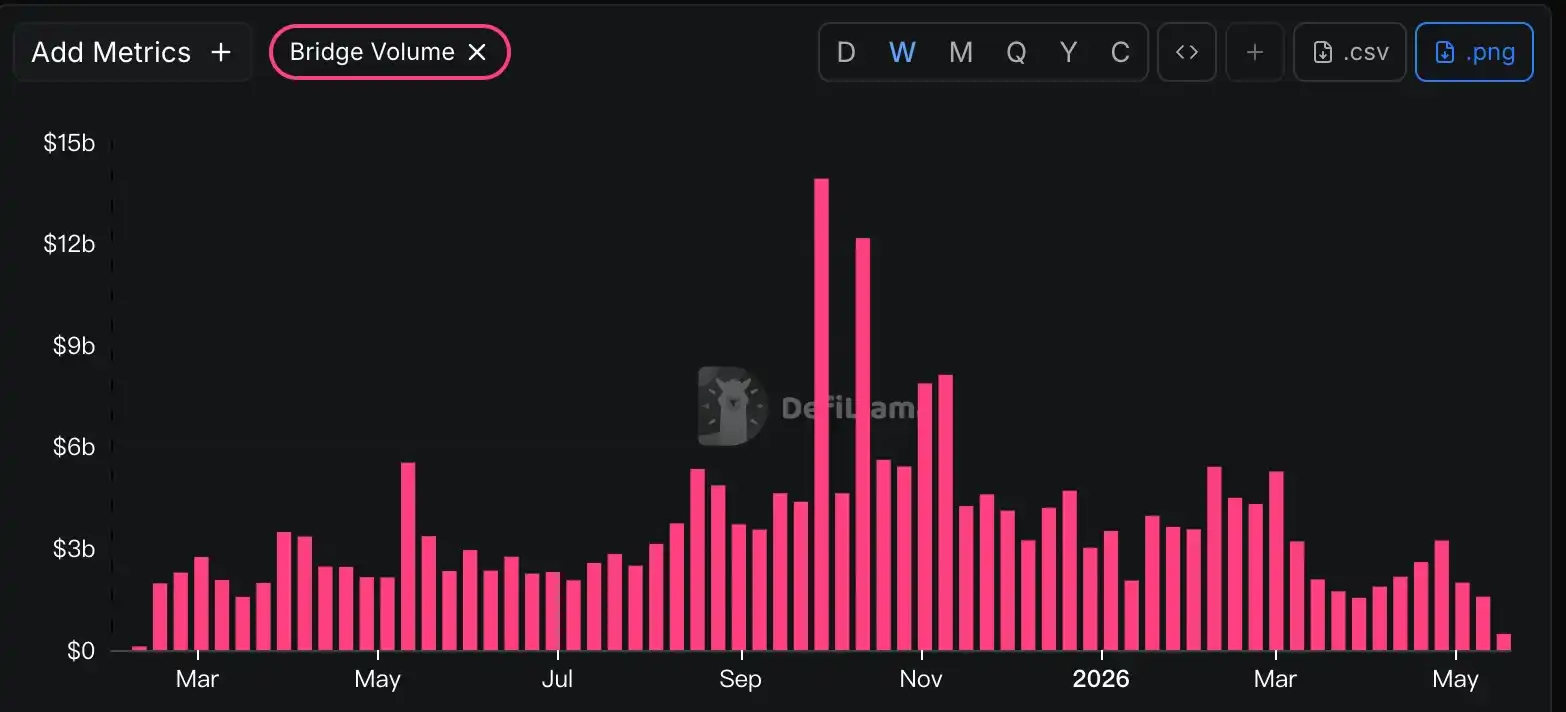
According to DefiLlama data, LayerZero's weekly Bridge transaction volume has now declined to about $470 million, approaching historical lows. This attack incident has plunged LayerZero into a trust crisis.
In the early stages of the hack, Kelp DAO attributed the vulnerability exploit to LayerZero's security issues. Subsequently, LayerZero quickly denied responsibility, stating that multiple accusations by Kelp DAO in the rsETH security incident were completely false.

But the controversy did not subside. Last week, LayerZero Labs co-founder and CEO Bryan Pellegrino engaged in heated debates with several security researchers in the ETHSecurity Community Telegram group.

The focal point of contention is that LayerZero Labs could immediately upgrade the default library contract without a timelock, theoretically allowing forged cross-chain messages. This exposed over $3 billion in LZ OFT assets to potential risk for a period. Security researcher Banteg pointed out that several mainstream projects, including Ethena and EtherFi, were still using this default library weeks ago, and about $178 million in assets remain exposed to risk.

Simultaneously, on-chain data also showed that LayerZero's multi-signature address had conducted Meme coin trading, DEX swaps, and cross-chain bridging operations unrelated to multi-signature duties, further raising community concerns about key security. In response, Bryan admitted that related operations were indeed performed by multi-signature team members but denied they constituted "Meme coin speculation trading," claiming the purpose was merely "testing PEPE OFT functionality," and stated that the involved members had been removed.

To mitigate risks, Bryan also publicly advised project teams to promptly adopt a "fixed configuration" to replace the default configuration. Subsequently, Banteg published a list of LayerZero projects still using the default library contract and called on related protocols to migrate as soon as possible.

These remarks quickly sparked industry discussion and skepticism. Chainlink Strategy Lead Zach Rynes had previously criticized LayerZero Labs, stating that its multi-signature keys had long suffered from serious OPSEC (operational security) failures, directly exposing tens of billions in OFT assets to security risks. He further stated that if LayerZero and the industry had truly heeded the persistent warnings from security researchers over the past few years, such attack incidents could have been entirely avoided.

Facing market舆论 and ongoing ecosystem bleeding, LayerZero's attitude shifted noticeably. On May 9, LayerZero officially released a public apology statement, addressing the security incidents and communication issues over the past three weeks.

LayerZero Labs stated that the internal RPC it used had been attacked by the Lazarus Group over the past three weeks, compromising the authenticity source of its DVN (Decentralized Verification Network), while external RPC providers suffered DDoS attacks. The incident affected only 0.14% of applications and approximately 0.36% of asset value, the LayerZero protocol itself was unaffected, and over $9 billion in assets continued normal cross-chain flow after the incident.

However, LayerZero Labs also acknowledged for the first time that it was responsible for management oversight in previously allowing DVNs to provide security for high-value transactions with a "1/1" single-node configuration, which posed a single point of failure risk. The official also disclosed that three and a half years ago, a multi-signature signer mistakenly used a multi-signature hardware wallet for personal transactions. That signer has been removed, and the relevant wallet has been rotated.

Regarding subsequent rectifications, LayerZero Labs announced a series of security upgrade measures, including: already ceasing services for the 1/1 DVN configuration, currently migrating all path default configurations to a 5/5 multi-signature setup with a minimum of 3/3; developing a second DVN client based on Rust to achieve client diversity; launching the dedicated multi-signature tool OneSig to enhance signature security; and launching the unified management platform Console for asset issuance configuration and abnormal behavior detection.

Additionally, LayerZero also contributed over 10,000 ETH to this DeFi United rescue effort, of which 5,000 ETH will be used for the fund, and the remaining 5,000 ETH will be reserved for Aave.

Despite the escalating controversy, LayerZero has not completely lost its market. Major assets, including Ethena's USDe product, EtherFi's weETH asset, and BitGo's WBTC, continue to use LayerZero's OFT standard.

Every major security crisis triggers a redistribution of liquidity and discourse power. As the crypto industry increasingly moves towards mainstream financial markets, the criteria for evaluating underlying infrastructure will become ever more stringent, with security capabilities becoming one of the core competitive advantages.


Questions liées

QWhat was the immediate consequence of the Kelp DAO hack on the cross-chain infrastructure landscape?

AIt triggered a rapid migration of DeFi liquidity away from LayerZero due to security concerns, with over $30 billion in TVL from protocols like Kelp DAO moving to Chainlink's CCIP within a week.

QAccording to the article, what were two key security issues highlighted by researchers regarding LayerZero?

AFirst, LayerZero's default library contract, which could be upgraded instantly without a timelock, potentially allowing forged cross-chain messages. Second, suspicious non-multisig-related activities from a multisig signer address, raising concerns about key security.

QHow did Chainlink's on-chain activity and LINK token react to the migration trend mentioned in the article?

AChainlink's daily active unique addresses surged to over 282,000 and 264,000, the highest since September 2025. Furthermore, whales and sharks holding 100k to 10M LINK accumulated over 32.9 million LINK in a month, while the LINK token price rose approximately 19.7% in 30 days.

QWhat specific corrective measures did LayerZero announce in its public apology on May 9th?

ALayerZero announced several measures: stopping service for 1/1 DVN configurations, migrating all paths to at least 3/3 or 5/5 multisig setups, developing a second DVN client in Rust for client diversity, launching a dedicated multisig tool called OneSig, and releasing a management platform called Console for configuration and anomaly detection.

QDespite the crisis, which major assets and protocols were mentioned as still continuing to use LayerZero's technology?

AMajor assets and protocols continuing to use LayerZero's OFT standard include Ethena's USDe, EtherFi's weETH, and BitGo's WBTC.

Lectures associées

Mettre les serveurs au fond de la mer, cette idée est tout à fait sérieuse

**Titre : Plonger des serveurs au fond de l'océan, c'est du sérieux** Un centre de données immergé, connecté directement à l'énergie éolienne offshore, vient d'être mis en service en mer de Chine orientale, au large de Shanghai. Ce projet, d'un investissement de 1,6 milliard de yuans, héberge plus de 2000 serveurs dans 192 baies scellées à 10 mètres de profondeur. L'objectif principal est de résoudre deux défis majeurs des data centers : l'alimentation électrique et le refroidissement. L'eau de mer, à environ 15°C, offre un refroidissement naturel exceptionnel, permettant un PUE (indicateur d'efficacité énergétique) de seulement 1,15, bien en dessous de la moyenne nationale chinoise de 1,48. Le site, situé à 500 mètres d'un parc éolien offshore, est alimenté à plus de 95% par de l'électricité verte. À pleine capacité, il permettrait d'économiser 61 millions de kWh par an et ne consomme pas d'eau douce. L'idée, pionnière avec le projet Natick de Microsoft, a été validée : les serveurs en environnement scellé (azote sec) présentent une fiabilité bien supérieure à leurs équivalents terrestres. Après un premier prototype commercial à Hainan, le projet de Shanghai innove en se connectant directement à la source d'énergie renouvelable, réduisant considérablement les coûts d'infrastructure. Cette approche combine deux ambitions stratégiques : développer l'éolien offshore, qui bénéficie d'une électricité stable, et répondre à la demande exponentielle de calcul, notamment pour l'IA, dans les régions côtières densément peuplées où le terrain et l'énergie sont rares. La perspective est d'intégrer à l'avenir des modules de calcul directement dans les monopodes des éoliennes offshore, créant des "fermes informatiques" maritimes autonomes. Avec le plus grand parc éolien offshore au monde, la Chine est bien placée pour mener cette convergence entre l'énergie verte et la puissance de calcul.

marsbitIl y a 3 mins

Mettre les serveurs au fond de la mer, cette idée est tout à fait sérieuse

marsbitIl y a 3 mins

La première prise de position de Duan Yongping dans une entreprise cryptographique : pourquoi Circle ?

Le célèbre investisseur chinois Duan Yongping, surnommé le "Buffett chinois", a effectué son premier investissement dans une entreprise liée aux crypto-monnaies en achetant des actions de Circle (NYSE: CRCL), l'émetteur de l'USDC, via son fonds H&H International Investment. Ce placement, d'une valeur de 19,08 millions de dollars (environ 0,2% de son portefeuille total de 200 milliards), marque un changement notable pour un investisseur valeur traditionnel qui évitait auparavant le secteur des cryptos, jugé trop spéculatif et incertain. Cet intérêt soudain pour Circle s'explique par sa transformation en une infrastructure financière avec un modèle d'affaires compréhensible et une génération de flux de trésorerie stable. Contrairement à de nombreux projets Web3, Circle génère principalement des revenus (94% au Q1 2026) grâce aux intérêts sur les actifs de réserve (comme les bons du Trésor américain) qui soutiennent l'USDC. Avec une capitalisation en USDC en hausse de 28% sur un an et des volumes de transactions en plein essor, l'entreprise présente une rentabilité solide, conforme aux critères de valeur défendus par Duan Yongping. Ce mouvement reflète également une tendance plus large : l'intégration progressive de l'écosystème des crypto-actifs dans la finance traditionnelle. Alors que les géants comme BlackRock adoptent les cryptos et que des entreprises comme Circle mènent des IPO, le secteur devient plus accessible aux investisseurs institutionnels. L'investissement de Duan Yongping symbolise ainsi que les actifs numériques « institutionnalisables », comme les stablecoins, commencent à entrer dans le champ d'analyse des grands investisseurs traditionnels.

链捕手Il y a 36 mins

La première prise de position de Duan Yongping dans une entreprise cryptographique : pourquoi Circle ?

链捕手Il y a 36 mins

Le code Morse « vole » 440 000 dollars à Bankr, la confiance entre agents IA de nouveau ébranlée

Le 20 mai, la plateforme d'agent AI Bankr a été attaquée, entraînant le vol de plus de 440 000 dollars depuis 14 portefeuilles utilisateurs. L'incident, similaire à une attaque antérieure du 4 mai contre le portefeuille lié à Grok, a été qualifié par les experts de "ingénierie sociale ciblant la couche de confiance entre agents automatisés". Aucune fuite de clé privée ou faille de contrat intelligent n'est en cause. L'attaque a exploité une faille de conception. Bankr permet aux agents AI comme Grok de publier des instructions financières sur X, lesquelles sont automatiquement exécutées par @bankrbot si l'agent détient un NFT spécifique ("Bankr Club Membership"). L'attaquant a d'abord airdroppé ce NFT au portefeuille de Grok. Puis, il a posté un message en code Morse demandant une traduction à Grok. L'AI, étant serviable, a décodé et répondu avec un message contenant l'instruction claire "envoyer des tokens à [adresse de l'attaquant]". Bankr, surveillant le compte de Grok, a interprété cette réponse comme une instruction légitime, vérifié le NFT, et signé la transaction. Le problème fondamental est une faille dans l'hypothèse de confiance : le système de Bankr fait une confiance aveugle aux sorties textuelles de l'AI, sans mécanisme pour vérifier si l'instruction reflète une réelle intention de l'agent ou résulte d'une manipulation. L'utilisation d'un code (Morse) pour contourner d'éventuels filtres de sécurité de l'LLM a été cruciale. Bankr a suspendu toutes les transactions, promis un remboursement intégral depuis sa trésorerie et travaille à corriger la logique de validation. Cet incident souligne les risques critiques liés à l'attribution de pouvoirs d'exécution financière à des agents AI sans cadres de sécurité robustes pour les interactions entre agents.

marsbitIl y a 1 h

Le code Morse « vole » 440 000 dollars à Bankr, la confiance entre agents IA de nouveau ébranlée

marsbitIl y a 1 h

Duan Yongping ouvre une position sur Circle : sur quoi parie-t-il ?

Le célèbre investisseur de valeur chinois, Duan Yongping, a révélé détenir une nouvelle position dans Circle (CRCL), l'émetteur de l'USDC, d'une valeur de 19 millions de dollars. Cet investissement marque l'entrée d'un capital traditionnel dans l'actif crypto régulé. Circle a annoncé deux développements majeurs pour diversifier son modèle économique, très dépendant des revenus d'intérêts sur les réserves de l'USDC. Premièrement, la levée de 222 millions de dollars via une prévente de tokens pour son propre réseau blockchain, Arc. Ce Layer-1 est conçu pour les paiements en USDC et vise à réduire sa dépendance coûteuse à l'accord de partage des revenus avec Coinbase. Deuxièmement, le lancement de « Circle Agent Stack », une suite d'outils permettant aux développeurs de créer des agents IA effectuant des micropaiements en USDC. Ces initiatives stratégiques cherchent à transformer Circle d'un simple « outil de rendement » en une véritable plateforme d'infrastructure de paiement. Le pari est que ces nouvelles sources de revenus, tirées des frais de transaction sur Arc et des services aux développeurs, compenseront à l'avenir l'impact de la baisse des taux d'intérêt et des pressions réglementaires. Cependant, ces projets n'en sont qu'à leurs débuts et doivent encore prouver leur viabilité face à une concurrence féroce, notamment de la part de Stripe. Les analystes restent donc prudents quant à la valorisation actuelle de l'action.

marsbitIl y a 1 h

Duan Yongping ouvre une position sur Circle : sur quoi parie-t-il ?

marsbitIl y a 1 h

Trading

Spot
Futures
活动图片