1 Billion DOT Minted Out of Thin Air, Yet Hacker Only Made $230,000

marsbitPubblicato 2026-04-13Pubblicato ultima volta 2026-04-13

Introduzione

On April 13, a security breach occurred involving the Polkadot bridge on the Ethereum network, where an attacker exploited a replay vulnerability in the MMR proof mechanism of Hyperbridge’s ISMP protocol. By reusing a historically valid proof and pairing it with a malicious request, the attacker bypassed verification and gained admin and minting rights over the wrapped DOT contract on Ethereum. They then minted 1 billion wrapped DOT tokens—2,805 times the existing supply—and attempted to liquidate them. However, due to extremely low liquidity in the wrapped DOT market, the massive sell-off crashed the token’s price by 99.98%, from $1.22 to approximately $0.000128. The attacker ultimately exchanged the tokens for only about 108.2 ETH (worth roughly $237,000), with gas costs as low as $0.74. The same exploit had been used previously in attacks on MANTA and CERE tokens, resulting in a total loss of around $242,000. Polkadot confirmed that the incident only affected DOT bridged via Hyperbridge to Ethereum and did not impact the native Polkadot network or DOT on other bridges. Exchanges including Upbit and Bithumb temporarily suspended DOT deposits and withdrawals as a precaution. The event highlights ongoing vulnerabilities in cross-chain infrastructure and the critical role of liquidity in limiting actual damages during large-scale exploits. It also reflects a broader trend of increasing DeFi security incidents in early 2026.

Author: Zhou, ChainCatcher


On the morning of April 13th Beijing time, on-chain monitoring platforms issued alerts one after another: abnormal issuance of Polkadot bridged assets was detected on the Ethereum network.

According to CertiK's analysis, the attacker submitted a carefully crafted cross-chain request to the HandlerV1 contract on the Ethereum side via Hyperbridge's ISMP protocol, and paired it with a real MMR proof that had been historically accepted by the system, successfully bypassing the verification mechanism.
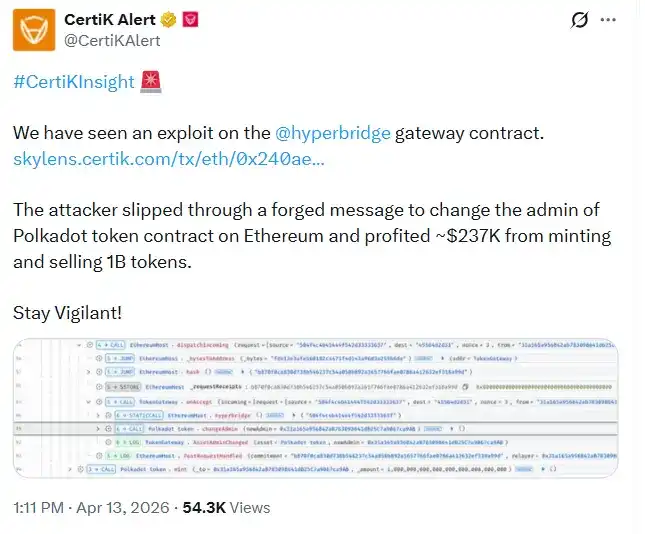
BlockSec Phalcon subsequently issued a technical alert, characterizing this vulnerability as an MMR proof replay vulnerability. According to their analysis, the root cause of the vulnerability lies in the fact that the replay protection of the HandlerV1 contract only verifies whether the hash of a request has been used before, but the proof verification process did not bind the submitted request payload to the proof being verified.

This logical flaw allowed the attacker to replay a historically valid proof and pair it with a newly constructed malicious request, thereby executing the ChangeAssetAdmin operation via the TokenGateway.onAccept() path, transferring the admin and minting permissions of the wrapped DOT contract on Ethereum (address: 0x8d...8F90b8) to an address controlled by the attacker.

On-chain data shows that after obtaining minting permissions, the attacker minted 1 billion wrapped DOT tokens, a quantity approximately 2805 times the reported circulating supply of about 356,000 tokens on Ethereum at the time.

Subsequently, the attacker exchanged the entire amount for approximately 108.2 ETH via Odos Router and Uniswap V4 liquidity pools, and transferred it to the attacker's external account, profiting about $237,000 at the time, with the gas cost for the entire attack being only about $0.74.

BlockSec Phalcon also mentioned that a previous attack using the same method had occurred, targeting MANTA and CERE tokens, resulting in a loss of about $12,000. The total combined loss from both attacks is approximately $242,000.

Following the incident, major South Korean exchanges Upbit and Bithumb announced the suspension of deposit and withdrawal services for DOT and the AssetHub Polkadot network to prevent potential fake deposit risks.

Polkadot officials stated that this vulnerability only affects DOT bridged to Ethereum via Hyperbridge, and does not affect DOT assets within the Polkadot ecosystem, nor DOT transferred via other bridges. Polkadot and its parachains, as well as native DOT, remain secure and unaffected. Hyperbridge has currently been suspended to investigate the issue.

It is worth mentioning that despite the minting scale reaching 1 billion tokens, the actual loss is far lower than the theoretical figure.Due to the extremely limited on-chain liquidity of wrapped DOT on Ethereum, the concentrated sell-off of 1 billion tokens instantly crashed the price of wrapped DOT from $1.22 to $0.00012831, a drop of 99.98%, rendering the vast majority of tokens unable to be effectively liquidated.

According to CoinMarketCap data, the price of native DOT tokens was also briefly dragged down by market sentiment, falling nearly 5%.

Users on X bluntly stated, who would have thought that DOT, once a cross-chain myth alongside Ethereum, would引爆 social media in this way. Cross-chain bridges have once again become the "Achilles' heel" of the crypto world. The once-deserted quiet has now turned into a scene of devastation and sighing. When 1 billion DOT appeared out of thin air, all technical indicators became worthless.

Other users jokingly remarked that low liquidity "saved Polkadot" in this incident by意外, limiting the actual loss to about $237,000.

However, while the low liquidity of bridged assets limited the hacker's profit, it exposed the potential fragility of the cross-chain interoperability layer.

It is reported that Hyperbridge, developed by Polytope Labs, is a cross-chain interoperability project within the Polkadot ecosystem, long positioning itself as trust-minimized cross-chain infrastructure with its core security mechanism relying on cryptographic proofs instead of multi-signature committees. The project had previously emphasized its resistance to common bridge attacks.
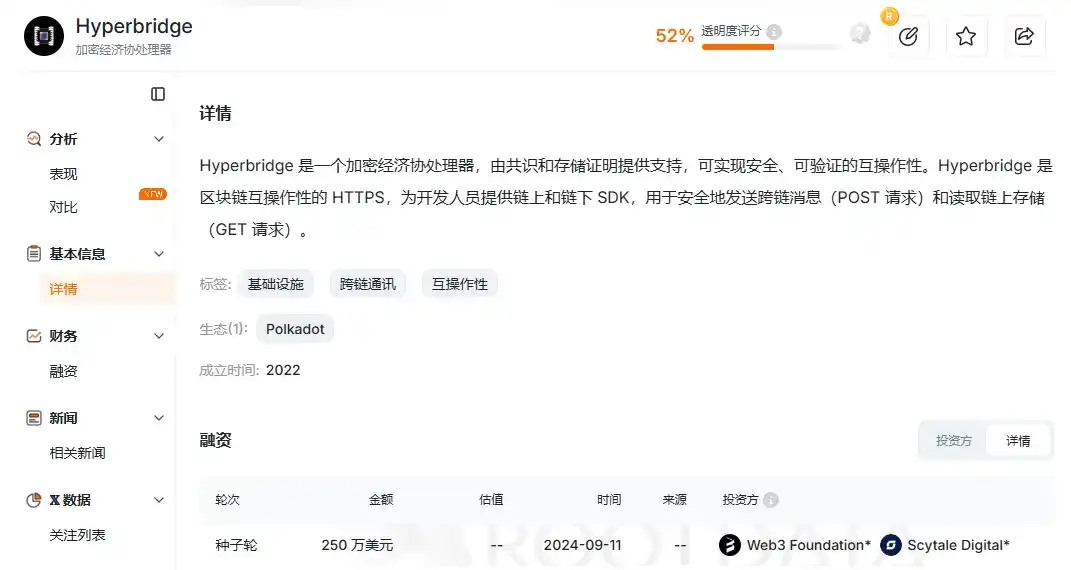
But this incident perhaps indicates that the integrity of the cryptographic proof mechanism itself is not sufficient to guarantee security; the specific implementation logic of the Gateway contract on the Ethereum side also constitutes an attack surface.

From a more macro perspective, this incident is a microcosm of the持续严峻 DeFi security landscape in 2026. Since the beginning of the year, several major attacks have occurred, including Venus generating $2.15 million in bad debt due to price manipulation, Resolve over-minting 80 million USR, and Drift losing over $285 million in assets. The attack methods varied and involved diverse areas.

Taking over minting rights for无限增发 is not a new attack模式. However, Hyperbridge's损失 was意外压低 due to its extremely shallow liquidity.

According to CertiK data, March alone recorded 46 security incidents, with total losses of approximately $39.8 million, the highest monthly record since November 2024. CertiK also pointed out that the increased frequency of code vulnerability exploits may be related to the rise of AI-assisted vulnerability mining tools.

The rise in attack frequency is also pushing the industry to重新审视 the boundaries of security and regulation. Circle's Chief Strategy Officer Dante Disparte previously, in response to the Drift Protocol theft, called for protocols, wallets, exchanges, and stablecoin issuers to treat security and accountability as a shared obligation. He suggested that DeFi protocols could develop on-chain technical protection measures参考 traditional market circuit breakers, and promote relevant legislation to enshrine property rights and financial privacy protection standards into law before the next major incident occurs.


Crypto di tendenza

Domande pertinenti

QWhat was the core vulnerability exploited in the Hyperbridge attack on April 13th?

AThe attack exploited an MMR proof replay vulnerability. The flaw was in the HandlerV1 contract, where the replay protection only checked if a request's hash had been used before, but the proof verification process did not bind the submitted request payload to the proof being validated. This allowed the attacker to replay a historically valid proof with a new, forged request.

QHow much wrapped DOT did the attacker mint, and why was the actual financial gain so low compared to the amount minted?

AThe attacker minted 1 billion wrapped DOT tokens. However, the actual financial gain was only about $237,000 because the on-chain liquidity for wrapped DOT on Ethereum was extremely limited. The massive sell-off crashed the token's price by 99.98%, from $1.22 to approximately $0.00012831, making it impossible to liquidate the vast majority of the tokens.

QWhich other tokens were previously targeted using the same attack method mentioned in the article?

AAccording to the article, the same attack method was previously used against MANTA and CERE tokens, resulting in losses of approximately $12,000.

QWhat was the official response from Polkadot regarding the scope and impact of this incident?

APolkadot official stated that the vulnerability only affected DOT that was bridged to Ethereum via Hyperbridge. It did not affect DOT within the Polkadot ecosystem, DOT bridged through other bridges, or native DOT. They confirmed that Polkadot, its parachains, and native DOT remained secure and unaffected. Hyperbridge was paused for investigation.

QWhat broader trend in DeFi security does this event represent, according to the article?

AThe article states this event is a reflection of the increasingly severe DeFi security landscape in 2026. It cites other major incidents like the Venus protocol ($2.15M in bad debt), Resolve (80M USR over-minted), and the Drift Protocol hack (over $285M). It also notes a rise in code vulnerability exploits, potentially linked to the emergence of AI-assisted bug-finding tools, with March alone seeing 46 security incidents totaling ~$39.8M in losses.

Letture associate

Weekly Editor's Picks (0725-0731)

Weekly Editor's Picks (0725-0731) provides a curated selection of deep analysis, filtering out market noise. Key themes from this week include: **Macro & Policy:** The Federal Reserve's upcoming meeting is marked by high uncertainty, balancing cooling inflation data against persistent price pressures. Meanwhile, the U.S. crypto regulatory Clarity Act faces critical political hurdles, with its 2026 passage probability seen as low. **Investing & Crypto:** Analysis suggests long-term crypto success depends on conviction through volatile cycles, focusing on assets like Bitcoin and core smart contract platforms. A trend noted is the increasing similarity between global equity markets (especially tech) and crypto, driven by narrative and leverage. Several major crypto protocols show strong revenue growth, but this isn't always translating to token price appreciation due to sell pressure and structural factors. **AI & Semiconductors:** Nvidia's rising credit default swap rates signal market concern over AI infrastructure financing risks. The storage sector experienced volatility as markets began pricing in potential 2027 oversupply. Despite a record profitable quarter, SK Hynix's results were deemed "below expectations," reflecting heightened investor demands for future growth visibility. **Markets & DeFi:** TradeXYZ demonstrated remarkable accuracy in pre-market pricing for a major A股 listing. The token ONDO saw gains, linked to its growing role in the on-chain tokenized stock ecosystem. **Ethereum:** Post-Pectra upgrade, a major structural shift is underway as Lido begins migrating millions of ETH to new validator architectures designed for capital efficiency. **Also Highlighted:** Butian's bullish stock market move; OpenAI's Altman promising major advances; Samsung and SK Hynix securing large AI chip deals; Apple reaching a $5T market cap; and ongoing discussions around exchange security following Poolin's bankruptcy case.

marsbit6 min fa

Weekly Editor's Picks (0725-0731)

marsbit6 min fa

Low Investment Isn't Apple's Immunity Pass

While Meta and Google face investor scrutiny over ballooning AI capital expenditures, Apple's minimal AI investment has paradoxically become a strength. Its market cap recently reclaimed the global top spot, surpassing $5 trillion. The irony is deep: Apple's own AI efforts have lagged, with "Apple Intelligence" delayed and core talent lost, forcing reliance on partners like Google Gemini and Alibaba's Qianwen. Its Q3 FY2026 (Q2 CY) earnings initially seemed stellar. Revenue hit $109.4B (up 16% YoY), with iPhone and Mac sales, growing 22% and 29% respectively, driving most of the growth. However, the stock fell over 8% post-earnings. The primary concern was a weaker Q4 revenue growth forecast of 9-11%, below expectations, due to looming supply chain constraints. Apple is feeling the indirect cost of the AI boom. Soaring memory and chip prices, fueled by massive data center investments from Microsoft, Amazon, and others, are forcing Apple to raise Mac and iPad prices significantly. The upcoming iPhone launch is also expected to see substantial price hikes. Despite avoiding heavy AI infrastructure spending—its capital expenditures are actually down 28%—Apple cannot escape the industry-wide supply and cost pressures. While Apple's operating cash flow remains robust, its substantial R&D spending (up 32% YoY) has yet to yield major AI breakthroughs. As Tim Cook prepares to step down as CEO, Apple faces a challenging transition: balancing its premium hardware success against the strategic and cost pressures of the AI era it has so far cautiously navigated.

marsbit56 min fa

Low Investment Isn't Apple's Immunity Pass

marsbit56 min fa

PA Graphics Explanation | One Chart to Understand the Major Web3 Events in August 2026

**PANews Crypto Calendar: Key Web3 Events in August 2026** PANews introduces its revamped crypto calendar, featuring comprehensive coverage, flexible filtering, and easy export options. The market in August will be shaped by multiple key events across macroeconomics, regulation, tokenomics, and project developments: * **Macro & Policy:** Key US economic data releases (July Non-Farm Payrolls, CPI), the Federal Reserve meeting minutes, and the Jackson Hole Economic Symposium will be in focus. On the regulatory front, the US Senate plans to release a new draft of the *CLARITY Act*, while the EU's expanded crypto ban against Belarus comes into effect. * **Token Unlocks:** Significant token unlocks are scheduled for assets including ENA, AVAX, CONX, ZRO, and KAITO, which may influence market volatility. * **Project Updates & Shutdowns:** Several services, including Exchange Art, Ctrl Wallet, Zapper, NFTfi, and Summer.fi, are set to cease operations or undergo major adjustments. Users are advised to manage their assets accordingly. * **Corporate Activity:** Q2 earnings reports from companies like SpaceX, Circle, and Nvidia are due. Unitree Robotics will initiate its IPO subscription on the STAR Market, and Moonshot AI plans to begin a Pre-IPO financing round. * **Industry Events:** Major conferences such as Bitcoin Asia 2026 and the 2026 Digital Expo will take place. The overarching market narrative for August will revolve around macroeconomic expectations, regulatory developments, token unlock schedules, and ongoing industry consolidation.

marsbit1 h fa

PA Graphics Explanation | One Chart to Understand the Major Web3 Events in August 2026

marsbit1 h fa

Wall Street's Most Famous 'Cassandra' Now Has His Sights Set on Nvidia

Michael Burry, the famed "Big Short" investor, has once again captured Wall Street's attention with a series of short positions against major tech and semiconductor stocks, most notably Nvidia. In late June and July, through his "Cassandra Unchained" newsletter, Burry disclosed short bets against Nvidia, Tesla, Applied Materials, Caterpillar, the SOXX semiconductor ETF, and later, Micron Technology. His core thesis revolves around potential distortions in the AI infrastructure boom, specifically questioning whether extended depreciation schedules (e.g., 6 years vs. a realistic 2-3 years for AI chips) by cloud giants like Microsoft and Google artificially inflate profits. He also raises concerns about possible "off-balance-sheet circular financing," where chip demand might be propped up by vendor-backed funding to clients. Nvidia's stock experienced volatility following these disclosures, briefly dipping but largely holding near Burry's reported entry points, leaving his positions roughly flat or slightly underwater as of late July. This move is part of a pattern for Burry, whose track record since his legendary 2008 bet is mixed. He has faced notable losses, such as on Tesla in 2021, while scoring on broader market turns like the 2020 pandemic crash. His methodology focuses intensely on free cash flow and scrutinizing original financial documents to spot overvaluation and structural risks, but it often struggles with timing the market. The article contrasts Burry's stance with other prominent investors. Steve Eisman, another "Big Short" figure, is not shorting Nvidia, citing strong fundamentals but expressing nervousness about sustainability. Jim Chanos agrees with the broad "accounting mismatch" concern—comparing it to the dot-com bubble—but targets financial leverage in private equity firms rather than the chip stocks themselves. While Nvidia's short interest remains relatively low at 1.3-1.4% of float, the massive stock size means absolute short losses have been significant, exceeding $5 billion earlier this year. The piece concludes that for ordinary investors, the key takeaway is not replicating specific short bets but learning from the critical frameworks these investors use: questioning rosy accounting, identifying structural vulnerabilities, and maintaining skepticism during market euphoria, even if pinpointing the exact catalyst for a downturn remains elusive.

marsbit1 h fa

Wall Street's Most Famous 'Cassandra' Now Has His Sights Set on Nvidia

marsbit1 h fa

Weekly Selection丨Epic Stock Market Volatility, Changxin Tech's IPO Reshapes Storage Landscape, Saylor Aims to Re-Anchor STRC Around September 8th

PANews Weekly Digest: Market Turmoil, Tech Breakthroughs, and Crypto Developments. The week saw significant volatility across global markets. South Korea's KOSPI index experienced extreme turbulence, including multiple trading halts, largely driven by sharp declines in AI hardware stocks like SK Hynix. In contrast, China's Changxin Xinqiao (CXC) achieved a landmark IPO with a market cap surpassing 4 trillion yuan, marking a major success for the domestic DRAM industry after a decade of losses. In the crypto and Web3 space, several key narratives emerged. AI is driving demand for new infrastructure, with projects like AI agent wallets and programmable payments gaining traction, attracting interest from firms like Coinbase. The Bitcoin mining sector is pivoting, with companies like MARA focusing on energy management as electricity becomes a core AI-era asset. Meanwhile, the RWA (Real World Assets) sector faces a "utilization puzzle," with hundreds of billions in on-chain assets remaining dormant. Notable market movements included a historic single-day surge of over 17% for the KOSPI index and a significant migration of $16.5 billion in staked ETH within the Lido ecosystem. Michael Saylor announced a target to re-peg the STRC stablecoin around September 8th. Other highlights include discussions on Ethereum's ambitious 2030 roadmap for scaling and privacy, analysis showing high protocol revenues not always translating to token price gains, and warnings from Citi about potential extreme commodity price shocks by late 2026.

marsbit1 h fa

Weekly Selection丨Epic Stock Market Volatility, Changxin Tech's IPO Reshapes Storage Landscape, Saylor Aims to Re-Anchor STRC Around September 8th

marsbit1 h fa

Trading

Spot

Articoli Popolari

Come comprare DOT

Benvenuto in HTX.com! Abbiamo reso l'acquisto di Polkadot (DOT) semplice e conveniente. Segui la nostra guida passo passo per intraprendere il tuo viaggio nel mondo delle criptovalute.Step 1: Crea il tuo Account HTXUsa la tua email o numero di telefono per registrarti il tuo account gratuito su HTX. Vivi un'esperienza facile e sblocca tutte le funzionalità,Crea il mio accountStep 2: Vai in Acquista crypto e seleziona il tuo metodo di pagamentoCarta di credito/debito: utilizza la tua Visa o Mastercard per acquistare immediatamente PolkadotDOT.Bilancio: Usa i fondi dal bilancio del tuo account HTX per fare trading senza problemi.Terze parti: abbiamo aggiunto metodi di pagamento molto utilizzati come Google Pay e Apple Pay per maggiore comodità.P2P: Fai trading direttamente con altri utenti HTX.Over-the-Counter (OTC): Offriamo servizi su misura e tassi di cambio competitivi per i trader.Step 3: Conserva Polkadot (DOT)Dopo aver acquistato Polkadot (DOT), conserva nel tuo account HTX. In alternativa, puoi inviare tramite trasferimento blockchain o scambiare per altre criptovalute.Step 4: Scambia Polkadot (DOT)Scambia facilmente Polkadot (DOT) nel mercato spot di HTX. Accedi al tuo account, seleziona la tua coppia di trading, esegui le tue operazioni e monitora in tempo reale. Offriamo un'esperienza user-friendly sia per chi ha appena iniziato che per i trader più esperti.

501 Totale visualizzazioniPubblicato il 2024.12.12Aggiornato il 2026.06.02

Come comprare DOT

Discussioni

Benvenuto nella Community HTX. Qui puoi rimanere informato sugli ultimi sviluppi della piattaforma e accedere ad approfondimenti esperti sul mercato. Le opinioni degli utenti sul prezzo di DOT DOT sono presentate come di seguito.

活动图片