US-Iran War: Why Did Turkey Sell Off 58.4 Tons of Gold in Two Weeks?

marsbitPublished on 2026-03-30Last updated on 2026-03-30

Abstract

Turkish Central Bank sold approximately 58.4 tons of gold, worth over $8 billion, within two weeks in March 2026, as a response to a severe financial crisis triggered by the U.S.-Israel military operation against Iran. The conflict led to Iran blocking the Strait of Hormuz, causing oil prices to surge over 40% and cutting off natural gas supplies to Turkey, which relies heavily on energy imports. This resulted in a plunging Turkish lira, massive foreign capital flight, and rapid depletion of foreign reserves. To defend the currency and meet urgent dollar demands, Turkey utilized gold swaps—temporarily exchanging gold for dollars with agreements to repurchase later—rather than outright sales, to avoid market panic and preserve long-term reserves. The move highlights Turkey's vulnerability to energy shocks and its strategic use of gold reserves for liquidity during crises. If the conflict persists, further gold sales may be necessary, adding downward pressure on global gold prices.

Author: Le Ming

A recent figure that has stunned global financial markets has emerged: the Turkish central bank sold off approximately 58.4 tons of gold in just two weeks, worth over $8 billion. Of this, 6 tons were reduced in the week of March 13, and 52.4 tons were sharply cut in the week of March 20.

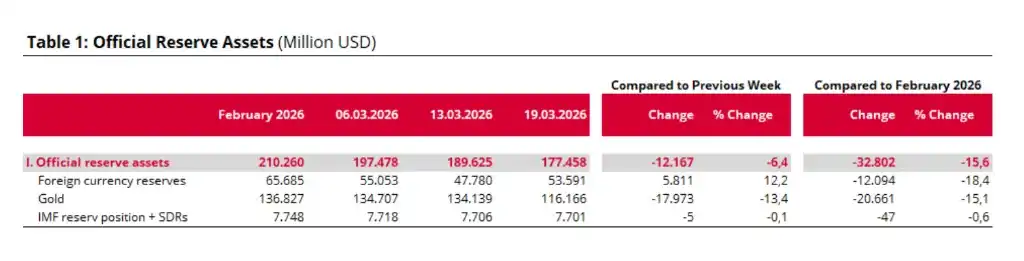
The weekly data from the Turkish central bank clearly outlines this picture: from March 13 to 19, the market value of gold reserves plummeted from $134.1 billion to $116.2 billion, evaporating nearly $18 billion in a single week; meanwhile, foreign exchange reserves (excluding gold) actually increased by $5.8 billion.

Between the decline and the rise, the traces of a "gold for foreign exchange" operation are unmistakable.

Over the past decade, Turkey has been one of the world's most aggressive gold buyers, with gold reserves rising from 116 tons in 2011 to over 820 tons.

Why suddenly sell off such hard-earned assets on a large scale within two weeks?

The answer is three words: to survive.

Trigger: A War That Pushed Turkey into a "Perfect Storm"

On February 28, the United States and Israel jointly launched a military operation codenamed "Epic Fury," launching airstrikes on Iranian nuclear facilities, military bases, and government buildings.

Iran retaliated and effectively blockaded the Strait of Hormuz—a passage for 20% of the world's seaborne oil and 20% of LNG trade.

Brent crude surged from $73 per barrel before the war to over $106, a rise of more than 40%. The International Energy Agency defined it as the "most severe global energy security challenge in history."

For most countries, this was a shock; but for Turkey, it was a survival crisis.

Turkey relies on imports for 90% of its oil and 98% of its natural gas. Every $10 increase in oil prices adds $4.5 to $7 billion to the current account deficit. Based on post-war oil prices, the annual energy import cost could surge by about $15 billion.

An even more fatal blow came on March 24—when Israel airstriked Iran's South Pars gas field, Iran subsequently halted natural gas exports to Turkey. Iran is Turkey's second-largest pipeline natural gas supplier, accounting for about 13% to 14% of its natural gas imports. The 25-year contract for this pipeline is set to expire in July 2026, and the war directly dashed prospects for renewal.

Simply put, Turkey's situation is: its energy bill suddenly doubled, a key gas source was cut off, and no equivalent replacement could be found in the short term.

Transmission Chain: Foreign Exchange Reserves Buckled First

Energy imports require settlement in US dollars, so importers scrambled for dollars, and the lira plummeted.

In the 16 trading days since the conflict began, the lira hit a record low against the dollar 11 times, reaching about 44.35 lira per dollar on March 25.

Behind this was the accelerated withdrawal of foreign investors: in three weeks, foreign capital outflows from Turkish bonds reached $4.7 billion, with $1.2 billion flowing out of the stock market, while carry trade positions shrank from a record $61.2 billion in January to below $45 billion.

The Turkish central bank was thus forced to launch a "lira defense battle." In just the first week of March, it sold over $8 billion in foreign exchange. In the three weeks ending March 19, the central bank cumulatively consumed about $25 to $30 billion in foreign exchange reserves. Net reserves, after deducting swaps, plummeted from $54.3 billion before the war to $43 billion.

Turkey's weekly data fully records this process: foreign exchange reserves (excluding gold) fell from $55 billion on March 6 to $47.8 billion on March 13—first using foreign exchange ammunition. By March 19, foreign exchange reserves rebounded to $53.6 billion, but gold reserves simultaneously plummeted from $134.1 billion to $116.2 billion—foreign exchange ammunition was nearly exhausted, and gold began to be used.

This is a textbook example of an emergency defense sequence: "first use foreign exchange, then use gold."

Figure: Foreign exchange data released by the Turkish central bank
Gold Swaps: Why "Sell" Instead of "Pawn"?

The key to understanding this operation is: more than half of Turkey's gold reduction was done through swaps, not direct sales.

The essence of a gold swap is "exchanging gold for foreign exchange, with redemption upon maturity." The central bank transfers gold to the counterparty (usually a primary investment bank) in exchange for an equivalent amount of US dollars, while signing a forward contract to repurchase the gold at a slightly higher price in the future. It is a short-term financing behavior, not a permanent liquidation.

The central bank chose swaps over outright sales for at least three reasons.

First, to retain long-term positions. If the oil price surge is judged to be a temporary shock, swaps can address the urgent need, and the gold can be redeemed later, avoiding the destruction of a decade of accumulation.

Second, to reduce the impact on gold prices. Directly dumping 60 tons of gold could trigger a cliff-like plunge in the market, in turn causing a significant devaluation of its remaining over $100 billion in gold reserves. Swaps are conducted quietly in the over-the-counter market, with much less impact.

Third, a buffer at the domestic political level. Gold is an "anti-inflation totem" in the hearts of the Turkish people. Announcing large-scale gold sales could easily trigger panic, while swaps can maintain a certain degree of ambiguity technically.

This operation was completed quickly within two weeks thanks to a key pre-arrangement: Turkey stored about 111 tons of gold, worth about $30 billion, at the Bank of England. This gold could be used for foreign exchange intervention without logistical constraints—no need for cross-border physical transport, directly pledged and liquidated in the City of London.

Pressure on Gold Prices

Turkey has a historical pattern: selling gold during crises and buying back after crises.

The 2018 lira crisis, the 2020 pandemic shock, the 2023 earthquake—each time the central bank reduced gold to provide liquidity but resumed accumulation afterward. Analysts generally believe that the operation in March 2026 continues this pattern.

But this judgment has a core premise: the war cannot be prolonged.

Swap agreements come with holding costs and interest. If the war continues, energy prices remain anchored at over $100 for the long term, and Turkey's foreign exchange earning capacity cannot cover the soaring energy bill, then these "temporary swaps" will never be redeemed, effectively becoming "permanent fire sales."

Therefore, in the coming weeks, if the war continues, Turkey will need to continue turning its $135 billion in gold reserves into a lifeline.

Although Turkey prefers to "pledge" gold to obtain foreign exchange liquidity, these transactions still substantially increase the downward pressure on the gold market. In the London over-the-counter market, when the Turkish central bank transfers tens of tons of gold as collateral to international counterparties (such as investment banks) in exchange for US dollars, these financial institutions, to hedge their own position risks, typically conduct corresponding short-selling or selling operations in the spot or futures derivative markets.

Therefore, the liquidity of this batch of gold will eventually be transmitted to the market, indirectly increasing supply and depressing prices.

Conclusion

The Turkish central bank's sale of 60 tons of gold in two weeks is not panic, not speculation, but a rational self-rescue by a country highly dependent on energy imports after its ally bombed its largest energy supplier, facing the triple blow of depleted foreign exchange, a plummeting lira, and a cut-off of natural gas supply.

Figure: The market is frantically shorting the lira, partly betting that the war will not end soon and partly betting that Turkey will ultimately not hold out.
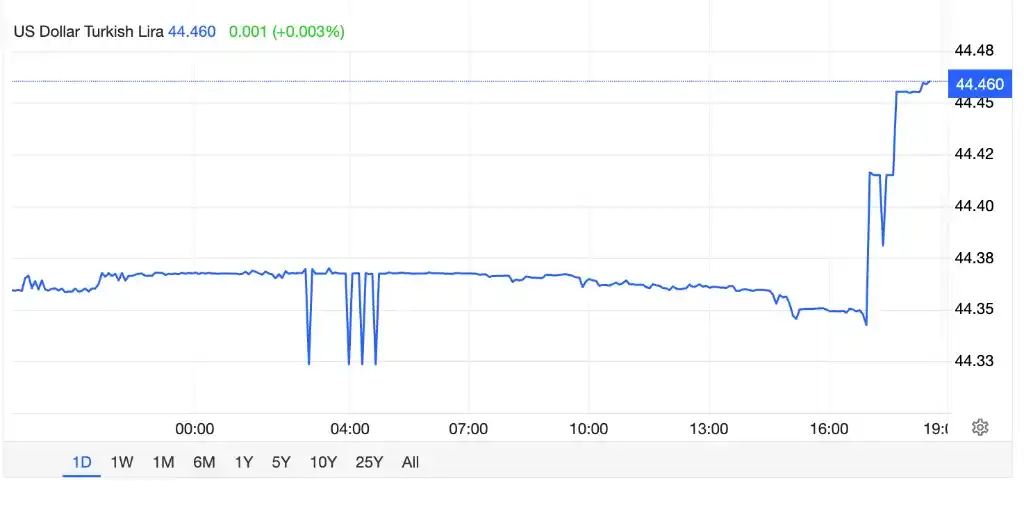
As the war prospects worsen, Turkey still needs to continue to withstand the pressure.


Trending Cryptos

Related Questions

QWhy did Turkey's central bank sell 58.4 tons of gold in just two weeks?

ATo survive a severe financial crisis triggered by the US-Israel war with Iran, which caused a surge in energy import costs, a collapse of the Turkish lira, and a critical depletion of foreign exchange reserves.

QWhat was the immediate trigger for Turkey's financial crisis in March 2026?

AThe US-Israel military operation 'Epic Rage' against Iran, which led to Iran blocking the Strait of Hormuz and cutting off natural gas exports to Turkey, causing oil prices to soar over 40%.

QHow did the Turkish central bank's gold sales operation work, and why was it done through swaps?

AOver half of the gold was减持 via swaps, not direct sales. This 'pawned' the gold to international banks for immediate USD liquidity, with an agreement to buy it back later. This was done to preserve long-term reserves, minimize market impact, and avoid domestic political panic.

QWhat impact did the energy crisis have on Turkey's currency and foreign reserves?

AThe lira hit record lows against the dollar 11 times in 16 trading sessions. The central bank burned through $250-300 billion in foreign reserves in three weeks defending it, forcing it to then use its gold reserves as a last resort.

QHow could the ongoing war turn Turkey's temporary gold swaps into a permanent loss?

AIf the war continues and energy prices remain high, Turkey may be unable to generate enough foreign exchange to redeem the gold from the swap agreements, effectively forcing a permanent sale.

Related Reads

After Three Consecutive Quarters of Decline, Can the Crypto Market Find a Window for Stabilization in Q3?

The cryptocurrency market has just concluded its worst-performing quarter since 2022, with total capitalization dropping 12.6% to $2.1 trillion. All core metrics indicate capital is leaving the sector, not just rotating within it. Bitcoin fell 14.2% and Ethereum dropped 25.4% in Q2, breaking their previous correlation with US tech stocks. A key driver is the reversal in US spot Bitcoin ETF flows, which saw a net outflow of approximately $4.67 billion in Q2, including a record monthly outflow near $4.5 billion in June. While recent data suggests long-term holders are accumulating again, sustained ETF outflows mean continued selling pressure. Market focus is now singularly on the Federal Reserve. The upcoming July FOMC meeting is seen as the most critical event for Q3. A dovish signal could support Bitcoin reclaiming a $68,000-$84,000 range, while a hawkish stance might establish a new trading band around $50,000-$56,000. Additionally, regulatory uncertainty persists, with the progress of the crucial *CLARITY Act* stalling in the Senate, reducing its perceived 2026 passage probability to 40-45%. Despite the broad downturn, a few sectors showed growth. Prediction markets saw nominal volume surge 48.7% year-over-year to $113.8 billion, and tokenized collectibles transaction volume rose 143% quarterly to $1.4 billion. The Real-World Asset (RWA) tokenization sector also continued steady growth, now representing ~$28.1 billion in on-chain value. The market's foundation for an extreme crash appears limited, with Bitcoin price hovering near its 200-week moving average. However, the trading paradigm has shifted from narrative-driven speculation to decisions based on price action, policy developments, and interest rate expectations, making a broad sentiment-driven rally unlikely in the near term.

marsbitYesterday 08:36

After Three Consecutive Quarters of Decline, Can the Crypto Market Find a Window for Stabilization in Q3?

marsbitYesterday 08:36

BIT Trading Moment: BTC Still Suppressed by Weekly 200 EMA, Rejection May Restart Decline; Storage and Semiconductors that Surged Last Night Begin Falling in Evening Trading

**Crypto & Stock Market Wrap: Bitcoin Tests Resistance, Stocks Retreat After AI Surge** Bitcoin consolidates around $66,000, facing key resistance near $68,000—an area seen as a major psychological and technical hurdle where previous rallies have failed. Analysts note the cryptocurrency is caught between its 200-week moving average (~$63,333) and 200-week EMA (~$68,328). A clear break above $68k is needed to signal a stronger bullish trend, while a rejection could lead to a retest of $63k support. Market sentiment remains cautious, with low futures open interest pointing to a low-liquidity rebound rather than a full bull market. Bitcoin spot ETFs saw another $203 million inflow. US stock futures pointed lower after a strong Tuesday session led by a massive rebound in semiconductors and memory stocks. The rally was fueled by renewed optimism about AI-driven hardware demand, with Micron, SanDisk, and SK Hynix surging. However, those gains reversed in pre-market trading. Super Micro Computer (SMCI) soared over 20% after hours on strong guidance and a record backlog. Other standouts included Rocket Lab and nuclear energy plays Oklo and X-Energy. Rising oil prices (Brent above $91) and climbing Treasury yields (10-year near 4.64%), however, are reigniting inflation concerns and acting as a headwind for equities. In Asia, markets were mixed. South Korea's KOSPI pared early gains to close slightly higher as semiconductor stocks like SK Hynix gave back initial surges. Japan's Nikkei edged lower as the yen hit a fresh 38-year low against the dollar, raising fears of potential market intervention. Key events to watch include the Samsung Galaxy launch, AMD's AI event, and a slew of major tech earnings from Alphabet, Tesla, and IBM after the close on Wednesday, followed by the ECB meeting and Intel's earnings on Thursday.

marsbitYesterday 08:28

BIT Trading Moment: BTC Still Suppressed by Weekly 200 EMA, Rejection May Restart Decline; Storage and Semiconductors that Surged Last Night Begin Falling in Evening Trading

marsbitYesterday 08:28

Former CFTC Chairman, Circle President Tarbert: Preaching Long-Termism While Cashing Out $30 Million Himself

Former CFTC Chairman and Circle President Heath Tarbert has consistently advocated for a long-term vision in public, urging patience from investors as Circle’s stock price has fallen significantly from its peak. However, it has been revealed that since Circle’s IPO, Tarbert has continuously sold his CRCL shares through pre-arranged trading plans, cashing out approximately $30 million, without making any public market purchases. This contrast between his public messaging and personal actions has drawn criticism. Tarbert joined Circle in July 2023 as Chief Legal Officer, leveraging his regulatory experience to help guide the company through its IPO and expansion. Despite promoting stablecoins as long-term infrastructure, he established a 10b5-1 trading plan just before Circle went public, leading to substantial stock sales over the following year. In March 2026, he initiated another plan to sell more shares. His career trajectory highlights a pattern of moving between high-level regulatory roles and influential positions in the financial sector. After resigning as CFTC Chairman in early 2021, he joined Citadel Securities as Chief Legal Officer just 27 days later, during a period of intense regulatory scrutiny for the firm. He later joined Circle, aiding its efforts to navigate regulatory challenges for its public listing. While Tarbert's expertise in policy and compliance is valuable to companies like Circle, his actions—advocating long-term confidence while personally divesting—raise questions about the alignment between his public statements and his private financial decisions, leaving investors who followed his advice to bear the market risks.

marsbitYesterday 08:06

Former CFTC Chairman, Circle President Tarbert: Preaching Long-Termism While Cashing Out $30 Million Himself

marsbitYesterday 08:06

Gate Research Institute: The 'Wall Street-ization' Wave of Crypto Financial Products – Competition or Integration?

The article titled "Gate Research Institute: Are Crypto Financial Products Sparking a 'Wall Street' Wave—Competition or Convergence?" explores the evolving relationship between the crypto ecosystem and traditional finance (TradFi). The piece begins by reflecting on Bitcoin's original 2009 vision of decentralization, disintermediation, and moving away from banks. It then contrasts this with the 2024 landscape, where key crypto assets like Bitcoin are increasingly held through Wall Street products like ETFs issued by giants like BlackRock. The article questions whether this signifies that TradFi is systematically taking over the rights to issue, price, custody, and distribute crypto financial assets. The core argument is that this is not a zero-sum takeover but rather a bidirectional convergence where each side addresses the other's weaknesses. Crypto offers 24/7 global markets, programmable settlement, and open access but lacks compliant channels, institutional-grade custody, deep fiat liquidity, and mainstream distribution. TradFi possesses these but is constrained by legacy systems, limited operating hours, and slow settlement. Two primary convergence paths are highlighted: * **Path A (CEX to TradFi):** Exemplified by Gate, which has progressed from offering tokenized stocks and CFDs to providing direct, real stock trading (US, Hong Kong, South Korea) within its platform, using USDT. * **Path B (TradFi to Crypto):** Exemplified by Robinhood, which has integrated crypto trading, acquired exchanges like Bitstamp, and is moving traditional assets like stocks onto the blockchain via tokenization and its own Layer 2. Both paths are ultimately competing to become the next-generation, unified financial account—a "super account" where users can seamlessly trade cryptocurrencies, stocks, ETFs, RWA (Real World Assets), and tokenized treasury products in one interface. The growth of RWA and tokenized treasuries (e.g., BlackRock's BUIDL) is presented as the asset-layer fusion, providing stable, yield-bearing assets on-chain and acting as a bridge between the two worlds. In conclusion, the "Wall Street-ization" of crypto is framed as a mutual transformation. Decentralized ideals persist in the protocol layer, while at the application layer, a more efficient, global, and accessible unified capital market is emerging from this convergence. The future competition lies not between crypto exchanges and stockbrokers, but between platforms vying to offer the most comprehensive asset coverage, liquidity, and user experience within a single account.

marsbitYesterday 08:01

Gate Research Institute: The 'Wall Street-ization' Wave of Crypto Financial Products – Competition or Integration?

marsbitYesterday 08:01

Trading

Spot

Hot Articles

How to Buy WAR

Welcome to HTX.com! We've made purchasing WAR (WAR) simple and convenient. Follow our step-by-step guide to embark on your crypto journey.Step 1: Create Your HTX AccountUse your email or phone number to sign up for a free account on HTX. Experience a hassle-free registration journey and unlock all features.Get My AccountStep 2: Go to Buy Crypto and Choose Your Payment MethodCredit/Debit Card: Use your Visa or Mastercard to buy WAR (WAR) instantly.Balance: Use funds from your HTX account balance to trade seamlessly.Third Parties: We've added popular payment methods such as Google Pay and Apple Pay to enhance convenience.P2P: Trade directly with other users on HTX.Over-the-Counter (OTC): We offer tailor-made services and competitive exchange rates for traders.Step 3: Store Your WAR (WAR)After purchasing your WAR (WAR), store it in your HTX account. Alternatively, you can send it elsewhere via blockchain transfer or use it to trade other cryptocurrencies.Step 4: Trade WAR (WAR)Easily trade WAR (WAR) on HTX's spot market. Simply access your account, select your trading pair, execute your trades, and monitor in real-time. We offer a user-friendly experience for both beginners and seasoned traders.

2.6k Total ViewsPublished 2024.03.29Updated 2026.06.02

How to Buy WAR

Discussions

Welcome to the HTX Community. Here, you can stay informed about the latest platform developments and gain access to professional market insights. Users' opinions on the price of WAR (WAR) are presented below.

活动图片