Chiliz 24小时内涨幅超10%,但0.04美元仍遥不可及——原因如下

ambcryptoPublished on 2026-03-29Last updated on 2026-03-29

Abstract

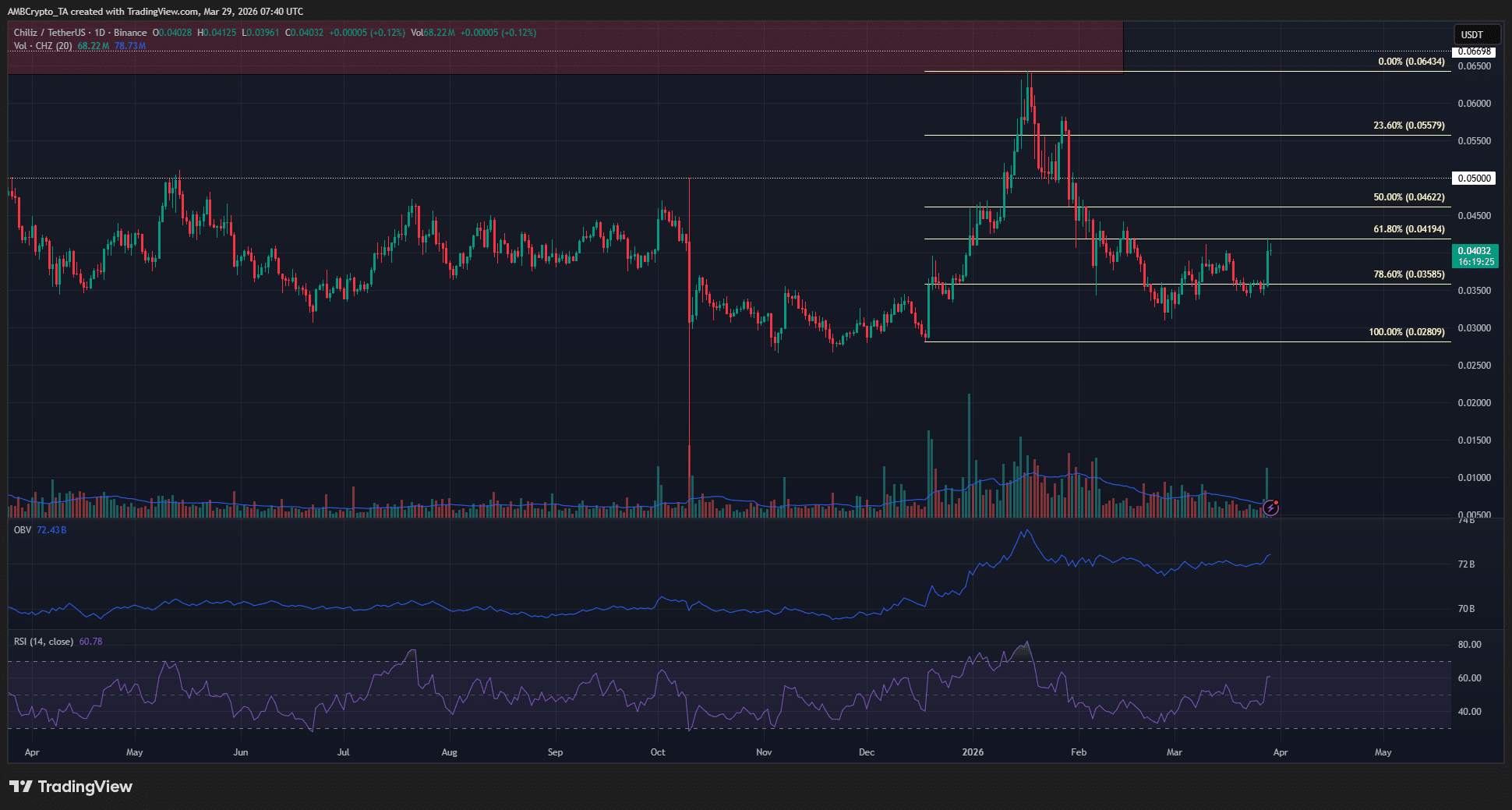
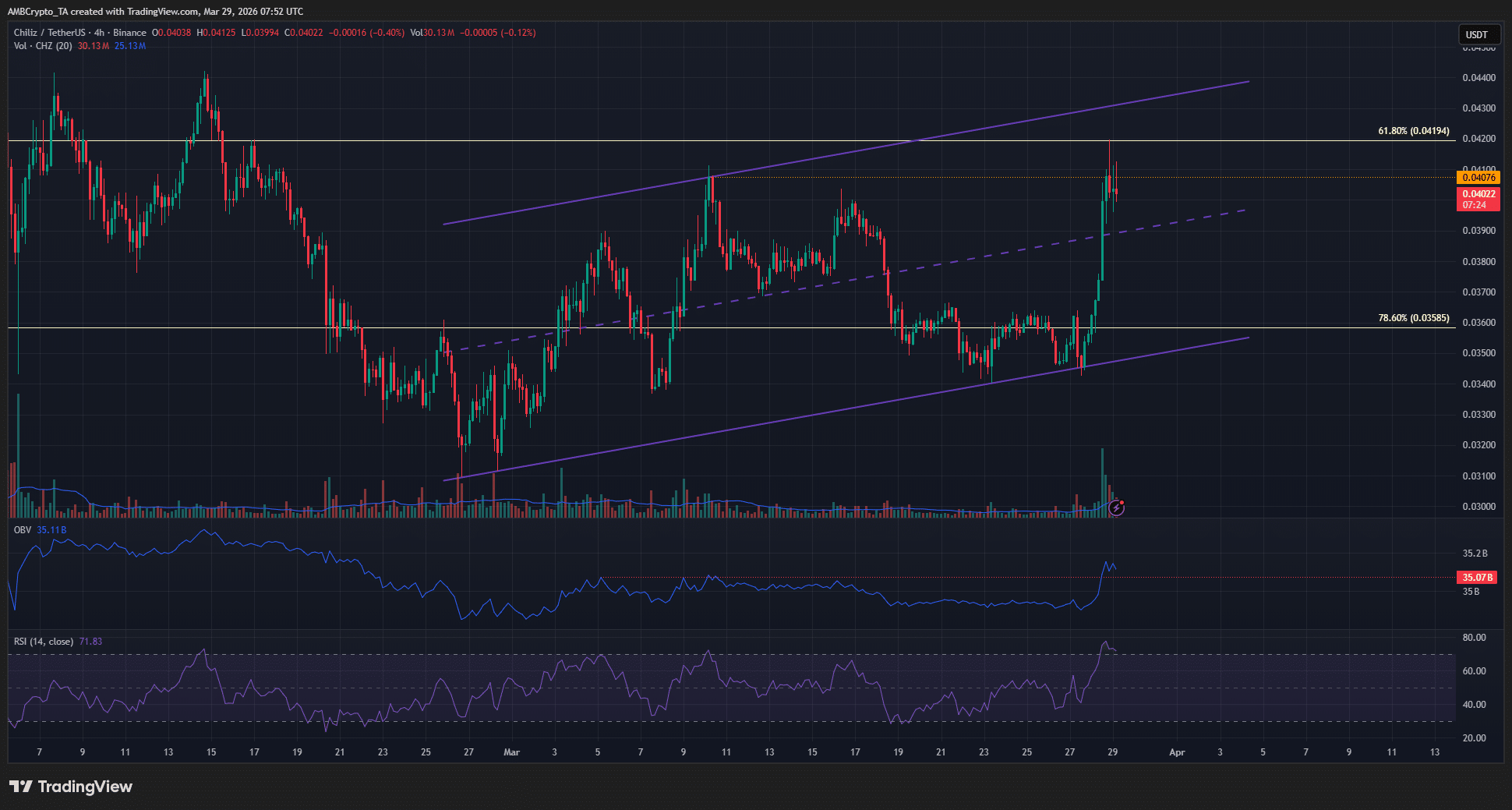
在过去的24小时内,Chiliz(CHZ)价格上涨了10.6%,日交易量激增160%。尽管通常3月29日的交易量和价格波动较为平淡,但此次放量上涨可能预示着接下来一周将出现强劲的上涨趋势。 从日线图来看,CHZ自年初以来的结构表现积极。在上涨至长期供应区0.055-0.065美元后,CHZ回撤至0.035美元水平,即今年早期涨幅的78.6%斐波那契回撤位。虽然该关键支撑位未立即引发看涨反应,但买家逐渐推动价格回升。 过去一个月,OBV(能量潮指标)逐渐上升,但交易量多数时间低于20日均值,RSI(相对强弱指数)也未能站稳50中性线上方。然而,过去24小时内,RSI升至60,OBV也因交易量激增而健康上涨。如果这一趋势持续,CHZ有望成为表现优异的资产,向0.065美元的高点回升。但受比特币悲观情绪和宏观经济担忧影响,其表现仍需观察。 尽管短期涨幅显著,CHZ多头未能突破3月早期的0.04美元局部高点。目前RSI已进入超买区域,且紫色上升通道的高点阻力位于0.043-0.045美元区间。因此,若价格突破0.04美元,该阻力可能抑制进一步反弹。 建议已持有多头头寸的摆动交易者考虑获利了结,错过上涨的投资者可等待价格回撤至0.034-0.036美元后再考虑做多。 总结: - CHZ的24小时上涨强化了其长期看涨结构。 - 未来几天,0.04美元和0.043-0.045美元可能成为阻力位,若突破并回测成功,或构成买入机会。

Chiliz(CHZ)在过去24小时内上涨10.6%,日交易量飙升160%。

3月29日出现的放量上涨(通常在交易量和价格波动平淡的时期发生)表明未来一周可能出现强劲上涨趋势。

来源:TradingView上的CHZ/USDT

从日线图来看,CHZ自年初以来展现的结构相当令人鼓舞。在上涨至0.055-0.美元65的长期供应区后,CHZ已回调至0.035美元水平。

这是基于今年早些时候冲动行情的78.6%斐波那契回撤位。对这一关键支撑位的重新测试并未立即引发看涨反应。

随着时间的推移,买家再次推动价格上涨。

过去一个月OBV(能量潮指标)持续走高,但存在一个隐患:大部分时间交易量都低于20日均值。同时,RSI(相对强弱指数)在过去六周也未能稳定在50中性线上方。

这一情况在过去24小时内发生改变。RSI达到60,交易量激增推动OBV健康上涨。

若能持续,CHZ在向0.065美元摆动高点回升的过程中可能成为表现优异的资产之一。鉴于比特币(BTC)极度悲观的市场情绪和令人担忧的宏观经济环境,Chiliz能否表现出色仍有待观察。

交易者行动指南——切勿盲目追涨

来源:TradingView上的CHZ/USDT

尽管过去24小时快速上涨,CHZ多头仍未能收复3月初设定的0.04美元局部高点。尽管出现回调,OBV已突破局部高点,RSI也进入超买区域。

目前已形成上升通道(紫色),其高点位于0.043-0.045美元区间。因此若CHZ突破0.04美元,该通道上轨将阻碍其进一步上涨。

已持有多头头寸的摆动交易者可考虑获利了结。错过本轮行情的交易者可等待价格回调至0.034-0.036美元区间后再考虑做多。


最终总结

  • CHZ过去24小时的上涨强化了该代币的长期看涨结构
  • 未来几日,0.04美元及0.043-0.045美元区间可能会阻止价格进一步上涨。若突破并成功回测该区间,可能构成买入机会

Trending Cryptos

Related Questions

QChiliz (CHZ) 在过去24小时内的涨幅和交易量增长分别是多少?

AChiliz (CHZ) 在过去24小时内上涨了10.6%,其日交易量飙升了160%。

Q根据文章,CHZ的长期供应区位于哪个价格区间?

ACHZ的长期供应区位于0.055美元至0.065美元的价格区间。

Q文章中提到CHZ的哪个关键技术指标突破了中性水平?

A相对强弱指数(RSI)在过去的24小时内突破了中性50水平,达到了60。

Q对于错过这波上涨的投资者,文章建议在什么价格区间考虑做多?

A文章建议错过上涨的投资者可以等待价格回调至0.034美元至0.036美元区间后再考虑做多。

Q文章指出CHZ如果突破并重新测试哪个价格区间,可能是一个买入机会?

A如果CHZ能够突破并重新测试0.043美元至0.045美元的价格区间,这可能是一个买入机会。

Related Reads

UNI Doubles in Two Months Against the Trend: A 5-Year-Overdue Value Realization

Amidst a generally stagnant crypto market in June and July, UNI, the governance token of Uniswap, saw a significant surge, nearly doubling in price from around $2.3 to $4.6. This rally represents a delayed but significant value reassessment, triggered by the practical implementation of its long-debated "fee switch" mechanism. The key turning point was the on-chain execution of the UNIfication proposal in December 2025. It activated a protocol fee on select pools, directed Unichain sequencer revenue (net of costs) to a communal treasury, executed a one-time burn of 100 million UNI, and established a system where all protocol revenue flows into a "TokenJar" contract. This treasury has a single exit: purchasing and permanently burning UNI via a "Firepit" contract. Initially, the market reacted tepidly as the generated revenue and corresponding burn rate were modest. The narrative shifted dramatically in July 2025 with two major developments. First, the launch of Robinhood Chain, tailored for tokenized stocks, rapidly became a primary source of volume and fees for Uniswap, at one point contributing nearly half of its weekly fees. Second, governance votes successfully expanded the fee mechanism to v4 pools and initiated a temperature check for fees on Robinhood Chain. The activation of v4 fees caused the protocol's daily revenue earmarked for UNI burns to nearly triple. The core of UNI's recent price action is the transition from a pure governance token to a cash-flow asset with a permanent, protocol-funded buyer. Its effectiveness is amplified by UNI's mature and widely distributed supply, with no major impending unlocks to dilute the impact of the buybacks. The sustainability of this rally now hinges on whether the transaction volume, particularly on Robinhood Chain, persists after its initial gas subsidies expire, determining if this is a genuine value realization or a subsidy-fueled spike.

marsbit25m ago
UNI Doubles in Two Months Against the Trend: A 5-Year-Overdue Value Realization

marsbit25m ago

Breaking: Google Earth Urgently Pulls Back Nano Banana 2 Image Generation Feature!

Google Earth's newly launched "Create image" feature, powered by the Nano Banana 2 AI image generation model, was abruptly withdrawn shortly after its release due to being "played" by users. The feature allowed users to generate and overlay AI-created visuals directly onto real-world satellite and 3D maps in Google Earth. The tool enabled creative applications like historical recreations (e.g., visualizing ancient Pompeii), generating informational graphics for landmarks, and envisioning architectural projects or futuristic cityscapes on real terrain. It operated under "geospatial grounding," meaning the AI respected the underlying geography, topography, and perspective of the chosen map view. The model also integrated with Gemini to retrieve relevant factual information. However, upon release, users quickly tested its limits. A prominent example involved reimagining Philadelphia's historic Independence Hall as a post-apocalyptic ruin overrun by "happy" zombies, evil clowns, and giant alien mechs. This highlighted both the feature's playful potential and its risks regarding the generation of inappropriate or misleading content on realistic maps, leading to its swift temporary removal. Google stated it would re-release the feature after implementing "enhanced guardrails." Analysts note this move strategically leverages Google's vast proprietary geospatial data, positioning its AI not just for artistic generation but for spatially accurate world visualization—a unique advantage in the competitive AI image generation landscape.

marsbit2h ago

Breaking: Google Earth Urgently Pulls Back Nano Banana 2 Image Generation Feature!

marsbit2h ago

Altman Admits: Overestimated AI Snatching Jobs! Huang Renxun: The Unemployment Narrative Is Completely Backwards

Sam Altman has revised his earlier predictions about AI rapidly replacing jobs, admitting he overestimated the speed at which AI would eliminate entry-level white-collar roles. Speaking on the "Invest Like the Best" podcast, he stated that people do not truly want an AI CEO, as accountability and human connection remain critical. He found that individuals prefer interacting with people who can be held responsible for decisions. Similarly, NVIDIA's Jensen Huang argued that the narrative of AI destroying jobs is misguided. He distinguishes between tasks and jobs, noting that while AI can automate specific tasks, entire jobs—encompassing communication, judgment, coordination, and accountability—are not eliminated. He cited examples like radiologists and software engineers, where demand for these roles has increased as AI handles repetitive tasks, allowing for business expansion and the creation of more positions. Data from a University of Maryland and LinkUp study supports this, showing that U.S. job postings for new graduates have actually risen, countering the fear of vanishing entry-level roles. However, a significant shift is occurring: the traditional entry-level tasks that help newcomers gain experience are being automated, making initial career access more challenging. The key insight is that as AI takes over standardized tasks, the enduring value of human work shifts toward areas of responsibility, trust-building, and final decision-making—aspects that AI cannot replicate. The real "moat" for professionals lies in these irreplaceable human elements.

marsbit2h ago

Altman Admits: Overestimated AI Snatching Jobs! Huang Renxun: The Unemployment Narrative Is Completely Backwards

marsbit2h ago

Weekly Editor's Picks (0725-0731)

Weekly Editor's Picks (0725-0731) provides a curated selection of deep analysis, filtering out market noise. Key themes from this week include: **Macro & Policy:** The Federal Reserve's upcoming meeting is marked by high uncertainty, balancing cooling inflation data against persistent price pressures. Meanwhile, the U.S. crypto regulatory Clarity Act faces critical political hurdles, with its 2026 passage probability seen as low. **Investing & Crypto:** Analysis suggests long-term crypto success depends on conviction through volatile cycles, focusing on assets like Bitcoin and core smart contract platforms. A trend noted is the increasing similarity between global equity markets (especially tech) and crypto, driven by narrative and leverage. Several major crypto protocols show strong revenue growth, but this isn't always translating to token price appreciation due to sell pressure and structural factors. **AI & Semiconductors:** Nvidia's rising credit default swap rates signal market concern over AI infrastructure financing risks. The storage sector experienced volatility as markets began pricing in potential 2027 oversupply. Despite a record profitable quarter, SK Hynix's results were deemed "below expectations," reflecting heightened investor demands for future growth visibility. **Markets & DeFi:** TradeXYZ demonstrated remarkable accuracy in pre-market pricing for a major A股 listing. The token ONDO saw gains, linked to its growing role in the on-chain tokenized stock ecosystem. **Ethereum:** Post-Pectra upgrade, a major structural shift is underway as Lido begins migrating millions of ETH to new validator architectures designed for capital efficiency. **Also Highlighted:** Butian's bullish stock market move; OpenAI's Altman promising major advances; Samsung and SK Hynix securing large AI chip deals; Apple reaching a $5T market cap; and ongoing discussions around exchange security following Poolin's bankruptcy case.

marsbit2h ago

Weekly Editor's Picks (0725-0731)

marsbit2h ago

Trading

Spot

Hot Articles

Discussions

Welcome to the HTX Community. Here, you can stay informed about the latest platform developments and gain access to professional market insights. Users' opinions on the price of S (S) are presented below.

活动图片