Pourquoi Morgan Stanley considère les titres tokenisés comme une 'évolution naturelle' à partir du second semestre 2026

ambcryptoPublished on 2026-03-25Last updated on 2026-03-25

Abstract

Morgan Stanley prévoit de lancer le support pour les titres tokenisés au second semestre 2026, en adaptant sa plateforme de trading Trajectory Cross, qui prend déjà en charge les actions traditionnelles, les ETF et les ADR. La banque d'investissement, qui gère 8 200 milliards de dollars d'actifs, considère cela comme une évolution naturelle de son infrastructure. Elle fait partie des grandes institutions financières, aux côtés de places boursières comme le NYSE et Nasdaq, qui se préparent à l'essor de la tokenisation. Ce secteur a enregistré une croissance de 245 % sur un an, avec un volume mensuel atteignant 2,5 milliards de dollars, soulignant son adoption massive et son potentiel pour améliorer l'efficacité opérationnelle et élargir l'accès aux marchés globaux.

La course institutionnelle aux titres tokenisés s'intensifie. Les bourses traditionnelles telles que le New York Stock Exchange (NYSE) et Nasdaq s'associent à des entreprises technologiques pour construire des systèmes dédiés aux titres tokenisés.

Les banques d'investissement se préparent également. Selon la responsable crypto de Morgan Stanley, Amy Oldenburg, la banque de gestion de patrimoine et d'investissement mondiale déploiera son support pour les titres tokenisés au second semestre 2026.

En marge du Digital Asset Summit de Blockworks, Oldenburg a déclaré,

L'une des choses que nous prévoyons pour la seconde moitié de 2026 est de faire évoluer notre Trajectory Cross, notre dark pool, pour qu'il prenne en charge les titres tokenisés plus tard cette année.

Elle a ajouté :

Il prend déjà en charge les actions traditionnelles, les ETF et les ADR. C'est donc une évolution naturelle d'ouvrir notre infrastructure pour supporter les actions tokenisées à l'avenir.

Décryptage du pari crypto et tokenisation de Morgan Stanley

Morgan Stanley fait partie des quatre grands courtiers (wirehouses), aux côtés de Merrill Lynch (Bank of America), UBS et Wells Fargo, qui permettent à leurs clients fortunés d'investir dans la crypto. Ensemble, ces sociétés gèrent environ 15 à 17 billions de dollars d'actifs clients, Morgan Stanley arrivant en tête avec 8,2 billions de dollars.

En conséquence, elles ont été perçues comme les moteurs clés de la 'deuxième vague' d'adoption des ETF Bitcoin. Fait intéressant, cette feuille de route se concrétise déjà.

Fin 2025, Morgan Stanley est devenue le premier courtier à autoriser ses conseillers à proposer activement les ETF spot BTC et ETH à tous les clients de gestion de patrimoine, y compris ceux gérant des comptes de retraite. Il s'agissait d'une extension de son accès restreint antérieur aux ETF crypto, qui était limité aux particuliers fortunés en août 2024.

Néanmoins, l'accès au spot crypto était inclus dans la plateforme E·TRADE de Morgan Stanley pour trader des actions, des obligations, des ETF, et plus encore. Par le biais de son unité de gestion d'actifs, le courtier a déposé une demande pour un ETF spot BTC interne, et les observateurs du marché estiment qu'il pourrait renverser la demande au détriment de l'IBIT de BlackRock. Désormais, elle parie sur le prochain récit de marché en vogue : la tokenisation.

Comme mentionné précédemment, Nasdaq et NYSE préparent le terrain pour le trading de titres tokenisés. Pour les acteurs de la finance traditionnelle (tradFi), la tokenisation améliore l'efficacité opérationnelle et permet un marché mondial élargi qui trade 24h/24 et 7j/7.

Le segment a déjà explosé pour atteindre une valeur totale d'un milliard de dollars, avec une croissance de 45% du volume mensuel des transferts pour atteindre 2,5 milliards de dollars, soulignant l'adoption massive dans ce sous-secteur. En fait, en mars, l'IA et les actifs tokenisés étaient les secteurs les plus performants et la plupart des segments ayant connu une adoption significative.
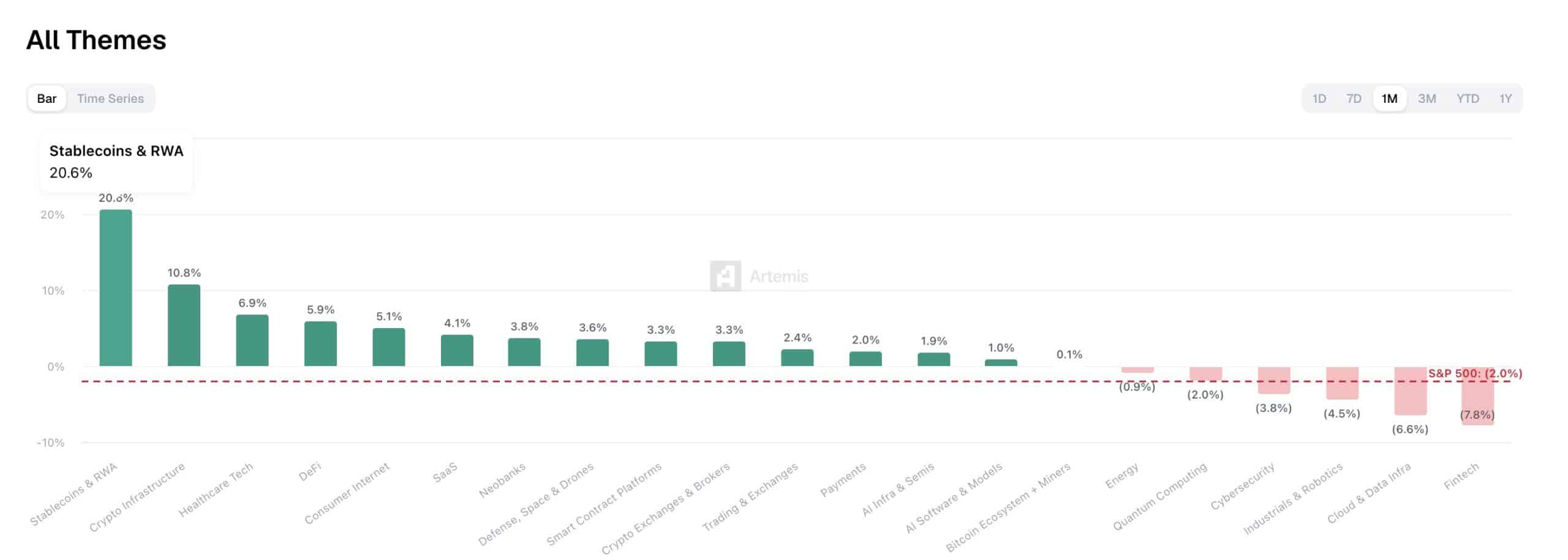
Source : Artemis

Soulignant la traction croissante, Grayscale a noté,

La croissance de l'activité de tokenisation est restée robuste. Les actifs tokenisés ont atteint de nouveaux sommets, en hausse de 245 % sur un an. Les stablecoins ont progressé de 35 %.


Résumé final

  • Morgan Stanley parie désormais sur les titres tokenisés, avec un support de trading probable attendu plus tard cette année.
  • Les actifs tokenisés ont connu l'un des taux de croissance les plus élevés du marché crypto, avec une adoption en hausse de 245 % sur un an.


Trending Cryptos

Related Questions

QQuand Morgan Stanley prévoit-il de lancer le support pour les titres tokenisés ?

AMorgan Stanley prévoit de lancer le support pour les titres tokenisés au second semestre 2026.

QQuel est la plateforme de Morgan Stanley qui sera adaptée pour supporter les titres tokenisés ?

ALa plateforme de Morgan Stanley qui sera adaptée est Trajectory Cross, son dark pool.

QQuels sont les avantages de la tokenisation pour les acteurs de la finance traditionnelle (tradFi) ?

APour les acteurs de la finance traditionnelle, la tokenisation améliore l'efficacité opérationnelle et permet d'accéder à un marché mondial élargi qui fonctionne 24h/24 et 7j/7.

QQuelle a été la croissance en pourcentage des actifs tokenisés sur une année, selon Grayscale ?

ASelon Grayscale, les actifs tokenisés ont connu une croissance de 245% sur un an.

QQuelle est la valeur totale du marché des titres tokenisés et son volume de transfert mensuel mentionnés dans l'article ?

ALe segment des titres tokenisés a atteint une valeur totale de 1 milliard de dollars, avec un volume de transfert mensuel en croissance de 45% pour atteindre 2,5 milliards de dollars.

Related Reads

Weekly Editor's Picks (0725-0731)

Weekly Editor's Picks (0725-0731) provides a curated selection of deep analysis, filtering out market noise. Key themes from this week include: **Macro & Policy:** The Federal Reserve's upcoming meeting is marked by high uncertainty, balancing cooling inflation data against persistent price pressures. Meanwhile, the U.S. crypto regulatory Clarity Act faces critical political hurdles, with its 2026 passage probability seen as low. **Investing & Crypto:** Analysis suggests long-term crypto success depends on conviction through volatile cycles, focusing on assets like Bitcoin and core smart contract platforms. A trend noted is the increasing similarity between global equity markets (especially tech) and crypto, driven by narrative and leverage. Several major crypto protocols show strong revenue growth, but this isn't always translating to token price appreciation due to sell pressure and structural factors. **AI & Semiconductors:** Nvidia's rising credit default swap rates signal market concern over AI infrastructure financing risks. The storage sector experienced volatility as markets began pricing in potential 2027 oversupply. Despite a record profitable quarter, SK Hynix's results were deemed "below expectations," reflecting heightened investor demands for future growth visibility. **Markets & DeFi:** TradeXYZ demonstrated remarkable accuracy in pre-market pricing for a major A股 listing. The token ONDO saw gains, linked to its growing role in the on-chain tokenized stock ecosystem. **Ethereum:** Post-Pectra upgrade, a major structural shift is underway as Lido begins migrating millions of ETH to new validator architectures designed for capital efficiency. **Also Highlighted:** Butian's bullish stock market move; OpenAI's Altman promising major advances; Samsung and SK Hynix securing large AI chip deals; Apple reaching a $5T market cap; and ongoing discussions around exchange security following Poolin's bankruptcy case.

marsbit19m ago

Weekly Editor's Picks (0725-0731)

marsbit19m ago

Low Investment Isn't Apple's Immunity Pass

While Meta and Google face investor scrutiny over ballooning AI capital expenditures, Apple's minimal AI investment has paradoxically become a strength. Its market cap recently reclaimed the global top spot, surpassing $5 trillion. The irony is deep: Apple's own AI efforts have lagged, with "Apple Intelligence" delayed and core talent lost, forcing reliance on partners like Google Gemini and Alibaba's Qianwen. Its Q3 FY2026 (Q2 CY) earnings initially seemed stellar. Revenue hit $109.4B (up 16% YoY), with iPhone and Mac sales, growing 22% and 29% respectively, driving most of the growth. However, the stock fell over 8% post-earnings. The primary concern was a weaker Q4 revenue growth forecast of 9-11%, below expectations, due to looming supply chain constraints. Apple is feeling the indirect cost of the AI boom. Soaring memory and chip prices, fueled by massive data center investments from Microsoft, Amazon, and others, are forcing Apple to raise Mac and iPad prices significantly. The upcoming iPhone launch is also expected to see substantial price hikes. Despite avoiding heavy AI infrastructure spending—its capital expenditures are actually down 28%—Apple cannot escape the industry-wide supply and cost pressures. While Apple's operating cash flow remains robust, its substantial R&D spending (up 32% YoY) has yet to yield major AI breakthroughs. As Tim Cook prepares to step down as CEO, Apple faces a challenging transition: balancing its premium hardware success against the strategic and cost pressures of the AI era it has so far cautiously navigated.

marsbit1h ago

Low Investment Isn't Apple's Immunity Pass

marsbit1h ago

PA Graphics Explanation | One Chart to Understand the Major Web3 Events in August 2026

**PANews Crypto Calendar: Key Web3 Events in August 2026** PANews introduces its revamped crypto calendar, featuring comprehensive coverage, flexible filtering, and easy export options. The market in August will be shaped by multiple key events across macroeconomics, regulation, tokenomics, and project developments: * **Macro & Policy:** Key US economic data releases (July Non-Farm Payrolls, CPI), the Federal Reserve meeting minutes, and the Jackson Hole Economic Symposium will be in focus. On the regulatory front, the US Senate plans to release a new draft of the *CLARITY Act*, while the EU's expanded crypto ban against Belarus comes into effect. * **Token Unlocks:** Significant token unlocks are scheduled for assets including ENA, AVAX, CONX, ZRO, and KAITO, which may influence market volatility. * **Project Updates & Shutdowns:** Several services, including Exchange Art, Ctrl Wallet, Zapper, NFTfi, and Summer.fi, are set to cease operations or undergo major adjustments. Users are advised to manage their assets accordingly. * **Corporate Activity:** Q2 earnings reports from companies like SpaceX, Circle, and Nvidia are due. Unitree Robotics will initiate its IPO subscription on the STAR Market, and Moonshot AI plans to begin a Pre-IPO financing round. * **Industry Events:** Major conferences such as Bitcoin Asia 2026 and the 2026 Digital Expo will take place. The overarching market narrative for August will revolve around macroeconomic expectations, regulatory developments, token unlock schedules, and ongoing industry consolidation.

marsbit1h ago

PA Graphics Explanation | One Chart to Understand the Major Web3 Events in August 2026

marsbit1h ago

Wall Street's Most Famous 'Cassandra' Now Has His Sights Set on Nvidia

Michael Burry, the famed "Big Short" investor, has once again captured Wall Street's attention with a series of short positions against major tech and semiconductor stocks, most notably Nvidia. In late June and July, through his "Cassandra Unchained" newsletter, Burry disclosed short bets against Nvidia, Tesla, Applied Materials, Caterpillar, the SOXX semiconductor ETF, and later, Micron Technology. His core thesis revolves around potential distortions in the AI infrastructure boom, specifically questioning whether extended depreciation schedules (e.g., 6 years vs. a realistic 2-3 years for AI chips) by cloud giants like Microsoft and Google artificially inflate profits. He also raises concerns about possible "off-balance-sheet circular financing," where chip demand might be propped up by vendor-backed funding to clients. Nvidia's stock experienced volatility following these disclosures, briefly dipping but largely holding near Burry's reported entry points, leaving his positions roughly flat or slightly underwater as of late July. This move is part of a pattern for Burry, whose track record since his legendary 2008 bet is mixed. He has faced notable losses, such as on Tesla in 2021, while scoring on broader market turns like the 2020 pandemic crash. His methodology focuses intensely on free cash flow and scrutinizing original financial documents to spot overvaluation and structural risks, but it often struggles with timing the market. The article contrasts Burry's stance with other prominent investors. Steve Eisman, another "Big Short" figure, is not shorting Nvidia, citing strong fundamentals but expressing nervousness about sustainability. Jim Chanos agrees with the broad "accounting mismatch" concern—comparing it to the dot-com bubble—but targets financial leverage in private equity firms rather than the chip stocks themselves. While Nvidia's short interest remains relatively low at 1.3-1.4% of float, the massive stock size means absolute short losses have been significant, exceeding $5 billion earlier this year. The piece concludes that for ordinary investors, the key takeaway is not replicating specific short bets but learning from the critical frameworks these investors use: questioning rosy accounting, identifying structural vulnerabilities, and maintaining skepticism during market euphoria, even if pinpointing the exact catalyst for a downturn remains elusive.

marsbit1h ago

Wall Street's Most Famous 'Cassandra' Now Has His Sights Set on Nvidia

marsbit1h ago

Trading

Spot

Hot Articles

What Is RWA and How It Differs From STO?

Real World Assets, or RWA, means tokenizing physical assets, such as real estate, stocks, bonds, commodities, and artwork, through blockchain technology.

2.5k Total ViewsPublished 2023.07.26Updated 2024.02.06

What Is RWA and How It Differs From STO?

How to Buy STO

Welcome to HTX.com! We've made purchasing StakeStone (STO) simple and convenient. Follow our step-by-step guide to embark on your crypto journey.Step 1: Create Your HTX AccountUse your email or phone number to sign up for a free account on HTX. Experience a hassle-free registration journey and unlock all features.Get My AccountStep 2: Go to Buy Crypto and Choose Your Payment MethodCredit/Debit Card: Use your Visa or Mastercard to buy StakeStone (STO) instantly.Balance: Use funds from your HTX account balance to trade seamlessly.Third Parties: We've added popular payment methods such as Google Pay and Apple Pay to enhance convenience.P2P: Trade directly with other users on HTX.Over-the-Counter (OTC): We offer tailor-made services and competitive exchange rates for traders.Step 3: Store Your StakeStone (STO)After purchasing your StakeStone (STO), store it in your HTX account. Alternatively, you can send it elsewhere via blockchain transfer or use it to trade other cryptocurrencies.Step 4: Trade StakeStone (STO)Easily trade StakeStone (STO) on HTX's spot market. Simply access your account, select your trading pair, execute your trades, and monitor in real-time. We offer a user-friendly experience for both beginners and seasoned traders.

5.5k Total ViewsPublished 2025.04.03Updated 2026.06.02

How to Buy STO

Discussions

Welcome to the HTX Community. Here, you can stay informed about the latest platform developments and gain access to professional market insights. Users' opinions on the price of STO (STO) are presented below.

活动图片