PIPPIN giảm 49% sau khi chuyển 560.000 USD vào sàn giao dịch gây ra đợt bán tháo

ambcryptoPublished on 2026-03-17Last updated on 2026-03-17

Abstract

PIPPIN đã ghi nhận mức giảm mạnh 49% trong phiên giao dịch gần nhất, dữ liệu on-chain cho thấy dòng tiền vào các sàn giao dịch có thể đã xảy ra ngay trước đợt bán tháo. Hai ví đã chuyển khoảng 560.000 USD token PIPPIN tới địa chỉ nạp tiền của sàn Gate.io vào khoảng 8:00 UTC, chỉ vài phút trước khi giá bắt đầu sụp đổ. Giá giảm từ vùng 0,35–0,40 USD xuống còn khoảng 0,19 USD, kích hoạt một đợt thanh lý các vị thế mua (long) và đẩy tỷ lệ funding (tài trợ) chuyển sang âm sâu. Sự đảo chiều đột ngột này cho thấy thị trường đã chuyển từ trạng thái kỳ vọng tăng giá sang áp đảo bởi các vị thế bán, một mô hình điển hình sau một đợt bán tháo. Triển vọng thị trường hiện chia làm hai hướng: sự yếu kém có thể tiếp diễn nếu dòng tiền vào sàn phản ánh một đợt phân phối rộng hơn, hoặc việc định vị bán khống đông đảo có thể tạo điều kiện cho một đợt phục hồi ngắn hạn nếu lực mua quay trở lại.

PIPPIN ghi nhận mức giảm mạnh 49% trong phiên giao dịch mới nhất, với dữ liệu on-chain cho thấy dòng tiền vào các sàn giao dịch có thể đã xảy ra trước động thái này.

Đợt giảm đã đẩy token từ vùng $0.35–$0.40 xuống còn khoảng $0.19, đánh dấu một trong những khoản lỗ nặng nhất trong một phiên gần đây.

Dữ liệu từ Bubblemaps cho thấy hai ví đã chuyển khoảng 560.000 USD bằng PIPPIN đến các địa chỉ gửi tiền. Sau đó, các địa chỉ này chuyển tiếp token đến Gate.io vào khoảng 8:00 UTC, chỉ vài phút trước khi đợt sụp đổ giá bắt đầu.

Các giao dịch chuyển ví xảy ra trước đợt bán tháo

Theo Bubblemaps, các giao dịch chuyển khoản xảy ra trong vòng vài phút, với cả hai ví đều gửi tiền đến các địa chỉ gửi tiền được liên kết với sàn giao dịch ngay trước khi giá giảm.

Mặc dù dữ liệu không xác nhận ý định, nhưng thời điểm cho thấy token đã được chuyển đến các sàn giao dịch trước khi áp lực bán gia tăng.

Trong thị trường crypto, những dòng tiền vào như vậy thường được theo dõi như các chỉ báo tiềm năng của phân phối, đặc biệt là khi sau đó có các biến động giá mạnh.

Đợt sụp đổ giá kích hoạt vòng xoáy thanh lý

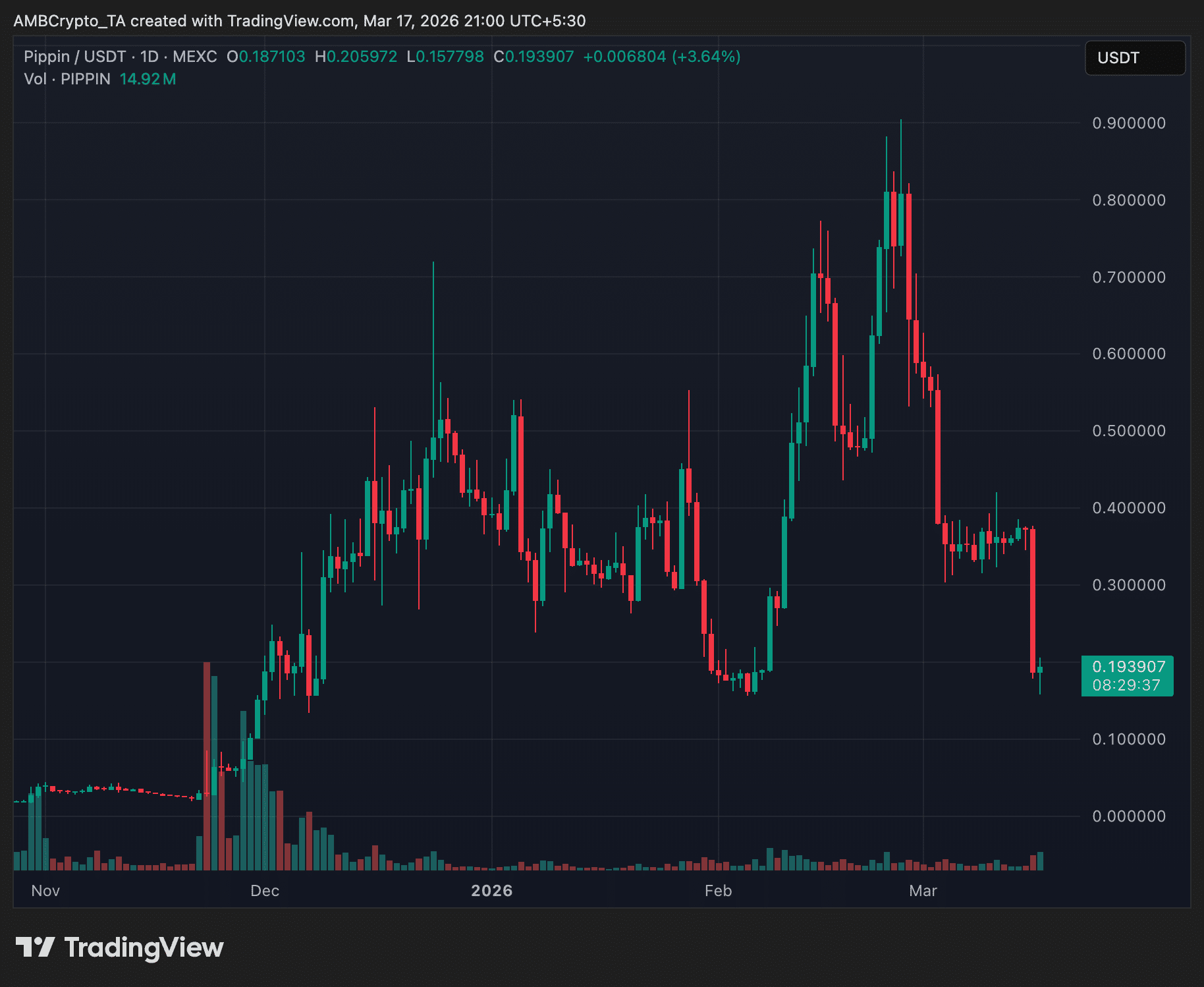
Biểu đồ giá cho thấy một sự mất cấu trúc rõ ràng trước khi đợt giảm tốc. Sau khi không giữ được mức hợp nhất $0.30, PIPPIN đã giảm mạnh với động lượng mạnh, kèm theo mức tăng đột biến rõ rệt về khối lượng giao dịch.
Nguồn: TradingView

Động thái này đẩy nhanh các khoản lỗ, xóa sổ các khoản lãi gần đây và đẩy token quay trở lại các mức giá lần cuối được thấy trong phạm vi giao dịch của nó. Tốc độ giảm cho thấy việc bán ép buộc và các khoản thanh lý dây chuyền, thay vì chốt lời dần dần.

Funding đảo chiều khi các lệnh long bị xóa sổ

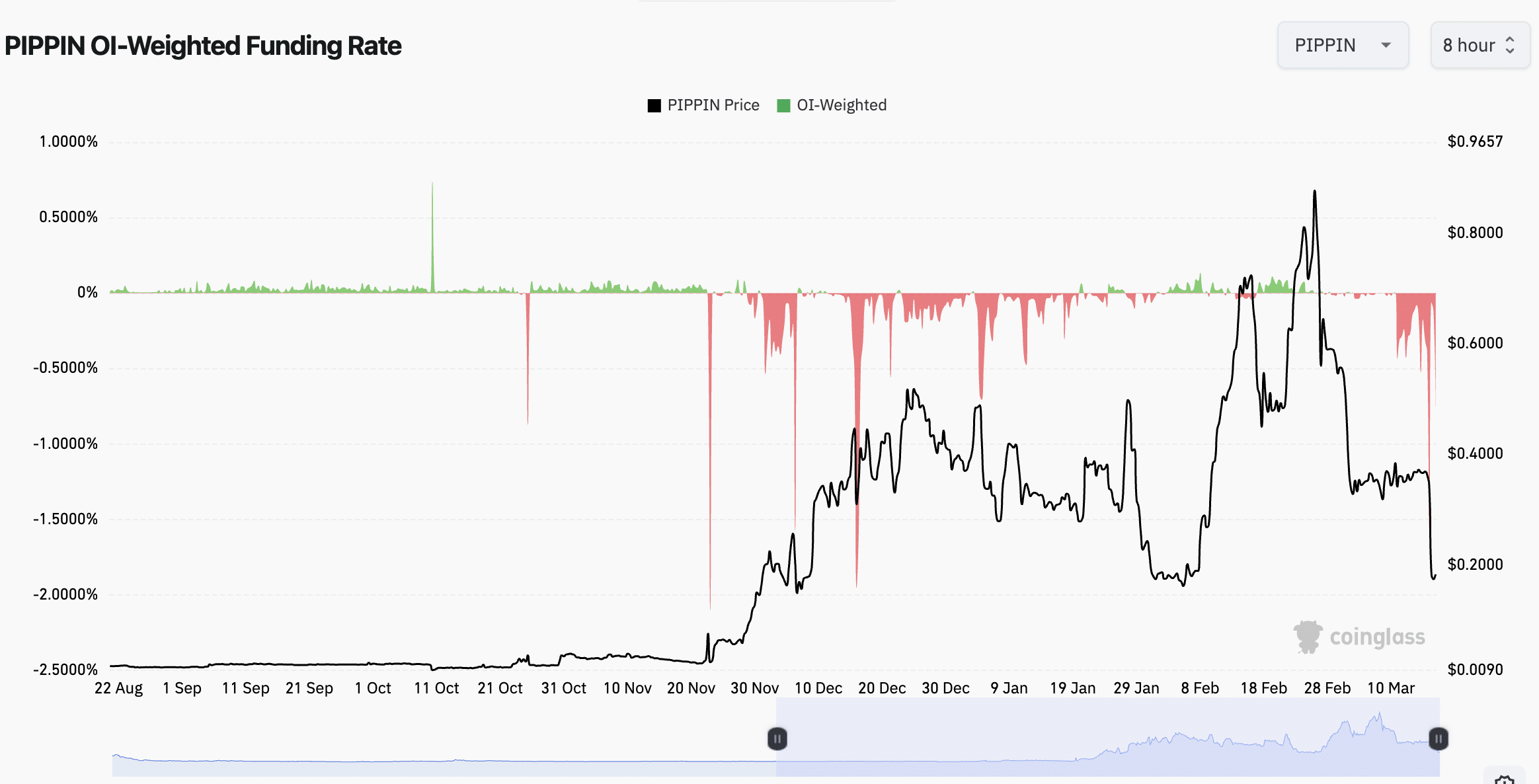
Dữ liệu phái sinh củng cố câu chuyện thanh lý. Tỷ lệ funding theo trọng số OI (Open Interest) đã lật sang âm sâu sau đợt giảm. Tính đến thời điểm viết bài, tỷ lệ funding là -0.8, một sự cải thiện so với –1.5 trong phiên giao dịch trước.

Điều này cho thấy các vị thế mua (long) đã bị đóng hoặc thanh lý một cách mạnh mẽ trong đợt biến động.
Nguồn: Coinglass

Trước đó trong chu kỳ, funding vẫn tương đối ổn định hoặc hơi dương, cho thấy thị trường đã được định vị cho xu hướng tăng. Sự đảo chiều đột ngột làm nổi bật sự chuyển dịch từ các vị thế mua (long) đông đảo sang sự thống trị của vị thế bán (short), một mô hình điển hình sau một đợt bóp méo lệnh mua.

Điều gì tiếp theo cho PIPPIN?

Với funding giờ đây ở mức âm và giá thấp hơn đáng kể, thị trường đối mặt với một triển vọng chia rẽ.

Một mặt, sự yếu kém tiếp tục có thể xảy ra nếu dòng tiền vào sàn phản ánh một đợt phân phối rộng hơn. Mặt khác, việc định vị bán (short) đông đảo có thể tạo ra điều kiện cho một đợt phục hồi ngắn hạn nếu sự quan tâm mua hàng trở lại.

Hiện tại, hành động giá của PIPPIN dường như được thúc đẩy bởi sự kết hợp của dòng chảy on-chain, áp lực bán spot và các khoản thanh lý phái sinh, với động thái mới nhất nhấn mạnh sự thay đổi tâm lý có thể nhanh chóng như thế nào trong môi trường thanh khoản thấp.


Tóm tắt cuối cùng

  • Đợt giảm 49% của PIPPIN xảy ra sau khi 560.000 USD token được chuyển đến các sàn giao dịch, với thời điểm cho thấy dòng tiền vào có thể đã xảy ra trước đợt bán tháo.
  • Động thái này đã kích hoạt các khoản thanh lý lệnh mua (long) và lật funding sang âm, khiến thị trường nghiêng về phe bán (short) trong ngắn hạn.


Related Questions

QPIPPIN đã giảm bao nhiêu phần trăm trong phiên giao dịch mới nhất?

APIPPIN đã ghi nhận mức giảm mạnh 49% trong phiên giao dịch mới nhất.

QKhoảng tiền trị giá bao nhiêu đã được chuyển đến các sàn giao dịch trước khi giá giảm?

AHai ví đã chuyển khoảng 560.000 đô la token PIPPIN đến các địa chỉ nạp tiền của sàn giao dịch.

QSàn giao dịch nào đã nhận lượng token được chuyển đến?

ACác token đã được định tuyến đến sàn giao dịch Gate.io vào khoảng 8:00 UTC.

QTỷ lệ funding thay đổi như thế nào sau đợt bán tháo?

ATỷ lệ funding được tính theo trọng số OI đã chuyển sang âm sâu, ở mức -0.8 vào thời điểm bài viết, so với mức -1.5 trong phiên giao dịch trước đó, cho thấy các vị thế mua (long) đã bị đóng hoặc thanh lý mạnh.

QNguyên nhân chính nào được cho là dẫn đến đợt sụt giảm giá mạnh của PIPPIN?

ADữ liệu on-chain cho thấy dòng tiền chảy vào sàn giao dịch (exchange inflows) từ hai ví lớn có thể đã đi trước và kích hoạt đợt bán tháo, dẫn đến việc giá mất cấu trúc và kích hoạt một chuỗi thanh lý (liquidation cascade).

Related Reads

OpenAI's Hyperliquid Pre-IPO Pricing Venture: Why Did It Last Only Half a Year?

The article discusses the rise and fall of Pre-IPO pricing markets on the Hyperliquid blockchain. Trade.xyz, an anonymous team, successfully built the largest pre-market for SpaceX (SPCX) by launching a contract with a clear anchor: the eventual Nasdaq listing price. This provided inherent price stability and validation. In contrast, Ventuals, a team backed by Paradigm, failed despite holding exclusive contracts for highly sought-after companies like OpenAI and Anthropic. Its key mistake was its pricing mechanism. For companies with no near-term IPO date, Ventuals' oracle relied partly on opaque private market transactions and, critically, partly on its own contract's moving average price. This created a self-referential feedback loop where prices were artificially propped up and detached from genuine supply and demand, leading to illiquid markets. Ventuals shut down after nine months, settling positions at final prices of $1,341.80 for OpenAI and $1,618.90 for Anthropic. Ironically, some employees and late-stage investors of these very companies reportedly used these flawed Ventuals prices for valuation reference, highlighting the acute demand for any price signal in illiquid private markets. The article concludes that while demand for pre-IPO trading is real and growing, with players like Coinbase now entering the space, the fundamental challenge remains: without a public listing to provide a definitive price anchor, these markets struggle to establish truly accurate and liquid pricing. The need for a transparent, self-correcting market is the critical lesson from Ventuals' failure.

marsbit5m ago

OpenAI's Hyperliquid Pre-IPO Pricing Venture: Why Did It Last Only Half a Year?

marsbit5m ago

With Daily Active Users Reaching 3-4 Times That of the Industry's Second Place, Which Crack in the Office Agent Market Has Tencent's WorkBuddy Torn Open?

Tencent's AI office assistant, WorkBuddy, has achieved daily active users (DAU) 3-4 times that of the industry's second-place product, primarily driven by non-technical users like HR, operations, and administrative staff. Its rapid growth, starting with a public beta in March 2026, highlights a key strategic divergence from competitors like OpenAI's Codex and Anthropic's Claude Code. Unlike those tools, which originated as developer-focused assistants (in command lines or IDEs) and are now expanding towards office scenarios, WorkBuddy was built from the ground up for non-technical office workers. Its development was user-driven, initiated after腾讯云's team observed non-technical employees using their CodeBuddy coding tool for general tasks. WorkBuddy's design is defined by three core decisions aimed at lowering barriers: 1) Using natural language instead of technical concepts, so users describe their goal without needing to understand prompts or agents. 2) Providing pre-packaged "Skill" templates for common office tasks like data processing, content creation, and research. 3) Natively integrating into existing腾讯 ecosystems like腾讯 Docs and WeChat, making the agent a seamless part of the user's workflow rather than a separate tool. This "scenario encapsulation" approach, prioritizing the shortest path for users to get work done, contrasts with the "underlying capability" focus of Codex and Claude, which offer more flexibility but require more technical setup. Analysts confirm WorkBuddy's leading market position in China by mid-2026, with massive user and request growth following its launch. Recognizing the same trend of surging non-technical adoption, OpenAI and Anthropic are now pivoting their products with features like role-based plugins (Codex) and a simplified desktop interface (Claude Cowork). However, adapting tools built for developers requires significant changes to interaction models and integrations. WorkBuddy currently holds an estimated six-month lead in delivering a complete solution for non-technical office users. Its recently launched enterprise version aims to solidify this advantage. The competition underscores two valid paths: embedding agent capabilities directly into familiar work environments versus building powerful, general-purpose agents that users must learn to access. WorkBuddy's early success demonstrates the effectiveness of the former strategy for mainstream office adoption.

marsbit13m ago

With Daily Active Users Reaching 3-4 Times That of the Industry's Second Place, Which Crack in the Office Agent Market Has Tencent's WorkBuddy Torn Open?

marsbit13m ago

Dalio's Latest Warning: Don't Get Carried Away by AI, Real Returns on US Stocks in the Next 5-10 Years Could Be -5% to -10%

Ray Dalio, founder of Bridgewater Associates, warns investors against excessive concentration in AI stocks. He argues the current market, dominated by a few AI giants, mirrors historical patterns where revolutionary new technologies lead to high risk, volatility, and uncertainty. While acknowledging AI's transformative potential, Dalio emphasizes that most investors fail at this stage of the cycle by over-concentrating in a handful of leading companies. He cites inherent risks: companies cannot accurately forecast investment needs or external shocks (e.g., monetary policy, geopolitics, taxes), face potential disruption from future technologies and international competition (notably from China), and experience significant price swings. Dalio's core advice is diversification, calling it his "Holy Grail of Investing." He presents a mathematical case that a well-diversified portfolio of 15-20 uncorrelated, good bets offers a superior risk-adjusted return compared to a concentrated position. Dalio also offers a cautious outlook, suggesting U.S. stocks may deliver real returns of -5% to -10% over the next 5-10 years based on valuation and bubble indicators. He concludes that in the face of high uncertainty, the prudent strategy is not to avoid betting entirely, but to avoid large, concentrated bets where one lacks sufficient informational edge. Instead, investors should build a strategically balanced, diversified portfolio.

marsbit1h ago

Dalio's Latest Warning: Don't Get Carried Away by AI, Real Returns on US Stocks in the Next 5-10 Years Could Be -5% to -10%

marsbit1h ago

Trading

Spot
Futures

Hot Articles

How to Buy PIPPIN

Welcome to HTX.com! We've made purchasing pippin (PIPPIN) simple and convenient. Follow our step-by-step guide to embark on your crypto journey.Step 1: Create Your HTX AccountUse your email or phone number to sign up for a free account on HTX. Experience a hassle-free registration journey and unlock all features.Get My AccountStep 2: Go to Buy Crypto and Choose Your Payment MethodCredit/Debit Card: Use your Visa or Mastercard to buy pippin (PIPPIN) instantly.Balance: Use funds from your HTX account balance to trade seamlessly.Third Parties: We've added popular payment methods such as Google Pay and Apple Pay to enhance convenience.P2P: Trade directly with other users on HTX.Over-the-Counter (OTC): We offer tailor-made services and competitive exchange rates for traders.Step 3: Store Your pippin (PIPPIN)After purchasing your pippin (PIPPIN), store it in your HTX account. Alternatively, you can send it elsewhere via blockchain transfer or use it to trade other cryptocurrencies.Step 4: Trade pippin (PIPPIN)Easily trade pippin (PIPPIN) on HTX's spot market. Simply access your account, select your trading pair, execute your trades, and monitor in real-time. We offer a user-friendly experience for both beginners and seasoned traders.

7.2k Total ViewsPublished 2025.01.11Updated 2026.06.02

How to Buy PIPPIN

Discussions

Welcome to the HTX Community. Here, you can stay informed about the latest platform developments and gain access to professional market insights. Users' opinions on the price of PIPPIN (PIPPIN) are presented below.

活动图片