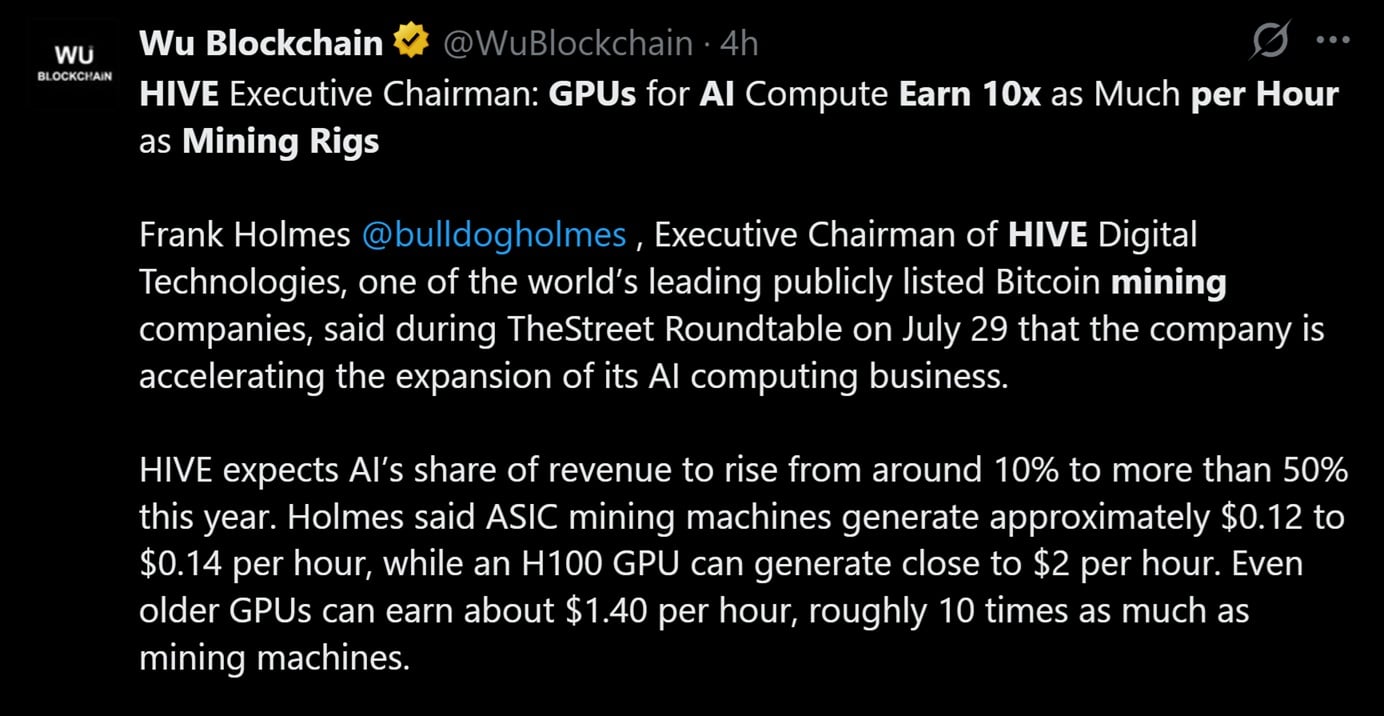
Holmes presented this comparison during the "Roundtable 100" series earlier this week, arguing that HIVE's pivot to artificial intelligence (AI) infrastructure has unlocked a revenue stream that significantly outperforms what the same hardware could generate from Bitcoin mining. A cluster of 504 Nvidia B200 GPUs operated by HIVE in Bell Canada's AI infrastructure in Manitoba brings in approximately $2.90 per GPU-hour, while HIVE's Bitcoin mining rigs generate about $0.12 per hour—a difference of more than 20 times for this specific metric.
This comparison underpins HIVE's strategy for the second half of the year, as outlined by Holmes: rather than viewing AI computing and Bitcoin mining as competing uses for the same power and hardware, the company is directing the majority of its infrastructure investments towards the higher-revenue business, while continuing its mining operations.
These mining operations remain significant, given that HIVE's average hashrate for fiscal year 2026 was 22.2 exahashes per second (EH/s), a 290% increase from the previous year, providing the company with approximately 3% of the total Bitcoin network hashrate. During the same period, the company mined 2,885 $BTC, more than double the 1,414 $BTC mined in fiscal 2025.
Diversified Balance
HIVE's total revenue for fiscal 2026 reached $297.8 million, a 158% increase from the previous year, with Bitcoin mining revenue growing by 164%. The company's new BUZZ HPC division, which focuses on AI and high-performance computing (HPC) segments, generated revenue of $19.5 million, a 94% increase from the $10 million recorded the year before.
The pivot to AI is not new for HIVE, considering that about three years ago the company made a $70 million bet on Nvidia chips—at a time when the majority of its GPU fleet was mining Ethereum until that network's transition to Proof-of-Stake eliminated GPU mining entirely. Holmes stated that this early bet, initially aimed at Ethereum mining, gave his company a head start when the boom in AI computing created new demand for the same hardware.
Since then, this infrastructure has gained recognition from external experts. For example, on July 27, Chardan Capital initiated coverage of HIVE's stock, assigning it a "Buy" rating and a $7.50 price target—the company's first-ever rating from a sell-side analyst. HIVE also signed a GPU cloud computing agreement worth approximately $220 million with Bell and AI startup Cohere, and raised $75 million through a bond offering, the proceeds of which will be used to further develop its AI infrastructure.
A More Ambitious Project: A 320 MW AI Center
HIVE's most ambitious project is a 320-megawatt (MW) AI data center under construction in the Greater Toronto Area, ultimately designed to house over 100,000 GPUs. The company stated that once fully operational in the second half of 2027, the facility is expected to generate approximately $360 million in annual recurring revenue.
However, HIVE is far from the only company on this path: competing mining firm MARA has also stated that AI computing generates more revenue per unit of electricity than Bitcoin mining and is therefore directing limited power resources to fulfill AI and HPC contracts. Similarly, Hut 8 signed an AI capacity lease in Texas worth about $9.8 billion, and Terawulf secured $12.8 billion in AI contracts—part of a broader shift among public mining companies amid shrinking Bitcoin mining margins and declining price per hash.
This margin pressure has been building throughout the year in the mining segment, as Bitcoin mining difficulty has adjusted 15 times this year alone, and mining economics have worsened further as more megawatts were redirected to serve AI and cloud computing customers rather than building new mining capacity.
HIVE's near-term goal is to increase its annual AI and HPC revenue tenfold from current levels by the end of the fiscal year; achieving this goal requires that the Toronto facility and further GPU cloud service contracts come online largely on schedule.