Les Bitcoiners Célèbrent le 'Genesis Day' Alors que la Dette Américaine Dépasse les 38 000 Milliards de Dollars

bitcoinistPublished on 2026-01-04Last updated on 2026-01-04

Abstract

Le 3 janvier 2026, la dette fédérale américaine a dépassé les 38 000 milliards de dollars, selon le Trésor américain. Cette augmentation rapide, passant de 34 000 milliards début 2024 à environ 38 500 milliards fin 2025, est attribuée aux déficits budgétaires persistants, aux paiements d'intérêts croissants et aux grandes lois de dépenses. Les analystes notent que la dette augmente d'environ 6 milliards de dollars par jour, ce qui alourdit le fardeau des intérêts et limite les options budgétaires futures. Le même jour, la communauté Bitcoin a célébré le "Genesis Day", marquant l'anniversaire du premier bloc miné en 2009. De nombreux partisans ont souligné le contraste entre la dette nationale croissante et l'offre limitée de Bitcoin, plafonnée à 21 millions de pièces. Certains considèrent les actifs rares comme Bitcoin comme une couverture contre les risques d'un endettement excessif. Les économistes mettent en garde contre les conséquences à long terme des déficits importants, qui pourraient augmenter les coûts d'emprunt et ralentir la croissance.

La dette fédérale américaine a dépassé les 38 000 milliards de dollars le 3 janvier 2026, selon le suivi du Trésor. Ce nouveau jalon a été atteint alors qu'une partie de la communauté cryptographique observait le Genesis Day, l'anniversaire du premier bloc de Bitcoin. Les rapports notent que le timing a attiré l'attention car il a mis en lumière les contrastes entre l'emprunt public et l'offre fixe de Bitcoin.

La Dette Atteint un Nouveau Sommet

Selon les chiffres du Trésor, la dette fédérale brute a grimpé au-dessus de 38 000 milliards de dollars le 3 janvier. La hausse a été forte au cours des deux dernières années, passant d'environ 34 000 milliards de dollars début 2024 à environ 36 000 milliards de dollars fin 2024, puis à 38 500 milliards de dollars fin 2025.

Les analystes ont calculé que la dette augmentait récemment d'environ 6 milliards de dollars par jour, un rythme qui pousse les coûts d'intérêt à la hausse et réduit les options pour les budgets futurs. Une partie de cette augmentation provient des déficits budgétaires continus où les dépenses dépassent les recettes.

Facteurs à l'Origine de la Flambée

Selon la couverture médiatique, plusieurs facteurs sont à l'origine de ce bond : des déficits annuels soutenus, l'augmentation des paiements d'intérêts sur la dette existante et les importantes lois de dépenses promulguées lors des récentes sessions du Congrès.

La dette détenue par le public et les montants dus aux fonds fiduciaires fédéraux constituent ensemble le chiffre principal. Les économistes avertissent qu'à mesure que la dette augmente par rapport à la taille de l'économie, davantage de dollars des contribuables seront nécessaires rien que pour servir les paiements d'intérêts, ce qui pourrait évincer d'autres priorités.
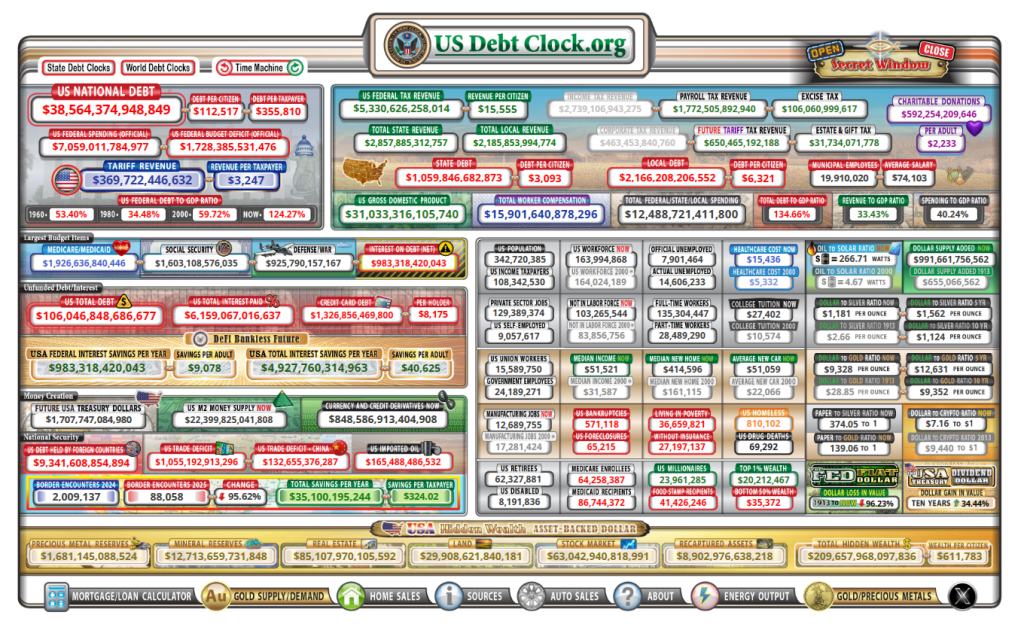
Un tableau de bord montrant la dette du gouvernement américain, désormais supérieure à 38 000 milliards de dollars et en hausse. Source : US Debt Clock

La Communauté Bitcoin Réagit

Le 3 janvier, de nombreux partisans de Bitcoin ont marqué le Genesis Day, une date qu'ils considèrent comme symbolique d'un changement financier lorsque le premier bloc de Bitcoin a été miné en 2009. Certains utilisateurs ont posté sur le contraste entre une dette nationale qui ne cesse de grimper et l'offre plafonnée de Bitcoin à 21 millions de pièces.

BTCUSD s'échange actuellement à 91 487 $. Graphique : TradingView

D'autres ont profité de cet anniversaire pour soulever des questions plus larges sur les règles budgétaires et la masse monétaire. Les réactions étaient mitigées ; certains y voient un avertissement, d'autres un moment de commémoration.

Les investisseurs et les commentateurs ont pesé les implications. Une partie du marché traite les actifs rares comme le Bitcoin et l'or comme des couvertures contre ce qu'ils perçoivent comme les risques d'un endettement élevé.

Dans le même temps, les économistes traditionnels mettent en garde contre le fait que des déficits importants et persistants peuvent augmenter les coûts d'emprunt et ralentir la croissance à long terme. Les responsables du Trésor surveillent de près les besoins de trésorerie et modifient parfois les calendriers d'emprunt pour combler les écarts entre les recettes et les dépenses.

Image vedette de Unsplash, graphique de TradingView

Related Questions

QQuel est le montant de la dette fédérale américaine atteint le 3 janvier 2026, selon l'article ?

ALa dette fédérale américaine a dépassé les 38 000 milliards de dollars le 3 janvier 2026.

QQu'est-ce que la communauté Bitcoin célèbre le 3 janvier, et pourquoi cette date est-elle significative ?

ALa communauté Bitcoin célèbre le 'Genesis Day' le 3 janvier, qui marque l'anniversaire du minage du premier bloc de Bitcoin (le bloc Genesis) en 2009. Cette date est symbolique car elle représente les origines d'un système financier alternatif.

QQuel titre de journal était intégré dans le premier bloc de Bitcoin, et quelle est sa signification ?

ALe titre de journal intégré était : 'Chancellor on brink of second bailout for banks' (Le Chancelier sur le point de procéder à un second renflouement des banques). Ce message ancre l'origine du Bitcoin comme une réponse à la crise financière et aux sauvetages bancaires.

QSelon les analystes, à quel rythme la dette américaine augmentait-elle récemment ?

ALes analystes ont calculé que la dette augmentait d'environ 6 milliards de dollars par jour récemment.

QComment une partie des investisseurs perçoivent-ils les actifs comme Bitcoin par rapport à la dette publique croissante ?

AUne partie des investisseurs considère les actifs rares comme le Bitcoin et l'or comme une couverture (hedge) contre les risques qu'ils perçoivent dans l'endettement important des États.

Related Reads

Pricing OpenAI Pre-IPO: A New, Life-or-Death Business on Hyperliquid Lasting Half a Year

Pricing OpenAI Pre-IPO: Hyperliquid's High-Stakes, Six-Month Business Venture The article analyzes the nascent market for pre-IPO perpetual contracts on the Hyperliquid blockchain, exemplified by two contrasting teams: Trade.xyz and Ventuals. Trade.xyz, an anonymous team, successfully built the largest pre-market on Hyperliquid. Its strategy focused on near-term events, like the SpaceX IPO. By listing a SpaceX contract with a known launch date and price, the market had a tangible "anchor" (the eventual Nasdaq opening price) to converge upon, which kept speculation in check. This approach fueled significant growth. In stark contrast, Ventuals, backed by Paradigm, failed despite holding coveted contracts for OpenAI and Anthropic. Its critical flaw was its pricing mechanism for these companies, which have no imminent IPO. Ventuals' oracle price was half-derived from infrequent private market transactions and half from its own contract's moving average. This created a self-reinforcing loop where buying pressure artificially inflated the price, disconnecting it from real supply and demand. The market became illiquid and structurally skewed. Ventuals shut down nine months after launch, reportedly through an acquisition. Its final settlement prices—OpenAI at ~$1,341 and Anthropic at ~$1,618—were thus partially products of its flawed model. Ironically, some company employees and late-stage VCs reportedly used these prices for valuation reference, highlighting the desperate demand for price discovery in opaque private markets. The failure of Ventuals exposes the core challenge of this business: price for illiquid, non-public assets requires a robust, self-correcting market, which is absent without a definitive public listing event. Nevertheless, demand is driving major players like Coinbase and traditional finance (e.g., Citi) to enter the space, aiming to provide 24/7 trading for coveted private company shares. The venture's ultimate viability, however, hinges on solving the fundamental pricing problem Ventuals could not.

marsbit1h ago

Pricing OpenAI Pre-IPO: A New, Life-or-Death Business on Hyperliquid Lasting Half a Year

marsbit1h ago

Trading

Spot
Futures

Hot Articles

What is $BITCOIN

DIGITAL GOLD ($BITCOIN): A Comprehensive Analysis Introduction to DIGITAL GOLD ($BITCOIN) DIGITAL GOLD ($BITCOIN) is a blockchain-based project operating on the Solana network, which aims to combine the characteristics of traditional precious metals with the innovation of decentralized technologies. While it shares a name with Bitcoin, often referred to as “digital gold” due to its perception as a store of value, DIGITAL GOLD is a separate token designed to create a unique ecosystem within the Web3 landscape. Its goal is to position itself as a viable alternative digital asset, although specifics regarding its applications and functionalities are still developing. What is DIGITAL GOLD ($BITCOIN)? DIGITAL GOLD ($BITCOIN) is a cryptocurrency token explicitly designed for use on the Solana blockchain. In contrast to Bitcoin, which provides a widely recognized value storage role, this token appears to focus on broader applications and characteristics. Notable aspects include: Blockchain Infrastructure: The token is built on the Solana blockchain, known for its capacity to handle high-speed and low-cost transactions. Supply Dynamics: DIGITAL GOLD has a maximum supply capped at 100 quadrillion tokens (100P $BITCOIN), although details regarding its circulating supply are currently undisclosed. Utility: While precise functionalities are not explicitly outlined, there are indications that the token could be utilized for various applications, potentially involving decentralized applications (dApps) or asset tokenization strategies. Who is the Creator of DIGITAL GOLD ($BITCOIN)? At present, the identity of the creators and development team behind DIGITAL GOLD ($BITCOIN) remains unknown. This situation is typical among many innovative projects within the blockchain space, particularly those aligning with decentralized finance and meme coin phenomena. While such anonymity may foster a community-driven culture, it intensifies concerns about governance and accountability. Who are the Investors of DIGITAL GOLD ($BITCOIN)? The available information indicates that DIGITAL GOLD ($BITCOIN) does not have any known institutional backers or prominent venture capital investments. The project seems to operate on a peer-to-peer model focused on community support and adoption rather than traditional funding routes. Its activity and liquidity are primarily situated on decentralized exchanges (DEXs), such as PumpSwap, rather than established centralized trading platforms, further highlighting its grassroots approach. How DIGITAL GOLD ($BITCOIN) Works The operational mechanics of DIGITAL GOLD ($BITCOIN) can be elaborated on based on its blockchain design and network attributes: Consensus Mechanism: By leveraging Solana’s unique proof-of-history (PoH) combined with a proof-of-stake (PoS) model, the project ensures efficient transaction validation contributing to the network's high performance. Tokenomics: While specific deflationary mechanisms have not been extensively detailed, the vast maximum token supply implies that it may cater to microtransactions or niche use cases that are still to be defined. Interoperability: There exists the potential for integration with Solana’s broader ecosystem, including various decentralized finance (DeFi) platforms. However, the details regarding specific integrations remain unspecified. Timeline of Key Events Here is a timeline that highlights significant milestones concerning DIGITAL GOLD ($BITCOIN): 2023: The initial deployment of the token occurs on the Solana blockchain, marked by its contract address. 2024: DIGITAL GOLD gains visibility as it becomes available for trading on decentralized exchanges like PumpSwap, allowing users to trade it against SOL. 2025: The project witnesses sporadic trading activity and potential interest in community-led engagements, although no noteworthy partnerships or technical advancements have been documented as of yet. Critical Analysis Strengths Scalability: The underlying Solana infrastructure supports high transaction volumes, which could enhance the utility of $BITCOIN in various transaction scenarios. Accessibility: The potential low trading price per token could attract retail investors, facilitating wider participation due to fractional ownership opportunities. Risks Lack of Transparency: The absence of publicly known backers, developers, or an audit process may yield skepticism regarding the project's sustainability and trustworthiness. Market Volatility: The trading activity is heavily reliant on speculative behavior, which can result in significant price volatility and uncertainty for investors. Conclusion DIGITAL GOLD ($BITCOIN) emerges as an intriguing yet ambiguous project within the rapidly evolving Solana ecosystem. While it attempts to leverage the “digital gold” narrative, its departure from Bitcoin's established role as a store of value underscores the need for a clearer differentiation of its intended utility and governance structure. Future acceptance and adoption will likely depend on addressing the current opacity and defining its operational and economic strategies more explicitly. Note: This report encompasses synthesised information available as of October 2023, and developments may have transpired beyond the research period.

374 Total ViewsPublished 2025.05.13Updated 2025.05.13

What is $BITCOIN

Discussions

Welcome to the HTX Community. Here, you can stay informed about the latest platform developments and gain access to professional market insights. Users' opinions on the price of BTC (BTC) are presented below.

活动图片