Meme Cultivation Manual: Reborn as a Diamond Hand (Part 4) | Produced by Nan Zhi

marsbitPublicado em 2026-01-04Última atualização em 2026-01-04

Resumo

"Meme Cultivation Guide: Reborn as a Diamond Hand (Part 4)" by Nan Zhi updates the progress of a meme coin copy-trading experiment on Solana. After implementing a depth evaluation system, Copy 1 and 2 accounts showed improved stability, providing steady returns, while Copy 6 saw a nearly 5x gain in a week (though this was partly due to an unexpected profit event from a split account strategy). As of November 4, the author details various copy-trading strategies: Accounts 1 and 2 follow low-frequency, high-profit-ratio "diamond hand" addresses; Account 5 follows an extremely low-frequency, high-risk address; and test accounts 1-6 track promising but unstable addresses with very small amounts to avoid significant losses. The depth evaluation system was upgraded with two new modules: a "copy-trading effect test" (calculating profit per initial trade round) and an "internal market performance evaluation" (assessing performance on Pump.fun to identify potential scam risks or poor internal trading skill). The author cautions that the system is still in early stages (28 days of operation) and lacks sufficient data for rigorous conclusions. Future plans include further system refinements to improve the copy-trading strategy.

Original | Odaily Planet Daily (@OdailyChina)

Author | Nan Zhi (@Assassin_Malvo)

Last week, after introducing the in-depth evaluation system, the stability of Copy Trading Accounts 1 and 2 significantly improved, beginning to provide sustained funding support for other test accounts. Furthermore, Copy Trading Account 6 achieved a nearly 5x increase in one week.

In this installment, the author will update the progress of each wallet, display the copy trading address tracking charts, and detail the upgrades to the in-depth evaluation system along with future plans.

Risk Warning: This system was launched on October 8th and has only been running for 28 days. While it has achieved certain results, objectively speaking, the data volume and controlled experiments are insufficient, and the rigor is limited. This is for readers' information only.

Funding Progress and Strategy Showcase

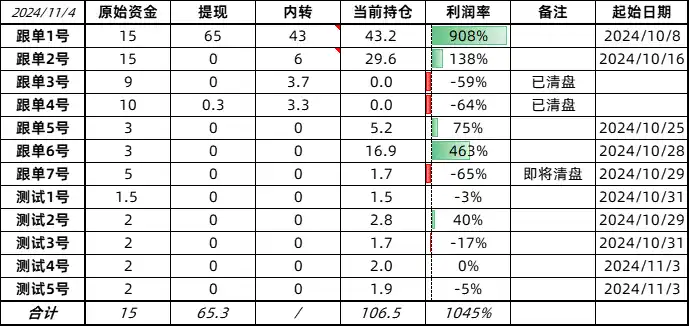
The funding status of each address as of November 4th, 17:30 (UTC+8) is shown below. The profit potential and growth curve vary significantly across accounts based on the style and strategy of the copied target. Notably, Copy Trading Account 6 achieved a nearly fivefold gain in one week under specific circumstances. For details, please refer to the next subsection.

This section will further elaborate on the specific copy trading strategies, showcasing the author's thought process.
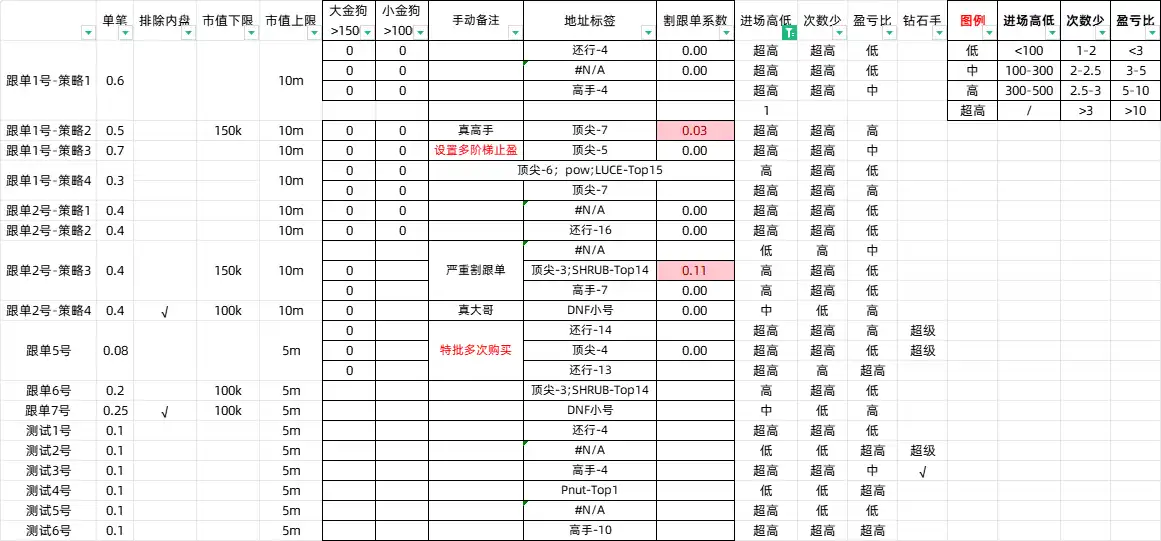
The details of the tracked copy trading targets are shown in the figure below:

  • The left column is the strategy column, with different settings based on the wallet's profitability, purchase frequency, and on-premises market (Pump.fun) profitability.
  • The middle section shows the practical results and preliminary evaluation system labels.
  • The right column shows labels based on the In-depth Evaluation System I, with the label categories as shown in the legend in the top right corner.

(Note: The rationale for the left column settings is detailed in "Diamond Hands, High Profit Ratio? What are the Winning Factors in Solana Meme Trading?" and "Meme Cultivation Manual: Reborn as a Diamond Hand (Part 2)". The right column is detailed in "Meme Cultivation Manual: Reborn as a Diamond Hand (Part 3)".)
Copy Trading Strategy Overview

  • Copy Trading Accounts 1 and 2 are addresses selected early on for their low frequency, high profit ratio, and diamond hand behavior. Furthermore, addresses with high drawdowns were removed based on the guiding principles from Part 3. The results so far are acceptable: Account 1's profit rate increased from 725% to 908% in 6 days, and Account 2's increased from 84% to 138%.
  • Copy Trading Account 5 is an extremely low-frequency (only 11 buy operations to date), high profit ratio, extreme diamond hand address. Because these addresses have historically successfully added positions at highs multiple times, they are the only addresses for which multiple purchases are enabled, and the single purchase amount has been reduced. However, due to the limited total number of transactions, no conclusions can yet be drawn regarding their impact on the system's profitability.
  • Before the split, Wallet B (i.e., Account 7) purchased a certain token. Wallet B performed numerous profit-taking operations on this token, but after the split, Wallet B's operations were no longer copied. This resulted in unexpected gains and profits (accounting for about 50% of Account 6's total profit). Therefore, although Account 6 achieved a fivefold gain in a week, Accounts 6 and 7 should actually be combined with Account 2 for comparison. The combined weekly growth was 10.6 SOL (a 132.5% increase), still showing a certain advantage compared to Account 2's growth of 8.1 SOL.
  • Test Accounts 1-6 are used to test addresses that have outstanding strengths but lack stability. They use ultra-small amounts to test their long-term purchasing ability. If an account gets liquidated (goes to zero), it is cleared and marked as unsuitable for copy trading.

Version Iteration

In-depth Evaluation System (I)

In Part 3, the author introduced the In-depth Evaluation System (I) to further analyze an address's ability to "buy at the bottom," the risk of losing money by "FOMOing at highs," the ability to achieve high returns with small capital, stop-loss style, and the degree of "diamond hands."

Last week, the system was further enhanced with two new sub-modules: "Copy Trading Effect Test" and "On-Premises (Pump.fun) Performance Evaluation." The complete evaluation results of the system are shown in the figure below.

The "Copy Trading Effect Test" is currently still relatively rudimentary. Its calculation method is: Total profit provided by GMGN ÷ Number of first-round transactions. The converted profit for each token is then summed to obtain the "Converted Profit" for each address.

(Number of first-round transactions = the number of transactions from the first buy to the first sell, sourced from GMGN - Address Data - Token Transaction Details. Transferring tokens is also considered a sell.)

The reason for adopting this calculation method is that the copy trading system mostly only copies the buy action once, so it's necessary to evaluate the profit change under this style. A small decrease or even an increase in the converted profit is the ideal scenario. This ideal scenario occurs because the high-profit tokens of the copied target are a result of "buying once after identifying an opportunity," while the high-loss tokens are caused by "multiple additions to the position."

The calculation method for the "On-Premises Performance Evaluation" is also currently quite straightforward. First, it statistics whether the token was purchased on the Pump.fun on-premises market. Then, the win rate and multiple are calculated based on the token's total profit and total cost. The purpose of this data is to evaluate whether to copy on-premises trades. If a situation arises where "on-premises participation rate" is too high + "on-premises win rate" is high + "on-premises multiple" is too low, then this address carries the risk of cutting (scamming) copy traders. In cases where the win rate is low and the profit ratio is not high, it indicates poor on-premises trading skills, and their on-premises trades should not be copied.

Future Outlook

The copy trading system still has many areas that need improvement. Those currently planned include:


Perguntas relacionadas

QWhat is the main topic of the article 'Meme修炼手册:重生之我要做钻石手(四)'?

AThe article provides an update on the progress of a copy-trading system for Solana Meme coins, detailing the performance of various copy-trading wallets, the upgrades to a deep evaluation system, and future plans.

QWhich copy-trading wallet achieved a nearly 5x increase in one week according to the article?

ACopy-trading Wallet No. 6 achieved a nearly 5x increase in one week.

QWhat new sub-modules were added to the Deep Evaluation System (一) in the past week?

ATwo new sub-modules were added: 'Copy-trading Effect Test' and 'Internal Market Performance Evaluation'.

QWhat is the purpose of the 'Internal Market Performance Evaluation' sub-module?

AIts purpose is to assess whether to follow an address's trades on internal markets (Pump fun) by evaluating their win rate and profit multiple there, helping to identify addresses that might be 'cutting off' copy-traders or have poor trading skills in that specific environment.

QWhat is the calculated metric for the 'Copy-trading Effect Test' sub-module?

AThe metric is 'Converted Profit', calculated as the total profit provided by GMGN divided by the number of first-round transactions (from first buy to first sell, where transferring tokens also counts as a sale), with the converted profit for each token then summed up.

Leituras Relacionadas

Is Crypto Trading Taxation Becoming a Reality? An In-Depth Analysis of the 2026 Global Crypto Tax Regulations

"Tax on Crypto Trading Becomes Reality? In-Depth Analysis of 2026 Global Crypto Tax Regulations" Hong Kong recently announced a consultation to implement the OECD's Crypto-Asset Reporting Framework (CARF) and revised Common Reporting Standard (CRS). The goal is to automatically exchange tax-related information on crypto asset transactions with partner jurisdictions starting in 2028, with revised CRS rules taking effect in 2029. Furthermore, from January 1, 2026, the UK and over 40 other countries will begin enforcing new tax rules, requiring local crypto service providers to collect user wallet and transaction data for future international tax information exchange. For example, UK-based exchanges must collect detailed records of all customer transactions. HM Revenue & Customs (HMRC) will use this data to cross-check tax returns for compliance, with sanctions for violations. This data may also be used for identity verification, anti-money laundering, and criminal investigations, significantly impacting the anonymity and compliance landscape of the crypto industry. CARF is an international standard developed by the OECD under G20 mandate to enhance tax transparency for crypto assets. It aims to collect standardized information on often opaque, cross-border crypto transactions and automatically exchange it annually with the tax authorities in the user's jurisdiction of tax residence. The framework covers a broad range of crypto assets, including stablecoins, crypto-derived financial instruments, and some NFTs. Reporting obligations fall on intermediaries like exchanges that facilitate conversions between crypto and fiat or between different crypto assets. CARF complements the existing CRS, which primarily targets traditional financial accounts. While CRS is mature for traditional finance, it struggled to cover crypto transactions occurring outside the banking system. CARF addresses this gap by targeting the native crypto market. The OECD has also revised CRS to include new products like CBDCs and close loopholes involving indirect crypto exposure through derivatives. As of early December 2025, 76 jurisdictions have committed to adopting CARF. The UK and EU are pioneers, starting data collection in 2026 and the first exchange in 2027. Singapore, the UAE, and Hong Kong follow with collection in 2027 and full implementation in 2028. Mainland China is not on the initial list of exchanging jurisdictions. Its strong regulatory stance against virtual asset businesses means there is currently no licensed domestic exchange system to be incorporated into CARF. Hong Kong's adoption does not automatically mean data will be shared with mainland authorities; such exchange depends on China's decision to participate and establish bilateral agreements. However, not being part of CARF does not mean immunity. Tax information could still be shared through existing tax treaties, case-by-case requests, or joint investigations. For individuals and institutions, the key takeaway is that as major jurisdictions systematically collect crypto transaction data, compliance and traceability will become the norm, especially for activities relying on centralized exchanges and fiat gateways.

marsbitHá 34m

Is Crypto Trading Taxation Becoming a Reality? An In-Depth Analysis of the 2026 Global Crypto Tax Regulations

marsbitHá 34m

Trading

Spot
Futuros

Discussões

Bem-vindo à Comunidade HTX. Aqui, pode manter-se informado sobre os mais recentes desenvolvimentos da plataforma e obter acesso a análises profissionais de mercado. As opiniões dos utilizadores sobre o preço de MEME (MEME) são apresentadas abaixo.

活动图片