Bitcoin, Ethereum : Deux trajectoires possibles, rebond technique ou retournement ? Altcoins à trader en range : SOL, LIQUID, PIPPIN, AAVE

金色财经Published on 2025-12-23Last updated on 2025-12-23

Abstract

Résumé de l'analyse crypto : Le marché reste en phase de consolidation. Le Bitcoin (BTC) a échoué à franchir la résistance clé de 88 800 $, une clé à mèche supérieure indiquant une forte vente. Un vrai breakout pourrait cibler 92 000-95 000 $, mais un rejet entraînerait une correction vers 87 700 $. L'Ethereum (ETH) suit une dynamique similaire, avec un niveau pivot à 3 010 $. La stratégie recommandée est de trader en range (acheter les dips, vendre les pics) et d'éviter les positions lourdes tant qu'il n'y a pas de breakout clair. Les altcoins présentent des opportunités sélectives : - **SOL** : Support à 120-121$, résistance à 131$. - **PIPPIN** : A atteint l'objectif de 0,26$. - **AAVE** : Projet fondamentalement solide, une baisse est une opportunité d'achat. - **ASTER** : Rebond technique possible, mais le projet est considéré comme faible à long terme. - **LIQUID** : Mécanisme innovant d'ajout automatique de liquidités. - **GUA** : Projet AI, semble en phase de accumulation. Méfiance générale : le marché américain devrait corriger, ce qui pourrait impacter BTC et ETH. Prudence face aux mouvements brusques (wicks).

Point clé : ne soyez pas trop investis ! Le marché actuel en range se prête au trading range (acheter bas, vendre haut), évitez les mouvements brusques avant une vraie breakout. Une mauvaise décision peut facilement mener à être fortement coincé. Surveillez attentivement la situation de breakout des résistances du BTC et de l'ETH. Un correctif US est inévitable, le BTC et l'ETH ne pourront y échapper, méfiez-vous des wicks qui ramènent les prix à leur point de départ. N'achetez pas au prix actuel, concentrez-vous sur les opportunités à court terme lors des mouvements brusques à la baisse ou à la hausse.

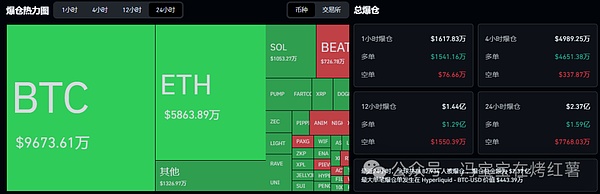
Sur les dernières 24 heures, 82 934 personnes ont été liquidées sur l'ensemble des plateformes, pour un montant total de 237 millions de dollars. Liquidations long : 159 millions USD, liquidations short : 77.6899 millions USD.
BTC

D'après la récente évolution, le prix du Bitcoin a tenté de franchir une zone de résistance clé, mais a finalement clôturé sur une bougie avec une longue mèche supérieure et un volume élevé, indiquant que la pression vendeuse reste forte. Cette bougie est apparue au niveau où la ligne de tendance baissière et la zone d'offre coïncident, le signal technique est très clair. Le marché n'est pas dépourvu de force haussière, mais la structure globale reste sous la pression des vendeurs.
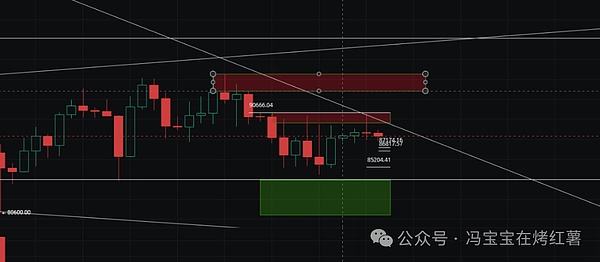
Si une breakout réelle de la zone de résistance à 88 800 $ intervient par la suite, le prix pourrait viser l'intervalle 92 000 - 95 000 $. Surveillez les résistances aux alentours de 89 600 - 90 585 - 91 355 $.

Chaque poussée haussière pourrait être un test. Si aujourd'hui le prix est rejeté et ne parvient pas à se maintenir au-dessus de 88 800 $, le rebond sur le timeframe inférieur sera considéré comme faible, et un retest des supports autour de 87 720 - 86 650 - 85 220 $ est à prévoir.

ETH

L'évolution de l'Ethereum reste essentiellement corrélée à celle du Bitcoin. Même en cas de breakout locale de la ligne de tendance baissière, tant que la logique de cycle plus large n'a pas changé, la signification de ce type de breakout reste limitée. Globalement, pour le moyen terme jusqu'au premier semestre de l'année prochaine, nous maintenons un jugement prudent, voire plutôt baissier.
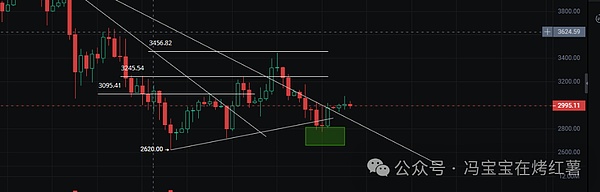
Aujourd'hui, surveillez le niveau de 3 010 $. Ce n'est qu'en se maintenant fermement au-dessus de ce niveau que ce correctif de timeframe 4H sera considéré comme terminé et que la tendance haussière pourra reprendre. Les résistances supérieures se situent autour de 3 043 - 3 078 - 3 115 $. Si la clôture aujourd'hui n'a pas au-dessus de 3 010 $, cela indiquera que le rebond sur le timeframe inférieur est faible, et un retest des supports autour de 2 970 - 2 943 - 2 906 $ est à prévoir.

Altcoins

Le marché ne fonctionne jamais selon la volonté de qui que ce soit. Un trader vraiment mature ne se mesure pas au nombre de fois où il a correctement prédit le marché, mais à sa capacité à avoir anticipé un plan d'action pour différents scénarios. À court terme, prévoir range et mouvements baissiers ; à moyen terme, attendre une structure plus optimale ; à long terme, respecter le cycle. C'est la logique centrale pour traverser les marchés haussiers et baissiers.

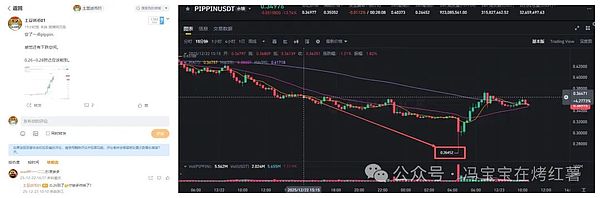
$PIPPIN

PIPPIN a directement touché l'objectif de 0,26 $. Ce n'est pas de la chance, c'est le respect de la tendance, la conviction dans le chartisme. Quand tout le monde achetait la hausse, j'ai attendu le repli ; pendant les ventes de panique, je suis resté serein. La prochaine fois, douterez-vous encore ?
$SOL

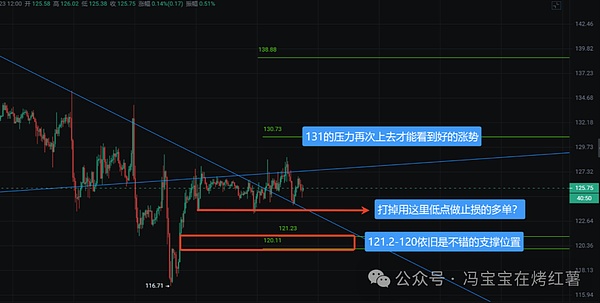
Le support pour Solana se situe toujours entre 121,2 et 120 $. Il faut surveiller une éventuelle descente vers ces niveaux pour capturer de la liquidité. La résistance supérieure à 131 $ devra être franç à nouveau pour envisager une bonne hausse.
$AAVE

Bien que l'équipe commence à avoir des dissensions internes, d'un point de vue fondamental, AAVE reste un excellent projet de prêt/emprunt defi. La baisse me semble plutôt être une opportunité, j'attends qu'il baisse encore un peu pour tenter d'acheter, il y a peu de chances de se faire piéger.
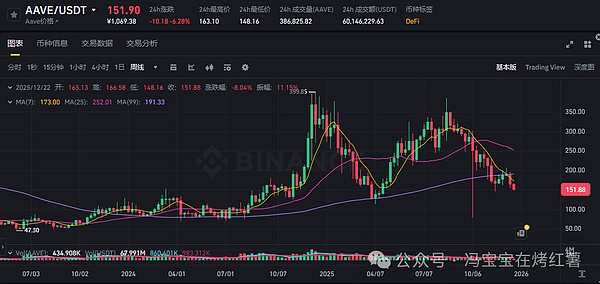
$ASTER

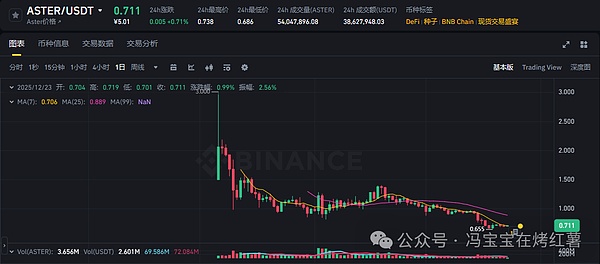
La baisse à court terme devrait toucher à sa fin : surachat technique, pression de vente réduite, un rebond à court terme est très probable. Mais fondamentalement, cela reste un projet médiocre : une activité quotidienne sur la chaîne de seulement quelques centaines d'utilisateurs pour une capitalisation de plusieurs milliards, c'est totalement déraisonnable ! Le secteur perpdex a déjà un leader absolu, HYPE. ASTER est né dans l'imitation et non l'innovation. Après le rebond à court terme, la baisse devrait donc se poursuivre.
$Hakimi

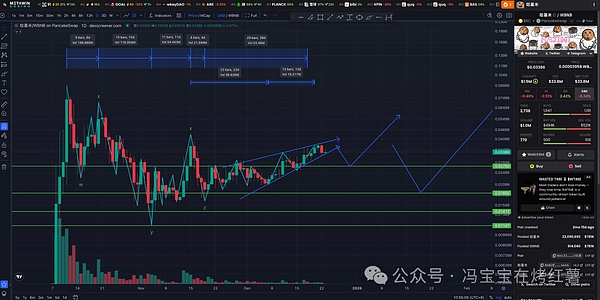
Hakimi : la formation en wedge arrive à son terme, le choix de direction est imminent, à surveiller de près pour du court terme. C'est bientôt Noël, si un bug apparaît avec le chinois, les ingénieurs seront en vacances et personne ne pourra le corriger. Donc, les nodes spot en chinois pourraient être meilleurs après le Nouvel An, nouveau départ pour la nouvelle année. S'il n'y a pas de situation imprévue, un correctif d'abord, puis peut-être un énorme pump.
$LIQUID

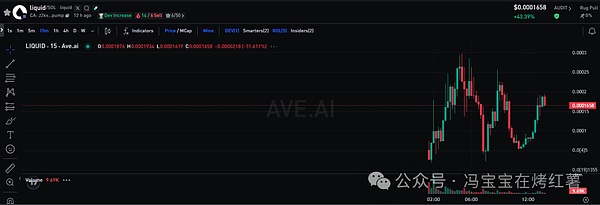
Ce jeton ajoute automatiquement des LP, c'est un projet de DEV leyten. Les amis intéressés par les mécanismes innovants peuvent aller jeter un œil.
$GUA

Projet de divination par IA, venant juste de lancer ses contrats, capitalisation de 100 millions, pas trop cher. Le "dog Zhuang" (gros poisson) maintient très activement le coût à 0,1$. Sur les 26 jours depuis le lancement sur Alpha, le coût à six chiffres pour maintenir le prix a été réellement dépensé. Cela semble former un bottom, l'espace pour le stop-loss est assez étroit, on peut en prendre un peu.


Related Reads

Behind HYPE's Repeated Record Highs, the 'Minions' in the Ecosystem Can't Keep Up

While HYPE, the native token of the Hyperliquid ecosystem, surges to new all-time highs above $76 and attracts significant institutional ETF inflows, a starkly different reality unfolds within its HyperEVM application layer. Multiple core DeFi protocols across lending, NFTs, stablecoins, and DEXs have announced shutdowns between May and June. The article argues HYPE functions more like an "application stock" than a traditional ecosystem token. Its value is anchored to the trading fees from Hyperliquid's core perpetual contracts platform (HyperCore), which boasts a diversified revenue stream from crypto, commodities, and indices. Approximately 97% of protocol fees fund buybacks and burns of HYPE. This means HYPE's price is largely decoupled from the health of projects built on HyperEVM. The closures of significant projects like lending protocol HypurrFi (peak TVL >$300M) and NFT marketplace Drip.Trade highlight a structural tension. Hyperliquid's minimalist philosophy offers infrastructure without official grants, liquidity support, or marketing coordination for HyperEVM projects. This forces protocols into a fiercely competitive environment from day one. Furthermore, the success of HyperCore creates a liquidity vacuum, and mechanisms like HIP-3 (allowing direct perpetual market deployment) divert user attention and capital away from application-layer projects. The stronger the core perpetual trading business becomes, the more difficult it is for peripheral "DeFi lego" projects to survive and capture value, despite the flagship token's rising price.

Foresight News25m ago

Behind HYPE's Repeated Record Highs, the 'Minions' in the Ecosystem Can't Keep Up

Foresight News25m ago

Conversation with Arthur Hayes: AI Has Drained Market Liquidity, BTC Will Be Below 100k by Year-End

In this June 2026 podcast interview, BitMEX co-founder Arthur Hayes explains his decision to sell his major crypto holdings (HYPE, NEAR, Worldcoin, Zcash). His rationale is based on a macro view linking oil prices, the Iran conflict, US politics, and an impending AI bubble burst. Hayes argues that high oil prices, driven by the ongoing war, will pressure domestic US inflation. To salvage the Republican Party's chances in the midterm elections, he believes Donald Trump may pivot to a populist, anti-AI stance—advocating for taxes and regulation—which would deflate the AI investment narrative. He sees the AI sector, particularly massive capital expenditure on data centers, as having absorbed nearly all excess market liquidity (around $1.5 trillion in debt issuance since 2025), starving other assets like Bitcoin. He highlights the upcoming SpaceX IPO at a ~$1.8 trillion valuation and 100x price-to-sales ratio as a potential tipping point. If these hyped IPOs underperform, it could shatter market confidence in AI. In such a scenario, all risk assets, including crypto, would fall together as correlations converge to 1 during a broad correction. Hayes has moved his portfolio into Treasuries and energy stocks (like ExxonMobil), predicting Bitcoin will be below $100k by year-end. He sees a potential crypto bull market only after the AI frenzy cools, liquidity stops flowing exclusively into AI, and possibly after a significant market downturn prompts new monetary stimulus.

marsbit36m ago

Conversation with Arthur Hayes: AI Has Drained Market Liquidity, BTC Will Be Below 100k by Year-End

marsbit36m ago

Fed's Internal Doves Flock to Hawkish Stance, Warsh's Debut "Between a Rock and a Hard Place"

U.S. Federal Reserve officials who previously advocated for rate cuts, including Governor Christopher Waller, have recently shifted their stance, with many now not ruling out the possibility of future rate hikes. This sets a challenging stage for new Fed Chair Kevin Warsh's first policy meeting. Appointed by President Trump based on his dovish views, Warsh now faces a committee where the debate has pivoted from "when to cut" to "whether to hike," driven by persistent inflation above 3%, a strong labor market, and supply-side pressures from AI infrastructure demands and geopolitical tensions. Key figures illustrate the shift. Governor Waller, once concerned about employment, now says data has pushed him toward considering rate increases. Even moderate voices like Governor Lisa Cook, while expecting inflation to ease, have indicated readiness to hike if it fails to do so. Long-time hawks such as regional Fed presidents Beth Hammack, Lorie Logan, and Neel Kashkari have grown more vocal, arguing that the real policy rate is effectively falling and that action may soon be needed. The upcoming Fed meeting is expected to keep rates steady but will likely remove the "easing bias" from its statement, signaling a neutral stance between cuts and hikes. The quarterly "dot plot" is anticipated to show most officials projecting no cuts this year, with some potentially indicating hikes. Chair Warsh, a critic of the Fed's reliance on forward guidance like the dot plot, must navigate communicating this pivot using tools he has questioned, all while steering policy in a direction counter to the preferences of the president who appointed him. The consensus suggests the Fed's next move could well be a rate increase.

marsbit1h ago

Fed's Internal Doves Flock to Hawkish Stance, Warsh's Debut "Between a Rock and a Hard Place"

marsbit1h ago

The Trillion-Yuan Market Cap 'Yi Zhong Tian': Who is the True Value King?

The article analyzes the three leading Chinese optical module companies, collectively nicknamed "Yi Zhong Tian": Xinyisheng, Zhongji Innolight, and TFC Optical Communication. It evaluates their "cost-performance" not by current stock price, but through three lenses: PEG ratio (growth vs. valuation), earnings quality, and premium/discount for certainty. Xinyisheng shows the most attractive PEG ratio and high profitability, but its valuation reflects discounts for risks like high customer concentration and reliance on overseas markets. Zhongji Innolight, the most expensive, commands a premium for its market leadership, dominant share in key products like 800G/1.6T modules, and higher earnings certainty, though it faces geopolitical risks. TFC Optical, as an upstream component supplier ("water seller"), has the highest gross margin and bets on the long-term CPO/NPO architecture trend, but trades at a high valuation with more stable, less explosive growth. The core argument is that while these companies dominate module assembly, the true profit pool and technological moat lie upstream in laser and switch chips, currently controlled by U.S. firms like Lumentum and Coherent. The long-term "cost-performance" for these Chinese leaders hinges on whether the domestic industry, exemplified by companies like Yuanjie Technology, can successfully move up the value chain into high-power laser chips. Otherwise, their high growth may remain confined to the lower-margin assembly segment.

marsbit1h ago

The Trillion-Yuan Market Cap 'Yi Zhong Tian': Who is the True Value King?

marsbit1h ago

Trading

Spot
Futures

Hot Articles

What is $BITCOIN

DIGITAL GOLD ($BITCOIN): A Comprehensive Analysis Introduction to DIGITAL GOLD ($BITCOIN) DIGITAL GOLD ($BITCOIN) is a blockchain-based project operating on the Solana network, which aims to combine the characteristics of traditional precious metals with the innovation of decentralized technologies. While it shares a name with Bitcoin, often referred to as “digital gold” due to its perception as a store of value, DIGITAL GOLD is a separate token designed to create a unique ecosystem within the Web3 landscape. Its goal is to position itself as a viable alternative digital asset, although specifics regarding its applications and functionalities are still developing. What is DIGITAL GOLD ($BITCOIN)? DIGITAL GOLD ($BITCOIN) is a cryptocurrency token explicitly designed for use on the Solana blockchain. In contrast to Bitcoin, which provides a widely recognized value storage role, this token appears to focus on broader applications and characteristics. Notable aspects include: Blockchain Infrastructure: The token is built on the Solana blockchain, known for its capacity to handle high-speed and low-cost transactions. Supply Dynamics: DIGITAL GOLD has a maximum supply capped at 100 quadrillion tokens (100P $BITCOIN), although details regarding its circulating supply are currently undisclosed. Utility: While precise functionalities are not explicitly outlined, there are indications that the token could be utilized for various applications, potentially involving decentralized applications (dApps) or asset tokenization strategies. Who is the Creator of DIGITAL GOLD ($BITCOIN)? At present, the identity of the creators and development team behind DIGITAL GOLD ($BITCOIN) remains unknown. This situation is typical among many innovative projects within the blockchain space, particularly those aligning with decentralized finance and meme coin phenomena. While such anonymity may foster a community-driven culture, it intensifies concerns about governance and accountability. Who are the Investors of DIGITAL GOLD ($BITCOIN)? The available information indicates that DIGITAL GOLD ($BITCOIN) does not have any known institutional backers or prominent venture capital investments. The project seems to operate on a peer-to-peer model focused on community support and adoption rather than traditional funding routes. Its activity and liquidity are primarily situated on decentralized exchanges (DEXs), such as PumpSwap, rather than established centralized trading platforms, further highlighting its grassroots approach. How DIGITAL GOLD ($BITCOIN) Works The operational mechanics of DIGITAL GOLD ($BITCOIN) can be elaborated on based on its blockchain design and network attributes: Consensus Mechanism: By leveraging Solana’s unique proof-of-history (PoH) combined with a proof-of-stake (PoS) model, the project ensures efficient transaction validation contributing to the network's high performance. Tokenomics: While specific deflationary mechanisms have not been extensively detailed, the vast maximum token supply implies that it may cater to microtransactions or niche use cases that are still to be defined. Interoperability: There exists the potential for integration with Solana’s broader ecosystem, including various decentralized finance (DeFi) platforms. However, the details regarding specific integrations remain unspecified. Timeline of Key Events Here is a timeline that highlights significant milestones concerning DIGITAL GOLD ($BITCOIN): 2023: The initial deployment of the token occurs on the Solana blockchain, marked by its contract address. 2024: DIGITAL GOLD gains visibility as it becomes available for trading on decentralized exchanges like PumpSwap, allowing users to trade it against SOL. 2025: The project witnesses sporadic trading activity and potential interest in community-led engagements, although no noteworthy partnerships or technical advancements have been documented as of yet. Critical Analysis Strengths Scalability: The underlying Solana infrastructure supports high transaction volumes, which could enhance the utility of $BITCOIN in various transaction scenarios. Accessibility: The potential low trading price per token could attract retail investors, facilitating wider participation due to fractional ownership opportunities. Risks Lack of Transparency: The absence of publicly known backers, developers, or an audit process may yield skepticism regarding the project's sustainability and trustworthiness. Market Volatility: The trading activity is heavily reliant on speculative behavior, which can result in significant price volatility and uncertainty for investors. Conclusion DIGITAL GOLD ($BITCOIN) emerges as an intriguing yet ambiguous project within the rapidly evolving Solana ecosystem. While it attempts to leverage the “digital gold” narrative, its departure from Bitcoin's established role as a store of value underscores the need for a clearer differentiation of its intended utility and governance structure. Future acceptance and adoption will likely depend on addressing the current opacity and defining its operational and economic strategies more explicitly. Note: This report encompasses synthesised information available as of October 2023, and developments may have transpired beyond the research period.

380 Total ViewsPublished 2025.05.13Updated 2025.05.13

What is $BITCOIN

Discussions

Welcome to the HTX Community. Here, you can stay informed about the latest platform developments and gain access to professional market insights. Users' opinions on the price of BTC (BTC) are presented below.

活动图片