Đạo luật SAFE Crypto sẽ khiến các kẻ lừa đảo run sợ: Luật sư tiền mã hóa

cointelegraphPublished on 2025-12-17Last updated on 2025-12-17

Abstract

Hai thượng nghị sĩ Mỹ đã giới thiệu Đạo luật SAFE Crypto nhằm chống gian lận tiền điện tử. Đạo luật này phối hợp Bộ Tài chính, cơ quan thực thi pháp luật và khu vực tư nhân để ngăn chặn các vụ lừa đảo, vốn khiến người Mỹ thiệt hại 9,3 tỷ USD năm 2024. Luật sư tiền điện tử Gabriel Shapiro nhận định đạo luật có thể khiến lừa đảo "hoảng sợ" khi tập trung vào truy tố tội phạm. Công ty phân tích blockchain TRM Labs cũng sẵn sàng hỗ trợ các cơ quan chức năng theo dõi hoạt động bất hợp pháp.

Hai Thượng nghị sĩ Hoa Kỳ đã đệ trình dự luật nhằm siết chặt các hành vi lừa đảo và gian lận tiền mã hóa bằng cách trang bị cho cơ quan thực thi pháp luật những công cụ tốt hơn để phát hiện các cuộc tấn công và xác định thủ phạm.

Đạo luật Tăng cường Khuôn khổ Cơ quan Thực thi Tiền mã hóa (SAFE), được đệ trình bởi Dân chủ Elissa Slotkin và Cộng hòa Jerry Moran vào thứ Hai, tìm cách phối hợp hành động giữa Bộ Tài chính Hoa Kỳ, cơ quan thực thi pháp luật, các cơ quan quản lý và các công ty tư nhân để giải quyết nạn lừa đảo và gian lận tiền mã hóa, vốn đã chiếm đoạt hàng triệu USD từ các nạn nhân.

“Lực lượng đặc nhiệm này, được thành lập bởi Đạo luật SAFE Cryptocurrency, sẽ cho phép chúng tôi huy động mọi nguồn lực để chống lại gian lận trong tài sản kỹ thuật số,” Slotkin nói, trong khi Moran bổ sung:

“Khi tiền mã hóa ngày càng được sử dụng rộng rãi, dự luật này sẽ giúp chống lại các mối đe dọa và đảm bảo rằng tất cả người Mỹ được bảo vệ tốt hơn khỏi các trò lừa đảo tiền mã hóa.”

Cục Điều tra Liên bang (FBI) báo cáo rằng người Mỹ đã mất 9,3 tỷ USD vào các trò lừa đảo đầu tư liên quan đến tiền mã hóa trong năm 2024, đánh dấu mức tăng 66% so với năm 2023. Các cá nhân trên 60 tuổi là nhóm bị ảnh hưởng nặng nề nhất, với tổng số tiền thiệt hại là 2,84 tỷ USD.

Cần lưu ý rằng con số này bao gồm bất kỳ trò lừa đảo đầu tư nào đơn giản chỉ đề cập đến tiền mã hóa như một phần trong thủ đoạn của nó. Nhiều vụ không liên quan đến blockchain hoặc tiền mã hóa.

Bất chấp những nỗ lực của cả khu vực công và tư nhân nhằm nâng cao nhận thức, những kẻ lừa đảo tiền mã hóa đã tìm ra những cách thức tinh vi hơn để đánh cắp tiền của các nhà đầu tư.

Nhưng Gabriel Shapiro, cố vấn pháp lý tổng quát của công ty đầu tư tiền mã hóa Delphi Labs, cho biết việc triển khai thành công Đạo luật SAFE Crypto có thể khiến những kẻ lừa đảo tiền mã hóa rơi vào tình trạng hoảng loạn.

“Bọn lừa đảo có lẽ sẽ sợ vãi ra quần nếu điều này được thực thi mạnh mẽ,” Shapiro nói trong một bài đăng trên X vào thứ Ba, đồng thời lưu ý rằng Tổng Chưởng lý, Giám đốc Mạng lưới Thực thi Tội phạm Tài chính (FinCEN) và Giám đốc Cơ quan Mật vụ Hoa Kỳ sẽ nằm trong số những quan chức cấp cao tham gia truy bắt tội phạm tiền mã hóa.
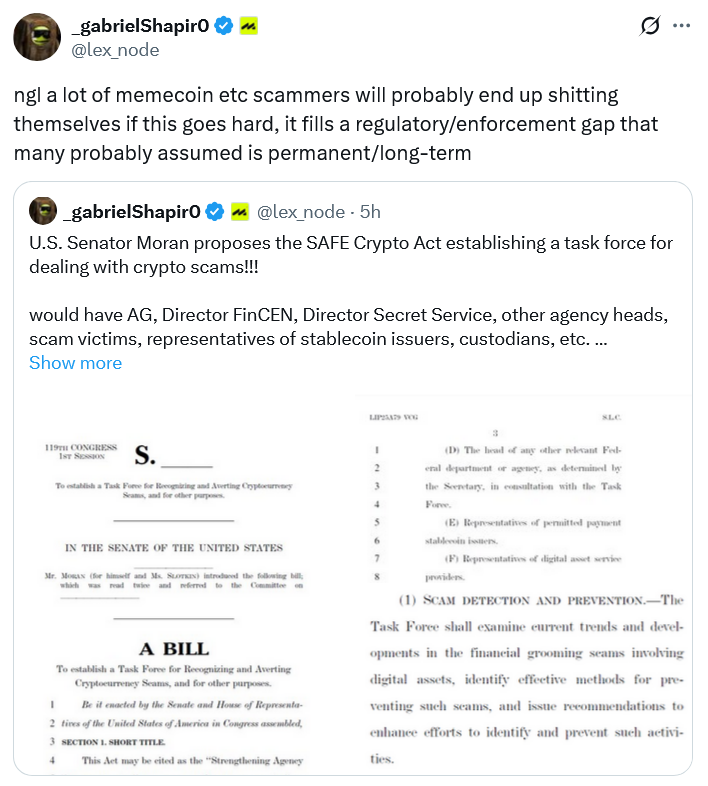
Nguồn: Gabriel Shapiro

Shapiro cho biết Đạo luật SAFE Crypto có thể “rất hữu ích” vì hiện tại các cơ quan quản lý chứng khoán và hàng hóa của Hoa Kỳ không tập trung nhiều vào hành động thực thi đối với tin tặc, kẻ lừa đảo và những người vận hành mô hình Ponzi.

TRM Labs nằm trong số các công ty tư nhân chung tay hỗ trợ

Công ty giám định blockchain TRM Labs nằm trong số các công ty khu vực tư nhân sẵn sàng hỗ trợ các quan chức Hoa Kỳ, với Phó chủ tịch kiêm Trưởng ban Chính sách Toàn cầu của họ, Ari Redbord, tuyên bố rằng sự hợp tác sẽ giúp theo dõi và phá vỡ các mạng lưới bất hợp pháp trong thời gian thực:

Liên quan: Cách sử dụng tiền mã hóa vào năm 2025: YouTube, thẻ Pokémon và hơn thế nữa

“Bằng cách đưa ngành công nghiệp và cơ quan thực thi pháp luật lại với nhau, chúng ta có thể giảm thiểu đáng kể khả năng tội phạm lợi dụng các công nghệ chuyển đổi để gây hại.”

Tạp chí: Gặp gỡ các thám tử onchain chống tội phạm tiền mã hóa tốt hơn cả cảnh sát

Related Questions

QĐạo luật SAFE Crypto được đề xuất nhằm mục đích gì?

AĐạo luật SAFE Crypto được đề xuất nhằm mục đích trang bị cho cơ quan thực thi pháp luật các công cụ tốt hơn để phát hiện các cuộc tấn công và xác định thủ phạm trong lĩnh vực tiền mã hóa, đồng thời phối hợp hành động giữa Bộ Tài chính Mỹ, cơ quan thực thi pháp luật, cơ quan quản lý và khu vực tư nhân để giải quyết nạn lừa đảo.

QNhững thống kê nào về thiệt hại do lừa đảo liên quan đến tiền mã hóa được đề cập trong bài viết?

ACục Điều tra Liên bang (FBI) báo cáo rằng người Mỹ đã mất 9,3 tỷ USD vào các vụ lừa đảo đầu tư liên quan đến tiền mã hóa trong năm 2024, tăng 66% so với năm 2023. Trong đó, các cá nhân trên 60 tuổi bị ảnh hưởng nặng nề nhất, với tổng số tiền thiệt hại là 2,84 tỷ USD.

QLuật sư tiền mã hóa Gabriel Shapiro nhận định gì về tác động của Đạo luật SAFE Crypto?

AGabriel Shapiro, cố vấn pháp lý của công ty đầu tư Delphi Labs, nhận định rằng việc triển khai thành công Đạo luật SAFE Crypto có thể khiến những kẻ lừa đảo tiền mã hóa rơi vào trạng thái hoảng loạn. Ông cho rằng đạo luật này sẽ rất hữu ích vì các cơ quan quản lý chứng khoán và hàng hóa hiện không tập trung nhiều vào hành động thực thi pháp luật đối với tin tặc và những kẻ vận hành mô hình Ponzi.

QCông ty tư nhân nào được nêu tên là sẵn sàng hỗ trợ các quan chức Mỹ trong cuộc chiến chống lừa đảo?

ACông ty giám định chuỗi khối TRM Labs là một trong những công ty khu vực tư nhân sẵn sàng hỗ trợ các quan chức Mỹ. Phó chủ tịch kiêm Trưởng ban Chính sách Toàn cầu của họ, Ari Redbord, tuyên bố rằng sự hợp tác này sẽ giúp theo dõi và phá vỡ các mạng lưới bất hợp pháp trong thời gian thực.

QĐạo luật này sẽ được phối hợp thực hiện bởi những cơ quan và cá nhân cấp cao nào?

AĐạo luật sẽ được phối hợp thực hiện với sự tham gia của các quan chức cấp cao bao gồm Tổng Chưởng lý, Giám đốc Mạng lưới Thực thi Tội phạm Tài chính (FinCEN) và Giám đốc Cơ quan Mật vụ Hoa Kỳ.

Related Reads

2029 Finale Prediction: When Cryptocurrency Completely "Vanishes", Who Can Remain in This Financial Upheaval?

By 2029, the crypto industry will have transformed into a largely invisible but foundational layer for traditional finance. This timeline outlines the key shifts from now until then. By mid-2026, the most sought-after assets on-chain will not be traditional tokens, but synthetic perpetual contracts for private, high-growth companies (like SpaceX, OpenAI). These become primary price discovery tools, highlighting the market's craving for real-world asset value. Most altcoins enter a sustained bear market as their fundamental lack of asset-backed value is exposed. In late 2026, the "AI + Crypto" narrative largely fades as AI giants prove they don't need crypto infrastructure, except for prediction markets betting on model performance. Simultaneously, a quiet but significant wave of tokenization for institutional assets (money market funds, private credit) begins. The industry splits into a noisy speculative economy and a silent institutional one. Throughout 2027, major public blockchain foundations pivot decisively to serve institutional clients, building compliance toolkits and sales teams. However, key sectors hit growth ceilings: private perpetual contracts are legally restricted from public promotion, stable币 growth is capped by looming political uncertainty, and tokenization projects remain cautious. In 2028, following a U.S. election assumed to maintain a regulatory (not prohibitive) stance, a pivotal change occurs. After a major liquidation crisis exposes the flaws of synthetic contracts lacking a real-asset anchor, new regulations allow the *public solicitation* of private security sales (secondary market shares) to accredited investors. This creates a legitimate, direct on-ramp for retail capital into previously illiquid private equity. By 2029, the resulting bull market is driven by trading in real, innovative company shares (biotech, robotics, AI labs), not speculative tokens. "Crypto" as a distinct asset class recedes; it becomes the mundane, unseen plumbing for this new global private markets infrastructure. Tokens that survive are those capturing real cash flows from this infrastructure. Speculation persists but is marginalized. The core questions posed at the start are answered: token value is tied to legally enforceable claims on real assets, frontier tech adoption happens via private market channels, and crypto's absorption into traditional finance is marked by its becoming boring and invisible. The key validation for this entire thesis is whether, by late 2028, a legal pathway exists for ordinary accredited investors to access private assets directly.

marsbit41m ago

2029 Finale Prediction: When Cryptocurrency Completely "Vanishes", Who Can Remain in This Financial Upheaval?

marsbit41m ago

After the U.S. Banned Fable 5, Zhipu's Stock Soared 47%

On June 15, Chinese AI company Zhipu's stock surged up to 47.6% in Hong Kong, closing with a 32.82% gain. This sharp rise followed two key industry events. On June 12, Anthropic was compelled by a U.S. government export control order to suspend global access to its latest flagship models, Claude Fable 5 and Claude Mythos 5, impacting developers and businesses reliant on them. The next day, Zhipu announced it was opening access to its new open-source flagship model, GLM-5.2, for all Coding Plan users, with API and model weights (under the MIT license) to follow. The Anthropic incident highlighted a critical shift in the AI industry: beyond raw capability, the stability, continuous accessibility, and control over AI models are becoming equally vital, especially as AI integrates deeper into business workflows. Zhipu's move, emphasizing that "frontier intelligence should not belong to a few nor be subject to arbitrary revocation," positioned its open, accessible model as an alternative. GLM-5.2 focuses on "Long Horizon Tasks" with a 1M context window, aiming for consistency in complex, extended projects. Market analysts suggest this event exposes the risk of dependency on closed-source models subject to single jurisdiction policies, potentially accelerating a shift toward domestic base models and localized deployments. The investment response indicates a new valuation metric is emerging—prioritizing which companies can provide AI capabilities that are not only advanced but also reliably and sustainably accessible.

marsbit42m ago

After the U.S. Banned Fable 5, Zhipu's Stock Soared 47%

marsbit42m ago

PANews Column Registration and Article Submission Guide

"PANews Column Registration and Submission Guide" provides instructions for users to register as columnists and publish articles on the PANews platform. Key application requirements are emphasized: content should focus on in-depth analysis within Crypto, Web3, blockchain, data, and viewpoints. Content primarily for brand/product introductions will not be approved, and heavily AI-generated content will be rejected. Promotional (PR/soft) content is directed to the business channel. **Registration Process:** * **Web:** Go to the official website footer, click "Apply for Column," and register with a phone number or email (login via verification code, no password). Fill in the column name, description, upload an avatar, and submit links to previously published work. * **Mobile:** Navigate to "My" -> "Contribute & Create" and complete the form. **Article Submission Tutorial:** 1. Log in to the PANews website. 2. Access the "Creator Center" from your personal homepage. 3. Use the editor to create and publish articles. **Video Upload:** The platform supports embedding videos from third-party sites (e.g., Bilibili). Copy the embed code from the source video, use the editor's "Insert/Edit media" button, paste the code under the "Embed" tab, and adjust the display size (recommended: width 100%, height 560px). **PANews Skills (AI Agent Tool):** PANews offers an official AI Agent skill set called PANews Skills, enabling AI tools to query platform content, track trends, and publish column articles directly. It includes three main skills: 1. `panews`: For tracking daily must-read lists, popular articles, and funding news. 2. `panews-creator`: For managing columns, publishing articles, and uploading images. 3. `panews-web-viewer`: For parsing PANews webpages into Markdown. These skills are compatible with various AI Agent tools (OpenClaw, Cursor, Claude Code, ChatGPT, Gemini, etc.). To use the `panews-creator` skill, users must obtain a specific authentication value from the PANews website after logging into their columnist account.

marsbit53m ago

PANews Column Registration and Article Submission Guide

marsbit53m ago

I Built Myself an Investment Workbench Using AI

For the past two weeks, I've been immersed in Vibe Coding—using AI to write code from natural language descriptions. This process has enabled me to quickly build functional tools that address long-standing personal ideas. Previously, I had many concepts but found execution too cumbersome. Key ideas included a unified dashboard for assets across US stocks, Crypto, HK stocks, and A-shares; a real-time alert system for price movements; an investment map visualizing sector relationships; and a tool to correlate prediction market bets with news and market data. Traditional development hurdles meant these often remained unrealized. Using AI (Codex, Claude Code, and DeepSeek API), I built four initial tools: 1. A **Cross-Market Asset Dashboard** showing total assets, daily P&L, and holdings by market, with added features for alerts and sector mapping. It's deployed locally for privacy. 2. A **Prediction Market (PM) Monitor** tracking bets on events (e.g., company valuations) and correlating probability shifts with news and market movements. I categorize bets by conviction to filter noise. 3. A **Simple Operations Backend** for managing my writing workflow (topics, progress, publishing). It's cloud-deployed for mobile access. 4. A **One-Click Formatting Tool** that automates converting drafts into various platform-specific formats, saving manual effort. While these tools are basic, they represent a significant shift: AI lowers the barrier to creating personalized systems. I believe individual investors can now feasibly build core systems for: * **Asset Observation** (tracking holdings and changes) * **Signal Monitoring** (watching for key market shifts) * **Sector Mapping** (understanding network relationships within a sector) * **Performance Review** (documenting rationale and outcomes) The power of Vibe Coding is its fast feedback loop. Ideas can be implemented, tested, and iterated on rapidly, turning "want-to-do" into "done." This marks the start of my new phase, where I'll share investment thoughts, tool tests, on-chain operations, and educational Web3 content.

marsbit1h ago

I Built Myself an Investment Workbench Using AI

marsbit1h ago

Trading

Spot
Futures

Hot Articles

How to Buy SAFE

Welcome to HTX.com! We've made purchasing Safe (SAFE) simple and convenient. Follow our step-by-step guide to embark on your crypto journey.Step 1: Create Your HTX AccountUse your email or phone number to sign up for a free account on HTX. Experience a hassle-free registration journey and unlock all features.Get My AccountStep 2: Go to Buy Crypto and Choose Your Payment MethodCredit/Debit Card: Use your Visa or Mastercard to buy Safe (SAFE) instantly.Balance: Use funds from your HTX account balance to trade seamlessly.Third Parties: We've added popular payment methods such as Google Pay and Apple Pay to enhance convenience.P2P: Trade directly with other users on HTX.Over-the-Counter (OTC): We offer tailor-made services and competitive exchange rates for traders.Step 3: Store Your Safe (SAFE)After purchasing your Safe (SAFE), store it in your HTX account. Alternatively, you can send it elsewhere via blockchain transfer or use it to trade other cryptocurrencies.Step 4: Trade Safe (SAFE)Easily trade Safe (SAFE) on HTX's spot market. Simply access your account, select your trading pair, execute your trades, and monitor in real-time. We offer a user-friendly experience for both beginners and seasoned traders.

2.0k Total ViewsPublished 2024.04.23Updated 2026.06.02

How to Buy SAFE

Discussions

Welcome to the HTX Community. Here, you can stay informed about the latest platform developments and gain access to professional market insights. Users' opinions on the price of SAFE (SAFE) are presented below.

活动图片