Animoca et Solv aident les entreprises japonaises détenant du Bitcoin à générer des rendements

cointelegraphPublished on 2025-12-10Last updated on 2025-12-10

Abstract

L'entreprise de jeux Web3 Animoca Brands s'est associée à la plateforme de finance décentralisée Solv Protocol pour aider les grands détenteurs japonais de Bitcoin à générer des rendements sur leurs actifs. Ce partenariat combine l'infrastructure de Solv et le réseau institutionnel d'Animoca pour cibler les entreprises et sociétés cotées disposant de grandes réserves de Bitcoin. Traditionnellement, le Bitcoin ne génère pas de rendement par lui-même. Solv propose désormais aux trésoreries d'entreprise un rendement annuel compris entre 4 % et 12 % grâce à son système de wrapper adossé au Bitcoin, via des prêts, de la fourniture de liquidité et des programmes de staking structurés. Parmi les entreprises japonaises détenant du Bitcoin, Metaplanet arrive en tête avec environ 30 823 BTC, ce qui en fait le quatrième plus grand détenteur corporatif au monde. Onze sociétés japonaises cotées détiennent du Bitcoin, dont Nexon et Remixpoint. La seule entreprise privée significative en détention reste Mt. Gox, avec plus de 34 000 BTC malgré sa faillite en 2014.

Le géant du jeu Web3 Animoca Brands s'est associé à la plateforme de finance décentralisée Solv Protocol pour aider les grands détenteurs de Bitcoin au Japon à générer des rendements sur leurs actifs.

Ce partenariat vise à combiner l'infrastructure de Solv avec le réseau institutionnel d'Animoca Brands pour cibler les entreprises et les entités cotées disposant de grandes réserves de Bitcoin (BTC), selon une déclaration partagée avec Cointelegraph mercredi.

Kensuke Amo, PDG d'Animoca Brands Japan, a déclaré que la plupart des entreprises se contentent de détenir du Bitcoin, mais que la nouvelle entreprise avec Solv vise à changer cela.

« Grâce à cette collaboration, nous visons à créer un environnement où les entreprises peuvent non seulement détenir le Bitcoin comme actif financier mais aussi l'utiliser comme un nouveau moteur de revenus qui stimule la croissance de l'entreprise », a-t-il déclaré.

Le Bitcoin n'est traditionnellement pas un actif générateur de rendement car le détenir dans un portefeuille ne génère pas d'intérêts, de dividendes ou de récompenses de staking ; il nécessite plutôt un système externe, tel que le prêt ou le verrouillage.

Solv propose un rendement Bitcoin entre 4% et 12%

La nouvelle entreprise utilisera l'encapsuleur universiel adossé au Bitcoin de Solv, permettant aux trésoreries d'entreprises de générer un pourcentage de rendement annuel compris entre 4% et 12%.

Solv génère du rendement Bitcoin grâce aux marchés de prêt, à la fourniture de liquidités aux pools AMM et à la participation à des programmes de staking structurés, selon son livre blanc.

Ryan Chow, co-fondateur et PDG de SOLV, a déclaré que son protocole a prouvé que « le Bitcoin peut servir de capital productif », et que la prochaine phase d'expansion consistera à « fournir des solutions de trésorerie sécurisées, conformes et à haut rendement aux entreprises les plus avant-gardistes du Japon ».

Article connexe : Metaplanet envisage de lever 135 millions de dollars via de nouvelles actions de classe B pour financer davantage d'achats de Bitcoin

SOLV est soutenu par des investisseurs tels que Binance Labs et Blockchain Capital, et gère plus de 2,8 milliards de dollars d'actifs, selon l'entreprise.

Metaplanet détient la plus grande trésorerie Bitcoin basée au Japon

Onze entreprises publiques basées au Japon détiennent du Bitcoin dans leur bilan, selon Bitbo. L'entreprise en tête, et la quatrième au classement général, est Metaplanet, avec environ 30 823 pièces à son bilan.
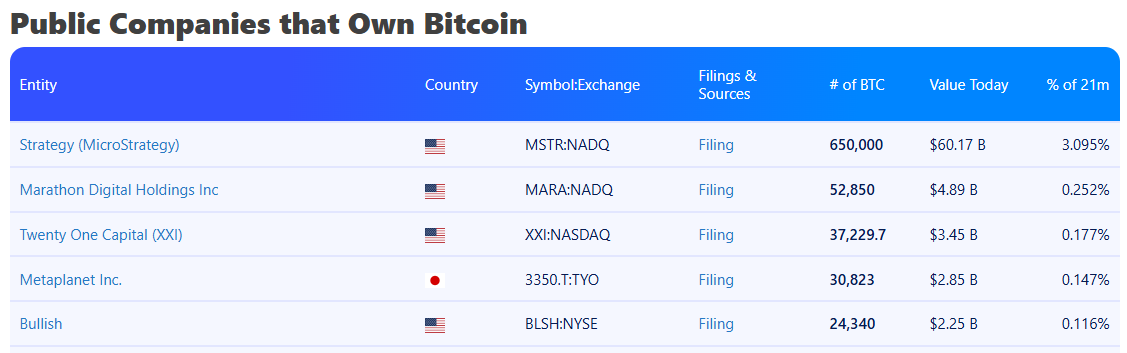
La société japonaise Metaplanet possède la quatrième plus grande trésorerie Bitcoin cotée. Source : Bitbo

Vient ensuite Nexon, un développeur de jeux vidéo sud-coréen, dont le siège est au Japon et qui détient 1 117 Bitcoin. Le top trois est complété par la société de services-conseils Remixpoint.

Une seule entreprise privée détient du Bitcoin dans son stock, Mt. Gox, l'exchange en faillite qui détient encore plus de 34 000 jetons malgré sa faillite en 2014.

Magazine : L'auteur de Mysterious Mr Nakamoto — Trouver Satoshi nuirait au Bitcoin

Related Questions

QQuel est l'objectif principal du partenariat entre Animoca Brands et Solv Protocol au Japon ?

AL'objectif principal est d'aider les grandes entreprises japonaises détentrices de Bitcoin à générer des rendements sur leurs actifs en combinant l'infrastructure de Solv et le réseau institutionnel d'Animoca Brands.

QQuel rendement annuel Solv Protocol propose-t-il aux trésoreries d'entreprise grâce à son wrapper Bitcoin ?

ASolv Protocol propose un rendement annuel compris entre 4% et 12% grâce à son wrapper universiel adossé au Bitcoin.

QComment Solv Protocol génère-t-il du rendement à partir du Bitcoin selon son livre blanc ?

ASelon son livre blanc, Solv génère du rendement grâce aux marchés du prêt, à la fourniture de liquidité aux pools AMM et à la participation à des programmes de staking structurés.

QQuelle entreprise japonaise cotée détient la plus grande trésorerie Bitcoin selon Bitbo ?

AMetaplanet est l'entreprise japonaise cotée détenant la plus grande trésorerie Bitcoin, avec environ 30 823 bitcoins à son bilan.

QQuels sont les principaux investisseurs qui soutiennent Solv Protocol ?

ASolv Protocol est soutenu par des investisseurs tels que Binance Labs et Blockchain Capital, et gère plus de 2,8 milliards de dollars d'actifs.

Related Reads

Uncovering the Truth About Agent Commerce, Payments, and Infrastructure

Decoding Agent Commerce, Payments, and Infrastructure: The Reality Over the past year, I've been building infrastructure for the Agent economy, engaging with major players like Stripe, Visa, Coinbase, Google, and dozens of startups. A clear conclusion emerges: true, large-scale demand does not yet exist. Startups face structural challenges. Data points illustrate this gap. Stripe's Agent commerce platform has over 1,000 merchants but only single-digit transacting agents. Visa's Agent payment token requires 9-month KYC and a $250M revenue threshold, accessible only to giants like Amazon. On-chain analysis reveals actual daily Agent transaction volume is around $17k, half of which are test transactions. The article analyzes four potential markets: **1. Agent-to-Merchant (A2M):** Current AI shopping UX is often inferior to traditional e-commerce for visual, comparison-heavy purchases (clothing, electronics). Chat interfaces are a step back. Real merchant interest is defensive "Agent Engine Optimization," fearing future obsolescence, not current demand. Potential exists in high-frequency, low-decision purchases (e.g., food delivery) or simplifying terrible UX (complex checkouts, non-native shoppers), but these require massive consumer distribution channels dominated by giants like DoorDash and Amazon. **2. Agent-to-API (A2A):** Developers already have subscriptions and billing for core APIs (compute, data). The argument for micro-payments via crypto for sub-dollar API calls is addressed by pre-paid balances today. The deeper issue is supplier resistance; major SaaS firms rely on enterprise contracts, not fractional cent pricing. Opportunity lies in the long tail of niche services, but this is a smaller market catering to developers, a historically low-paying group. **3. Agent-to-Agent (A2A):** This remains a theoretical long-term vision with near-zero current transaction volume. It involves unique challenges: discovery, trust, negotiation, dispute resolution. When it materializes, it will require a fundamentally new settlement infrastructure for high-speed, variable-value, multi-party transactions. It's a real long-term bet, but not the current market. **4. Agent-to-Finance (A2F):** This is the only category with existing, paying demand. Integrating AI into financial workflows (trading, portfolio management) is a natural evolution and enables new capabilities like autonomous rebalancing. However, competition favors incumbents with regulatory licenses, compliance infrastructure, and existing client relationships. **The Real Issue:** Why is infrastructure still being built? Incumbents can afford long-term bets, and payment companies see every problem as a nail for their payment hammer. However, payment is just one piece. The core challenge is *coordination*—orchestrating work between Agents and humans, verifying outcomes, and settling results. Payment is part of settlement, which is part of coordination. Companies that solve the coordination problem will subsume payments, not the other way around. Startups lack the infinite runway of giants and must find today's real market, which, after a year of exploration, lies outside these four categories—in an area with real, growing, and underserved activity.

marsbit2h ago

Uncovering the Truth About Agent Commerce, Payments, and Infrastructure

marsbit2h ago

Trading

Spot
Futures

Hot Articles

What is $BITCOIN

DIGITAL GOLD ($BITCOIN): A Comprehensive Analysis Introduction to DIGITAL GOLD ($BITCOIN) DIGITAL GOLD ($BITCOIN) is a blockchain-based project operating on the Solana network, which aims to combine the characteristics of traditional precious metals with the innovation of decentralized technologies. While it shares a name with Bitcoin, often referred to as “digital gold” due to its perception as a store of value, DIGITAL GOLD is a separate token designed to create a unique ecosystem within the Web3 landscape. Its goal is to position itself as a viable alternative digital asset, although specifics regarding its applications and functionalities are still developing. What is DIGITAL GOLD ($BITCOIN)? DIGITAL GOLD ($BITCOIN) is a cryptocurrency token explicitly designed for use on the Solana blockchain. In contrast to Bitcoin, which provides a widely recognized value storage role, this token appears to focus on broader applications and characteristics. Notable aspects include: Blockchain Infrastructure: The token is built on the Solana blockchain, known for its capacity to handle high-speed and low-cost transactions. Supply Dynamics: DIGITAL GOLD has a maximum supply capped at 100 quadrillion tokens (100P $BITCOIN), although details regarding its circulating supply are currently undisclosed. Utility: While precise functionalities are not explicitly outlined, there are indications that the token could be utilized for various applications, potentially involving decentralized applications (dApps) or asset tokenization strategies. Who is the Creator of DIGITAL GOLD ($BITCOIN)? At present, the identity of the creators and development team behind DIGITAL GOLD ($BITCOIN) remains unknown. This situation is typical among many innovative projects within the blockchain space, particularly those aligning with decentralized finance and meme coin phenomena. While such anonymity may foster a community-driven culture, it intensifies concerns about governance and accountability. Who are the Investors of DIGITAL GOLD ($BITCOIN)? The available information indicates that DIGITAL GOLD ($BITCOIN) does not have any known institutional backers or prominent venture capital investments. The project seems to operate on a peer-to-peer model focused on community support and adoption rather than traditional funding routes. Its activity and liquidity are primarily situated on decentralized exchanges (DEXs), such as PumpSwap, rather than established centralized trading platforms, further highlighting its grassroots approach. How DIGITAL GOLD ($BITCOIN) Works The operational mechanics of DIGITAL GOLD ($BITCOIN) can be elaborated on based on its blockchain design and network attributes: Consensus Mechanism: By leveraging Solana’s unique proof-of-history (PoH) combined with a proof-of-stake (PoS) model, the project ensures efficient transaction validation contributing to the network's high performance. Tokenomics: While specific deflationary mechanisms have not been extensively detailed, the vast maximum token supply implies that it may cater to microtransactions or niche use cases that are still to be defined. Interoperability: There exists the potential for integration with Solana’s broader ecosystem, including various decentralized finance (DeFi) platforms. However, the details regarding specific integrations remain unspecified. Timeline of Key Events Here is a timeline that highlights significant milestones concerning DIGITAL GOLD ($BITCOIN): 2023: The initial deployment of the token occurs on the Solana blockchain, marked by its contract address. 2024: DIGITAL GOLD gains visibility as it becomes available for trading on decentralized exchanges like PumpSwap, allowing users to trade it against SOL. 2025: The project witnesses sporadic trading activity and potential interest in community-led engagements, although no noteworthy partnerships or technical advancements have been documented as of yet. Critical Analysis Strengths Scalability: The underlying Solana infrastructure supports high transaction volumes, which could enhance the utility of $BITCOIN in various transaction scenarios. Accessibility: The potential low trading price per token could attract retail investors, facilitating wider participation due to fractional ownership opportunities. Risks Lack of Transparency: The absence of publicly known backers, developers, or an audit process may yield skepticism regarding the project's sustainability and trustworthiness. Market Volatility: The trading activity is heavily reliant on speculative behavior, which can result in significant price volatility and uncertainty for investors. Conclusion DIGITAL GOLD ($BITCOIN) emerges as an intriguing yet ambiguous project within the rapidly evolving Solana ecosystem. While it attempts to leverage the “digital gold” narrative, its departure from Bitcoin's established role as a store of value underscores the need for a clearer differentiation of its intended utility and governance structure. Future acceptance and adoption will likely depend on addressing the current opacity and defining its operational and economic strategies more explicitly. Note: This report encompasses synthesised information available as of October 2023, and developments may have transpired beyond the research period.

363 Total ViewsPublished 2025.05.13Updated 2025.05.13

What is $BITCOIN

Discussions

Welcome to the HTX Community. Here, you can stay informed about the latest platform developments and gain access to professional market insights. Users' opinions on the price of BTC (BTC) are presented below.

活动图片














