Bitcoin Most Reactive Group Faces Heavy Losses: Drawdowns Match Prior Cycle Bottoms

bitcoinistPublished on 2025-12-02Last updated on 2025-12-02

Abstract

Bitcoin is entering a decisive moment as selling pressure intensifies and uncertainty continues to grip the market. Bulls are struggling...

Trusted Editorial content, reviewed by leading industry experts and seasoned editors. Ad Disclosure

Bitcoin is entering a decisive moment as selling pressure intensifies and uncertainty continues to grip the market. Bulls are struggling to reclaim higher levels, and each failed rebound reinforces the prevailing downtrend. With momentum weakening across spot and derivatives markets, investors are increasingly questioning whether BTC can stabilize before more serious structural damage occurs.

According to a report by Darkfost, the situation is especially difficult for short-term participants. With a realized price of $113,692, the BTC 1–3 month cohort is now experiencing the largest percentage loss of this entire cycle.

This analysis focuses exclusively on the spot market, isolating a group of investors known for more speculative behavior and faster reaction times. Because these holders typically enter during strong momentum phases, their capitulation or continued holding often signals pivotal shifts in market structure.

The deep losses within this cohort reveal how aggressively the market has reversed and underscore the mounting pressure on shorter-term players. As Bitcoin approaches critical support levels, the behavior of these investors may determine whether the current correction stabilizes — or accelerates into a broader downturn.

Short-Term Holder Capitulation Often Signals Bottom Formation

Darkfost highlights that the 1–3 month Bitcoin holder cohort has now spent nearly two weeks sitting on average unrealized losses between 20% and 25%. Historically, this type of drawdown among short-term participants has tended to occur near cyclical bottom formation.

These traders typically react quickly to volatility, and when their losses reach this depth, they are pushed into a critical decision point: sell and exit the market, or hold and endure further downside.
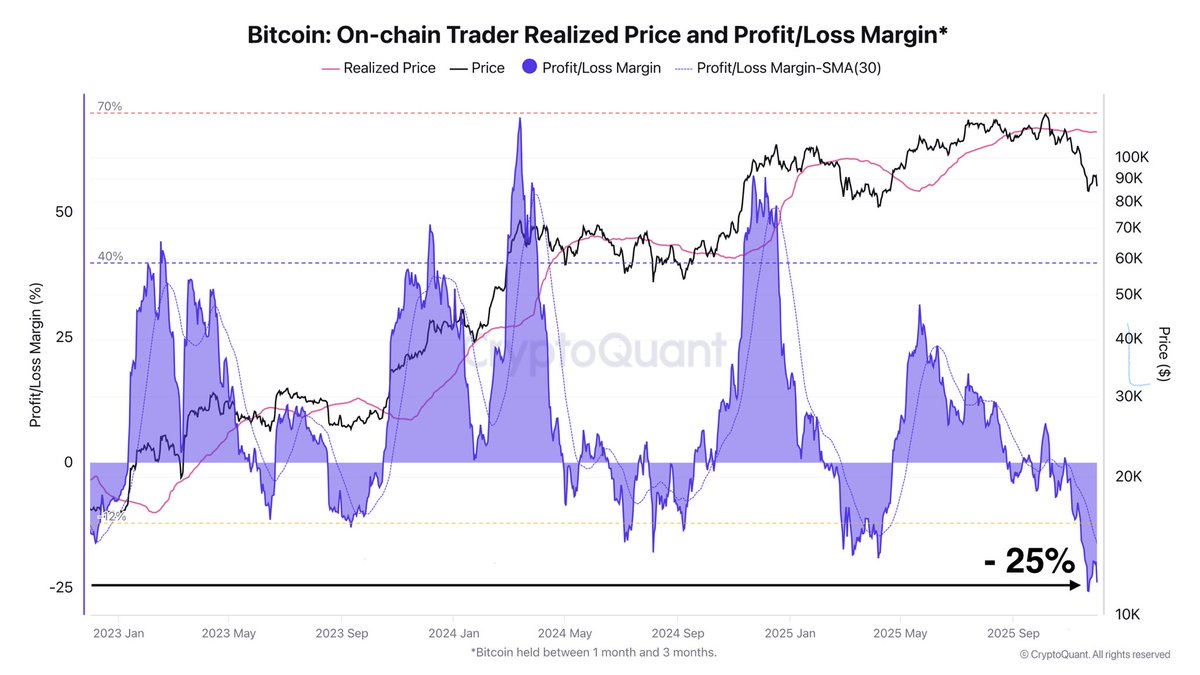
Bitcoin On-Chain Trader Realized Price and Profit/Loss Margin | Source: Darkfost
Bitcoin On-Chain Trader Realized Price and Profit/Loss Margin | Source: CryptoQuant

Throughout this cycle, similar phases of elevated losses have preceded major inflection points. Once a large portion of these speculative holders capitulates — a process that appears to have been unfolding in recent weeks — selling pressure usually begins to exhaust. This shift often creates an environment where accumulation becomes far more attractive for patient investors who track sentiment and realized-price dynamics.

However, Darkfost emphasizes that this pattern only holds if the long-term bullish trend remains intact. Structural on-chain indicators, broader demand trends, and long-horizon holder behavior continue to support the idea that Bitcoin’s macro trend has not been invalidated.

While volatility may persist in the short term, the alignment of capitulation signals with a still-intact long-term structure suggests that current levels could become an opportunity for strategic accumulation.

Bitcoin Tests Weekly Level as Market Searches for Higher-Timeframe Support

Bitcoin’s weekly chart shows the most significant corrective phase since the early stages of the cycle, with price falling sharply from the $120,000 region and now attempting to stabilize around the 100 SMA near $84,000–$85,000. This moving average has historically acted as a major structural support during bull markets, and BTC’s current interaction with it marks a critical juncture for the broader trend.
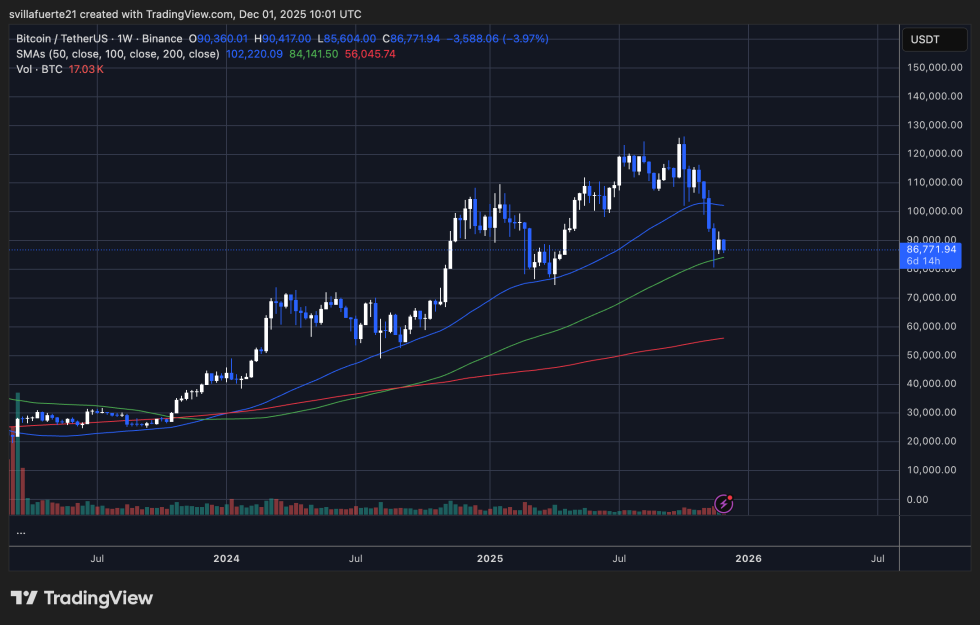
BTC testing key demand | Source: BTCUSDT chart on TradingView

The breakdown below the 50 SMA was a clear sign of weakening momentum, signaling that sellers have gained control of the higher-timeframe structure. However, the wick formed beneath the 100 SMA suggests that buyers are beginning to step in, attempting to defend this crucial zone. The reaction so far is constructive but not yet decisive — BTC needs a stronger weekly close above $90,000 to confirm stability.

Volume has increased during the decline, indicating forced selling and capitulation rather than organic trend reversal. Historically, pullbacks into the 100 SMA often precede medium-term bottoms within a long-term bullish market, but continuation depends on whether BTC can avoid a sustained weekly close below this level.

Featured image from ChatGPT, chart from TradingView.com

Editorial Process for bitcoinist is centered on delivering thoroughly researched, accurate, and unbiased content. We uphold strict sourcing standards, and each page undergoes diligent review by our team of top technology experts and seasoned editors. This process ensures the integrity, relevance, and value of our content for our readers.

Sebastian's journey into the world of crypto began four years ago, driven by a fascination with the potential of blockchain technology to revolutionize financial systems. His initial exploration focused on understanding the intricacies of various crypto projects, particularly those focused on building innovative financial solutions. Through countless hours of research and learning, Sebastian developed a deep understanding of the underlying technologies, market dynamics, and potential applications of cryptocurrencies. As his knowledge grew, Sebastian felt compelled to share his insights with others. He began actively contributing to online discussions on platforms like X and LinkedIn, focusing on fintech and crypto-related content. His goal was to expose valuable trends and insights to a wider audience, fostering a deeper understanding of the rapidly evolving crypto landscape. Sebastian's contributions quickly gained recognition, and he became a trusted voice in the online crypto community. To further enhance his expertise, Sebastian pursued a UC Berkeley Fintech: Frameworks, Applications, and Strategies certification. This rigorous program equipped him with valuable skills and knowledge regarding Financial Technology, bridging the gap between traditional finance (TradFi) and decentralized finance (DeFi). The certification deepened his understanding of the broader financial landscape and its intersection with blockchain technology. Sebastian's passion for finance and writing is evident in his work. He enjoys delving into financial research, analyzing market trends, and exploring the latest developments in the crypto space. In his spare time, Sebastian can often be found immersed in charts, studying 10-K forms, or engaging in thought-provoking discussions about the future of finance. Sebastian's journey as a crypto analyst and investor has been marked by a relentless pursuit of knowledge and a dedication to sharing his insights. His ability to navigate the complex world of crypto, combined with his passion for financial research and communication, makes him a valuable asset to the industry. As the crypto landscape continues to evolve, Sebastian remains at the forefront, providing valuable insights and contributing to the growth of this revolutionary technology.

Related Reads

Trading

Spot
Futures

Hot Articles

What is $BITCOIN

DIGITAL GOLD ($BITCOIN): A Comprehensive Analysis Introduction to DIGITAL GOLD ($BITCOIN) DIGITAL GOLD ($BITCOIN) is a blockchain-based project operating on the Solana network, which aims to combine the characteristics of traditional precious metals with the innovation of decentralized technologies. While it shares a name with Bitcoin, often referred to as “digital gold” due to its perception as a store of value, DIGITAL GOLD is a separate token designed to create a unique ecosystem within the Web3 landscape. Its goal is to position itself as a viable alternative digital asset, although specifics regarding its applications and functionalities are still developing. What is DIGITAL GOLD ($BITCOIN)? DIGITAL GOLD ($BITCOIN) is a cryptocurrency token explicitly designed for use on the Solana blockchain. In contrast to Bitcoin, which provides a widely recognized value storage role, this token appears to focus on broader applications and characteristics. Notable aspects include: Blockchain Infrastructure: The token is built on the Solana blockchain, known for its capacity to handle high-speed and low-cost transactions. Supply Dynamics: DIGITAL GOLD has a maximum supply capped at 100 quadrillion tokens (100P $BITCOIN), although details regarding its circulating supply are currently undisclosed. Utility: While precise functionalities are not explicitly outlined, there are indications that the token could be utilized for various applications, potentially involving decentralized applications (dApps) or asset tokenization strategies. Who is the Creator of DIGITAL GOLD ($BITCOIN)? At present, the identity of the creators and development team behind DIGITAL GOLD ($BITCOIN) remains unknown. This situation is typical among many innovative projects within the blockchain space, particularly those aligning with decentralized finance and meme coin phenomena. While such anonymity may foster a community-driven culture, it intensifies concerns about governance and accountability. Who are the Investors of DIGITAL GOLD ($BITCOIN)? The available information indicates that DIGITAL GOLD ($BITCOIN) does not have any known institutional backers or prominent venture capital investments. The project seems to operate on a peer-to-peer model focused on community support and adoption rather than traditional funding routes. Its activity and liquidity are primarily situated on decentralized exchanges (DEXs), such as PumpSwap, rather than established centralized trading platforms, further highlighting its grassroots approach. How DIGITAL GOLD ($BITCOIN) Works The operational mechanics of DIGITAL GOLD ($BITCOIN) can be elaborated on based on its blockchain design and network attributes: Consensus Mechanism: By leveraging Solana’s unique proof-of-history (PoH) combined with a proof-of-stake (PoS) model, the project ensures efficient transaction validation contributing to the network's high performance. Tokenomics: While specific deflationary mechanisms have not been extensively detailed, the vast maximum token supply implies that it may cater to microtransactions or niche use cases that are still to be defined. Interoperability: There exists the potential for integration with Solana’s broader ecosystem, including various decentralized finance (DeFi) platforms. However, the details regarding specific integrations remain unspecified. Timeline of Key Events Here is a timeline that highlights significant milestones concerning DIGITAL GOLD ($BITCOIN): 2023: The initial deployment of the token occurs on the Solana blockchain, marked by its contract address. 2024: DIGITAL GOLD gains visibility as it becomes available for trading on decentralized exchanges like PumpSwap, allowing users to trade it against SOL. 2025: The project witnesses sporadic trading activity and potential interest in community-led engagements, although no noteworthy partnerships or technical advancements have been documented as of yet. Critical Analysis Strengths Scalability: The underlying Solana infrastructure supports high transaction volumes, which could enhance the utility of $BITCOIN in various transaction scenarios. Accessibility: The potential low trading price per token could attract retail investors, facilitating wider participation due to fractional ownership opportunities. Risks Lack of Transparency: The absence of publicly known backers, developers, or an audit process may yield skepticism regarding the project's sustainability and trustworthiness. Market Volatility: The trading activity is heavily reliant on speculative behavior, which can result in significant price volatility and uncertainty for investors. Conclusion DIGITAL GOLD ($BITCOIN) emerges as an intriguing yet ambiguous project within the rapidly evolving Solana ecosystem. While it attempts to leverage the “digital gold” narrative, its departure from Bitcoin's established role as a store of value underscores the need for a clearer differentiation of its intended utility and governance structure. Future acceptance and adoption will likely depend on addressing the current opacity and defining its operational and economic strategies more explicitly. Note: This report encompasses synthesised information available as of October 2023, and developments may have transpired beyond the research period.

363 Total ViewsPublished 2025.05.13Updated 2025.05.13

What is $BITCOIN

Discussions

Welcome to the HTX Community. Here, you can stay informed about the latest platform developments and gain access to professional market insights. Users' opinions on the price of BTC (BTC) are presented below.

活动图片