内斗、丑闻、股价脚踝斩:DAT 还能靠什么续命?

比推Published on 2025-11-29Last updated on 2025-11-29

ALT5 Sigma 正在经历一场典型的“DAT 修罗场”。
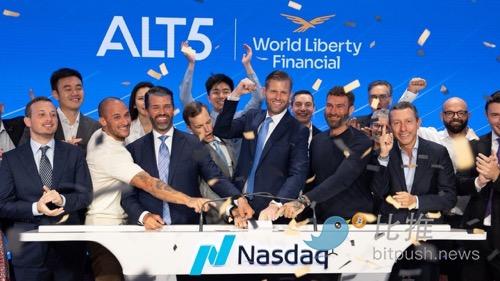
image.png

这家在纳斯达克上市、原本主营区块链金融基础设施的公司,今年 8 月高调宣布转型为数字资产金库(Digital Asset Treasury,DAT)公司,计划筹集高达15亿美元的资金,押注由特朗普家族站台的 World Liberty Financial(WLFI)治理代币。

然而仅三个月,反噬便迅猛而来:股价从9美元暴跌近八成,一度跌破2美元。
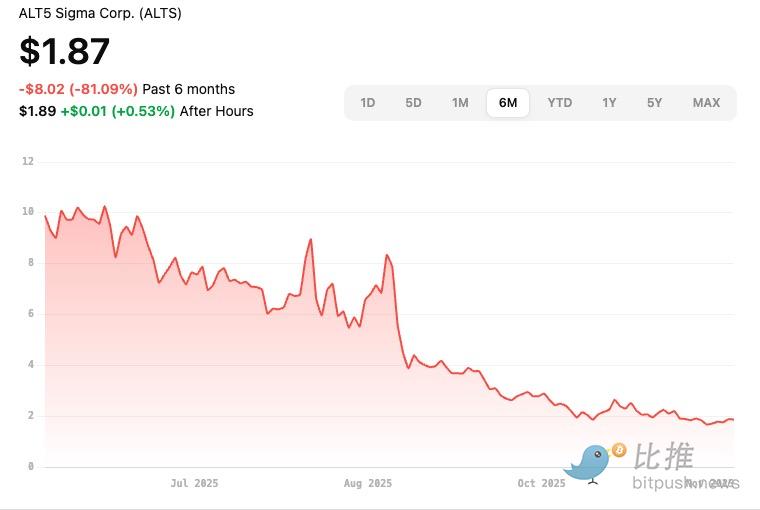
image.png

CEO 被内部停职,员工收到“公司可能面临诉讼和监管调查”的预警;更糟糕的是,据《The Information》报道,ALT5被爆出旗下子公司在卢旺达涉嫌洗钱罪名,而这一关键信息在 World Liberty 交易谈判与对外宣传阶段,并未充分披露给董事会与投资者。

ALT5 更像是把 DAT 模式所有风险踩了一遍的“放大样本”:内部治理混乱、对单一代币的极端集中暴露、信息披露滞后乃至缺失、监管阴影下的股价坍塌。

但 ALT5 不是孤例,而是 2025 年整个 DAT 行业从“财富神话”走向“一地鸡毛”的缩影。

从 4 家到 142 家的爆炸式增长,再到分化

ALT5 的风波引发关注的更深层原因是:DAT 的数量与规模已经在 2025 年迎来“指数级增长”。
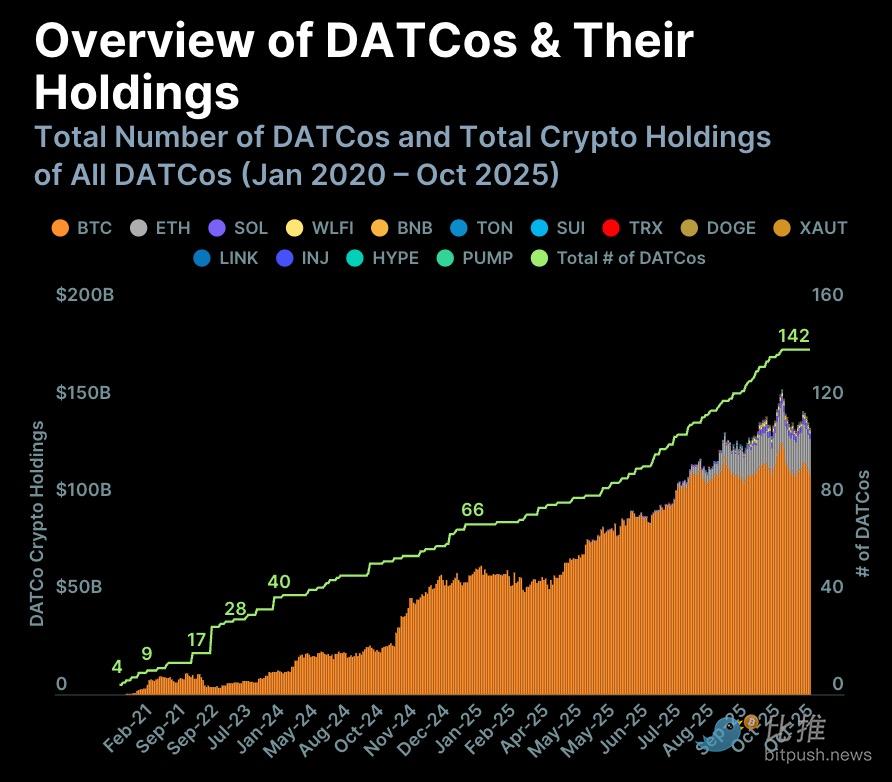
image.png

CoinGecko 11 月发布的《Digital Asset Treasury Companies(DATCo)》报告显示:

  • DAT 公司数量从 2020 年的 4 家暴增到 2025 年的 142 家;

  • 仅 2025 年就新增 76 家,为历史最高;

  • “纯金库型” DAT 普遍模仿的是 2020 年开始重仓 BTC 的 Strategy(原 MicroStrategy)模式;

  • 绝大多数 DAT 资产为比特币

    • 持有 BTC 的公司 ≈ 142 家

    • 持有 ETH 的公司 = 15 家

    • 持有 SOL 的公司 = 10 家

这意味着:DAT = 以 BTC 为核心资产的行业。
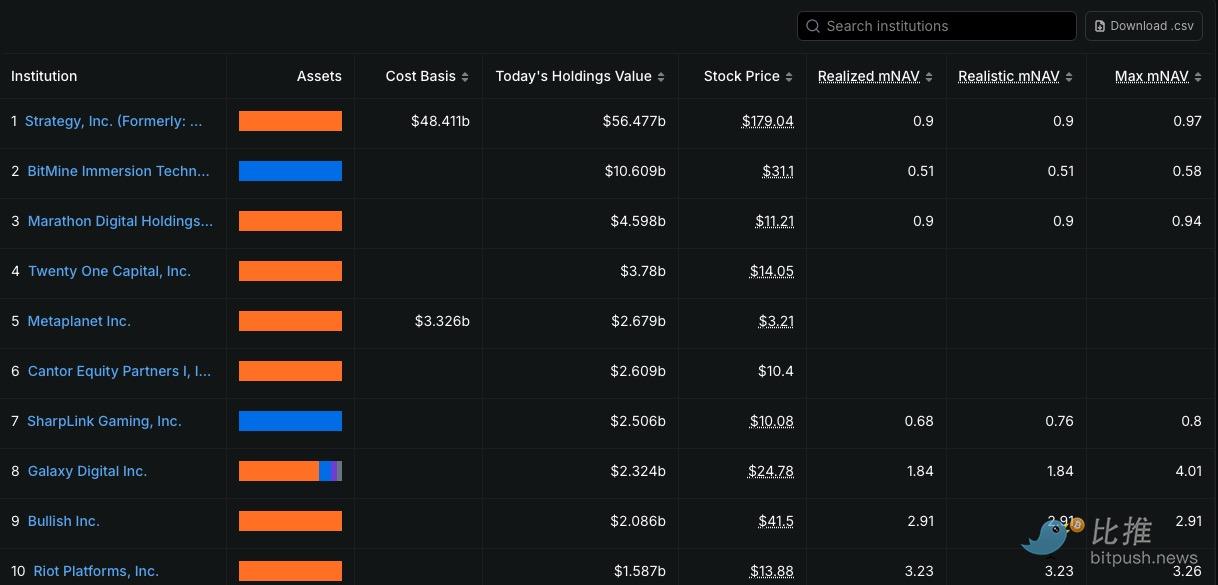
image.png

DefiLlama 的最新数据显示:

  • Strategy 仍是全球最大 DAT,持有 BTC 价值达 566 亿美元;

  • 第二名为Tom Lee 创立的 BitMine,持有 ETH 与 BTC 合计约 106 亿美元。

可见,DAT 并非单边散乱,而是呈现“头部极大 + 长尾极广”的典型结构。

然而在规模爆发的背后,风险也正在积累。今年以来,DAT 公司整体市值在加密资产回调的背景下,从高点 1760 亿美元跌至不足千亿美元,蒸发超过 770 亿美元。

在 2025 年上半年,比特币多次创新高,DAT 公司普遍呈现出高 Beta 特征:主流金库股涨幅常常是比特币涨幅的数倍,一些叙事更强的“Altcoin 金库股”甚至出现十倍级上涨。

但随着 10 月进入政策与流动性双重收紧期,加密市值蒸发近万亿美元,DAT 的股价开始后知后觉地集体补跌。Strategy 在 11 月单月跌幅超过 36%,Metaplanet 较年内高点回撤近 80%,ALT5 更成为样本级“暴跌股”。

这一轮下跌也暴露出 DAT 的核心脆弱性:它们的“价值支撑”并非传统意义上的现金流和经营业务,而是金库里的加密资产。

随着价格回调,市值与金库价值会同步缩减,而融资能力、偿债能力和叙事热度也随之快速衰退。
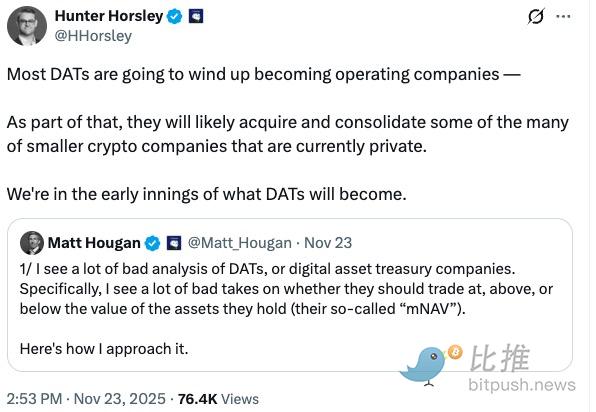
image.png

Bitwise CIO Matt Hougan 在日前的推文中指出,今年前六个月,DAT 股价呈现高度同步涨跌,很像一篮子“加密高杠杆指数”;但往后则会分化,“能够持续提升每股持币量的公司,会走向溢价交易;管理能力弱、资产结构差的 DAT 将持续折价,乃至面临被收购甚至清算。”

换句话说,DAT 的同质化狂飙期已经结束,行业正在步入“分化筛选期”。

分化背后的真相:估值错觉、mNAV 与隐藏风险

DAT 的估值体系一直依赖一个重要指标:mNAV(market NAV)
即:金库资产的账面价值折算成每股,再与股价对比,看公司是否“折价”。

但多家行业机构明确指出:
mNAV 会制造“虚假安全感”。

Galaxy Digital 在 7 月的报告中强调:
账面写着持有多少币,并不代表能按这个价格卖出。尤其 Altcoin 金库,流动性差、滑点大,抛售本身就是价格灾难。

Animoca Brands 指出:
mNAV 完全忽略了 DAT 的负债结构。许多公司依赖可转债与 PIPE 融资,账面金库虽大,但真正属于股东的部分被不断稀释。

Breed VC 则提醒
没有主营业务的 DAT,经营亏损会持续吞噬金库价值,账面资产看着亮眼,实际自由资产一年比一年少。

Bitwise CIO Matt Hougan 补充:
DAT 的成本和风险是“随时间复利增长”的,而不是静态的。

对于普通投资者来说,mNAV 的问题可以简单理解成四句话:

  • 账面价值 ≠ 可兑现的价值

  • 金库资产 ≠ 股东可以拿到的资产

  • 负债、稀释和费用会侵蚀金库

  • 治理和监管事件能让折价瞬间变成陷阱

因此,mNAV 只能作为起点,而不是 DAT 的“价值锚”,结构性风险”才是最重要的主线。

换句话说,DAT 行业正在被倒逼“回归经营逻辑”——规模、现金流、治理和透明度,正在成为新的竞争壁垒。

DAT 如何自救

面对股价暴跌与监管压力,DAT 公司正在尝试不同的自救路径。

一个最常见的动作是直接抛售部分金库资产,以缓解债务或维持运营。例如,日本 Metaplanet 在今年秋季股价大幅下跌后,就出售了部分比特币头寸,用以偿付短期负债,其股价也因此短暂止血。不过这种做法只能解决当下的问题,却削弱了“金库故事”本身,难以恢复长期信心。

与此相反,一些资金实力较强的公司选择复制 Strategy 的路径–在回调中继续增持。Strategy(前 MicroStrategy)在过去两轮下跌中都通过可转债继续买入 BTC,使得“每股持币量”反而逆势上升,这让它在 2024–2025 年的反弹中成为行业里最早恢复溢价的企业。类似的策略也被 BitMine 等更大规模的 DAT 采纳,但对中小公司而言,这条路需要强融资能力支撑,失败成本极高。

另一种趋势则更接近“转型自救”。部分矿业系 DAT,例如 Core Scientific、Hut 8 和 Iris Energy,正在将算力或技术能力外包给 AI、节点、清算和托管业务,以减少对单一币价的依赖。它们开始从“金库驱动的估值”向“现金流驱动的估值”过渡,虽然转型尚处早期,但至少为金库股提供了新的叙事支点。

监管的压力同样在改变 DAT 的行为方式。今年以来,美国 SEC 已要求多家 DAT 详细披露金库定价方式、可转债结构与审计安排。受到监管信号影响,Strategy 和 BitMine 等大型 DAT 已开始引入更频繁的金库证明,甚至与四大合作做即时审计。透明度的提升虽带来短期成本,却可能成为未来唯一能换取投资者信任的路径。

总体而言,DAT 的“自救”正在走向三条截然不同的道路:

  • 能够持续融资的公司选择逆势加仓,试图延续“增长型金库”的故事;

  • 拥有技术或资源禀赋的公司则向运营能力转型,努力摆脱对币价的单一依赖;

  • 而缺乏现金流与融资渠道的中小 DAT,只能通过抛售资产维持生存。

行业的运行逻辑已从“只要买币就能上涨”转向“规模、透明度与治理能力的硬实力竞争”。

未来真正能够穿越周期的 DAT,很可能是那些持有高度流动性的核心资产、拥有稳定业务与收购能力、并能在治理与披露上持续提升的公司。

而更多的中小 DAT,在失去流动性、融资和叙事之后,终将在市场波动与监管收紧的夹缝中被淘汰。
这意味着,随着狂飙时代的终结,DAT 行业正在迎来一场真正的“生死赛跑”——
谁能活下来?要靠金库之外的东西。

作者:Seed.eth


Twitter:https://twitter.com/BitpushNewsCN

比推 TG 交流群:https://t.me/BitPushCommunity

比推 TG 订阅: https://t.me/bitpush
说明: 比推所有文章只代表作者观点,不构成投资建议

Related Reads

How Many Tokens Away Is Yang Zhilin from the 'Moon Chasing the Light'?

The article explores the intense competition between two leading Chinese AI companies, DeepSeek and Kimi (Moon Dark Side), and the mounting pressure on Yang Zhilin, the founder of Kimi. While DeepSeek re-emerged after 15 months of silence with its powerful V4 model—boasting 1.6 trillion parameters and low-cost, long-context capabilities—Kimi has been focusing on long-context processing and multi-agent systems with its K2.6 model. Yang faces a threefold challenge: technological rivalry, commercialization pressure, and investor expectations. Despite Kimi’s high valuation (reaching $18 billion), its revenue heavily relies on a single product with low paid conversion rates, while DeepSeek’s strategic silence and open-source influence have strengthened its market position and valuation prospects, now targeting over $20 billion. Both companies reflect broader trends in China’s AI ecosystem: Kimi aims for global influence through open-source contributions and agent-based advancements, while DeepSeek prioritizes foundational innovation and hardware independence, notably shifting to Huawei’s chips. Their competition is seen as vital for China’s AI progress, with the gap between top Chinese and U.S. models narrowing to just 2.7% on the Elo rating scale. Ultimately, the article argues that this rivalry, though anxiety-inducing for leaders like Zhilin, is essential for driving innovation and solidifying China’s role in the global AI landscape.

marsbit47m ago

How Many Tokens Away Is Yang Zhilin from the 'Moon Chasing the Light'?

marsbit47m ago

TechFlow Intelligence Bureau: ChatGPT Helps Amateur Mathematician Crack 60-Year-Old Problem, CFTC Sues New York Regulator Over Coinbase and Gemini

An amateur mathematician, with the assistance of ChatGPT, has solved a combinatorial mathematics puzzle originally proposed by Hungarian mathematician Paul Erdős in the 1960s. This marks another milestone in AI-aided mathematical research, demonstrating the evolving capabilities of large language models in formal reasoning. In other AI developments, OpenAI introduced a new privacy filter tool for enterprise API usage, automatically screening sensitive data. Meanwhile, the Qwen3.6-27B model achieved 100 tokens per second on a single RTX 5090 GPU using quantization, significantly lowering the cost barrier for local AI deployment. In crypto and Web3, the U.S. CFTC sued New York’s financial regulator, challenging its oversight of Coinbase and Gemini—a first-of-its-kind federal-state regulatory clash. Following a vulnerability, KelpDAO and major DeFi protocols established a recovery fund. Tether froze $344 million in assets linked to Iran’s central bank upon U.S. Treasury request, highlighting the centralized control risks in stablecoins. Separately, Litecoin underwent a 3-hour chain reorganization to undo a privacy-layer exploit. In the U.S., former President Trump invoked the Defense Production Act to address power grid bottlenecks affecting AI data centers and dismissed the entire National Science Board, raising concerns over research independence. A retail trader gained 250% on a $600k Intel options bet amid AI-related speculation. Xiaomi announced its first performance electric vehicle, targeting rivals like Tesla. Meanwhile, iPhone users reported devices automatically reinstalling a hidden app daily, suspected to be MDM-related. A Chinese securities report noted that A-share institutional crowding has reached its second-longest streak since 2007, signaling high valuations and potential style rotation. The day’s developments reflect a dual narrative: AI is enabling unprecedented individual breakthroughs, while centralized power structures—whether governmental or corporate—are becoming more assertive, underscoring that decentralization is as much a political-economic challenge as a technical one.

marsbit1h ago

TechFlow Intelligence Bureau: ChatGPT Helps Amateur Mathematician Crack 60-Year-Old Problem, CFTC Sues New York Regulator Over Coinbase and Gemini

marsbit1h ago

Trading

Spot
Futures
活动图片