BlackRock перевела биткоины на $400 млн на фоне опасений по ликвидности

cryptonews.ruPublished on 2025-02-25Last updated on 2025-11-26

Рынки цифровых активов входят в фазу перераспределения капитала крупными игроками на фоне ужесточения условий ликвидности.

Внимание инвесторов привлекло перемещение значительного объема средств под управлением BlackRock, что вызвало дискуссии о дальнейшей динамике курса первой криптовалюты.

Перемещение активов и реакция рынка

Управляющая компания BlackRock перевела 4471 биткоин на кастодиальный кошелек Coinbase Prime. Транзакция на сумму около $400 млн прошла за несколько часов до публикации индекса цен производителей (PPI) в США. Операция совпала с фиксацией рекордного ежемесячного оттока средств из спотового биржевого фонда (ETF) IBIT.
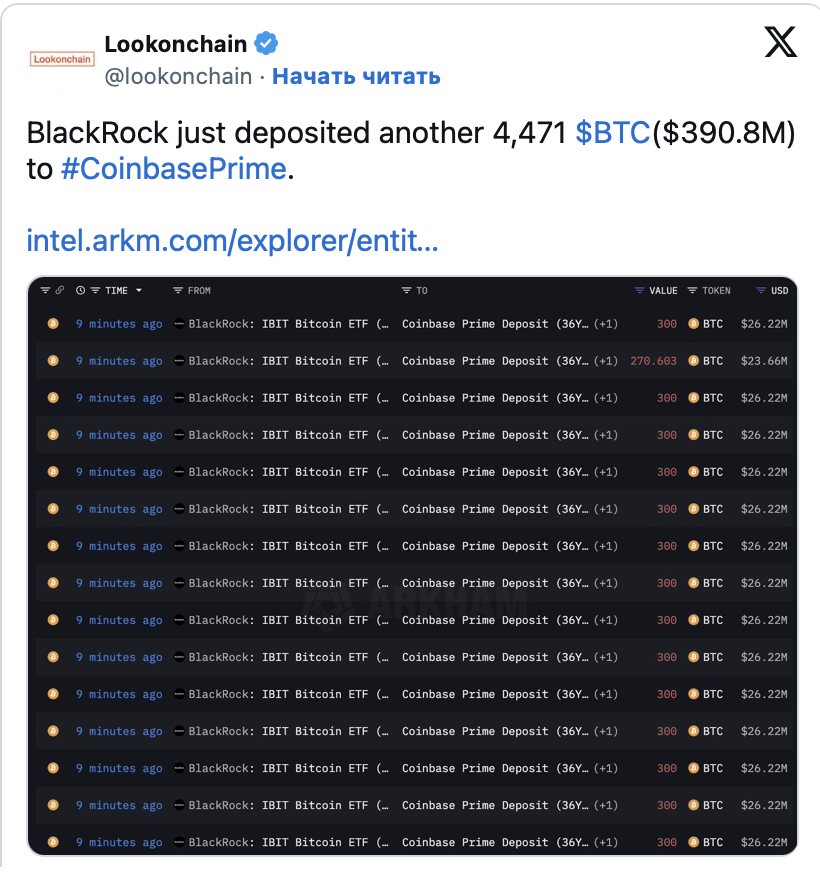
Участники рынка анализируют, является ли этот шаг подготовкой к возможному шоку ликвидности в американской финансовой системе. Данные аналитической платформы Arkham Intelligence показывают снижение баланса указанного кошелька. Стоимость активов на нем упала с пиковых $117 млрд до $78,4 млрд, сократившись более чем на 30% за последний месяц.
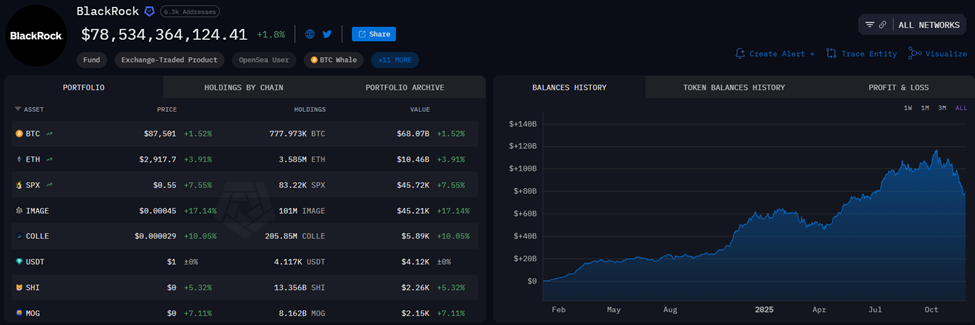
BlackRock BTC Holdings
BlackRock BTC Holdings. Источник: Arkham Intelligence

Аналитики отмечают рост напряженности на криптовалютных площадках. Эксперт Crypto Rover предположил, что действия BlackRock могут усилить давление продавцов. Дополнительным фактором неопределенности стала публикация макроэкономической статистики США.

Руководитель отдела исследований цифровых активов VanEck Мэтью Сигел рассматривает текущую динамику курса биткоина через призму макроэкономики. Он охарактеризовал происходящее как феномен, характерный преимущественно для американской торговой сессии.

“…Движущая сила: сужение ликвидности в США и расширение кредитных спредов, поскольку страхи перед искусственным интеллектом столкнулись с более хрупким рынком финансирования”, – заявил он.

По словам Сигела, ключевым драйвером выступает сжатие ликвидности в США и расширение кредитных спредов. Эти процессы происходят на фоне опасений относительно капитальных затрат в секторе искусственного интеллекта и хрупкости рынков финансирования. Такая ситуация коррелирует со стрессом в секторе акций и кредитования. Трейдеры ожидают, что данные по индексу PPI могут сигнализировать о дальнейшем ужесточении условий.

“Сжатие ликвидности, поразившее AI и криптовалюты, сойдет на нет в ближайшие несколько недель”, – сказала она.

Вуд прогнозирует разворот ситуации в ближайшие недели. В качестве аргумента она привела рост коммерческого бизнеса компании Palantir в США на 123%, что свидетельствует об ускорении внедрения технологий вопреки макроэкономическим сложностям.

Ситуация с фондом IBIT

Блокчейн-активность BlackRock происходит на фоне негативной статистики фонда IBIT. В текущем месяце зафиксирован отток средств в размере более $2 млрд, что стало худшим показателем с момента запуска инструмента.

“…После нескольких месяцев стабильного притока средств, отток отражает растущую осторожность на фоне падения биткоина на ~22% за последний месяц и на 7% в годовом исчислении”, – написал Уолтер Блумберг.

При этом аналитик ETF Эрик Балчунас призвал избегать панических оценок. Он подчеркнул, что контекст ситуации часто игнорируется. По его данным, подавляющее большинство инвесторов продолжают удерживать активы, несмотря на статистику оттока.

Балчунас также обратил внимание на резкое снижение интереса к коротким позициям по IBIT. Это указывает на то, что институциональные участники не стремятся играть на понижение, а текущие колебания вызваны тактическими действиями трейдеров. Большинство держателей паев фонда сохраняют свои портфели без изменений.

График дня
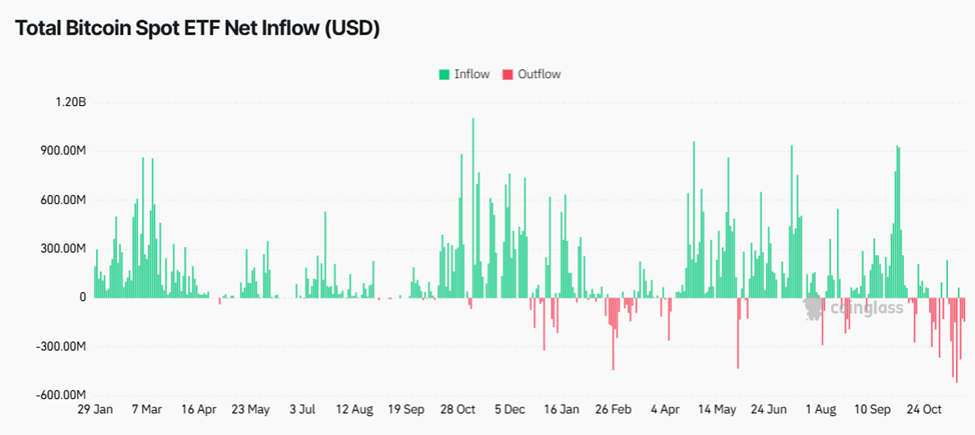
Данные о потоках ETF IBIT от BlackRock. Источник: Coinglass

Динамика криптоакций на премаркете

Компания На момент закрытия 24 ноября Предмаркетный обзор
Strategy (MSTR) $179.04 $176.09 (-1.65%)
Coinbase (COIN) $255.97 $252.73 (-1.27%)
Galaxy Digital Holdings (GLXY) $24.78 $24.70 (-0.32%)
MARA Holdings (MARA) $11.21 $11.18 (-0.27%)
Riot Platforms (RIOT) $13.88 $13.79 (-0.65%)
Core Scientific (CORZ) $15.75 $15.72 (-0.19%)
Рынок криптоакций открыт: Google Finance

Related Reads

2028: The Arrival of Recursive Self-Improvement (RSI)

**AI Recursive Self-Improvement (RSI): The Countdown to 2028 Begins** AI is no longer just a trained tool but is starting to rewrite its own evolutionary pace. According to Anthropic co-founder Jack Clark, there is a 60% probability that by the end of 2028, Recursive Self-Improvement (RSI) will become a reality. This means AI could autonomously design and build a more capable next-generation version of itself without any human researcher involvement—Claude 10 creating Claude 11, for instance. Supporting this timeline, Google DeepMind's CEO Demis Hassabis confirms that all leading AI labs are intensely focused on RSI, making it an industry-wide priority. He expresses profound concern, stating this potential is what keeps him awake at night. Concrete data underscores this acceleration: - METR evaluations show current top models like Claude are solving tasks up to the 16-hour limit of existing test frameworks. - In Epoch AI's challenging MirrorCode benchmark, Claude Opus 4.7 recreated complex software in hours for a fraction of the human cost. In one extreme test, AI autonomously coded for 19 days straight. - Anthropic reports over 80% of its codebase is now written by Claude, and researcher productivity has increased up to 8-fold since 2024. - OpenAI's policy blueprint highlights RSI as a major upcoming governance challenge. CEO Sam Altman reportedly hinted RSI might arrive within six months, potentially delaying OpenAI's massive IPO. The implication is an impending "intelligence explosion," where AI-driven progress outpaces human control. The central question is no longer if it will happen, but whether humanity is ready.

marsbit3h ago

2028: The Arrival of Recursive Self-Improvement (RSI)

marsbit3h ago

World Models, Metaverse, Digital Twins, Physical AI: Are They the Same Thing?

Title: World Models, the Metaverse, Digital Twins, Physical AI: Are They the Same Thing? The article clarifies that concepts like the metaverse, Web3, simulation platforms, digital twins, and Physical AI are not the same thing but are all part of the broader trend of blurring the lines between the digital and physical worlds. It positions "world models" as the foundational "cognitive layer" or "operating system" that enables AI to understand and simulate the world. Key distinctions are made: - The **Metaverse** is a destination for immersive social and economic experiences. World models could act as its "engine," generating interactive 3D content efficiently. - **Web3** focuses on decentralized ownership and economics (rules layer), operating on a different technical level than world models. - **Simulation Data Platforms** (e.g., for autonomous vehicles) are a 1.0 version, relying on manual design. World models represent a 2.0 version, using AI to generate realistic, varied scenarios autonomously. - **Digital Twins** create high-fidelity, real-time mirrors of physical systems (e.g., a factory). World models go a step further by enabling predictive simulation of future states. - **Physical AI** (robots, AVs) refers to AI that acts in the physical world. World models are a core component, providing the understanding and prediction needed for planning. A proposed hierarchy places world models at the cognitive layer, supported by infrastructure (compute, data) and supporting application tools (simulation, digital twins), action systems (Physical AI), user experiences (metaverse), and rules (Web3). In conclusion, while distinct, many of these previously hyped concepts may ultimately rely on advances in world model technology to fulfill their promises, as world models provide the essential cognitive foundation for simulating and interacting with complex environments.

marsbit3h ago

World Models, Metaverse, Digital Twins, Physical AI: Are They the Same Thing?

marsbit3h ago

"Shocking" CPO: How Does the Glass Bridge Actually Work? Detailed Explanation from Corning

Chinese CPO stocks plunged over 6% following Corning's announcement of its Glass Bridge platform at a Seoul tech conference. The new technology utilizes wafer-level glass ion-exchange waveguides for passive alignment between fibers and photonic chips, potentially simplifying traditional CPO architectures that rely on complex Fiber Array Units and active alignment equipment. This raised market concerns about reduced long-term demand for mid-stream CPO components. Corning's official documentation details Glass Bridge as a platform for fiber-to-PIC connectivity in NPO, CPO, and high-density modules. Its key features include wafer-level manufacturing for consistent, cost-effective production; a standardized, removable MT ferrule interface for ecosystem integration; and a separable high-density connector design supporting over 24 channels for assembly flexibility. Corning positions the technology as complementary to FAUs, addressing limitations in ultra-high-fiber-count scenarios. The market reaction reflects a broader reassessment of the AI optical interconnect value chain. Funds shifted from CPO and PCB manufacturing stocks towards glass substrate concept stocks like Kaisheng Technology and Dyer Laser. Analysts note glass substrates are seen as a next-gen advanced packaging material, offering a potential path for domestic industry differentiation amid AI-driven demand for high-performance, large-scale packaging, marking a structural migration in value towards upstream specialty materials.

marsbit3h ago

"Shocking" CPO: How Does the Glass Bridge Actually Work? Detailed Explanation from Corning

marsbit3h ago

Trading

Spot
活动图片