Рост вероятности снижения ставки ФРС в декабре обнадежил биткоин‑инвесторов

cryptonews.ruPubblicato 2025-08-21Pubblicato ultima volta 2025-11-22

Активность представителей сообщества биткоина в социальных сетях заметно возросла сегодня после того, как вероятность снижения процентной ставки ФРС США в декабре почти удвоилась по сравнению с показателями предыдущего дня.

Некоторые участники криптовалютного рынка предполагают, что это может стать катализатором для остановки нисходящего тренда.

«Посмотрим, достаточно ли этого для формирования дна», — написал в публикации на X крипоаналитик Мориц.

На момент публикации цена биткоина составляла $83 926, потеряв 12,54% за последние семь дней.

В пятницу вероятность снижения процентной ставки на декабрьском заседании Федерального комитета по операциям на открытом рынке почти удвоилась и достигла 69,40% согласно данным CME FedWatch. Еще в четверг этот показатель был на 30,30% ниже и составлял 39,10%.


Вероятность снижения ставки ФРС США выросла на 30,30% в пятницу. Источник: CME Group

Многие на рынке связали этот скачок с мягкими заявлениями президента Федерального резервного банка Нью-Йорка Джона Уильямса. Он допустил, что ФРС может снизить ставки «в ближайшей перспективе» без угрозы для целевых показателей инфляции. По мнению аналитика Bloomberg Джо Вайзенталя, именно это стало причиной значительного роста вероятностей.

Аналитик: ситуация выглядит «невероятно бычьей»

Однако экономист Мохамед Эль-Эриан призвал участников рынка не преувеличивать значение этих комментариев. В то же время более широкое криптосообщество отреагировало еще более оптимистично.

«Обычно это было бы по-бычьи», — написал Mister Crypto в публикации на X.

Снижение ставки ФРС обычно поддерживает более рискованные активы, такие как биткоин и весь криптовалютный рынок, поскольку традиционные активы, вроде облигаций и срочных вкладов, становятся менее привлекательными для инвесторов.
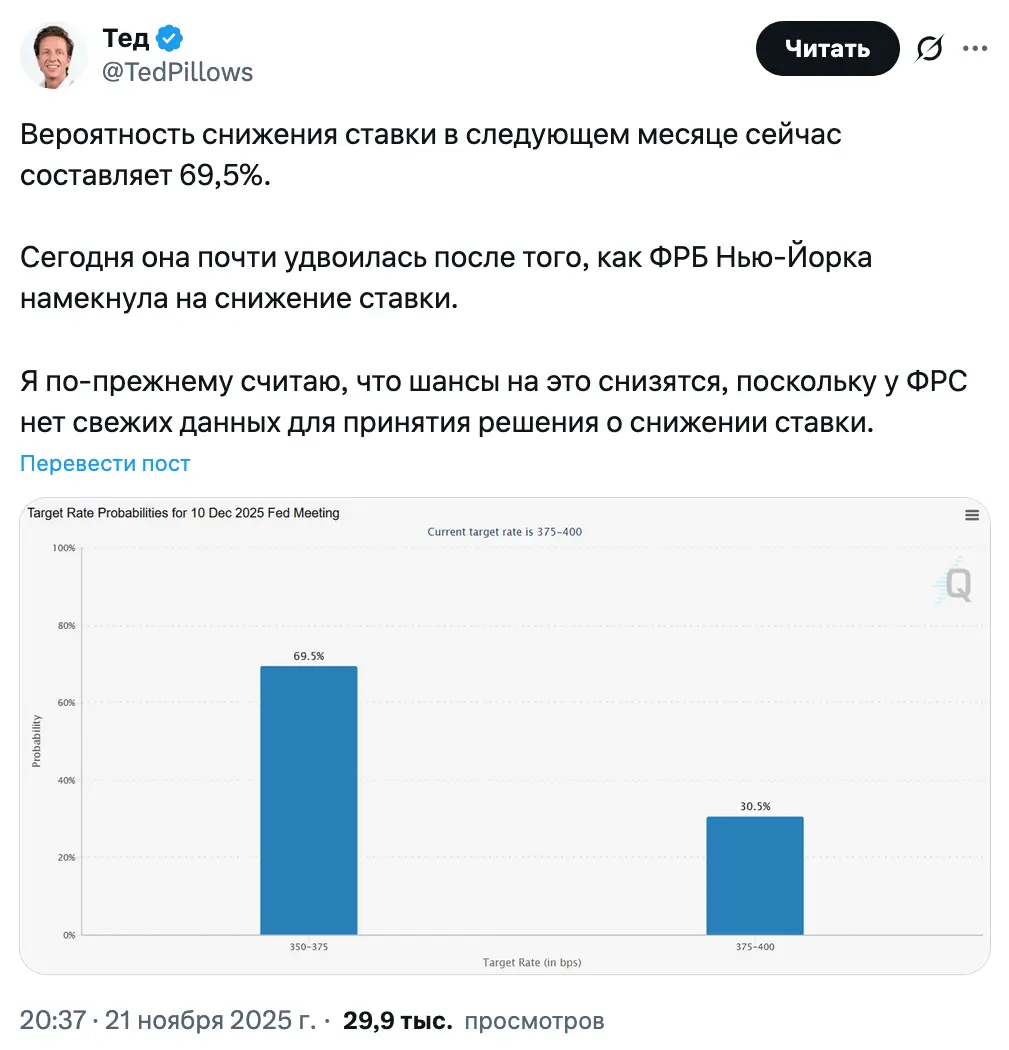

Источник: Тед.

Криптоаналитик Джесси Эккель указал на резкий рост вероятности снижения ставки и заявил: «Если смотреть шире, ситуация невероятно бычья».

«Не понимаю, почему мы продолжаем снижаться, — добавил Эккель. — Мы переходим от цикла ужесточения к циклу смягчения».

Криптоаналитик Кёрб предрек: «Криптовалюты взорвутся массовым ралли».

Вероятность снижения ставки ранее была «недооценена»

В своем заявлении Coinbase Institutional отметила:

«Хотя рынки склоняются к варианту „без снижения“ на этот раз, мы считаем вероятность снижения ставки недооцененной. Недавние исследования пошлин, данные частного рынка и индикаторы инфляции в реальном времени свидетельствуют об обратном».

«После октябрьского заседания FOMC фьючерсы сместились от ожидания снижения на 25 б.п. к сохранению ставки, в основном из-за растущих опасений по поводу инфляции», — пояснили в компании.

«Однако исследования показывают, что повышение пошлин может снизить инфляцию и увеличить безработицу в краткосрочной перспективе, действуя как негативный шок спроса», — заключили в Coinbase Institutional.

Эти события развиваются на фоне сохраняющихся слабых настроений на всем криптовалютном рынке в течение последних семи дней. Индекс страха и жадности, измеряющий общие настроения на крипторынке, показал значение «чрезвычайный страх», равное 14, в своем обновлении в пятницу.
Letture associate

Upbit is Anxious: A Hasty Counterattack Aimed at Regaining Stablecoin Market Share

Title: Upbit's Rushed Counterattack to Reclaim Stablecoin Market Share Facing a dramatic shift in South Korea's stablecoin market, leading exchange Upbit launched a promotional campaign from July 26 to August 9, waiving the 0.05% trading fee for stablecoins paired with the Korean Won (KRW) and rapidly listing new stablecoins like RLUSD and USDG. This move is a direct response to its plummeting market share in this sector. Historically a duopoly with Bithumb, the market has been reshaped since October 2025 when Coinone permanently removed fees for USDC trading. By June 2026, Coinone led with 34.8% of stablecoin volume, followed by Bithumb (31.1%) and Upbit (30.1%). This contrasts sharply with the overall crypto market, where Upbit commands 60%. The data shows stablecoin demand is highly sensitive to fees, as users primarily buy them to transfer capital overseas for derivatives trading or forex arbitrage. South Korean exchanges have seen a net outflow of stablecoins for 18 consecutive months, totaling approximately 14.9 trillion KRW, underscoring their role as a cross-border capital conduit. Upbit's limited-time promotion initially boosted its daily stablecoin volume by 162%, but the surge was almost entirely in USDT (98.1% of volume). The newly listed stablecoins saw negligible, fleeting interest. Furthermore, the promotional effect quickly waned in the second week, with volume dropping 33% on weekdays. A concurrent weakening of the KRW also contributed to the trading spike, independent of the fee waiver. The analysis suggests that once the promotion ends, Upbit is unlikely to retain its temporary gains unless it matches Coinone's permanent zero-fee policy, forcing a choice between market share and fee revenue. Upbit's strategic push may be less about immediate profit and more about preparing for future regulatory shifts. With South Korea's *Digital Asset Basic Act* on the horizon, which will regulate KRW-backed stablecoins, and following Dunamu's (Upbit's parent) integration into Naver Financial to build a payment ecosystem, securing a dominant position in the dollar stablecoin distribution channel holds long-term strategic value. However, potential regulatory conflicts could prevent Upbit from listing a future Naver-issued KRW stablecoin, making the current fight for dollar stablecoin flow even more critical.

marsbit5 h fa

Upbit is Anxious: A Hasty Counterattack Aimed at Regaining Stablecoin Market Share

marsbit5 h fa

Michael Saylor Compares Bitcoin and Gold!

Michael Saylor, founder of MicroStrategy, argues that Bitcoin fundamentally changes how wealth is stored and transferred by transforming digital scarcity into economic value. He describes Bitcoin as the first digital monetary network, combining computers, digital networks, and cryptography. It digitizes monetary assets, allowing their supply to be controlled by public protocols rather than institutions, thus converting economic value into information transmissible over global networks. Comparing Bitcoin to gold, Saylor states that while increasing Bitcoin's supply is harder, its integration with software and transfer is easier. He highlights Bitcoin's proof-of-work mechanism, which ties it to the physical world by consuming real energy to secure the ledger, making past transactions immutable. This creates a shared security system involving miners, energy companies, and investors. Saylor suggests "digital monetary energy" is a more accurate term than "digital gold." He emphasizes that the Bitcoin network is an adaptive ecosystem of miners, nodes, developers, and users. Its core design is intentionally simple, focused on maintaining a secure ledger for scarce digital assets, with complex functionalities built in higher-layer applications. This architecture allows Bitcoin to serve as a foundation for transmitting value and fostering innovation in payments and financial services. Saylor notes Bitcoin's deeper impact lies in creating digital sovereignty, where private keys give individuals permissionless control over their economic power, with ownership verified mathematically, not by institutions. He concludes that while gold's physical scarcity makes it money, Bitcoin's digital scarcity does the same, characterizing Bitcoin as the monetary energy of the digital age.

cryptonews.ru6 h fa

Michael Saylor Compares Bitcoin and Gold!

cryptonews.ru6 h fa

Trading

Spot
活动图片