Ethereum Developer Consensys Inches Closer To IPO: Report

bitcoinistPublished on 2025-10-30Last updated on 2025-10-30

Abstract

Consensys, the Ethereum infrastructure firm best known for building the MetaMask wallet and the Infura developer toolkit, has quietly taken...

Trusted Editorial content, reviewed by leading industry experts and seasoned editors. Ad Disclosure

Consensys, the Ethereum infrastructure firm best known for building the MetaMask wallet and the Infura developer toolkit, has quietly taken the next formal step toward going public, selecting JPMorgan and Goldman Sachs to lead work on a planned initial public offering, according to Axios. The move places one of the most systemically important companies in the Ethereum ecosystem on a path toward public market scrutiny and capital access after nearly a decade of operating as a privately held, founder-controlled Web3 software company.

Ethereum’s Consensys Gears Up For IPO

The reported bank mandate is the clearest signal so far that Consensys is positioning itself to test US equity markets in the post-2024 regulatory environment, and comes as crypto companies have re-opened the IPO window in 2025 after two years of near-total freeze. Axios reported that JPMorgan and Goldman Sachs have been tapped to run the offering, a role traditionally reserved for deals that are expected to command institutional interest at scale. While neither timeline nor targeted valuation has been formally disclosed, Axios indicated that Consensys is working toward a listing as early as 2026.

Consensys did not confirm an imminent S-1 filing but acknowledged that it is actively evaluating capital markets options. “Consensys is constantly exploring opportunities to expand its impact,” the company told Decrypt when asked about the IPO report. “While we continuously evaluate strategic options for growth, we have nothing to announce at this time.”

A Consensys IPO would be structurally different from the wave of crypto listings that defined the last cycle. Rather than a centralized exchange, a miner, or a pure-play trading proxy, Consensys is an infrastructure and tooling company embedded in Ethereum’s execution layer. The firm develops MetaMask, the self-custody wallet that has, for years, functioned as a default retail access point to Ethereum and EVM-compatible networks, and Infura, the backend service used by hundreds of thousands of developers to route blockchain queries and broadcast transactions without running their own nodes.

MetaMask has been repeatedly described by Consensys as having tens of millions of monthly active users, and Infura processes billions of requests per day for applications that rely on reliable RPC infrastructure. That combination gives Consensys direct exposure to core on-chain activity rather than speculative token price action, which is likely to be a central part of the pitch to public market funds that want revenue tied to Ethereum’s usage rather than just its volatility.

Regulatory posture is a critical part of that story. In February 2025, the US Securities and Exchange Commission informed Consensys that it would move to dismiss its lawsuit over MetaMask’s staking features, walking back allegations that the company had acted as an unregistered broker. The agency’s reversal effectively removed a material overhang on one of Consensys’ most commercially sensitive products, and it did so against the backdrop of a broader softening in crypto enforcement tone under the Trump administration.

Consensys last raised external capital in March 2022, when it closed a $450 million Series D led by ParaFi Capital with participation from Temasek, SoftBank’s Vision Fund 2, Microsoft, and others, valuing the company at roughly $7 billion post-money.

The timing of Consensys’ reported IPO push also lines up with a broader re-entry of crypto names into US public markets in 2025. Stablecoin issuer Circle listed in June at a valuation in the high single-digit billions, while exchange operator Bullish won a New York Stock Exchange listing in August.

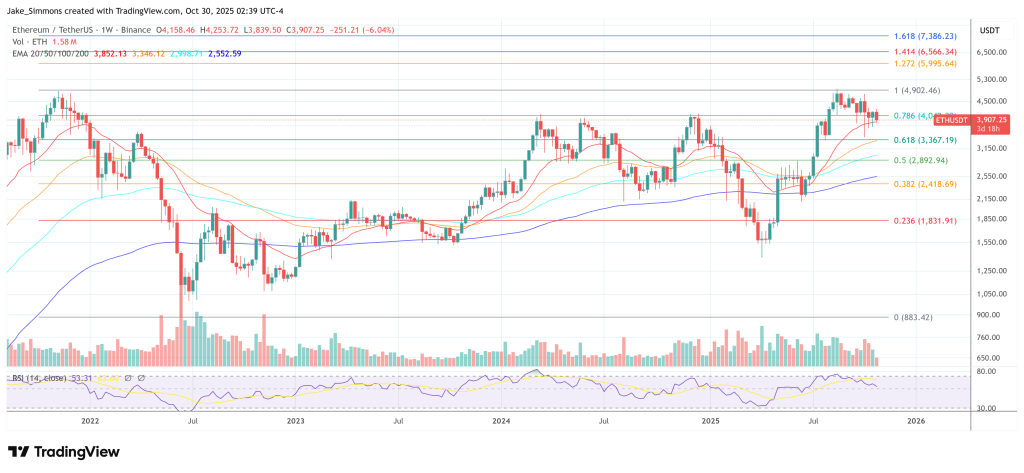
At press time, ETH traded at $3,907.
Ethereum price
ETH slips below the 0.786 Fib again, 1-week chart | Source: ETHUSDT on TradingView.com
Featured image created with DALL.E, chart from TradingView.com
Editorial Process for bitcoinist is centered on delivering thoroughly researched, accurate, and unbiased content. We uphold strict sourcing standards, and each page undergoes diligent review by our team of top technology experts and seasoned editors. This process ensures the integrity, relevance, and value of our content for our readers.

Jake Simmons has been a Bitcoin enthusiast since 2016. Ever since he heard about Bitcoin, he has been studying the topic every day and trying to share his knowledge with others. His goal is to contribute to Bitcoin's financial revolution, which will replace the fiat money system. Besides BTC and crypto, Jake studied Business Informatics at a university. After graduation in 2017, he has been working in the blockchain and crypto sector. You can follow Jake on Twitter at @realJakeSimmons.

Trending Cryptos

Related Reads

After Changxin, Yushu Takes the Lead: The Value and Weight of the First Humanoid Robot Stock

On August 19, 2026, Unitree Robotics (688836.SH), known as China's "first humanoid robotics stock," officially listed on the Shanghai Stock Exchange's STAR Market. The stock opened at 1,100 yuan, a surge of 629.44% from its 150.80 yuan IPO price, with its market capitalization briefly reaching 445 billion yuan. This highlights intense market enthusiasm for the humanoid robot sector. The IPO was characterized by high demand and low circulation, with only 7.44% of shares initially tradable. This scarcity, coupled with strong investor interest (record-high participation and a low 0.0181% lottery win rate), contributed to the dramatic price surge. Founder Wang Xingxing, holding over 31% of shares, saw his wealth exceed 110 billion yuan, making him China's wealthiest "post-90s" entrepreneur. Major institutional backers like Meituan, DeepSeek, Tencent, and Sequoia China also reaped substantial gains. Key to the valuation is Unitree's status as a profitable company in a field where many competitors are not. In 2025, it achieved 600 million yuan in adjusted net profit and delivered over 5,500 humanoid robots, ranking first globally in shipments. However, over 70% of its humanoid revenue still comes from R&D and education, with industrial applications accounting for only about 9%, indicating early-stage commercialization. The company faces competition from global players like Figure AI (est. $39-40B valuation), Boston Dynamics, and Tesla's Optimus, as well as domestic rivals like Zhiyuan and Ubtech. To become the "global humanoid robotics leader," its market cap would need to exceed 500 billion yuan. Market opinions on its future are divided: optimists cite its profitability, leading shipments, and strategic tie-up with DeepSeek; the cautious point to high valuations and unproven mass-market adoption; a neutral view expects a post-surge consolidation into an "earnings verification phase." Risks include high valuation digestion pressure, slower-than-expected commercialization in industrial/household settings, potential US FCC regulatory impacts on new models, intense competition, rapid technological iteration, and short-term stock volatility. The IPO marks a significant milestone, but Unitree's path to becoming a global leader remains challenging.

Odaily星球日报22m ago

After Changxin, Yushu Takes the Lead: The Value and Weight of the First Humanoid Robot Stock

Odaily星球日报22m ago

Token Economy Surges, Have Ordinary People Got a Slice of the Pie?

Token Frenzy: Is the Average Person Getting a Piece of the Pie? As AI adoption soars in China, daily Token consumption—the basic unit for AI text processing—has skyrocketed, exceeding 140 trillion. This "Token economy" is often measured like GDP, touted as a sign of progress. However, this metric primarily reflects supply-side activities: corporate investment, infrastructure scaling, and platform revenues. The crucial question of whether this growth translates into tangible benefits for ordinary citizens—higher wages, better jobs, improved public services, or increased leisure—remains largely unanswered. The article argues there's a fundamental mismatch. Policy, exemplified by subsidies in Beijing's Yizhuang district, often stimulates "demand" by incentivizing companies to consume more Tokens (an intermediate business cost), rather than by boosting household income or final consumer spending. This creates a closed loop where growth in Token usage justifies further production capacity expansion, without necessarily extending value to the broader population. Several disconnects are highlighted. High Token usage doesn't equal completed tasks, increased profits, or macroeconomic productivity gains. Even when corporate efficiency improves, the benefits may not trickle down due to existing economic structures favoring investment over household consumption. The risk is that AI, a genuinely productive technology, becomes another tool for supply-side expansion within a system adept at measuring output (like server capacity and call volumes) but less focused on distributing the gains widely. Drawing a parallel to Henry Ford's assembly line, the piece notes that Ford's revolution combined ruthless production efficiency with a social compact (higher wages, stability) that enabled mass consumption. Today's "Token economy" narrative enthusiastically champions the first part—process re-engineering and cost reduction—but lacks a credible mechanism for the second: ensuring that productivity gains lead to broader societal welfare. The ultimate challenge is not whether Tokens have value, but whether their economic benefits can escape a system that excels at building supply but struggles to cultivate its own demand.

marsbit1h ago

Token Economy Surges, Have Ordinary People Got a Slice of the Pie?

marsbit1h ago

Overnight Global Shock: Why Did AI Stocks Plunge Across the Board?

Overnight, U.S. AI-related stocks fell sharply, with the Nasdaq down 1.33% and the Philadelphia Semiconductor Index plunging nearly 5%. Panic spread globally, dragging down Asia-Pacific markets. Key negative drivers included: 1. **Geopolitical Tension & Macro Pressure:** Escalating U.S.-Iran tensions pushed oil prices higher, fueling inflation fears and expectations of prolonged high interest rates. Rising bond yields pressured high-valuation, capital-intensive AI stocks, especially as soaring AI infrastructure financing costs became evident. 2. **AI Commercialization Concerns:** OpenAI's Q2 results showed slowing revenue growth and widening losses, dampening market optimism about near-term AI application profitability. This shifted investor focus from pure capital expenditure narratives to actual commercial returns. 3. **Supply Chain Uncertainty:** U.S.-South Korea semiconductor investment disputes intensified. Market fears that Korean memory giants (Samsung, SK Hynix) face a dilemma—either divert capital to costly U.S. production or risk trade barriers—disrupted the critical HBM memory sector, amplifying sell-offs via leveraged ETFs. While long-term AI demand remains, the market is now scrutinizing real profitability, financing costs, and supply chain stability rather than paying premiums for unchecked growth stories. For markets like China's A-shares, the impact is primarily sentiment-driven, requiring distinction between short-term panic and fundamental deterioration.

marsbit1h ago

Overnight Global Shock: Why Did AI Stocks Plunge Across the Board?

marsbit1h ago

Trading

Spot

Hot Articles

Discussions

Welcome to the HTX Community. Here, you can stay informed about the latest platform developments and gain access to professional market insights. Users' opinions on the price of ETH (ETH) are presented below.

活动图片