DeepSeek Predicts SOL to Break $450 – $750 by Year-End, Snorter Token Stands to Benefit

bitcoinistPublished on 2025-10-01Last updated on 2025-10-01

Abstract

Chinese AI tool DeepSeek has high hopes for Solana’s next growth spurt, citing several bullish catalysts: technological upgrades, a favorable...

Trusted Editorial content, reviewed by leading industry experts and seasoned editors. Ad Disclosure

Chinese AI tool DeepSeek has high hopes for Solana’s next growth spurt, citing several bullish catalysts: technological upgrades, a favorable macro environment, and ETF approvals.

Suppose these factors work as planned, the chatbot believes that $SOL could exceed $450 by this year’s end – a 108%+ increase compared to its current $220 price tag.

It even goes as far as to suggest that a $750 price point might not be out of the equation.

And when $SOL rises, it’s not just a win for the asset itself. Solana-based projects often experience increased user activity and deeper liquidity – especially those pushing boundaries, like Snorter Token’s upcoming trading bot.

Solana’s Growth to Explode Under Compute Limit Upgrade

DeepSeek scouts the web in real time, ingesting and analyzing vast amounts of publicly available data – its findings aren’t to be sneezed at.

The chatbot found that a key driver of Solana’s future will likely be its expanding ecosystem. As applications like DeFi protocols and NFT marketplaces scale, demand for $SOL – which is required for transaction fees and staking – is expected to surge.

Another major catalyst includes technological advancements on the Solana network. Under Jump Crypto, Firedancer developers are working on SIMD-0370 to eliminate Solana’s fixed compute limit.

In turn, it should slash transaction finality from roughly 12.8 seconds to just 150 milliseconds. This would significantly boost Solana’s efficiency as a leading blockchain for real-time apps.
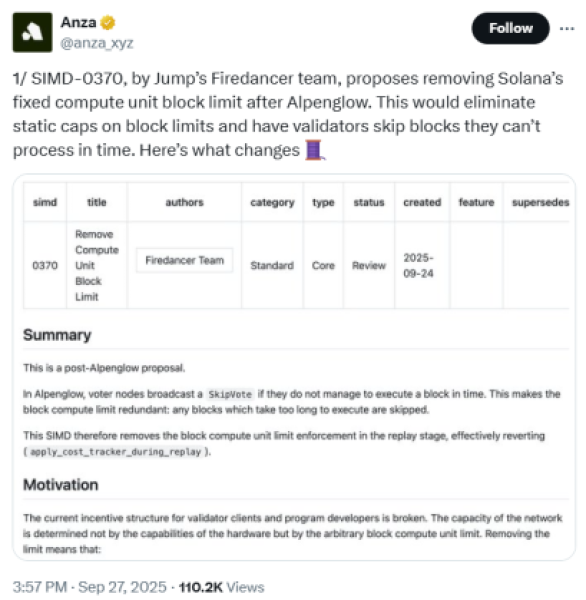
Anza announced Jump Crypto SIMD-0370 upgrade on X.
Source: X (Anza)

Macroeconomic conditions could also play a major role in $SOL’s success.

If 2025 brings lower interest rates and increased market liquidity, risk-on sentiment could return to financial markets. In such an environment, capital often flows into riskier assets like crypto, and which are better ones to invest in than the leaders: $BTC, $ETH, and $SOL?
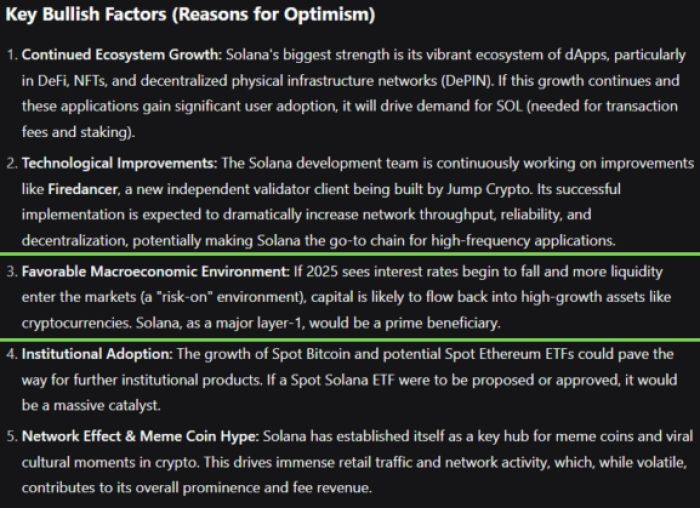
SOL bullish factors on DeepSeek.
Source: DeepSeek

Another area to watch? Solana ETFs, of course. The reason is that they’d unlock institutional capital, increase market liquidity, and cement $SOL’s status alongside $BTC and $ETH as a cornerstone asset in the digital economy.

Bloomberg analyst James Seyffart recently announced that significant movement is already underway on this front. Multiple issuers – Franklin, Fidelity, CoinShares, Direction, and Bitwise – have all submitted updated filings for $SOL ETFs.

With progress being made by the Securities and Exchange Commission (SEC), approvals may be just around the corner.
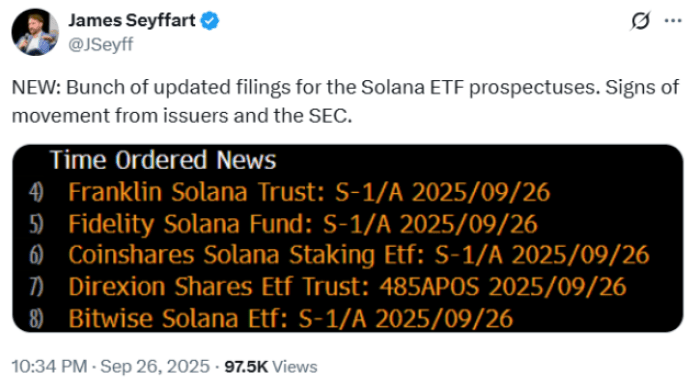
Bloomberg analyst announced SOL ETF filings on X.
Source: X (James Seyffart)

Finally, the network, driven by the best Solana meme coins and viral cultural moments like high-profile NFT mints (check out Mad Lads and Tensorians), continues to be a significant growth engine.

Together, these developments could propel not only $SOL but Solana-based projects like Snorter Token ($SNORT) to even rosier pursuits.

Snorter Bot to Go Live on Solana This Quarter

$SNORT would significantly benefit from a $SOL price rise as its flagship product – Snorter Bot – is set to go live on Solana this quarter.

The Telegram trading bot is designed to give traders a potent edge in the ultra-fast crypto market. By leveraging Solana’s high throughput, it promises to offer the lowest trading fees (at just 0.85%) and the fastest execution speeds.

When also taking into account Solana’s upcoming SIMD-0370 upgrade, its transaction fees might become even lower.

While it strategically picks Solana as its first network of choice, the bot’s also set to expand across Ethereum, BNB Chain, and other EVM-compatible chains. Doing so means that it’ll open the door to broader trading opportunities.

Whichever chain you favour, the bot will offer many ways to help you hunt down the next crypto to explode.

Take its copy trading tool, for instance. By copying the strategies of top-performing traders, you’ll be able to capitalize on market opportunities without deep crypto know-how.

To top it off, it promises to roll out automated sniping so that you can enter new token launches as soon as they go live.

Another boon is its upcoming set limit tool. You’ll be able to automatically buy and sell tokens at your preferred price tag, whether online or offline.
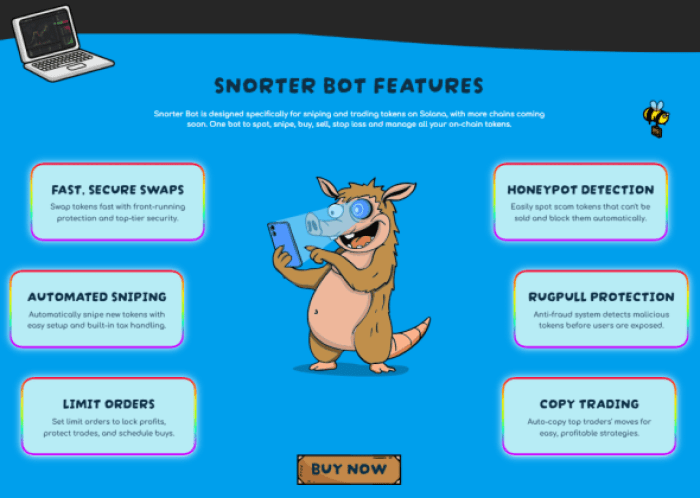
Top Snorter Token bot benefits.
Source: Snorter Token

And all will be achieved without compromising security. Snorter Bot will be MEV-protected and include built-in rug pull and honeypot detection alerts, so you don’t fall victim to scams.

Join the Snorter Token Presale for Possible 782% Returns

Behind it all is $SNORT, the ecosystem’s native token. It sets aside a substantial 25% of its total token supply for development, ensuring continuous innovation and growth.

By purchasing $SNORT, you not only contribute to its future trajectory, but are also granted perks. Think leaderboard rewards, staking yields up to 113% APY (if you join now), and DAO rights.

You can get involved by purchasing $SNORT on presale for as little as $0.1065, using either $SOL, $ETH, $USDT, $USDC, $BNB, or fiat.

Our Snorter Token price prediction anticipates it to close at around $0.94 this year. There might not be any better time to join the presale for potential returns exceeding 782%.

Join Snorter Token for possible 8x gains.

Disclaimer: This isn’t investment advice. DYOR and never invest more than you’re willing to lose. 

Authored by Leah Waters, Bitcoinist – https://bitcoinist.com/deepseek-sol-prediction-boosts-snorter-token

Editorial Process for bitcoinist is centered on delivering thoroughly researched, accurate, and unbiased content. We uphold strict sourcing standards, and each page undergoes diligent review by our team of top technology experts and seasoned editors. This process ensures the integrity, relevance, and value of our content for our readers.

Leah is a British journalist with a BA in Journalism, Media, and Communications and nearly a decade of content writing experience. Over the last four years, her focus has primarily been on Web3 technologies, driven by her genuine enthusiasm for decentralization and the latest technological advancements. She has contributed to leading crypto and NFT publications – Cointelegraph, Coinbound, Crypto News, NFT Plazas, Bitcolumnist, Techreport, and NFT Lately – which has elevated her to a senior role in crypto journalism. Whether crafting breaking news or in-depth reviews, she strives to engage her readers with the latest insights and information. Her articles often span the hottest cryptos, exchanges, and evolving regulations. As part of her ploy to attract crypto newbies into Web3, she explains even the most complex topics in an easily understandable and engaging way. Further underscoring her dynamic journalism background, she has written for various sectors, including software testing (TEST Magazine), travel (Travel Off Path), and music (Mixmag). When she's not deep into a crypto rabbit hole, she's probably island-hopping (with the Galapagos and Hainan being her go-to's). Or perhaps sketching chalk pencil drawings while listening to the Pixies, her all-time favorite band.

Related Reads

Grayscale Report: Financial Privacy in the AI Era, Why Zcash Should Not Be Overlooked?

Title: Grayscale Report: Financial Privacy in the AI Era – Why Zcash Should Not Be Overlooked The article argues that privacy is a fundamental, not niche, attribute of functional money. It highlights that technological shifts, like the rise of AI and stablecoins, are driving a new wave of public focus on financial privacy. Zcash, a decentralized digital currency similar to Bitcoin but with built-in privacy via zero-knowledge proofs, is positioned to address this need. Unlike transparent blockchains, Zcash offers users the option to conduct "shielded" transactions that hide sender, receiver, and amount while remaining verifiable. The report details Zcash's evolution, noting key upgrades that improved usability and security. It points to rising on-chain usage of privacy features as evidence of real demand. Currently, ZEC holds a minimal share (~0.4%) of the total crypto market cap. Grayscale suggests this reflects a market assumption that privacy is a marginal concern. The investment thesis hinges on a potential market re-evaluation: if privacy is recognized as a core monetary feature in an era of enhanced surveillance, Zcash's current valuation represents significant upside potential. Key risks discussed include regulatory challenges, historical trusted setup concerns for older pools (mitigated by newer protocols), quantum computing threats, and execution risks associated with future technical upgrades. The conclusion is that while the future scale of private digital currency is uncertain, the market currently prices in little chance of its value increasing substantially, presenting a potential opportunity for investors.

marsbit31m ago

Grayscale Report: Financial Privacy in the AI Era, Why Zcash Should Not Be Overlooked?

marsbit31m ago

Vitalik Moves to Local Mixing as Obfuscation Series Reaches Third Stage

Ethereum co-founder Vitalik Buterin published the third part of his series on cryptographic obfuscation, focusing on a method called "local mixing." This method abandons lattices and elliptic curves in favor of ideas borrowed from hash function design. Buterin described local mixing as a "completely different way of cryptography," free from elliptic curves, prime factorization, and lattices, making it more akin to symmetric cryptography used in everyday encryption. The process begins with a circuit of logic gates like XOR, AND, and NOT. It undergoes a pipeline that ensures a correct output while obscuring any trace of the internal logic. Key steps include adding reversibility, strengthening, mechanization, mixing, and finally obfuscation. The mixing step scatters extra logic gates and shuffles their arrangement. Reversibility is foundational, allowing gates to be rewritten as other reversible gates with similar behavior. Buterin acknowledged local mixing is a "wild and risky undertaking," lying on the "graveyard of failed attempts at white-box cryptography." However, its proponents argue it needs more research effort and a willingness to accept higher overhead costs. Buterin suggested AI could accelerate its development. He called obfuscation the "final boss of cryptography," with the most complex constructions having runtimes exceeding the universe's age. The article concludes by explaining obfuscation's utility: it can encrypt a program so it still functions with normal inputs and outputs while hiding the code. Combined with blockchain, this moves toward a "trusted third party that requires no trust," enabling applications like private, collusion-resistant voting without relying on a trusted committee.

cryptonews.ru1h ago

Vitalik Moves to Local Mixing as Obfuscation Series Reaches Third Stage

cryptonews.ru1h ago

India Orders Closure of Hundreds of Google Firebase Accounts Used in Banking Frauds

India's cybercrime agency ordered Google to block hundreds of accounts on its Firebase app development platform. The move came after investigators traced numerous fake banking apps and phishing websites to the service. The Indian Cyber Crime Coordination Centre (I4C) sent multiple notices to Google, identifying at least 57 websites and databases on Firebase allegedly used to distribute malware and steal victims' financial data. Among these, seven were phishing pages mimicking login screens of major Indian banks like State Bank of India, ICICI Bank, and Axis Bank. The rest were reportedly data collection points for stolen information like credit card numbers and one-time passwords. The fraud scheme involved Android malware disguised as legitimate banking apps, luring victims with promises of new credit cards, rewards, or credit limit increases. Once installed, the app secretly forwarded device data to a Firebase database controlled by scammers, granting them access to other apps and the victim's funds. One scam specifically targeted beneficiaries of a government farmer aid program. This action marks a shift in India's approach. Previously focused on blocking individual fraudulent websites, authorities are now targeting the broader infrastructure enabling these scams. The move highlights how fraudsters exploit widely accessible platforms like Firebase, attracted by its free tier and database capabilities, to target India's vast digital payment user base.

cryptonews.ru1h ago

India Orders Closure of Hundreds of Google Firebase Accounts Used in Banking Frauds

cryptonews.ru1h ago

Trading

Spot
活动图片