Memecoins vs. Altcoins: Market Cap Ratio Signals Potential Reversal

bitcoinistPublished on 2025-09-15Last updated on 2025-09-15

Abstract

Memecoins have been under heavy selling pressure since December 2024, with many declaring the sector as good as dead. Prices...

Trusted Editorial content, reviewed by leading industry experts and seasoned editors. Ad Disclosure

Memecoins have been under heavy selling pressure since December 2024, with many declaring the sector as good as dead. Prices collapsed across the board, liquidity dried up, and retail enthusiasm that once fueled massive rallies seemed to vanish. For months, memecoins have trended lower, underperforming most of the broader crypto market and leaving investors skeptical about their long-term survival.

Yet, despite the gloom, some analysts argue that dismissing memecoins entirely may be premature. As the market prepares for a new phase driven by shifting liquidity flows, institutional positioning, and macroeconomic catalysts, speculation could once again find fertile ground in this volatile sector. Top analyst Darkfost has gone as far as to suggest that the time to take a fresh look at memecoins may have arrived. According to him, data shows that the market is entering an area where memecoin dominance has historically regained strength, often sparking sharp rebounds.

While risks remain high—memecoins are still among the most speculative assets in crypto—the potential for explosive gains continues to attract attention.

Memecoin Dominance Signals Possible Rebound

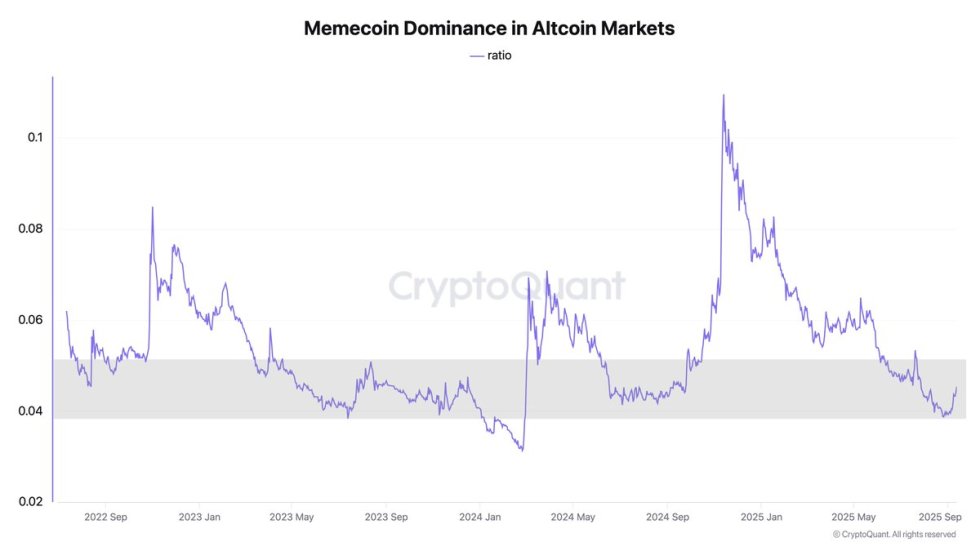
Darkfost highlights the importance of monitoring the Memecoin Dominance in Altcoin Markets chart, which compares the market capitalization of key memecoins against that of established altcoins. This ratio offers valuable insight into whether memecoins are gaining or losing influence relative to the broader altcoin sector.

Since the massive rush that peaked at the end of 2024, memecoins have been in a prolonged decline, steadily losing both valuation and investor interest. The frenzy that once drove parabolic gains gave way to exhaustion, with most of the sector retracing sharply.
Memecoin Dominance in Altcoin Markets | Source: Darkfost

Investors in memecoins understand the unique challenge of this asset class. Unlike Bitcoin or Ethereum, memecoins often lack fundamental backing, making them highly speculative. As a result, timing entries and, more importantly, exiting positions quickly to secure profits are essential strategies. Hesitation can easily turn short-term gains into significant losses.

Despite this, Darkfost observes that the memecoin dominance chart is signaling a potential turning point. The ratio has entered an area where memecoins have historically regained strength, marking the beginning of sharp rebounds. Early signs of reaction suggest that market sentiment may be shifting, with speculative capital slowly re-entering the space.

If the trend persists, the conditions could align for a renewed memecoin mania. While it may not replicate the extreme fervor of late 2024, a resurgence in speculative appetite could drive significant rallies. For traders watching closely, the data implies that memecoins may once again become a hot narrative in the crypto cycle, though managing risk remains paramount.

Market Cap Growth Analysis

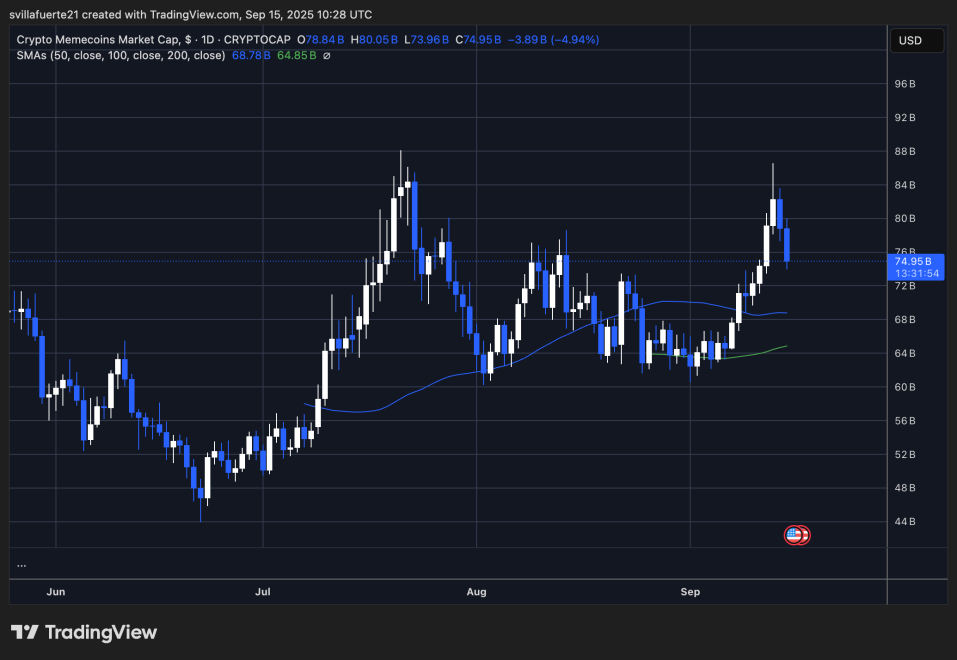
The chart of the Memecoin Market Cap (Daily) shows how the sector remains highly volatile, reflecting speculative behavior that defines this corner of the crypto market. After rebounding strongly from the July lows near $64B, the market surged to a local peak above $88B in early September. However, that momentum quickly faded, with the cap now retracing toward $75B, down nearly 5% in the latest session.
Crypto Memecoin Market Cap | Source: MEME.C chart on TradingView

The 50-day moving average at $68.7B has acted as a strong dynamic support throughout this recovery, showing that buyers continue to step in when valuations approach this level. Meanwhile, the sector’s ability to push above $80B and briefly test the $88B resistance highlights that speculative capital is still present, even if profit-taking remains aggressive.

For now, memecoins are consolidating after a sharp upswing, and the market appears to be searching for balance. If capitalization holds above the $72–74B range, a renewed attempt to reclaim $80B could follow, reigniting bullish sentiment. On the other hand, a breakdown below the 50-day average would suggest fading momentum and open the door for a deeper retracement. Ultimately, memecoins remain sensitive to liquidity flows and broader risk sentiment, making timing critical.

Featured image from Dall-E, chart from TradingView

Editorial Process for bitcoinist is centered on delivering thoroughly researched, accurate, and unbiased content. We uphold strict sourcing standards, and each page undergoes diligent review by our team of top technology experts and seasoned editors. This process ensures the integrity, relevance, and value of our content for our readers.

Sebastian's journey into the world of crypto began four years ago, driven by a fascination with the potential of blockchain technology to revolutionize financial systems. His initial exploration focused on understanding the intricacies of various crypto projects, particularly those focused on building innovative financial solutions. Through countless hours of research and learning, Sebastian developed a deep understanding of the underlying technologies, market dynamics, and potential applications of cryptocurrencies. As his knowledge grew, Sebastian felt compelled to share his insights with others. He began actively contributing to online discussions on platforms like X and LinkedIn, focusing on fintech and crypto-related content. His goal was to expose valuable trends and insights to a wider audience, fostering a deeper understanding of the rapidly evolving crypto landscape. Sebastian's contributions quickly gained recognition, and he became a trusted voice in the online crypto community. To further enhance his expertise, Sebastian pursued a UC Berkeley Fintech: Frameworks, Applications, and Strategies certification. This rigorous program equipped him with valuable skills and knowledge regarding Financial Technology, bridging the gap between traditional finance (TradFi) and decentralized finance (DeFi). The certification deepened his understanding of the broader financial landscape and its intersection with blockchain technology. Sebastian's passion for finance and writing is evident in his work. He enjoys delving into financial research, analyzing market trends, and exploring the latest developments in the crypto space. In his spare time, Sebastian can often be found immersed in charts, studying 10-K forms, or engaging in thought-provoking discussions about the future of finance. Sebastian's journey as a crypto analyst and investor has been marked by a relentless pursuit of knowledge and a dedication to sharing his insights. His ability to navigate the complex world of crypto, combined with his passion for financial research and communication, makes him a valuable asset to the industry. As the crypto landscape continues to evolve, Sebastian remains at the forefront, providing valuable insights and contributing to the growth of this revolutionary technology.

Related Reads

Trillion-Dollar Pension Fund Entry? Franklin Bitcoin Dividend Reinvestment ETF Comes with a Built-in Selling Pressure Ceiling

Franklin Templeton has filed to launch two ETFs that embed a "default configuration" logic into Bitcoin investment, aiming to tap into massive pension fund flows. These "Bitcoin Dividend Reinvestment Index ETFs" will initially hold 95% equities and 5% Bitcoin, automatically reinvesting stock dividends to buy Bitcoin. However, a quarterly rebalancing rule forces selling of Bitcoin if its allocation exceeds 5%, capping its maximum holding at 20%. While the product cleverly circumvents advisor reluctance and compliance hurdles by labeling itself as a U.S. equity product, its actual Bitcoin buying power is minimal. Given low dividend yields (e.g., ~1% for broad market indices), annual Bitcoin purchases from a fund the size of Franklin's existing Bitcoin ETF would be a mere $3.6 million—negligible against Bitcoin's daily trading volume. Crucially, during bull markets, the fund becomes a programmed, passive *seller* of Bitcoin, potentially creating sustained sell pressure if many similar funds emerge. The strategy leverages investor inertia and automatic enrollment, similar to the success of target-date funds in 401(k) plans. It also uses an offshore Cayman subsidiary for holding Bitcoin and raises a tax complication where investors must pay taxes on dividends they never receive as cash. Although recent U.S. regulatory changes allow crypto in retirement plans, widespread adoption as a default option faces legal hurdles. The core premise remains: the system doesn't need to convince anyone to buy Bitcoin actively; it simply relies on people doing nothing.

marsbit24m ago

Trillion-Dollar Pension Fund Entry? Franklin Bitcoin Dividend Reinvestment ETF Comes with a Built-in Selling Pressure Ceiling

marsbit24m ago

Bitcoin Hits 20-Month Low as Largest Bull Suffers $15 Billion Paper Loss

Bitcoin Hits 20-Month Low as Major Bull Loses $15 Billion On June 25th, Bitcoin fell below $60,000, hitting a low of $58,030—its lowest level since October 2024. The sell-off triggered over $1 billion in leveraged liquidations in 24 hours, with longs accounting for $788 million. This marks a more than 53% decline from the October 2025 all-time high of $126,198. A critical factor in the downturn is the weakening position of MicroStrategy, the largest corporate Bitcoin holder. With 847,363 BTC at an average cost of $75,651, the company now faces over $14.6 billion in unrealized losses. Its core financing flywheel—raising capital to buy Bitcoin—is stalling. Its variable-rate preferred shares (STRC), a key fundraising tool, have fallen 25% below their $100 target. This raises doubts about its ability to continue providing steady institutional demand for Bitcoin. Simultaneously, U.S. spot Bitcoin ETFs are experiencing significant outflows, with a single-day net outflow of $469 million on June 24th. This represents the most severe sustained capital flight since their launch. The macroeconomic backdrop remains restrictive, with persistent inflation delaying expected Fed rate cuts. Analysts note a shift in capital allocation, with institutional funds moving away from crypto towards AI infrastructure stocks. Immediate pressure comes from approximately $10 billion worth of Bitcoin options expiring on June 26th, which could increase market volatility. The combined effect of these factors—eroding core demand pillars, macro headwinds, and capital rotation—has decisively broken the $60,000 support level.

Foresight News31m ago

Bitcoin Hits 20-Month Low as Largest Bull Suffers $15 Billion Paper Loss

Foresight News31m ago

STRC Falls Below $80, Can Conservative Investors Still Buy the Dip?

The article analyzes whether the STRC (a perpetual preferred stock issued by MicroStrategy) presents a buying opportunity after its price fell below its $100 par value to around $80, offering a seemingly high yield of 13-15%. The core argument is that STRC's discount reflects market skepticism about the sustainability of MicroStrategy's capital structure model, not just temporary panic. This model relies on issuing securities (like STRC) to raise funds to buy more Bitcoin, a "flywheel" that works in a bull market. The recent small sale of BTC to fund dividends, while minor, broke the psychological "never sell" anchor and signaled potential strain. Key risks identified are not a traditional Ponzi collapse but a potential breakdown in the financing narrative: 1) If Bitcoin enters a deep bear market, crushing MicroStrategy's stock premium (mNAV), its ability to raise cheap capital weakens. 2) If STRC remains deeply discounted, it signifies permanently higher funding costs. 3) The high cash dividend yield represents a significant ongoing expense. 4) If selling BTC to pay dividends becomes routine, the bullish narrative reverses. The conclusion is that STRC is not a risk-free high-yield asset. It is a high-coupon bet on whether MicroStrategy's BTC treasury financing model can withstand a bear market. Buying it is a wager that the market will continue to believe in and fund this structure at acceptable costs. The current price asks if this cycle's "casualty" might be a BTC treasury company's融资 model itself.

marsbit46m ago

STRC Falls Below $80, Can Conservative Investors Still Buy the Dip?

marsbit46m ago

Why Do Crypto Projects Keep Changing Their Names?

**Why Do Crypto Projects Keep Changing Names?** In the crypto world, changing a project's name is common—over 16% of projects have done so, including major ones like Polygon (formerly Matic Network). This contrasts sharply with traditional businesses, which fiercely protect brand equity. The core reason is that in crypto, brand loyalty is often weak. Users are frequently investors, airdrop hunters, or yield seekers, not traditional consumers. A name associated with price crashes, hacks, or failed narratives becomes a liability, not an asset. Renaming can be a strategic reset to shed this baggage. Name changes serve as a potent marketing tool. They can signal a genuine pivot in strategy or scope (e.g., EthSign dropping "Eth" as it expanded). However, they are often used to "narrative surf," rebranding to align with hot trends like AI, RWA, or the metaverse (e.g., Elrond → MultiversX). Critically, renaming is also a PR tactic to distance a project from past failures like security breaches (e.g., Anyswap → Multichain). The most significant risk emerges when a name change is coupled with a token migration or swap. This process can allow projects to reset exchange price charts, erase visible historical downtrends, and create an illusion of a fresh start. It often facilitates liquidity resets, where low float can be exploited for pumps. More alarmingly, migrations sometimes mask overhauls to tokenomics, introducing substantial new token supply through "ecosystem funds" or "node rewards," effectively diluting existing holders. The fundamental issue isn't renaming itself, which can be valid for strategic evolution. The problem is when it functions as an escape from history—a way to avoid accountability for past mistakes, failed promises, and poor performance. When a project announces a rebrand, the critical questions are: What tangible new capability or strategy does it represent? Has the tokenomics changed? And what part of its past is it most trying to make users forget?

marsbit53m ago

Why Do Crypto Projects Keep Changing Their Names?

marsbit53m ago

Trading

Spot
Futures
活动图片