Основатель майнинг-пула Qubic угрожает биткоину

cryptonews.ruPublished on 2025-01-14Last updated on 2025-09-15

Основатель майнинг-пула Qubic Сергей Иванчегло продолжает делать громкие заявления и предпринимать действия, которые провоцируют тревогу в криптосообществе. На фоне атаки на Monero (XMR) он пригрозил переключить мощности на биткоин (BTC). Ранее сообщество Qubic голосовало за атаку на Dogecoin (DOGE)

Рассказываем, что происходит и почему Иванчегло угрожает представителям биткоин-сообщества.

Угроза биткоину

В своем обращении Иванчегло заявил, что «китам биткоина стоит прекратить пытаться выставлять его в плохом свете». Он добавил, что в противном случае Qubic может принять решение майнить BTC после DOGE, и при этом «никто не знает, как это повлияет на состояние крупных инвесторов». В его сообщении прослеживается прямая угроза биткоин-сообществу. Речь, вероятно, идет о попытке организации атаки 51%, которую проект уже ранее проводил в других сетях.
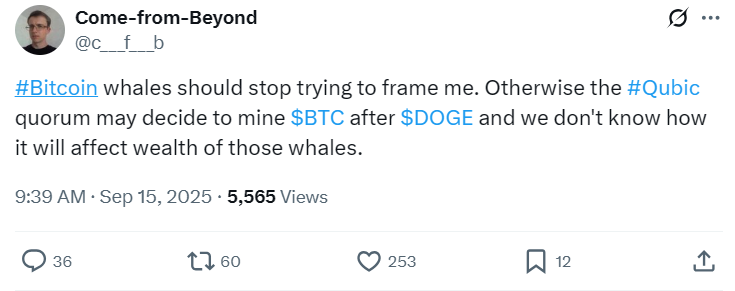
угроза Иванчегло
Скрин сообщения Иванчегло

Подобные заявления участники криптосообщества расценивают как косвенную угрозу крупнейшим держателям биткоина. Если пул действительно переключит мощности, это может изменить распределение хешрейта и отразиться на доверии к сети.

Напомним, первой жертвой Quibic стала Monero. О том, что происходит с сетью криптовалюты и курсом XMR на фоне атаки, рассказали в отдельном обзоре. В августе 2025 участники Quibic проголосовали за перенос вычислительных мощностей для добычи самого капитализированного мемкоина, Dogecoin. Теперь Quibic угрожает биткоину.

Сеть самой капитализированной криптовалюты, BTC, стремительно теряет децентрализацию. В августе 2025 свыше 51% хешрейта монеты оказалось под контролем всего двух майнинг-пулов. По состоянию на момент написания обзора, ситуация несколько выправилась. Под контролем двух крупнейших пулов, Foundry USA и AntPool, чуть более 47% хешрейта.
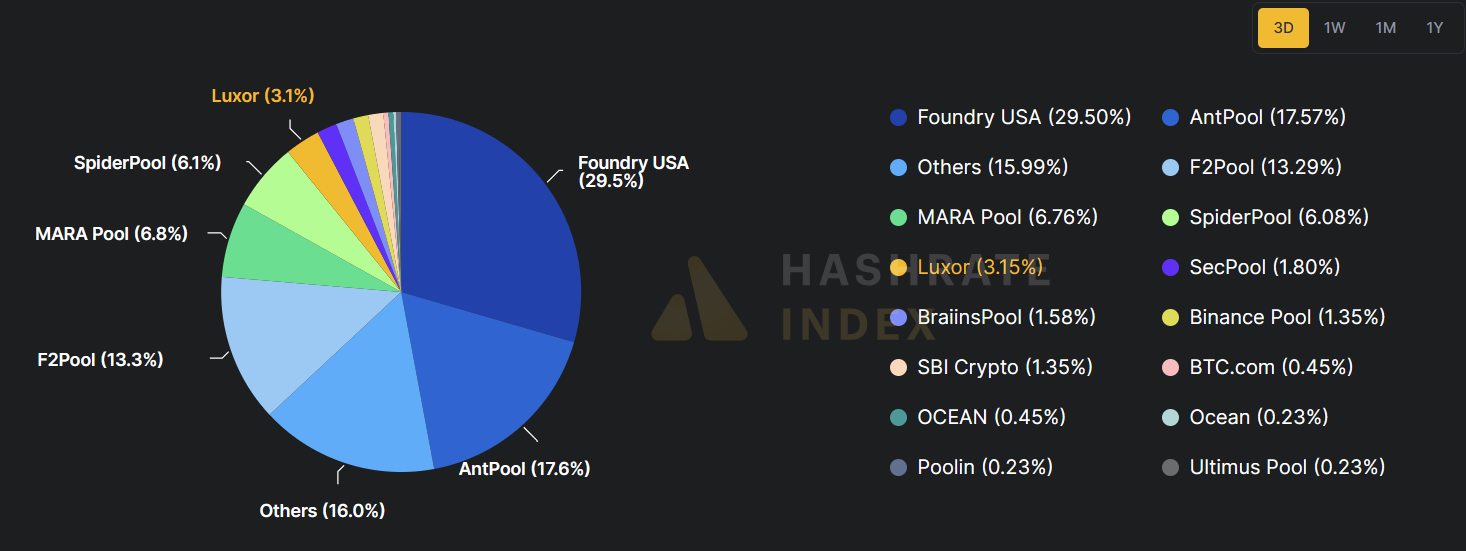
Распределение хешрейта в сети биткоина. Источник: hashrateindex

Мнения участников криптосообщества о том, сможет ли Quibic навредить биткоину, разошлись. Одни пользователи сети видят угрозу, другие считают, что Иванчегло блефует.

реакция на угроу Иванчегло
Мнения участников криптосообщества об угрозе Иванчегло

Итог

Не все участники криптосообщества верят в угрозы основателя Quibic. При этом инвесторов должны насторожить уже успешно реализованные атаки на криптопроекты, ответственность за которые взял проект. Проблем добавляет высокий уровень централизации сети биткоина. На момент написания обзора, свыше 47% хешрейта BTC подконтрольно всего двум пулам.

Ранее команда Quibic утверждала, что для атаки на Monero им поребовалось перехватить не 51%, а всего 34% сети. Может ли схема сработать в случае с BTC — неизвестно.

Related Reads

The Most Hidden AI Winners

"The Most Under-the-Radar AI Winners" While core AI giants and their direct suppliers have dominated headlines, a group of seemingly unrelated, decades-old manufacturing companies have emerged as major beneficiaries. A key example is Japan's TOTO, famous for bathroom fixtures. Its stock soared 145% in a year, driven not by its mainstay toilet business but by its nearly 40-year-old semiconductor ceramic component unit. Specifically, TOTO manufactures electrostatic chucks—critical, hard-to-replace parts for advanced chip manufacturing processes like etching and EUV lithography. This segment, though only 9% of revenue, contributed over 54% of operating profit in FY2025 with a 43% margin. High barriers to entry, including deep know-how in high-purity ceramic sintering and long supplier certification cycles (5+ years), secure its position. This pattern repeats across industries. Nitto Boseki, a 128-year-old glass fiber maker, saw its stock rise 325% due to near-monopoly supply of T-glass, an essential low-expansion material for AI chip substrates. Similarly, Ajinomoto, the global MSG leader, commands 80-95% of the market for ABF film, a vital insulating layer in chip packaging. These "hidden" segments, often born from deep materials science expertise, are now bottleneck supplies in the AI hardware chain, enjoying pricing power and high margins. In China's A-share market, the theme combines this AI-driven demand with domestic substitution. Companies like Zhongci Electronic (advancing in electrostatic chucks) and Honghe Technology & Feilihua (in high-end electronic glass fabrics) are gaining traction. The investment thesis hinges on whether these domestic players can rapidly scale qualified capacity to capture the supply gap within the critical time window. Ultimately, these cases show that in the AI supply chain, high-profit concentrations exist not only at the cutting-edge tech frontier but also in indispensable, difficult-to-replicate materials and components. Market recognition often lags behind fundamental profit shifts, creating potential for significant re-ratings as traditional industrial firms are re-evaluated as key enablers of advanced semiconductor manufacturing.

marsbit22m ago

The Most Hidden AI Winners

marsbit22m ago

The Most Secretive Winners of the AI Boom

"The Most Hidden AI Winners" An unlikely group of companies are emerging as major beneficiaries of the AI boom, not from designing chips, but from supplying critical materials and components essential for advanced semiconductor manufacturing. These 'hidden winners' are traditional manufacturers whose deep expertise in materials science has become indispensable. Japanese companies are leading this trend. Toto, globally known for bathroom fixtures, has seen its stock surge 145% over the past year, driven by its 40-year-old semiconductor ceramics business, which now contributes over half of its operating profit. Its electrostatic chucks are vital for advanced chip production and require years of expertise to manufacture. Similarly, Nittobo, a 128-year-old textile firm, controls 90% of the market for T-glass, a low-expansion glass fiber essential for AI chip substrates. Ajinomoto, the world's largest MSG producer, dominates the market (80-95% share) for ABF insulating film used in chip packaging. The core insight is that chasing "advanced" chips paradoxically increases reliance on traditional, high-precision material science where supply cannot be quickly replicated. These materials are now critical bottlenecks in the AI supply chain. This trend is mirrored in China's A股 market, framed by the theme of 'import substitution'. Companies like Zhongci Dianzi (electrostatic chucks) and Honghe Technology (ultra-thin electronic cloth) are making progress, but face the test of scaling production and matching Japanese rivals' quality. The key tension lies in the slow change of market perception. While profit structures rapidly shift towards high-margin tech components, these firms retain their traditional industry classifications, creating a valuation gap that is gradually closing as their roles in the AI ecosystem become undeniable.

链捕手29m ago

The Most Secretive Winners of the AI Boom

链捕手29m ago

DeFi Enters a Moment of Value Reassessment: Risks and Opportunities Behind the $70 Billion TVL

DeFi Enters a Moment of Value Reassessment: Peril and Opportunity Behind $70 Billion TVL On July 1st, the total value locked (TVL) across all DeFi protocols fell below $70 billion to approximately $69.358 billion, hitting its lowest point since February 2024. This decline signals a significant contraction in DeFi liquidity and marks a new adjustment phase for the industry, far from its 2021 peak of over $180 billion. The primary drivers of this TVL drop are a general decrease in crypto market risk appetite, which leads capital to exit volatile sectors like DeFi first, and the fading effectiveness of the high-yield liquidity incentive models that fueled the initial DeFi boom. Many protocols' high TVL figures were built on temporary subsidy-driven capital rather than genuine demand. Furthermore, capital is migrating to newer narratives like AI, RWA, and modular infrastructure. This cooldown exposes DeFi's growth bottlenecks: innovation has slowed with rampant protocol copycats, real yields have normalized to single digits, and poor user experience continues to hinder mass adoption beyond crypto-natives. However, the TVL decline does not spell the end for DeFi. The metric itself is limited, as it fluctuates with underlying asset prices. The industry is shifting from capital accumulation to efficiency competition, leveraging Layer 2 solutions and modular architecture to do more with less locked value. Crucially, DeFi is expanding into real-world financial use cases like the tokenization of real-world assets (RWA) and the growth of the stablecoin ecosystem, moving its value proposition from speculative token subsidies to real cash flows. In conclusion, while short-term pressures from liquidity contraction and user growth stagnation persist, the sector is undergoing a necessary value reassessment. DeFi is transitioning from a subsidy-driven, hype-based era toward a more mature, rational, and efficiency-focused phase, with long-term growth hinging on meeting real-world financial needs through RWA, stablecoins, and robust infrastructure.

marsbit48m ago

DeFi Enters a Moment of Value Reassessment: Risks and Opportunities Behind the $70 Billion TVL

marsbit48m ago

Trading

Spot
活动图片