Coinbase has slammed the US Securities and Exchange Commission (SEC) for a “destroy-and-delay approach” to records, accusing the agency of erasing crucial text messages related to pending crypto litigations
Coinbase Accuses SEC Of ‘Destroying’ Records
On Thursday, crypto exchange Coinbase, through historical research firm History Associates, asked the federal court to “bring the SEC’s secretive policy shifts on crypto to sunlight” with a Freedom of Information Act (FOIA) case.
Coinbase’s CLO, Paul Grewal, explained that the company asked the US District Court for the District of Columbia to address the “gross violation of public trust” that the regulatory agency was recently part of “to ensure it never happens again.”
“The Gensler SEC destroyed documents they were required to preserve and produce. We now have proof from the SEC’s own Inspector General,” Grewal wrote on X, affirming that the regulatory agency “destroyed” key text message records, even though Coinbase had asked for “information about ‘all communications’ within the SEC related to crypto regulatory and enforcement decision-making years ago.”
As reported by Bitcoinist, the Commission was recently under fire after an Office of Inspector General (OIG) report detailed a series of “avoidable” mistakes from the watchdog’s IT department that resulted in the loss of records linked to crypto enforcement actions during Gary Gensler’s tenure, resulting in the loss of the former SEC Chairman’s text messages between 2022 and 2023.
According to the court filing, the SEC “revealed to the world just days ago that the agency has forever stymied public investigation of these issues by flouting FOIA’s mandates and destroying key documents.”
Coinbase’s court case highlighted that the recent report detailed how the Commission has “excluded” SEC officials’ text messages when processing FOIA requests, even if many constituted agency records subject to the request. Additionally, it revealed that the lost Gensler text messages “were destroyed (…) after these FOIA requests were filed, but long before the litigation began.”
The document also alleged that the same has happened to more than 20 other high-ranking SEC officials’ texts, and dozens more have been or could be at imminent risk. “Although the SEC has known of these glaring and urgent problems for two years, none of this was disclosed to this Court or History Associates during 14 months of litigation,” it added.
Holding the SEC To Its Own Standard
Previously, Coinbase’s CLO affirmed that “this isn’t some ‘oops’ moment. This was a destruction of evidence relevant to pending litigation.” Similarly, the filing stated that the SEC can’t claim “no harm, no foul” for running “thirteenth-hour searches” that come “far too late.”
It argued that if the regulatory agency had conducted prompt, proper searches when History Associates first submitted its FOIA requests in July and August 2023, the Commission could have reviewed the records at the time or taken actions to preserve them.
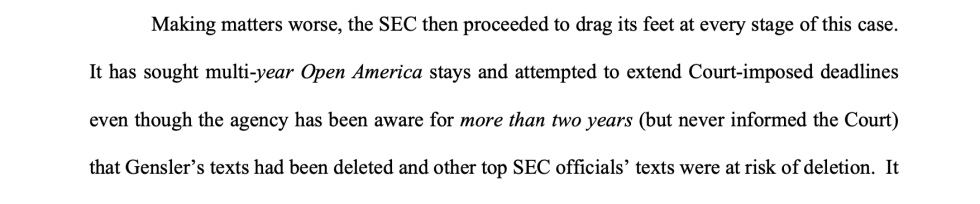
Excerpt of Coinbase's court document. Source: Paul Grewal
“It may be impossible to reconstruct how many responsive texts have been irretrievably lost due to the SEC’s stonewalling and what critical information will never see daylight as a result. But what is certain is that the SEC’s destroy-and-delay approach to records must end immediately,” the document read.
The case noted that within the last few years, the SEC had imposed over a billion dollars in fines on private parties for similar failures to preserve securities-related text messages and communications while emphasizing that “everybody should play by the same rules” and be held “accountable for violating (…) time-tested record keeping requirements.”
To ensure that the SEC is “held to its own standard” and prevent similar incidents in the future, Coinbase asked the Court to hold a hearing and order appropriate relief, including an expedited proper search for and production of all relevant texts that the agency’s searches did not uncover, discovery to “get to the bottom of the agency’s spoliation,” and all appropriate sanctions.
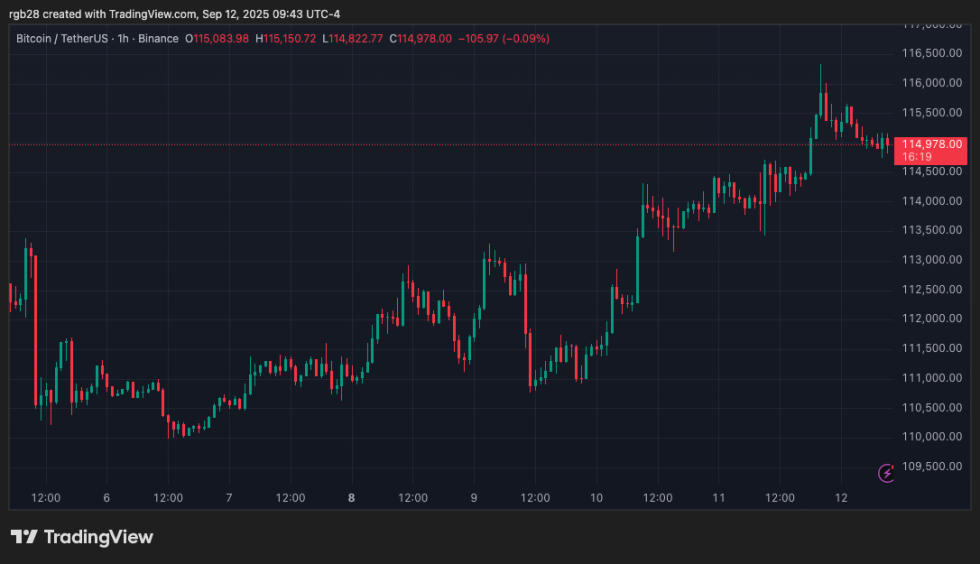
Bitcoin (BTC) trades at $114,978 in the one-week chart. Source: BTCUSDT on TradingView

Related Posts