Что происходит с альткоинами: ралли или ловушка для розницы

cryptonews.ruPublished on 2025-03-08Last updated on 2025-09-09

В последние недели крипторынок наблюдает заметный рост котировок альткоинов. Многие инвесторы спешат интерпретировать его как начало новой фазы альтсезона. Однако аналитики расходятся во мнениях о природе происходящего

Рассказываем, что происходит на рынке альткоинов, по мнению экспертов.

Иллюзия роста

Трейдер и аналитик Doctor Profit считает, что текущий рост альткоинов — это не начало альтсезона, а так называемый «выход из рынка» крупных игроков. По его мнению, маркетмейкеры специально разгоняют цены, чтобы розничные инвесторы — частные трейдеры и новички — покупали на максимумах. Таким образом, мелкие участники становятся «ликвидностью для выхода», то есть теми, кто фактически позволяет крупным фондам и трейдерам фиксировать прибыль.

«Это не альтсезон. Это краткосрочный рост, за которым последует спад. Розничные инвесторы празднуют слишком рано. Позже они поймут, что стали лишь удобным способом выйти из рынка для других игроков в перегруженном кредитным плечом рынке альткоинов».

Он также предупреждает о макроэкономических рисках. На ближайших неделях запланированы публикации индекса цен производителей (PPI), индекса потребительских цен (CPI), а также заседание Федеральной резервной системы (FOMC). По словам аналитика, эти события могут спровоцировать падение рынка. Зафиксированный рост альткоинов, по его мнению, отвлекает от реальных угроз.

Оптимистичный сценарий

Аналитик Михаэль ван де Поппе придерживается противоположного мнения. Он считает, что рынок альткоинов только вступает в фазу стремительного роста, которую можно сравнить с пузырем доткомов начала 2000-х годов.

«Медленно, но верно альткоины начинают расти. Никто не готов к тому, что произойдет. Это финальный легкий бычий цикл. Криптовалютный аналог пузыря доткомов. Наслаждайтесь этим!»

По его словам, мы стоим на пороге глобального ралли, в котором большинство альткоинов могут показать многократный рост.

Ставка на крупнейший альтсезон

Еще более уверенно на будущем альткоинов настроен популярный трейдер Ash Crypto. Он утверждает, что сегодня альткоины находятся в самой перепроданной за всю историю рынка зоне. Перепроданность означает, что цены на активы упали слишком низко по сравнению с их реальной или потенциальной стоимостью.

«Альткоины никогда не были настолько перепроданными. Даже в 2018 году, во время падения на фоне Ковид-19, в глубочайшем медвежьем рынке 2022-го или во время торговых войн ситуация не была столь экстремальной.

Деньги на рынке традиционно переходят из биткоина в ETH, а затем в другие альткоины. Сейчас мы находимся на стадии Ethereum. Альткоины достигнут дна в сентябре – начале октября, после чего начнется ротация ликвидности в крупные, средние и мелкие монеты. Если посмотреть на альтсезон 2017 и 2021 годов, можно заметить, что альткоины способны вырасти в 10–50 раз всего за 3–4 месяца.

Четвертый квартал готовится стать параболическим, и мы станем свидетелями крупнейшего альтсезона в истории».

Под «ротацией ликвидности» трейдер подразумевает процесс, когда капитал постепенно перетекает с биткоина в ETH, а затем в остальные альткоины — сначала крупные, затем средние и мелкие по капитализации.
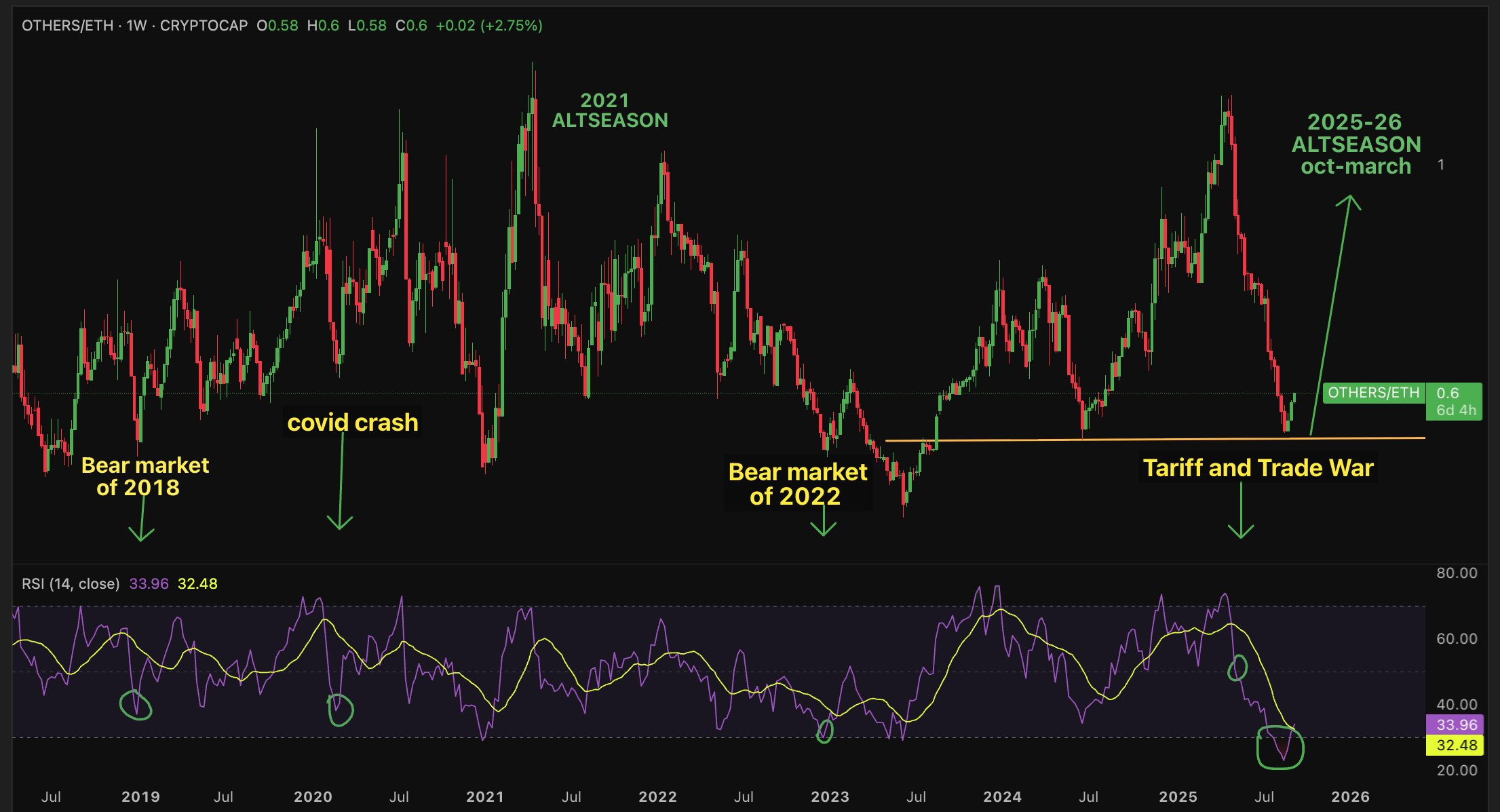
альткоины
Анализ поведения рынка альткоинов от Ash Crypto

Что все это значит для инвесторов

Различие взглядов показывает главную особенность крипторынка: он остается крайне спекулятивным и зависит как от макроэкономики, так и от поведения крупных игроков.

  • Скептики уверены, что рост искусственный и закончится падением.
  • Умеренные оптимисты ждут «финального бычьего цикла».
  • Радикальные быки прогнозируют крупнейший альтсезон в истории.

Для частных инвесторов это означает одно: важно не поддаваться эмоциям. Умеренный риск-менеджмент, внимательное отслеживание макроэкономических событий и готовность к высокой волатильности остаются ключевыми звеньями любой стратегиями.

Ранее редакция BeInCrypto рассказала о том, какие альткоины покупают киты, чтобы заработать в сентябре.


Related Reads

Just now, DeepSeek V4 updates with DSpark, improving inference speed by 80%

DeepSeek has updated its DeepSeek V4 model with the DSpark speculative decoding framework, achieving a significant 60-85% speedup in generation for Flash models and 57-78% for Pro models while maintaining the same overall throughput. This engineering-focused update, rather than a core architectural change, introduces DSpark to address latency and throughput bottlenecks in high-concurrency production environments. DSpark combines high-throughput parallel generation with adaptive load-aware verification. Its key innovations include a semi-autoregressive generation architecture to model dependencies within token blocks and a hardware-aware confidence-scheduled verification system. This system uses a confidence head to predict token acceptance probabilities, allowing it to dynamically optimize verification length per request and allocate compute only to tokens with the highest expected payoff. The asynchronous scheduler is designed for real-world deployment, ensuring zero-overhead scheduling and continuous CUDA graph replay while preserving the target model's output distribution. In tests across mathematical reasoning, code generation, and daily dialogue, DSpark outperformed state-of-the-art models like Eagle3 and DFlash, increasing average acceptance length by 26.7%-30.9% and 16.3%-18.4% respectively on Qwen3 target models. DeepSeek also open-sourced DeepSpec, a full-stack codebase for training and evaluating speculative decoding draft models, providing a standardized toolkit that includes data preparation tools, model implementations, training code, and evaluation scripts.

marsbit1h ago

Just now, DeepSeek V4 updates with DSpark, improving inference speed by 80%

marsbit1h ago

BIT Research: The 2028 Halving Is Not the End, the Real Shake-Up of the Bitcoin Mining Industry Is Just Beginning

The Bitcoin mining industry is undergoing its most complex structural adjustment since inception. Despite Bitcoin's price holding near $61,000 and the network hash rate approaching a record 1 ZH/s, miner profitability is deteriorating. The industry is operating close to its breakeven point, with the 2028 halving expected to accelerate consolidation. The challenges extend beyond the halving's subsidy reduction; the industry's revenue model has yet to successfully transition towards a fee-driven structure. Increasingly, mining companies are evolving from simple Bitcoin producers into infrastructure and energy operators, including providers of AI/HPC computing power. Competition is shifting from pure hash rate expansion to business model upgrades. Economic pressure is evident. The theoretical daily mining revenue at current prices is around $78 million, yet the actual figure is only about $33 million—a 136% gap. Transaction fees remain low at roughly $220k daily, far below historical implied levels. With a current estimated industry-wide breakeven price near $65,000, mining alone is struggling to generate ideal profits. The 2028 halving is projected to push the fundamental production cost floor to approximately $93,289. This will likely accelerate a shift towards consolidation among larger, well-capitalized miners with diversified revenue streams. Competitive advantage will belong to institutionalized players with access to low-cost energy, AI/HPC hosting operations, and stronger balance sheets. In essence, Bitcoin mining is transitioning from a "mining business" to an "infrastructure business." Future profitability and resilience will depend less on block rewards and more on diversified income sources like energy management and computational infrastructure services. For investors, the key question is not the halving itself, but which miners can successfully navigate this business model transformation.

marsbit2h ago

BIT Research: The 2028 Halving Is Not the End, the Real Shake-Up of the Bitcoin Mining Industry Is Just Beginning

marsbit2h ago

This is How God Karpathy Uses Claude?

Andrej Karpathy, a prominent figure in AI, has reportedly joined Anthropic, leading to a noticeable decrease in his open-source contributions and social media activity. A document claiming to be his personal "CLAUDE.md" file—a set of instructions for the Claude AI to follow within a specific codebase—has been circulating online. While its authenticity is unverified, the content aligns closely with Karpathy's publicly shared principles on effective AI-assisted programming. The document outlines key rules for AI coding assistants, emphasizing the importance of reading existing code thoroughly before writing new code to maintain consistency. It advises against over-engineering, advocating for simple, surgical modifications that match the project's existing style. Other guidelines include clarifying assumptions upfront, writing meaningful tests, thoughtful debugging, and carefully considering dependencies. The core message is that these principles help prevent common AI coding failures, such as introducing unnecessary abstractions, style drift, or making invisible architectural decisions. The community has noted that even experts like Karpathy require detailed instructions to guide AI effectively, akin to managing a junior developer. A related GitHub repository, "andrej-karpathy-skills," which encapsulates these ideas, is reported to significantly reduce Claude's code error rate. Ultimately, the advice stresses that the best CLAUDE.md is tailored to one's own tech stack and coding practices.

marsbit2h ago

This is How God Karpathy Uses Claude?

marsbit2h ago

Trading

Spot
活动图片