谷歌做的区块链,算 Layer1 吗?

深潮Published on 2025-08-26Last updated on 2025-08-27

GCUL 究竟是一条真正的 Layer1 公链,还是更接近传统意义上的联盟链?

撰文:Nicky,Foresight News

近日,谷歌 Web3 战略负责人 Rich Widmann 通过社交媒体宣布,谷歌云正式推出其区块链网络 Google Cloud Universal Ledger(GCUL),并将其定义为「Layer1 区块链」。围绕其技术定位的讨论随之浮现:GCUL 究竟是一条真正的 Layer1 公链,还是更接近传统意义上的联盟链?

官方定位与核心特性
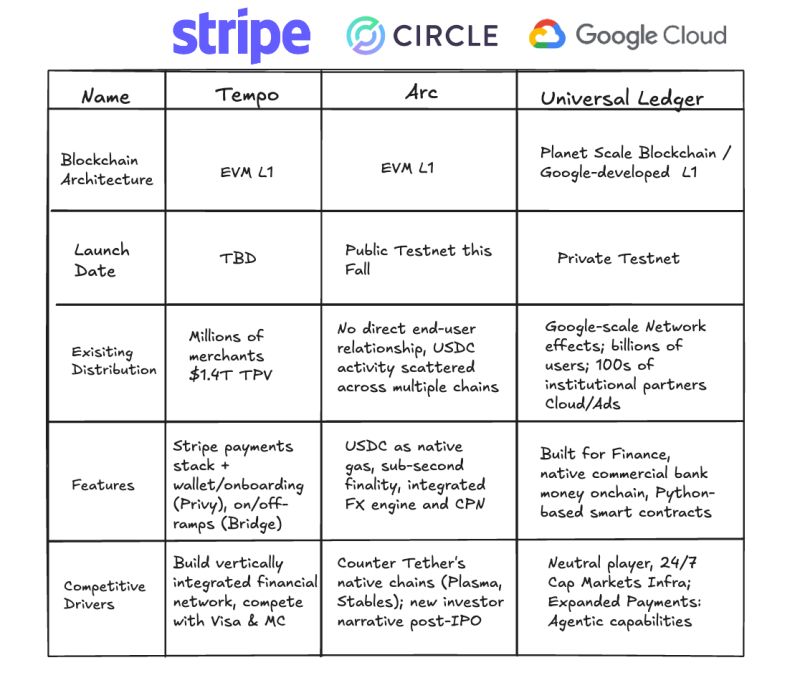
根据官方描述,GCUL 被设计为一个「高性能、可信中立且支持 Python 智能合约」的分布式账本平台,目前处于私有测试网阶段,主要面向金融机构提供服务。谷歌云强调,GCUL 旨在简化商业银行货币账户的管理,并通过分布式账本技术实现多货币、多资产的转账和结算,同时支持可编程支付和数字资产管理。

在官方发布的《稳定币之外:数字货币的演变》一文中,谷歌进一步阐释了 GCUL 的定位:它并非要「重新发明货币」,而是通过升级基础设施来解决传统金融系统的碎片化、高成本和低效率问题。GCUL 被包装为一项服务,通过 API 接口提供,强调其易用性、灵活性和安全性,尤其是在合规性(如 KYC 验证)和私有化部署方面的优势。

值得注意的是,GCUL 的早期测试已与芝加哥商品交易所(CME Group)展开合作。双方于 2025 年 3 月宣布启动分布式账本试点,探索批发支付与资产代币化的解决方案。

CME 首席执行官 Terry Duffy 表示,GCUL 有望在「24/7 交易趋势下」提升抵押品管理、保证金结算等环节的效率;谷歌云金融服务总经理 Rohit Bhat 则强调,此次合作是「传统金融机构通过现代基础设施实现业务转型的典型案例」。

Layer1 与联盟链:定义与分歧

在区块链领域,Layer1 通常指底层基础公链,如以太坊、Solana 等,其核心特征包括去中心化、无需许可和公开透明。任何用户均可自由参与网络验证、交易或部署智能合约,且链上数据对所有人可见。

相比之下,联盟链(Consortium Blockchain)是一种需许可(Permissioned)的分布式账本,由特定组织或机构共同维护,节点准入受控,数据访问权限可定制。典型应用包括 Hyperledger Fabric、蚂蚁链等。联盟链的优势在于合规可控、性能较高,但牺牲了开放性和抗审查性。

GCUL 更符合哪种模式?

从目前已披露的信息看,GCUL 表现出明显的联盟链特征:

  • 私有与许可性:GCUL 明确运行在「私有且需许可的网络」上,节点准入和账号权限由管理机构控制。

  • 目标用户:专注于金融机构(如 CME Group),而非公众自由参与。

  • 合规优先:设计初衷包含 KYC 验证、交易费用符合外包规定等传统金融合规要求。

  • 技术架构:尽管支持智能合约(基于 Python),但其底层基础设施由谷歌云采取中心化的方式维护,与「去中心化」的 Layer1 理念存在差异。

然而,谷歌云官方仍坚持将其称为「Layer1」,并强调「可信中立」和「基础设施中立」 — 即任何金融机构均可使用,而非仅限于特定利益集团。这种表述试图在叙事上模糊公链与联盟链的边界。

第三方观点:质疑与观望

行业从业者对 GCUL 的定位提出了不同看法:

  • BODL Ventures 合伙人刘锋认为,GCUL 更符合「联盟链」特征,与去中心化、无需许可的公链存在本质区别。

  • Dragonfly 合伙人 Omar 表示,此前谷歌对 GCUL 的表述较为模糊,如今团队明显倾向于将其包装为「Layer1」,但实际技术细节尚未完全公开。

  • Helius CEO Mert 指出,GCUL 目前仍是「私有且需许可」的系统,与公链的开放模型不同。

尽管存在质疑,也有观点认为 GCUL 可能代表一种「渐进式创新」。例如,谷歌与 CME 集团的合作试点显示,机构对分布式账本技术在结算、抵押品管理等场景的应用存在需求。GCUL 若能整合谷歌的技术能力和金融合规经验,或许能在传统金融与区块链之间找到一条实用化路径。

免责声明:本文基于公开信息分析,GCUL 的具体技术架构和运营模式仍需以谷歌官方后续披露为准。

Related Reads

Consumer Confidence Hits Bottom, Macro Correlations Simultaneously Break Down: How Much Longer Can the U.S. Stock Market's Solo Rally Last?

The U.S. stock market is exhibiting a rare divergence: while consumer confidence hits historic lows and traditional macro asset correlations break down, major indices like the Nasdaq 100 and S&P 500 continue reaching record highs, fueled primarily by AI and semiconductor momentum. The rally is now highly concentrated, with strength rotating from giants like Nvidia to higher-beta plays within semiconductors, particularly memory chips. This surge occurs despite a significant split between pessimistic consumer sentiment and still-resilient actual spending behavior, partially supported by fiscal stimulus. Goldman Sachs traders highlight a critical structural fissure: correlations between the S&P 500 and key macro assets (rates, gold, VIX, oil) have deviated extremely from long-term historical norms. Concurrently, the market is in a negative Gamma regime, making it more sensitive to price moves, and hedge fund positioning in momentum and semiconductors is at crowded levels. The sustainability of this "solo rally" faces three main constraints: 1) Oil price volatility linked to Middle East geopolitical risks, 2) Extreme crowding in semiconductor and momentum trades, increasing vulnerability to disappointments, and 3) The breakdown of traditional macro correlations, suggesting the rally reflects a specific mix of factors rather than broad-based risk appetite. The key question is not if indices can rise further, but which variable—oil, rates, or semiconductor momentum—might trigger a repricing of the current fragile logic.

marsbit25m ago

Consumer Confidence Hits Bottom, Macro Correlations Simultaneously Break Down: How Much Longer Can the U.S. Stock Market's Solo Rally Last?

marsbit25m ago

Will OpenAI Swallow the Application Layer? a16z Says Real Opportunities Lie Outside General Models

As large language models (LLMs) from companies like OpenAI and Anthropic become more powerful, many fear they will dominate the AI application layer, leaving no room for startups. However, this article argues that the real opportunity lies not on the "Yellow Brick Road"—the high-profile, general-purpose tasks like code and text generation that model labs are directly pursuing—but in the "rest of Oz": complex, vertical-specific applications. On the Yellow Brick Road, model companies have inherent advantages: control over the model, better margins, pricing power, and strong distribution. Startups building generic, horizontal "co-pilot" tools for standard tasks are competing directly on this path and are vulnerable. True defensibility and value are found in specialized, vertical applications. These involve deep integration into messy, multi-step business workflows (e.g., sales, insurance, legal), handling legacy systems, data quality issues, compliance, and governance. The "scaffolding" around the model—the specialized tools, automations, workflows, and industry knowledge—becomes more critical than the raw model power itself. Vertical AI companies can build defensible moats through: * **Data & Learning Flywheels:** Capturing unwritten industry practices and specific customer feedback not found in public training data. * **Managing Model Complexity:** Routinely evaluating and routing queries across multiple models (including open-source) to optimize for performance and cost, and absorbing the migration burden of model upgrades for clients. * **Cost Optimization:** Using cheaper, fine-tuned models for specific sub-tasks instead of always calling the most expensive, general-purpose model. * **Governance & Compliance:** Providing the control plane for permissions, auditing, and ensuring compliance with industry-specific regulations (e.g., HIPAA, FINRA). Examples from sales (11x) and insurance (FurtherAI) illustrate that clients pay for systems that drive specific business outcomes (e.g., sales pipeline, policy underwriting), not for generic intelligence. These systems become the "operational memory" of a business, a layer that is hard to replace, even as the underlying LLMs commoditize and improve. To test if a startup is building in the "rest of Oz," it should pass checks like the **Tool & Steps Test** (requires complex, multi-step workflows), the **System Test** (owns the end-to-end workflow, not just a tool on top), and the **Hedge Fund / P&L Test** (measured by client business outcomes, not benchmark scores). Both model labs and vertical application companies will win. The next generation of enterprise software will be built in the specialized, complex, and high-value territory beyond the Yellow Brick Road.

marsbit53m ago

Will OpenAI Swallow the Application Layer? a16z Says Real Opportunities Lie Outside General Models

marsbit53m ago

'ASIC Giant' Marvell Sets Record Quarterly Revenue, Raises Guidance Again, CEO Says Data Center Business Is 'On Fire'

Marvell Technology, a leading player in custom AI chips and data center connectivity, reported record revenue for its fiscal Q1 2027, driven by explosive demand in its data center business. Revenue reached $2.418 billion, slightly surpassing expectations, though GAAP net income fell year-over-year due to acquisition-related costs. Crucially, data center revenue hit $1.83 billion, making up 76% of the total and growing 27% YoY. The company significantly raised its full-year and next-year guidance, citing "exceptionally strong AI-related orders." Revenue is now projected at ~$11.5 billion for FY2027 and ~$16.5 billion for FY2028. CEO Matt Murphy emphasized that growth in the data center segment is accelerating. The AI Interconnect business, now expected to grow over 70% annually, saw its forecast lifted again due to rising network demands in complex AI models. Additionally, Marvell's custom chip (XPU) business is on a steep growth path, with FY2028 revenue anticipated to double and a target of over $10 billion by FY2029. The company also expanded its strategic collaboration with NVIDIA, focusing on silicon photonics, system integration, and AI-RAN solutions. To secure supply for surging demand, Marvell plans about $1 billion in supplier prepayments this fiscal year, highlighting its long-term capacity planning. Despite the strong results, the stock dipped slightly in after-hours trading.

marsbit1h ago

'ASIC Giant' Marvell Sets Record Quarterly Revenue, Raises Guidance Again, CEO Says Data Center Business Is 'On Fire'

marsbit1h ago

Trading

Spot
Futures
活动图片