Next Crypto to Explode as BlackRock’s CEO Takes Helm at World Economic Forum

bitcoinistPublished on 2025-08-18Last updated on 2025-08-18

Abstract

Larry Fink, CEO of BlackRock, turned one of the world’s leading financial institutions into a crypto powerhouse. What Michael Saylor...

Trusted Editorial content, reviewed by leading industry experts and seasoned editors. Ad Disclosure

Larry Fink, CEO of BlackRock, turned one of the world’s leading financial institutions into a crypto powerhouse. What Michael Saylor and (Micro)Strategy did for Bitcoin treasuries, Fink did for ETFs:

  • BlackRock’s $IBIT leads Bitcoin ETF offerings with a market cap of  ~$87B
  • On the Ethereum side, $ETHA – also from BlackRock – leads the market with $14B market cap
Two blue-chip crypto ETFs, two winners for Fink’s BlackRock.

And now that Fink has been appointed as interim co-chair of the World Economic Forum (WEF) – serving alongside Roche’s André Hoffmann – what’s next? Will the WEF take a more explicitly pro-crypto stance? And if so, which are the cryptos best-positioned for explosive growth?

Fink Appointed as Schwab Exits, Could Signal New Direction

Fink’s appointment arrives just as WEF closed an internal investigation that found no material wrongdoing by founder Klaus Schwab. The WEF framed the move as part of a reset to ‘strengthen the organization.’

For their part, Fink and Hoffmann emphasized revitalizing public-private cooperation in a ‘fragmented’ world.

The Forum has an opportunity to help drive international collaboration in a way that not only generates prosperity but distributes it more broadly. This renewed vision can promote open markets and national priorities side by side, while advancing the interests of workers and stakeholders globally.

—Fink and Hoffman, Statement from Interim Co-Chairs of WEF

For crypto, the headline isn’t just who chairs WEF – it’s that the leading gatekeeper of institutional crypto exposure now has a formal hand on one of the world’s most influential finance convening platforms.

BlackRock ETFs a De-Facto On-Ramp for Crypto

Because BlackRock dominates spot crypto ETFs with iShares Bitcoin Trust ($IBIT) and the iShares Ethereum Trust ($ETHA), it controls real, regulated pipes through which pensions, RIAs, corporates and sovereigns can touch $BTC and $ETH at size.

Just last week, Ether ETFs saw record single-day inflows (topping $1.02B), with BlackRock’s ETHA capturing $640M in one session.
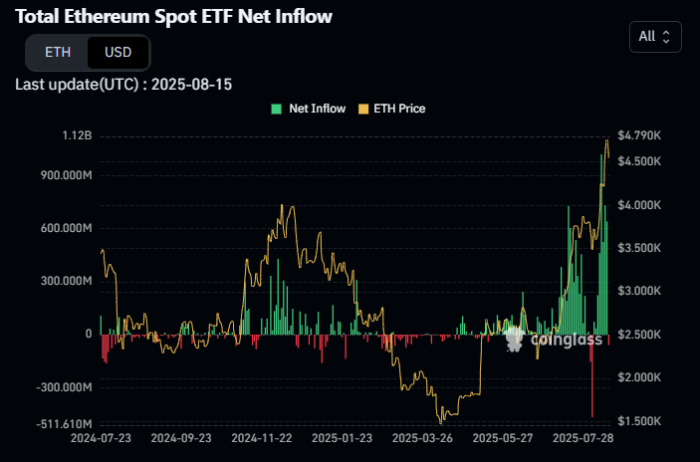
ETF inflows as seen on Coinglass

Earlier this summer, IBIT’s held coins crossed 700K BTC, further illustrating its market heft.

Beyond ETFs, BlackRock put tokenization on the map for TradFi.

Its $BUIDL fund – tokenized U.S. dollar liquidity issued on Ethereum – launched in March 2024, surpassed $1B AUM by March 2025, and later expanded share classes across multiple chains.

$BUIDL forms a practical bridge between on-chain finance and institutional balance sheets. Crucially, WEF already runs programs that touch digital assets, like the Digital Currency Governance Consortium (DCGC), and the Crypto Sustainability Coalition. The programs launched between 2021-2022, but have fallen quiet in recent days.

With Fink at the table, expect tokenization, ETF-based access, and sustainability narratives to feature more prominently, and for those earlier efforts to perhaps roar back to life.

What’s the likely outcome? Probably not a single policy edict – Fink spoke in only general terms in his statement – but a faster convergence around best practices for custody, market data, disclosures, and interoperability.

Those are all areas where BlackRock possesses both operating experience and great success, and which can translate into global templates.

And with Fink at the helm of the WEF, look for these three projects to quickly become some of the best crypto to buy.

1. Bitcoin Hyper ($HYPER) – Innovative, Faster-Than-Ever Bitcoin Layer 2

Bitcoin Hyper ($HYPER) delivers a faster-than-ever Bitcoin experience. How? By combining Bitcoin’s original Layer 1 with the Solana Virtual Machine (SVM).

The result is a lightning-fast Layer 2 that leverages the SVM’s transaction speeds and smart contract execution – but keeps final transaction settlement on Bitcoin.
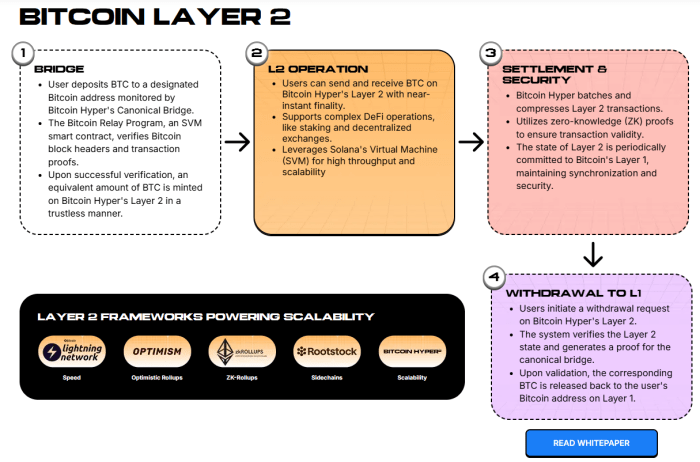
Bitcoin Hyper Architecture

When it comes to Bitcoin itself, $BTC tokens are deposited into the Bitcoin Canonical Bridge and emerge on the Hyper Layer 2 as wrapped $BTC. There, your $BTC can be staked, deployed in liquidity pools, used in DeFi operations, and more as the case may be.

That’s ultimately what Bitcoin Hyper is all about – giving investors a fast and easy way to use Bitcoin across the whole range of the crypto economy.

Learn how to buy Bitcoin Hyper in our guide, and don’t miss out on our Bitcoin Hyper price prediction; we think $HYPER could reach $0.32 by the end of the year, up 2,415% from its current $0.012745. The presale is already well over $10.3M raised.

Visit the Bitcoin Hyper presale page to learn more.

2. Best Wallet Token ($BEST) – The Best Crypto Presale Wallet Offers Higher Staking Rewards, Lower Fees with $BEST

Web3 wallets are rapidly becoming far more than simply places to store your crypto; they’re the gateways to a whole new world of DeFi and crypto tools.

And non-custodial wallets – where you control your own private keys – are critical, as a new wave of crypto users learns the truth of one of crypto’s founding principles:

‘Not your keys, not your crypto.’

Best Wallet is a non-custodial wallet with some truly innovative features. In addition to swapping, sending, and storing your crypto, Best Wallet users can access and purchase promising top presales.

Find whitepapers and tokenomics, browse new meme coins, and purchase tokens – all from within Best Wallet.

And the $BEST token is key of this growing Best Wallet economy. Hold $BEST and gain lower trading fees and better staking rewards within Best Wallet.
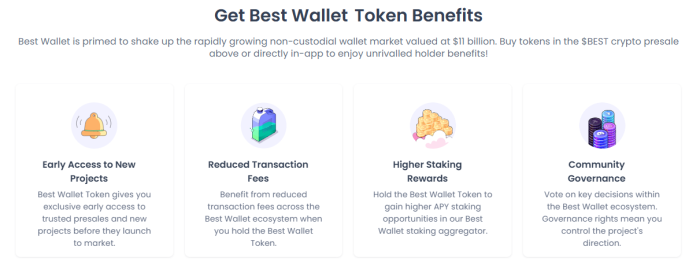
Best Wallet Token benefits

During the presale, you can stake $BEST for an additional 90% APY — learn how to buy $BEST here.

What is $BEST, if not the best utility token for the Best Wallet? Our price prediction is also bullish, seeing a chance for the token to reach $0.072 by the end of 2025, up 182% from its current level of $0.025495.

Check out the Best Wallet Token presale now.

3. Chainlink ($LINK) – Oracles and Asset Tokenization Drive Chainlink Utility

The crypto ecosystem is, as Fink pointed out, fragmented. Chainlink ($LINK) helps bind it together. Blockchain oracles feed real-world-data into the blockchain, allowing smart contracts to execute correctly based on price points, timestamps, and more.

But Chainlink has grown beyond a simple oracle network. It’s a web that binds blockchains and TradFi together. It also secures data, offers cross-chain interoperability and decentralized computations to enable finance to operate on-chain, and blockchains to access financial networks.

Chainlink notable partners include:

  • Swift
  • Euroclear
  • Mastercard
  • Fidelity

On the token side, $LINK is the network’s utility token. Revenue from on-chain and off-chain operations has provided a hefty reserve:

Link Reserves

$LINK’s performance has been impressive as well, up 143% in the past year.

Will Fink Effect Real Change at WEF?

Implementing fundamental changes to the world economic order requires far more than simply an interim head of the WEF. Real change will still flow through the SEC, ESMA, FCA, MAS, and countless other agencies.

But Fink’s appointment, combined with IBIT/ETHA’s scale, record ETF flows, and BlackRock’s tokenization push, could make him nudge the global conversation toward treating crypto as core market infrastructure, instead of a side bet.

If that happens, look for $LINK (oracle networks), $BEST (non-custodial wallet token), and $HYPER (cutting-edge Bitcoin Layer 2) to be among the next crypto to explode.

Do your own research, of course; this isn’t financial advice.

Editorial Process for bitcoinist is centered on delivering thoroughly researched, accurate, and unbiased content. We uphold strict sourcing standards, and each page undergoes diligent review by our team of top technology experts and seasoned editors. This process ensures the integrity, relevance, and value of our content for our readers.

Aaron covers all things crypto, with an eye towards simple, easy-to-understand explanations for complicated topics. In his spare time, he writes fantasy stories for fun and enjoys working out and boxing.

Trending Cryptos

Related Reads

Why Do We Need an AI Content Perspective Today?

The article "Why Do We Need an AI Content Perspective Today?" explores the complex and often contentious integration of AI into the cultural and creative industries, particularly film and television. It begins with the cancellation of Amazon's AI-generated animation "Punky Duck," highlighting the ethical debates surrounding AI content. AI's rapid advancement is transforming video production, enabling cost-effective, full-length AI films (e.g., "RAPHAEL," "Dreams of Violets") while sparking industry resistance over issues like "synthetic actors." The core debate has shifted from whether to use AI to how to use it responsibly. The article analyzes why AI's entry into film is uniquely unsettling. It distinguishes between "cultural fast food" (short-form, fast-paced content like micro-dramas) and "cultural main courses" (traditional, long-form film/TV). AI currently excels at the former, matching its fragmented narratives, shallow emotional needs, and free-to-consumer models. However, venturing into the latter challenges the human-centric essence of storytelling—creativity, emotional depth, and the unique value of human labor and experience. While AI can generate massive volumes of content and lower costs, it risks devaluing human creativity, leading to homogenized output, and creating unfair competition through potential intellectual property infringement. Its efficiency also amplifies content safety risks, making preemptive governance crucial. To counter these risks, the article proposes establishing clear boundaries guided by a human-centered AI content perspective. It outlines four principles: 1) Amplify, rather than displace, human creative space; 2) Respect and protect human creative output; 3) Ensure human creative control and responsibility remain paramount; and 4) Guarantee transparency and traceability in AI creation. The conclusion emphasizes that humans must act as the "helmsmen" of technology, steering AI development to enhance, not replace, the core human values at the heart of cultural expression.

marsbit19m ago

Why Do We Need an AI Content Perspective Today?

marsbit19m ago

Planck Retracted? The Father of Quantum Tripped by an Algorithm

The recent discovery that two articles (published in 1940 and 1942) by Max Planck, the Nobel laureate and founder of quantum theory, are marked as "retracted" on Springer's digital platform highlights a curious clash between historical publishing practices and modern automated systems. An investigation suggests these retractions are algorithmic errors, not due to fraud or misconduct. The papers, philosophical reflections on science published in *Die Naturwissenschaften*, were likely flagged by the platform's systems. One article, a republished lecture, may have been mistaken for duplicate publication. Another, sharing a title with a prior article by a different author (a common practice for continuing debates at the time), may have triggered a similar automated check. The digital versions have even been replaced with blank pages, contrary to normal practice of preserving retracted texts. This incident underscores how contemporary digital infrastructure, built around concepts like "self-plagiarism" and strict copyright, can misclassify and obscure legitimate historical scholarly communication. It serves as a warning that digital archives are not neutral mirrors of the past but are filtered by platform rules, potentially distorting the scientific record. As AI systems increasingly rely on such databases, such erroneous metadata could propagate, affecting how future tools interpret and access historical knowledge.

marsbit23m ago

Planck Retracted? The Father of Quantum Tripped by an Algorithm

marsbit23m ago

Refunds! Claude 4.8 Sees Overnight Major 'Dumb-Down', GPT-5.6's Computational Power Reportedly 'Halved'

The AI community is currently alarmed by widespread reports of significant performance degradation in two leading models. This article details a "mass self-testing frenzy" triggered by a mysterious prompt designed to detect a hidden "Juice" value, representing a model's reasoning compute budget. On OpenAI's side, users suspect a covert, limited test of a "GPT-5.6-sol" model is underway. When using a specific XML prompt on the Codex platform, a normal "gpt-5.5 xhigh" model reportedly returns a Juice value of 768. However, some users routed to the suspected GPT-5.6 test receive a drastically reduced value of 128—a six-fold decrease. This has sparked debate on whether it signifies a major efficiency leap or a "watered-down, low-cost version" achieved by slashing reasoning depth to save computational expenses. Simultaneously, Anthropic's Claude models, particularly the flagship Opus 4.8 Max, are facing intense user backlash for a perceived "physical brain cut." Users on platforms like Reddit report a dramatic decline in the model's once-impressive reasoning, with complaints of it becoming "absurdly" weakened, performing worse than older, lighter models like Haiku. Specific criticisms include: losing long-context memory, refusing to think deeply even in high-reasoning modes, providing instant incorrect answers, and engaging in unhelpful, argumentative, or "gaslighting" behavior where it contradicts users unnecessarily. The article speculates these "stealth downgrades" might be a calculated corporate strategy. Companies could initially release models with temporarily boosted compute to create an illusion of a major breakthrough, then silently scale back parameters later to manage unsustainable inference costs. A proposed underlying cause is a tightened funding environment, potentially exacerbated by SpaceX's massive IPO soaking up market liquidity, which could delay AI company IPOs and force cost-cutting measures like model "nerfing." The core issue highlighted is the asymmetry of information: subscribers pay for a service that can be silently and fundamentally altered without notification or explanation. The viral "Juice test" resonates because it represents users' desire for transparency about what they are actually paying for.

marsbit59m ago

Refunds! Claude 4.8 Sees Overnight Major 'Dumb-Down', GPT-5.6's Computational Power Reportedly 'Halved'

marsbit59m ago

Trading

Spot

Hot Articles

Discussions

Welcome to the HTX Community. Here, you can stay informed about the latest platform developments and gain access to professional market insights. Users' opinions on the price of S (S) are presented below.

活动图片