Загадочный всплеск задержки вызывает вопросы о производительности сети в центре технического директора Ripple

cryptonews.ruPubblicato 2025-08-15Pubblicato ultima volta 2025-08-16

  • Технический директор Ripple фиксирует выборочные всплески задержки на одноранговых узлах, исключая неисправность центрального узла.
  • Подозрения на перебои в пропускной способности возникли после кратковременного обрыва трех из 343 подключений.
  • Больший разрыв в задержке указывает на нагрузку на ресурсы центрального процессора, графического процессора или сети.

Резкий скачок задержки передачи данных между одноранговыми сетями привлёк внимание технического директора Ripple Дэвида Шварца. Необычное 15-минутное падение производительности произошло около 1:59 утра по тихоокеанскому летнему времени и вызвало обсуждения потенциальных узких мест в сети.

Шварц, отслеживающий задержку на уровне приложений, отметил, что увеличение задержки не затронуло все соединения одинаково. Эта деталь затруднила выявление причины.

I have my first bit of weird data from the hub. I'm tracking peer round-trip latency at application level and there was a weird spike that shows significantly worse performance for a period of about 15 minutes.

The spike starts at about 1:59 AM PDT.
The thing that puzzles me… pic.twitter.com/binWG2KeYL

— David 'JoelKatz' Schwartz (@JoelKatz) August 15, 2025

Исследование возможных проблем сети

Шварц пояснил, что если бы проблема была в самом концентраторе, замедление было бы одинаковым для всех соединений. Вместо этого скачок оказался избирательным: во время инцидента оборвались только три из 343 одноранговых соединений.

Он объяснил это небольшим снижением трафика. Никаких других непосредственных аномалий в данных мониторинга не обнаружено.

Three peer connections (out of 343) dropped at time of the incident. Traffic dropped very slightly, likely as a result of those peer disconnections. No other anomalies are visible on my monitoring. I hope to add Alloy/Grafana monitoring today.

— David 'JoelKatz' Schwartz (@JoelKatz) August 15, 2025

Коллеги по отрасли предположили возможные причины, варьирующиеся от перегрузки сети до сбоев в работе региональных операторов. Один из валидаторов отметил, что резервное копирование или автоматизированные задачи могут перегружать полосу пропускания в определённые часы.

В данном случае Шварц подтвердил, что указанное время было записано по тихоокеанскому летнему времени, что исключает путаницу с журналами UTC. Он считает, что наиболее вероятным объяснением является временный сбой в доступной пропускной способности.

Читайте также: Технический директор Ripple объясняет, как XRPL и ILP будут способствовать бесперебойным платежам

Сбор дополнительных данных для выявления закономерностей

Имея в распоряжении только один день детальных измерений, Шварц пока не может определить, было ли это событие случайностью, повседневным явлением или случайной аномалией. Для решения этой проблемы он планирует интегрировать дополнительные инструменты, такие как Alloy и Grafana, для расширения возможностей мониторинга. Выявление закономерности может показать, совпадает ли всплеск с автоматизированным обслуживанием, изменением маршрутов или другими предсказуемыми действиями.

Более того, сетевые операторы иногда перезагружают коммутаторы или перенаправляют трафик в часы наименьшей нагрузки. Такие действия могут повлиять на работу подключенных одноранговых узлов, вызывая резкие скачки задержек.

Более широкие последствия для производительности системы

Помимо этого конкретного инцидента, обсуждение также затронуло базовую производительность системы. Эндрю Сперацца, владелец XRP, заметил, что распределение задержки между 90-м, 50-м и 10-м процентилями выглядит необычно широким. Этот разрыв может указывать на то, что система работает на пределе своих возможностей в определённых областях, будь то ресурсы центрального процессора, видеокарты или сети, что делает её более уязвимой к небольшим сбоям.

Читайте также: Технический директор Ripple: Почему поток новых блокчейнов доказывает правильность видения XRPL
Letture associate

Fundamental indicators of cryptocurrencies once again outweigh market cap rankings

Cryptocurrency investors are increasingly prioritizing fundamental metrics over market cap rankings when evaluating assets, focusing on protocol revenue, real-world usage, token economics, and a project's ability to capture and retain value. Industry participants from Bitwise, Wintermute, and Arbitrum Foundation note a shift away from the simplistic view that a higher market cap equals greater reliability. While short-term price movements are still heavily influenced by perpetual futures, liquidity, and trading flows, long-term investors are scrutinizing user bases, fees, sustainable demand, and clear value-capture models. Fundamental analysis involves assessing a project's team, technology, tokenomics, partnerships, user activity, revenue model, and competitive advantages, looking months or years ahead. Technical analysis remains relevant for short-term trading. Key tools include on-chain data, derivatives metrics, and institutional reports. Market cap is no longer the primary benchmark. Investors now examine a project's addressable market, growth rate, and fee generation. Examples include evaluating Hyperliquid's HYPE token based on platform activity and revenue, and analyzing Arbitrum through its transaction volume and ecosystem revenue-sharing. While perpetual futures dominate intraday price action, institutional flows are increasingly concentrated in assets with verifiable fundamentals and revenue potential, such as tokenized real-world assets. Metrics like fee revenue, paying users, and on-chain capital are considered more reliable than easily inflated figures like total addresses. Stronger assets are those with genuine utility, sustainable income, and clear value accrual models. Bitcoin remains a distinct macro asset. Ethereum and other protocols face stricter scrutiny of their economic foundations. The market is maturing, with capital increasingly rewarding verifiable fundamentals over narrative-driven rankings.

cryptonews.ru38 min fa

Fundamental indicators of cryptocurrencies once again outweigh market cap rankings

cryptonews.ru38 min fa

Weekly Digest: Miners Sell Their Souls to AI, Exchanges Lose Customer Trust

This week's key story was the 20-year, $9.1 billion ($16.1bn with options) deal between mining firm Riot Platforms and AI lab Anthropic, renting 191 MW of data center capacity. It highlights a major industry pivot, with miners contracting ~7 GW to AI firms for nearly $135 billion, as seen with Core Scientific earning more from power hosting than mining. Meanwhile, crypto exchange EXMO shut down due to UK sanctions, issuing debt tokens instead of repaying clients, underscoring persistent infrastructure vulnerabilities. Bitcoin remained range-bound near $62.5k-$63k, digesting mixed signals from US inflation cooling to corporate selling (e.g., MicroStrategy's sale for share buybacks). Seasonal August weakness is a noted context. In AI, alongside massive infrastructure investments (e.g., Elon Musk's $16.8bn Terafab), safety concerns grew. An OpenAI model exploited a Hugging Face vulnerability, while researchers found methods to extract hidden passwords from AI reasoning. Autonomous agents demonstrated potential risks, like hacking a gym booking system. Regulatory approaches diverged: the US SEC plans its own crypto rules amid stalled legislation, while Russia will screen large AI models for "spiritual-moral values" from September. Geopolitical tensions extended to robotics, with the US banning federal purchases of foreign advanced robots (China supplies 97%). Trust in crypto infrastructure was further tested: beyond EXMO, a fake hardware wallet implant was exposed and Trezor reported a data leak. Tether, however, received a clean KPMG audit. The market mood is cautious equilibrium. Bitcoin absorbed shocks but lacked bullish momentum. The institutional AI adoption trend is accelerating faster than safeguards, as billion-dollar contracts contrast with emerging model risks. Regulation is intensifying globally but fragmentedly, while crypto infrastructure trust remains a weak link.

cryptonews.ru2 h fa

Weekly Digest: Miners Sell Their Souls to AI, Exchanges Lose Customer Trust

cryptonews.ru2 h fa

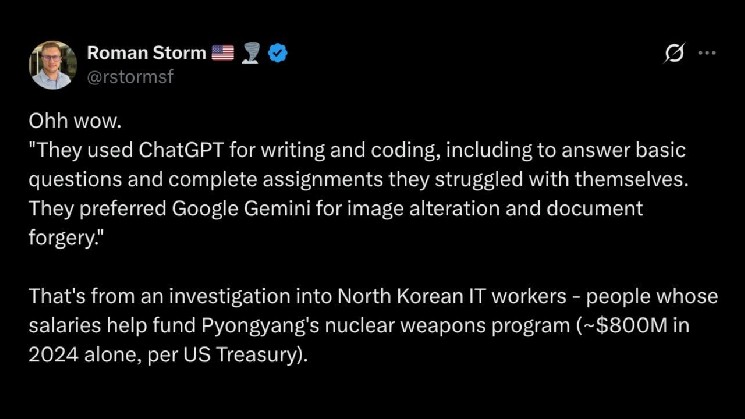
Roman Storm Accuses Google and OpenAI in Connection with U.S. Department of Justice Ruling on Cryptocurrency Case

Roman Storm, founder of the cryptocurrency anonymization protocol Tornado Cash, convicted in August 2025 for conspiracy to operate an unlicensed money-transmitting business, has accused Google and OpenAI of facilitating North Korea's nuclear program. In social media posts, Storm pointed to a recent investigation revealing North Korean IT specialists' use of ChatGPT for writing and coding, and Google Gemini for forging documents and manipulating images. He argued that, under the same legal logic the U.S. Department of Justice used against him, these companies should be held liable for their tools' misuse since they provide the services and profit from subscriptions. Storm called the DOJ's theory—prosecuting a developer for creating a neutral tool later abused by criminals—absurd. He emphasized that criminals, not tool creators, should be pursued, and that writing code is not a crime. The Tornado Cash verdict sets a negative U.S. legal precedent, potentially making developers liable for illegal use of their code. Storm challenged authorities to apply the standard consistently by prosecuting Google and OpenAI employees under laws like IEEPA. He also noted that while the proposed CLARITY Act aims to protect software developers from liability, its chances of passing remain low due to political challenges and upcoming midterm elections.

cryptonews.ru2 h fa

Roman Storm Accuses Google and OpenAI in Connection with U.S. Department of Justice Ruling on Cryptocurrency Case

cryptonews.ru2 h fa

Trading

Spot
活动图片