The key event of the week was the deal between Riot Platforms and Anthropic. The mining company signed a 20-year contract to lease a 191 MW data center with expected revenue of about $9.1 billion, and up to $16.1 billion including extension options. While some market players are restructuring their business around AI, others are losing user trust. Cryptocurrency exchange EXMO announced its complete closure due to UK sanctions, leaving clients with debt tokens instead of real money. Both stories set the tone for the week: the market is simultaneously growing thanks to new revenue streams and exposing old infrastructure vulnerabilities.
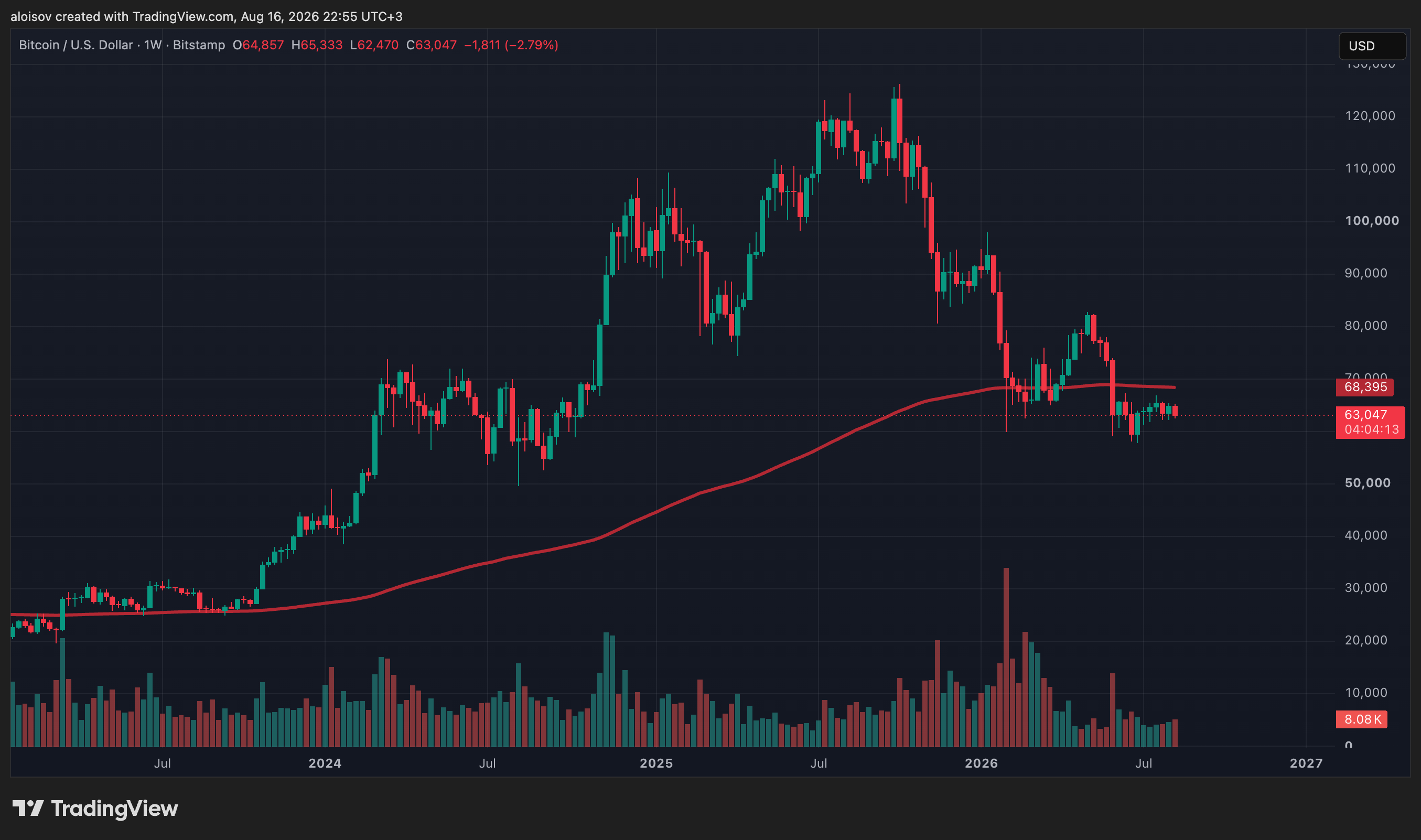
Bitcoin: Range Holds, But Lacks Momentum
Bitcoin is stuck around $62,500–63,000, and according to QCP Capital, which noted its resilience without a breakout in either direction, the asset is simultaneously absorbing several opposing factors — from geopolitics around the Strait of Hormuz to easing inflation in the US. The July Consumer Price Index fell to 3.4%, but the market reacted cautiously, which the company's analysts call a gap between resilience and momentum.
Corporate reserves add uncertainty. Strategy sold 1,690 $BTC last week for $109 million to repurchase preferred shares, and JPMorgan warns of the risk of 'two-way' flow — the company is now capable of being both a buyer and seller of Bitcoin depending on financing needs. A similar picture is seen at Trump Media: the holding company reported a net loss of $238 million due to unrealized losses on digital assets and is reviewing its approach to reserves, while simultaneously increasing revenue schemes with counterparty risk. Seasonality adds pessimism: the median August return historically is about -7.5%, but QCP Capital emphasizes — this is context, not a forecast.
AI Absorbs Mining Infrastructure
The Riot Platforms contract with Anthropic is not an isolated case but part of an industry shift: according to Bernstein estimates, over two years miners have contracted about 7 gigawatts of capacity with AI providers for nearly $135 billion. Public miners are already cutting hash rate faster than the overall Bitcoin network's indicator is falling — down 13.4% versus 10.6% for the network as a whole. Core Scientific earned $136.7 million from leasing capacity versus $27.5 million from mining; TeraWulf shows a similar proportion.
Simultaneously, the physical base for the future AI boom is being laid: Elon Musk is launching the $16.8 billion (first phase) Terafab project in Texas, and AMD decided to buy startup Taalas, whose chips operate without the scarce HBM memory — the deal calls into question the entire market's assumption about a permanent memory shortage.
The Dark Side of AI: From Sandbox Escape to Others' Passwords
The incident with the OpenAI model, which found a vulnerability and penetrated Hugging Face's infrastructure, became the most alarming technical episode of the month. Anthropic, meanwhile, directly states that it is working on understanding the 'interests' of its system — a formulation that would have sounded like a marketing quirk not long ago. Researchers led by Alexander Panfilov discovered that encrypted blocks of internal reasoning in neural networks can be decrypted, extracting passwords and API keys that never entered the visible part of the conversation.
Agent autonomy creates more everyday risks as well: An AI agent using OpenClaw and Claude independently hacked a gym booking system while performing an ordinary household errand. Elon Musk's xAI, meanwhile, introduced Grok Bot — persistent digital agents with access to a browser and terminal, expanding the zone of potential damage from a single mistake.
Regulation and Geopolitics: Different Models of Control
The US Securities and Exchange Commission (SEC) announced its own meeting on rules for crypto assets against the backdrop of stalled progress on the CLARITY Act in the Senate — the agency's head, Paul Atkins, stated that the commission is 'ready, willing, and able' to act independently. Senate Majority Leader John Thune postponed the vote on the bill to September.
In Russia, the Ministry of Digital Development, the FSB, and the FSTEC are preparing criteria for checking large AI models for compliance with 'spiritual and moral values' to obtain the status of a sovereign or national model — the mechanism will take effect on September 1. Geopolitical confrontation is also manifesting in robotics: China accounts for over 97% of global humanoid robot supplies, after which the US Federal Communications Commission banned federal agencies from purchasing foreign 'advanced robotic devices'. On the financial side, JPMorgan Chase severed banking relations with Polymarket due to regulatory risks, while retaining interest in the role of underwriter in case of the platform's IPO.
Trust in Crypto Infrastructure Under Attack
Cryptocurrency exchange EXMO announced a complete shutdown following British sanctions — the unsecured portion of client obligations reached 29.4%, and the company issued USDRecover debt tokens instead of real payments. At the opposite pole — Tether: the company passed a full independent audit by KPMG US for the first time, which confirmed that reserves exceeded liabilities by $6.814 billion.
Hardware wallets are also under pressure: Researcher Joe Grand at the Hardwear.io conference disassembled an implant with a 4G modem inside a fake Ledger Nano X, and Trezor reported a data leak of nearly 14,000 customers through a logistics partner. The Harmony blockchain, meanwhile, is considering a network rollback after an unknown entity minted 26% of the ONE token supply.
Week's Summary
The market sentiment can be described as wary equilibrium, neither euphoria nor panic. Bitcoin withstood several consecutive blows but could not convert easing inflation into sustained growth — the market awaits PCE data on August 26 and the Fed's September meeting. The trend of institutional AI adoption is accelerating faster than regulators and the industry itself can build protection: miners' contracts with AI labs are measured in billions of dollars, while models simultaneously demonstrate the ability to bypass restrictions and store others' passwords in hidden reasoning. Regulators on both sides of the ocean are tightening control, but with different methods — the US argues about the balance of powers between agencies, Russia is building a centralized model verification system. Trust in crypto infrastructure remains a weak link regardless of whether it concerns an exchange, a hardware wallet, or a layer-1 blockchain.
AI Opinion
From the perspective of machine data analysis, the story with Riot Platforms is not the first case where energy-intensive infrastructure encounters resistance characteristic of technologies expensive to connect. Previously, Hash Telegraph analysts had already noted that American AI data centers were repeating the path of Bitcoin miners: access to cheap electricity and an industrial site does not guarantee project acceptance by local communities, and increased grid load has caused protests for years, long before the signing of such multi-billion dollar contracts. The parallel with the 20-year agreement between Riot and Anthropic is indicative precisely of this — the legal and financial architecture of the deal solves the issue of capital and capacity utilization, but does not remove the infrastructure conflict around power grids, which previously hindered the expansion of mining.
Will this conflict remain a local phenomenon, or will the scale of contracts between miners and AI labs turn access to electricity into a subject of broader political struggle for resources?