30-Year Treasury Yield Breaks 5% Again: The Era of 'Everything Is Cheap' Is Over

marsbitPublished on 2026-06-01Last updated on 2026-06-01

Abstract

The yield on the 30-year U.S. Treasury bond has again surpassed 5%, signaling a fundamental shift as markets begin to accept that high interest rates are here to stay. This reflects the simultaneous breakdown of three pillars that underpinned half a century of low inflation and low rates: cheap capital, cheap labor, and cheap energy. Global capital flows are shifting, energy security is strained, and labor costs are rising due to shortages and unionization, though partly offset by AI's impact. Long-term pressures like soaring government debt, geopolitical friction, and populism are also pushing up long-term borrowing costs. The role of AI remains the biggest uncertainty—it could boost productivity and lower debt or become a new source of inflation if it merely automates jobs while consuming vast resources. The core challenge for investors is adapting their models and expectations, calibrated during decades of cheap money, to this new, more persistent high-rate environment.

The yield on the 30-year Treasury bond has once again broken through 5%. This time, the market's reaction is markedly different from that in 2023—investors are beginning to truly accept the reality that high interest rates will persist for a long time.

Analysis points out that behind this lies a deeper structural shift: the three pillars supporting low inflation and low interest rates in the U.S. over the past 50 years—cheap capital, cheap labor, and cheap energy—are simultaneously eroding. And the direction of AI will be the biggest unknown determining future inflation trends.

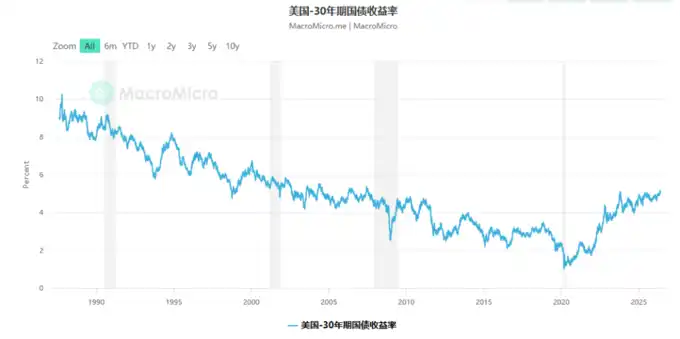
The yield on the 30-year U.S. Treasury bond recently broke through 5% again. Writing in the Financial Times, columnist Rana Foroohar points out that, unlike the brief breach of 5% in 2023 followed by a rapid decline, this time the market's reaction is distinctly different—investors finally seem to be truly accepting the reality that the U.S. is bidding farewell to the era of low interest rates and entering a new phase with more persistent and diverse inflationary pressures.

The article cites a recent report to clients by Apollo chief economist Torsten Sløk, which states, "Investors should position their portfolios for a persistent high interest rate environment in the short, medium, and long term."

Behind this lies a larger structural story: the three cheap factors that drove U.S. economic growth over the past 50 years—cheap capital, cheap labor, and cheap energy—are simultaneously reversing.

How Did Half a Century of "Cheap Dividends" Come About?

The nearly half-century-long downward trend in the 30-year Treasury yield, falling from around double-digit percentages in the early 1980s to about 1% during the pandemic, was not an accident.

It was underpinned by a complete macro logic:

Cheap Capital: Decades of globalization and manufacturing technology advancements kept goods prices low; oil-exporting countries recycling massive petrodollars into the U.S. provided ample cheap funding; pension privatization reforms spurred enormous demand for various financial products; global investors vied to buy U.S. Treasuries, as no country was safer than America.

Cheap Labor: Outsourcing of industries, weakening of unions, automation waves, and the "shareholder primacy" corporate culture (emphasizing financial engineering over employee investment) collectively suppressed wages, especially for non-college-educated workers, persistently supporting corporate profit margins.

Cheap Energy: The petrodollar system helped curb inflation to some extent, and the global energy trade being settled in dollars also reinforced the dollar's global dominance.

These three pillars jointly supported half a century of low-inflation, low-interest-rate prosperity in the U.S.

The Three Pillars Are Simultaneously Loosening

In her article, Rana Foroohar notes that each of these supporting factors is now changing.

On the Capital Front: With each U.S. Treasury auction, international buyers are decreasing, not increasing. Deglobalization and supply chain reshoring will push up goods and services prices in the short term. Meanwhile, the foundation of the petrodollar system is being eroded.

On the Energy Front: Continued tensions in the Middle East directly impact Asian energy-importing countries. But in the longer term, this may accelerate the deployment of clean energy in major Asian nations—while the U.S. is retreating from climate commitments. This means long-term capital flows may shift from the U.S. to major Asian countries.

On the Labor Front: In recent years, labor shortages, large-scale strikes (including successful union action in the auto industry), tighter immigration restrictions, and growth in union membership in some sectors (especially white-collar industries) have all pushed wages higher. However, this trend is being partly offset by two factors: one is rising corporate healthcare insurance costs, leading companies to hedge by suppressing wages; the other is the impact of artificial intelligence.
And Then There Are the Slow Variables: Debt, Geopolitics, and Populism

In addition to the explicit factors above, there are several "slow variables": rising government debt, intensifying geopolitical friction, and the spread of populism.

The combined effect of these risks is that lenders demand a higher risk premium to lend money out—especially for terms of several years.

This directly pushes up long-term interest rates, i.e., the yield on the 30-year Treasury bond.

AI: Savior or New Source of Inflation?

Of all the variables, the direction of artificial intelligence is the most difficult to judge, yet its impact could be the most far-reaching.

Rana Foroohar outlines two starkly different scenarios:

The Optimistic Scenario: The productivity benefits of AI diffuse widely across industries and individuals, creating new jobs and income sources. Models from Yale's Budget Lab show that in this scenario, U.S. national debt would fall significantly, and inflation would also recede.

The Pessimistic Scenario: AI serves merely as a tool for corporate layoffs, cost compression, and profit expansion, while the infrastructure construction of AI itself (consuming vast amounts of chips, land, water, and electricity) creates new inflationary pressures. The net effect is to raise, not lower, costs. Governments would also be forced to bail out displaced workers, increasing debt instead.

Currently, AI giants are voraciously consuming real estate, chips, water resources, and electricity, already pushing up the prices of these resources in the overall economy. The final outcome will likely take years to become clear.

The Real Challenge Facing Investors

The article's conclusion is direct and sobering: Most market participants have spent their entire careers in the "cheap era." Their intuition, models, and expectations were calibrated in a low-interest-rate environment.

And now, that environment is changing.

"Expectational inertia" is a powerful force—when the 30-year yield broke 5% in 2023, many thought it was just a brief anomaly that would soon recede. But this time, the market's reaction is already different.

Adjusting means abandoning old expectations. For investors accustomed to low interest rates, that is no easy task.


Related Questions

QWhat is the main reason behind the recent sustained rise in the 30-year US Treasury yield above 5%, according to the article?

AThe main reason is a deeper structural shift where the three pillars supporting low inflation and low interest rates in the US for the past 50 years—cheap capital, cheap labor, and cheap energy—are simultaneously eroding, leading investors to accept that a high-rate environment is here to stay.

QWhat were the three 'cheap pillars' that drove US economic growth for half a century?

AThe three pillars were cheap capital (from globalization, petrodollar recycling, and high demand for safe US debt), cheap labor (due to outsourcing, weaker unions, automation, and a 'shareholder-first' culture), and cheap energy (supported by the petrodollar system).

QHow might Artificial Intelligence (AI) contribute to future inflation, based on the pessimistic scenario described in the article?

AIn the pessimistic scenario, AI does not boost broad productivity but is used mainly for cost-cutting and layoffs. Meanwhile, AI infrastructure itself (consuming chips, real estate, water, and electricity) creates new inflationary pressures. Governments may also need to bail out displaced workers, increasing debt.

QBesides the three main pillars, what other 'slow-moving' factors are contributing to higher long-term interest rates?

AOther factors include rising government debt, increasing geopolitical friction, and the spread of populism. These factors increase risk premiums, meaning lenders demand higher yields for long-term loans, which pushes up long-end rates like the 30-year Treasury yield.

QWhy is adjusting to the new high-rate environment particularly challenging for investors, as stated in the article's conclusion?

AAdjusting is challenging because most market participants have spent their entire careers in the 'cheap era' of low interest rates. Their instincts, models, and expectations are calibrated for that environment, creating a powerful 'expectational inertia' that makes it difficult to abandon old assumptions.

Related Reads

Promised Year of Crypto IPOs? Only One Went Public in Six Months, Down 70%

The much-anticipated wave of crypto IPOs in 2026 has failed to materialize, with market conditions worsening dramatically. While SpaceX prepares for the largest IPO in history, raising $75 billion at a $1.75 trillion valuation, the crypto sector faces a frozen pipeline. The sole crypto IPO success this year, BitGo, serves as a cautionary tale. After launching on the NYSE in January at $18, its stock has plummeted approximately 70%. Other major contenders have stalled or delayed. Kraken, which secretly filed in late 2025, has put its plans on ice, seeing its valuation drop 33% to $13.3 billion. Consensys has postponed its filing until autumn at the earliest, and Bitpanda is poised to miss its self-imposed H1 deadline for a Frankfurt listing. This widespread retreat is driven by a severe liquidity crunch. Bitcoin has fallen below $60,000, with capital being diverted to AI stocks and the massive SpaceX offering. The poor performance of earlier crypto listings like Gemini and the stagnant price of Coinbase further dampen investor appetite. A key underlying pressure is the impending US midterm elections in November, which could alter the currently favorable regulatory landscape. Companies had hoped to go public during this window of policy certainty, but challenging market dynamics have overridden those plans. The transparency that comes with being a public company is now seen as a potential liability rather than a benefit in a down market. The industry's fate now hinges on a few critical watchpoints: whether Kraken restarts its process in H2, if Consensys files in the fall, and if SpaceX's debut can revitalize market liquidity. Otherwise, the promised "crypto IPO year" will likely be pushed beyond the election.

marsbit6m ago

Promised Year of Crypto IPOs? Only One Went Public in Six Months, Down 70%

marsbit6m ago

Behind Musk and Huang Jen-hsun's 'AI Factories', an Unseen Battle for Freshwater Has Begun

Behind the "AI factories" of Elon Musk and Jensen Huang lies a hidden battle for a critical resource: fresh water. As AI models like ChatGPT and Claude process billions of prompts daily, they consume vast amounts of water for cooling. By 2030, global AI infrastructure is projected to use 9.3 trillion liters annually—enough to meet the basic needs of 1.3 billion people. This "water grab" stems from the massive heat generated by high-powered GPUs. Over 70% of data centers use evaporative cooling systems, where water absorbs heat and evaporates into the atmosphere, depleting local groundwater. Training models like GPT-4 can consume over 600 million liters of water. Tech giants like Google and Microsoft report skyrocketing water usage, sparking conflicts with local communities over resources. A flashpoint occurred in Memphis, Tennessee, where Musk's xAI built the Colossus supercomputer. It draws nearly 3.8 million liters of drinking water daily from local aquifers, leading to public outrage and legal action. In response, xAI is building an $80 million water recycling plant to use treated wastewater instead. Facing pressure, companies like Microsoft promote "waterless" closed-loop cooling systems. However, these systems increase electricity consumption by 20-30%, shifting the water burden to power plants, which require immense cooling water themselves—a case of indirect water footprint transfer. For China's AI industry, this crisis offers a strategic warning and opportunity. Instead of replicating the West's resource-intensive model, China can leverage its "East Data, West Computing" policy to locate data centers in cooler, water-rich regions like Guizhou. Furthermore, developing lightweight edge computing for smart homes and embodied AI robots can drastically reduce the need for constant cloud queries, cutting both water and energy consumption at the source. The freshwater war underscores a fundamental question: Will AI be a tool for human advancement or a silicon-based monster competing for our planet's last drops of clean water? The answer is becoming clearer as the water vapor rises.

marsbit52m ago

Behind Musk and Huang Jen-hsun's 'AI Factories', an Unseen Battle for Freshwater Has Begun

marsbit52m ago

AGI is Just One Step Away

The article discusses Anthropic's release of the Fable 5 model, a heavily restricted version of its powerful Mythos model. Initially unveiled in April, Mythos reportedly identified over 10,000 high-risk vulnerabilities for 50 enterprise clients, causing significant concern. Due to its dangerous capabilities in areas like autonomous cyber-attacks and biochemical weapons design guidance (classified as CB-1 level), the unaltered Mythos 5 remains limited to about 200 vetted entities like government agencies. Fable 5, released with a safety classifier, demonstrates extraordinary performance, leading benchmarks in coding (SWE-Bench Pro), software engineering, and research. It exhibits true "long-horizon agency," autonomously planning and executing complex, multi-step tasks like migrating 50 million lines of code in a day, moving beyond simple question-answering. The article positions Fable 5 at OpenAI's Level 3 ("Agent") and progressing toward Level 4 ("Innovator"), suggesting AGI (Artificial General Intelligence) is within reach, potentially 18-24 months away. To mitigate risks, Anthropic implemented a two-layer safety "cage": a silent routing system that redirects dangerous queries to a weaker model, and a mandatory 30-day data retention policy for all Mythos traffic to detect patterns of malicious use. Despite its high cost ($10/$50 per million input/output tokens), the model targets the enterprise market, where its unparalleled productivity and defensive capabilities against AI-powered cyber threats justify the premium. This signals a market maturation where top-tier AI becomes a strategic, high-value tool for businesses, potentially widening the gap with consumer-focused models and accelerating the rise of "one-person companies" while disrupting labor markets.

marsbit1h ago

AGI is Just One Step Away

marsbit1h ago

Trading

Spot
Futures

Hot Articles

Ethena: Building a New Era of Web3‑Native Digital Dollars

Ethena is an Ethereum‑based synthetic dollar protocol that delivers crypto‑native monetary solutions, including USDe, a synthetic dollar, and sUSDe, a globally accessible U.S. dollar savings asset.

53.2k Total ViewsPublished 2026.03.16Updated 2026.03.16

Ethena: Building a New Era of Web3‑Native Digital Dollars

Discussions

Welcome to the HTX Community. Here, you can stay informed about the latest platform developments and gain access to professional market insights. Users' opinions on the price of ERA (ERA) are presented below.

活动图片