Старые биткоинеры уходят, но это здоровая динамика

cryptonews.ruPubblicato 2025-08-22Pubblicato ultima volta 2025-08-22

Старая гвардия продает крупные партии биткоинов новым институциональным игрокам и это свидетельствуют о «финансовой интеграции актива», заявил Райан Макмиллин, инвестиционный директор Merkle Tree Capital.

Хотя многие крупные держатели биткоина активизировались в прошлом месяце, фиксируя прибыль при цене выше $122 000, аналитики считают это естественным процессом для зрелого рынка, не угрожающим долгосрочной стоимости актива.

В среду компания Swan Bitcoin сообщила в Twitter, что крупнейшая в истории смена держателей биткоина близится к завершению: «старую гвардию сменяют новые уверенные игроки» — корпорации и казначейские фонды.
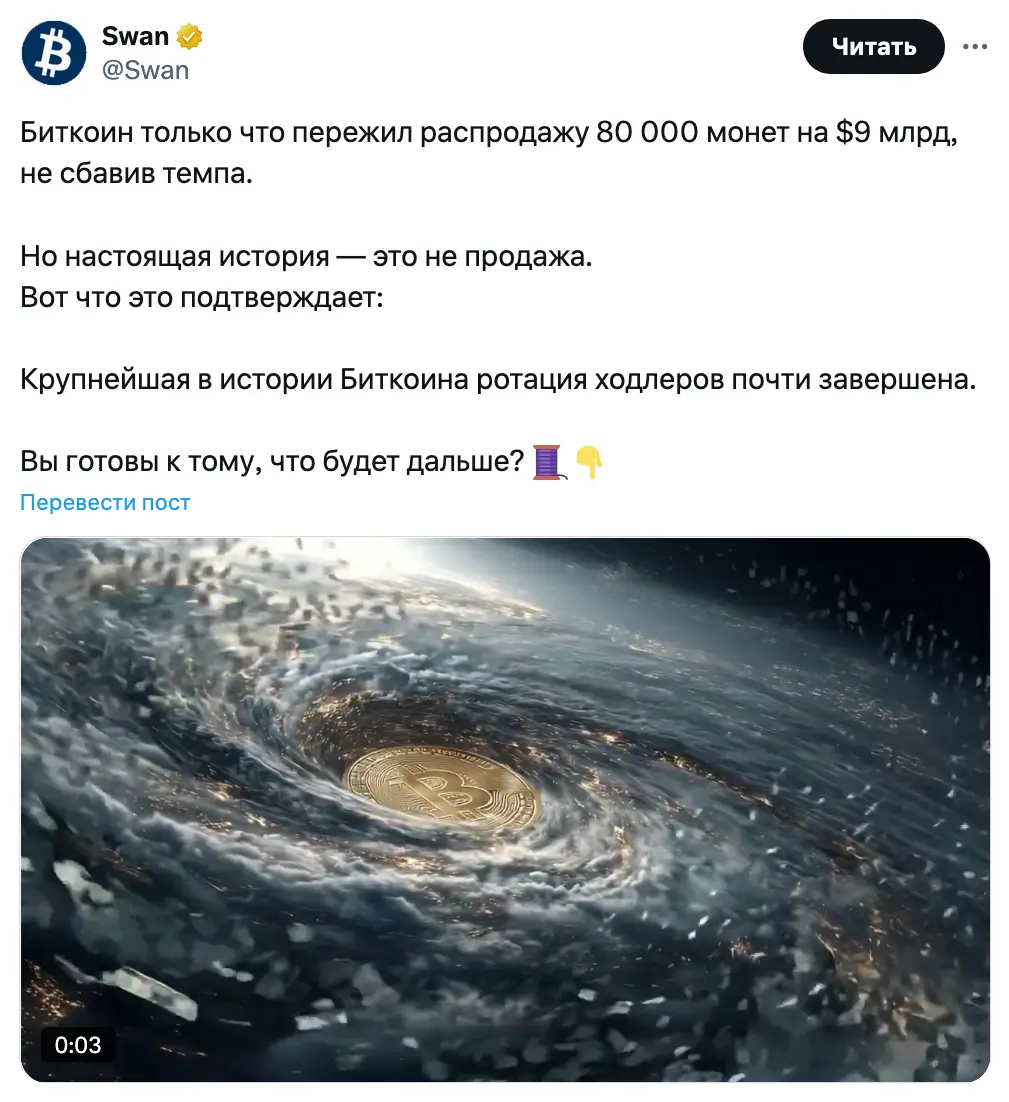

Крупнейшая в истории Биткоина ротация держателей почти завершена. Источник: Swan.

Ранее в этом месяце кит эпохи Сатоши продал весь свой запас в 80 201 BTC ($9,6 млрд) серией транзакций.

Во время этих переводов цена временно снизилась на 4%, но, по словам исследователя Виджая Бояпати, рынок быстро абсорбировал этот объем.

Аналитическая платформа CryptoQuant подтвердила, что недавние продажи были вызваны фиксацией прибыли новыми крупными держателями, что помешало биткоину закрепиться выше $120 000.

Криптоаналитик Вилли Ву отметил в июне, что киты (владельцы 10 000+ BTC) стабильно продают актив с 2017 года, отвечая на вопрос о природе продаж на фоне растущего институционального интереса.

Распродажи китов — позитивный сигнал для рынка

Чэк Чжэн, соучредитель хедж-фонда ZX Squared Capital, считает смену держателей признаком здоровой рыночной динамики:

«Приход новых покупателей характеризует формирование нового бычьего рынка».

Данные аналитической платформы Santiment показывают, что с конца марта кошельки с балансом 10-10 000 BTC увеличили holdings на 218 570 монет (+0,9% от общего предложения).

Институциональные игроки аккумулируют биткоин

Чжэн отмечает, что замещение розничных инвесторов институциональными участниками представляет собой «естественную эволюцию системы», создающую новый рыночный порядок.

Особой популярностью биткоин пользуется у корпоративных казначейств. Согласно Bitbo, 219 организаций (включая ETF, государства, публичные и частные компании) владеют 3,6 млн BTC на $419 млрд.
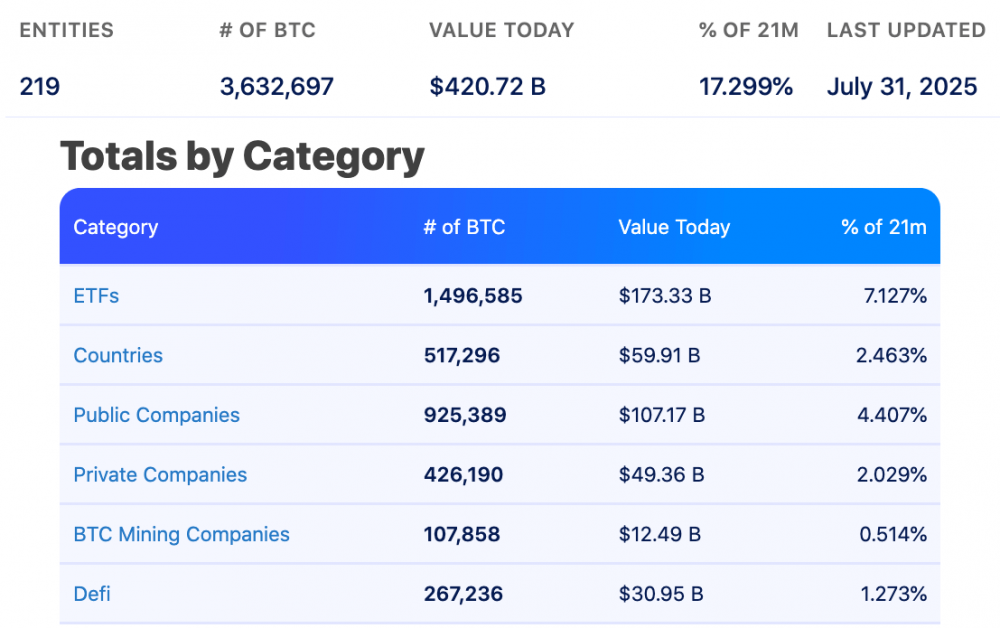

219 организаций владеют 3,6 млн BTC на $419 млрд. Источник: Bitbo.

«Корпоративные казначейства и биткоин-ETF формируют новый институциональный порядок, интегрируя актив в механизмы Уолл-стрит, — пояснил Чжэн. — Это здоровый путь для будущего роста».

Однако аналитик предупреждает, что волатильность сохранится до полного признания биткоина «цифровым золотом», что может потребовать нескольких рыночных циклов.

Финансовая интеграция по образцу золота

Райан Макмиллин из Merkle Tree Capital проводит параллели с историей золота:

«Переход биткоина от ранних энтузиастов к институциональным фондам повторяет путь золота в 2000-х, когда его биржевая котировка запустила десятилетний рост с $350 до $2000 за унцию».

По его словам, аналогичный процесс ожидает биткоин по мере включения в портфели пенсионных фондов, что снизит волатильность и привлечет консервативных инвесторов.

Диверсификация как естественный процесс

Чжэн объясняет продажи китов логикой диверсификации в перспективные секторы (например, ИИ), подчеркивая, что смена владельцев не влияет на фундаментальную стоимость актива:

«Это аналогично рынку недвижимости: первоначальные владельцы фиксируют прибыль, новые инвесторы входят — ценность актива при этом не меняется».


Letture associate

Upbit is Anxious: A Hasty Counterattack Aimed at Regaining Stablecoin Market Share

Title: Upbit's Rushed Counterattack to Reclaim Stablecoin Market Share Facing a dramatic shift in South Korea's stablecoin market, leading exchange Upbit launched a promotional campaign from July 26 to August 9, waiving the 0.05% trading fee for stablecoins paired with the Korean Won (KRW) and rapidly listing new stablecoins like RLUSD and USDG. This move is a direct response to its plummeting market share in this sector. Historically a duopoly with Bithumb, the market has been reshaped since October 2025 when Coinone permanently removed fees for USDC trading. By June 2026, Coinone led with 34.8% of stablecoin volume, followed by Bithumb (31.1%) and Upbit (30.1%). This contrasts sharply with the overall crypto market, where Upbit commands 60%. The data shows stablecoin demand is highly sensitive to fees, as users primarily buy them to transfer capital overseas for derivatives trading or forex arbitrage. South Korean exchanges have seen a net outflow of stablecoins for 18 consecutive months, totaling approximately 14.9 trillion KRW, underscoring their role as a cross-border capital conduit. Upbit's limited-time promotion initially boosted its daily stablecoin volume by 162%, but the surge was almost entirely in USDT (98.1% of volume). The newly listed stablecoins saw negligible, fleeting interest. Furthermore, the promotional effect quickly waned in the second week, with volume dropping 33% on weekdays. A concurrent weakening of the KRW also contributed to the trading spike, independent of the fee waiver. The analysis suggests that once the promotion ends, Upbit is unlikely to retain its temporary gains unless it matches Coinone's permanent zero-fee policy, forcing a choice between market share and fee revenue. Upbit's strategic push may be less about immediate profit and more about preparing for future regulatory shifts. With South Korea's *Digital Asset Basic Act* on the horizon, which will regulate KRW-backed stablecoins, and following Dunamu's (Upbit's parent) integration into Naver Financial to build a payment ecosystem, securing a dominant position in the dollar stablecoin distribution channel holds long-term strategic value. However, potential regulatory conflicts could prevent Upbit from listing a future Naver-issued KRW stablecoin, making the current fight for dollar stablecoin flow even more critical.

marsbit5 h fa

Upbit is Anxious: A Hasty Counterattack Aimed at Regaining Stablecoin Market Share

marsbit5 h fa

Michael Saylor Compares Bitcoin and Gold!

Michael Saylor, founder of MicroStrategy, argues that Bitcoin fundamentally changes how wealth is stored and transferred by transforming digital scarcity into economic value. He describes Bitcoin as the first digital monetary network, combining computers, digital networks, and cryptography. It digitizes monetary assets, allowing their supply to be controlled by public protocols rather than institutions, thus converting economic value into information transmissible over global networks. Comparing Bitcoin to gold, Saylor states that while increasing Bitcoin's supply is harder, its integration with software and transfer is easier. He highlights Bitcoin's proof-of-work mechanism, which ties it to the physical world by consuming real energy to secure the ledger, making past transactions immutable. This creates a shared security system involving miners, energy companies, and investors. Saylor suggests "digital monetary energy" is a more accurate term than "digital gold." He emphasizes that the Bitcoin network is an adaptive ecosystem of miners, nodes, developers, and users. Its core design is intentionally simple, focused on maintaining a secure ledger for scarce digital assets, with complex functionalities built in higher-layer applications. This architecture allows Bitcoin to serve as a foundation for transmitting value and fostering innovation in payments and financial services. Saylor notes Bitcoin's deeper impact lies in creating digital sovereignty, where private keys give individuals permissionless control over their economic power, with ownership verified mathematically, not by institutions. He concludes that while gold's physical scarcity makes it money, Bitcoin's digital scarcity does the same, characterizing Bitcoin as the monetary energy of the digital age.

cryptonews.ru6 h fa

Michael Saylor Compares Bitcoin and Gold!

cryptonews.ru6 h fa

Trading

Spot
活动图片



