Fundamental Global упала на 13% после объявления о переходе на Ethereum‑казначейство

cryptonews.ruPublished on 2025-01-31Last updated on 2025-08-01

Акции Fundamental Global (Nasdaq: FG) потеряли 13% своей стоимости после того, как компания объявила о планах создания Ethereum-казначейства с резервами в размере $200 млн. Рыночная реакция оказалась резко негативной, несмотря на стратегическую инициативу компании.

На бирже Nasdaq котировки Fundamental Global продемонстрировали значительное снижение после заявления о переходе к использованию Ethereum (ETH) в качестве основного резервного актива. Для формирования казначейских резервов компания планирует провести частное размещение 40 млн варрантов на обыкновенные акции по цене $5 за каждый.

Это решение ставит Fundamental Global в ряд компаний, создающих Ethereum-казначейства. В официальном заявлении подчеркивается намерение предложить инвесторам «множество факторов стоимости помимо роста цены ETH», включая доходность от стекинга и доступ к токенизированным активам.

Среди стратегических партнеров, поддерживающих инициативу, значатся Galaxy Digital (управление резервами ETH), Kraken (техническая поддержка стекинга) и Hivemind Capital (стратегическое партнерство). В рамках преобразований Fundamental Global сменит название на «FG Nexus».
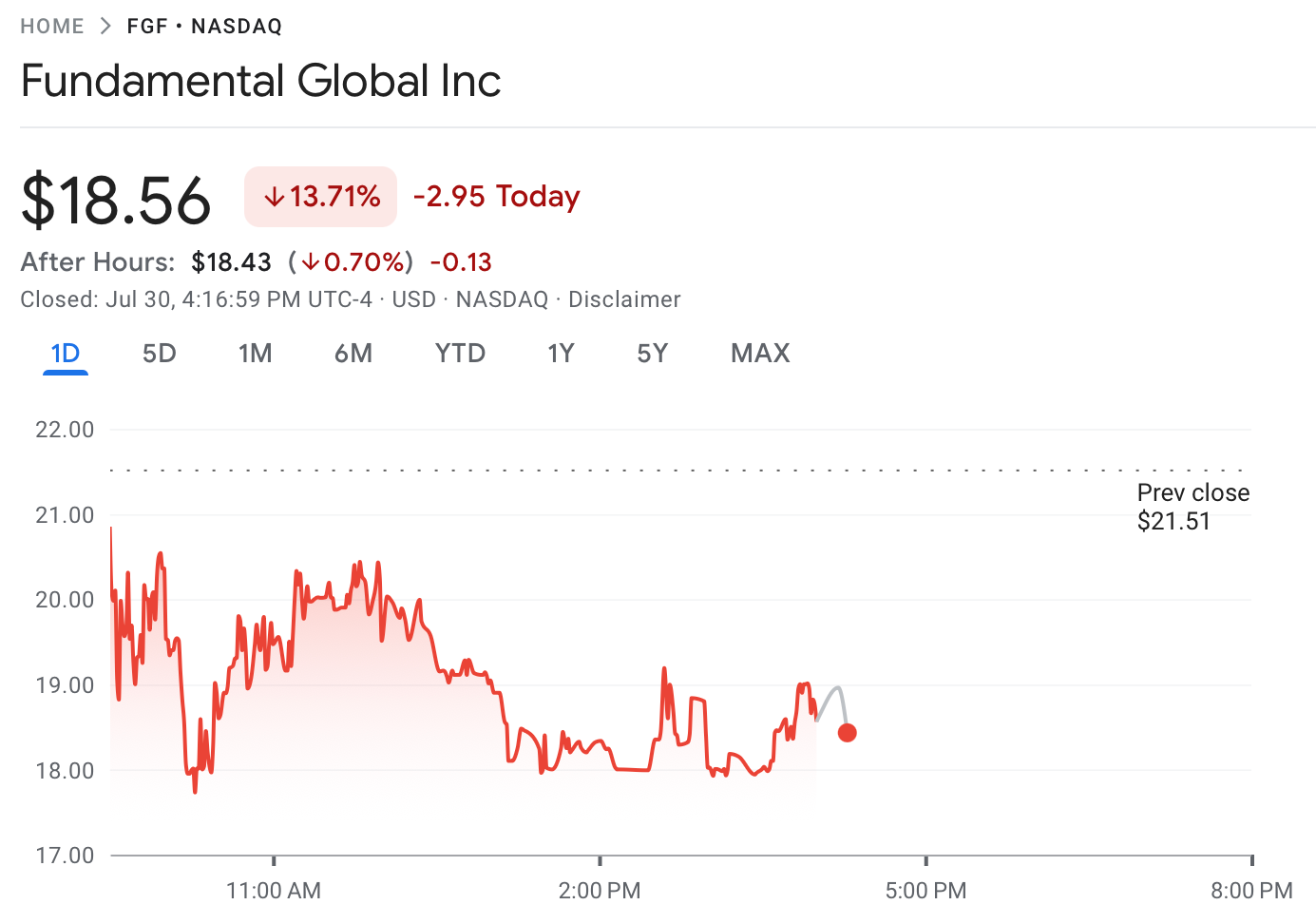

Несмотря на серьезную поддержку, акции компании упали на 13,7% за один торговый день, согласно данным Google Finance.

Цена акций Fundamental Global в среду. Источник: Google Finance

Fundamental Global присоединяется к растущему числу компаний, формирующих Ethereum-казначейства, следуя примеру первых корпоративных инвесторов в биткоин. По данным Standard Chartered, с начала июня компании, создающие криптовалютные казначейства, приобрели 1% от общего объема ETH в обращении, при этом аналитики прогнозируют рост этой доли до 10%.

BitMine Immersion Technologies, занимающаяся майнингом биткоина, в настоящее время является крупнейшим корпоративным держателем Ethereum с резервами в 625 000 ETH (около $2,35 млрд). Компания SharpLink, акции которой торгуются на Nasdaq, занимает второе место с накопленными 290 млн долларов в ETH по средней цене $3 756 за токен в период с 21 по 27 июля.

Ether Machine увеличила резервы ETH на $56,9 млн к годовщине Ethereum

Компания Ether Machine, специализирующаяся на институциональном доступе к инфраструктуре Ethereum, объявила о приобретении почти 15 000 ETH на сумму $56,9 млн.

«Нормативная ясность от регулирующих органов позволяет крупным институтам создавать промышленные решения на Ethereum, — заявил соучредитель и генеральный директор Ether Machine Дэвид Мерин. — Все сценарии использования, обсуждавшиеся последние десять лет, теперь могут быть реализованы. Я никогда не был так оптимистичен в отношении среднесрочных перспектив Ethereum».

Это заявление было сделано в день празднования 10-летия Ethereum.

Trending Cryptos

Related Reads

Why Do We Need an AI Content Perspective Today?

The article "Why Do We Need an AI Content Perspective Today?" explores the complex and often contentious integration of AI into the cultural and creative industries, particularly film and television. It begins with the cancellation of Amazon's AI-generated animation "Punky Duck," highlighting the ethical debates surrounding AI content. AI's rapid advancement is transforming video production, enabling cost-effective, full-length AI films (e.g., "RAPHAEL," "Dreams of Violets") while sparking industry resistance over issues like "synthetic actors." The core debate has shifted from whether to use AI to how to use it responsibly. The article analyzes why AI's entry into film is uniquely unsettling. It distinguishes between "cultural fast food" (short-form, fast-paced content like micro-dramas) and "cultural main courses" (traditional, long-form film/TV). AI currently excels at the former, matching its fragmented narratives, shallow emotional needs, and free-to-consumer models. However, venturing into the latter challenges the human-centric essence of storytelling—creativity, emotional depth, and the unique value of human labor and experience. While AI can generate massive volumes of content and lower costs, it risks devaluing human creativity, leading to homogenized output, and creating unfair competition through potential intellectual property infringement. Its efficiency also amplifies content safety risks, making preemptive governance crucial. To counter these risks, the article proposes establishing clear boundaries guided by a human-centered AI content perspective. It outlines four principles: 1) Amplify, rather than displace, human creative space; 2) Respect and protect human creative output; 3) Ensure human creative control and responsibility remain paramount; and 4) Guarantee transparency and traceability in AI creation. The conclusion emphasizes that humans must act as the "helmsmen" of technology, steering AI development to enhance, not replace, the core human values at the heart of cultural expression.

marsbit20m ago

Why Do We Need an AI Content Perspective Today?

marsbit20m ago

Planck Retracted? The Father of Quantum Tripped by an Algorithm

The recent discovery that two articles (published in 1940 and 1942) by Max Planck, the Nobel laureate and founder of quantum theory, are marked as "retracted" on Springer's digital platform highlights a curious clash between historical publishing practices and modern automated systems. An investigation suggests these retractions are algorithmic errors, not due to fraud or misconduct. The papers, philosophical reflections on science published in *Die Naturwissenschaften*, were likely flagged by the platform's systems. One article, a republished lecture, may have been mistaken for duplicate publication. Another, sharing a title with a prior article by a different author (a common practice for continuing debates at the time), may have triggered a similar automated check. The digital versions have even been replaced with blank pages, contrary to normal practice of preserving retracted texts. This incident underscores how contemporary digital infrastructure, built around concepts like "self-plagiarism" and strict copyright, can misclassify and obscure legitimate historical scholarly communication. It serves as a warning that digital archives are not neutral mirrors of the past but are filtered by platform rules, potentially distorting the scientific record. As AI systems increasingly rely on such databases, such erroneous metadata could propagate, affecting how future tools interpret and access historical knowledge.

marsbit23m ago

Planck Retracted? The Father of Quantum Tripped by an Algorithm

marsbit23m ago

Refunds! Claude 4.8 Sees Overnight Major 'Dumb-Down', GPT-5.6's Computational Power Reportedly 'Halved'

The AI community is currently alarmed by widespread reports of significant performance degradation in two leading models. This article details a "mass self-testing frenzy" triggered by a mysterious prompt designed to detect a hidden "Juice" value, representing a model's reasoning compute budget. On OpenAI's side, users suspect a covert, limited test of a "GPT-5.6-sol" model is underway. When using a specific XML prompt on the Codex platform, a normal "gpt-5.5 xhigh" model reportedly returns a Juice value of 768. However, some users routed to the suspected GPT-5.6 test receive a drastically reduced value of 128—a six-fold decrease. This has sparked debate on whether it signifies a major efficiency leap or a "watered-down, low-cost version" achieved by slashing reasoning depth to save computational expenses. Simultaneously, Anthropic's Claude models, particularly the flagship Opus 4.8 Max, are facing intense user backlash for a perceived "physical brain cut." Users on platforms like Reddit report a dramatic decline in the model's once-impressive reasoning, with complaints of it becoming "absurdly" weakened, performing worse than older, lighter models like Haiku. Specific criticisms include: losing long-context memory, refusing to think deeply even in high-reasoning modes, providing instant incorrect answers, and engaging in unhelpful, argumentative, or "gaslighting" behavior where it contradicts users unnecessarily. The article speculates these "stealth downgrades" might be a calculated corporate strategy. Companies could initially release models with temporarily boosted compute to create an illusion of a major breakthrough, then silently scale back parameters later to manage unsustainable inference costs. A proposed underlying cause is a tightened funding environment, potentially exacerbated by SpaceX's massive IPO soaking up market liquidity, which could delay AI company IPOs and force cost-cutting measures like model "nerfing." The core issue highlighted is the asymmetry of information: subscribers pay for a service that can be silently and fundamentally altered without notification or explanation. The viral "Juice test" resonates because it represents users' desire for transparency about what they are actually paying for.

marsbit59m ago

Refunds! Claude 4.8 Sees Overnight Major 'Dumb-Down', GPT-5.6's Computational Power Reportedly 'Halved'

marsbit59m ago

Trading

Spot

Hot Articles

Discussions

Welcome to the HTX Community. Here, you can stay informed about the latest platform developments and gain access to professional market insights. Users' opinions on the price of ETH (ETH) are presented below.

活动图片