Кто-то перевел нетронутые 14 лет биткоины. Их цена выросла в 300 тыс. раз

RBK-cryptoPubblicato 2025-07-24Pubblicato ultima volta 2025-07-24

Неизвестный «кит», хранивший первую криптовалюту с 2011 года, переместил свои накопления

Неизвестный владелец перевел на новый адрес биткоины, которые не трогал с января 2011 года. Согласно данным BitInfoCharts, на кошельке хранились 3962 BTC, по большей части поступившие при курсе $0,39 за монету.

14 лет назад они оценивались примерно в $1558, а на момент сегодняшнего перевода их стоимость превысила $468 млн при курсе биткоина выше $118 тыс. Цена монет выросла за время хранения в 300 тыс. раз.
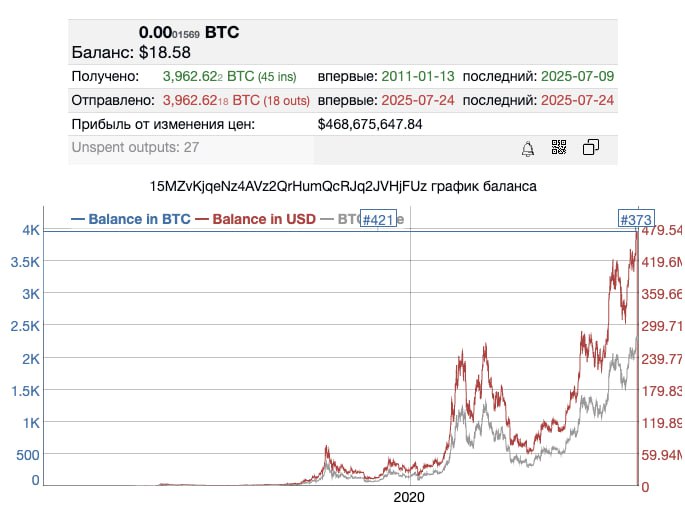
График баланса криптокошелька в BTC и USD. Источник: BitInfoCharts

Телеграм-канал «РБК-Крипто» — подпишитесь и будьте в курсе самых главных и актуальных новостей о криптовалюте.

Присоединяйтесь к форуму «РБК-Крипто» в Telegram для обсуждения новостей и тенденций криптомира.

Кто стоит за транзакцией, неизвестно. Также пока не ясно, связан ли этот кошелек с другими крупными переводами, зафиксированными в начале месяца.

В первых числа июля владелец другой группы кошельков, на которых с 2011 года хранилось более 80 тыс. BTC (свыше $9 млрд по текущему курсу), начал массово перемещать средства на новые адреса, откуда они затем поступили на биржи и к криптоброкерам. Одна из обсуждаемых версий в сообществе — возможная связь этих кошельков с пионером криптоиндустрии Адамом Бэком.

Сегодняшний перевод, в отличие от предыдущих, начался с тестовой транзакции на небольшую сумму. Такой способ обычно используется перед отправкой значительных объемов в криптовалюте.

В середине июля курс биткоина обновил исторический максимум около $123 тыс. и постепенно откатился к $118 тыс. Аналитики отмечают, что участники рынка, которые с 17 июля активно фиксируют прибыль, давят на курс BTC.

У США может быть в 7 раз меньше биткоинов, чем заявлено. Почему так вышло

Tether заморозила $1,6 млн в USDT в секторе Газа и перевыпустила для США

Курсы криптовалют откатились. Как рынок вошел в коррекцию

Letture associate

The Year's Most Expensive New Stock Hits the Market: Pinson Laser, Bright Prospects Amid Concerns

Annual Most Expensive IPO Debuts: Pinsun Laser's Bright Prospects Shadowed by Concerns Pinsun Laser, dubbed "A-share's first precision laser stock", has made its debut on the STAR Market with a record-high issue price of 186.88 yuan per share this year. Despite the hype, its journey is marked by challenges. The company's allure lies in its "small and beautiful" profile. It issued a small float of only 10 million new shares, boosting its price elasticity and retail investor appeal. Financially, it has shown strong performance with revenue growing at a 68.2% CAGR from 2023 to 2025 and gross margins consistently above 67%. As the domestic leader in precision lasers for quantum technology, it holds a 9.21% global and 16.85% domestic market share in 2024, offering a scarce A-share investment opportunity. Its P/E ratio of 49.42x at issuance was below the industry average, suggesting room for valuation growth. However, Pinsun's path is fraught with hurdles. Its core market—lasers for quantum tech (computing, sensing, communication)—remains a niche, research-driven sector. Global demand is projected to grow at a modest sub-8% CAGR through 2030, constrained by the distant commercialization timeline of quantum computing, which heavily relies on research funding cycles. The company's prestigious clientele, including top global universities, exposes it to funding volatility. It faces intense competition from entrenched giants like Germany's Toptica and the US's Coherent. While Pinsun employs a differentiated, cost-effective technical architecture, it still lags in brand recognition. To mitigate reliance on the quantum research market, Pinsun is cultivating semiconductor applications as a second growth engine, with related revenue surging from 25.15 million yuan in 2023 to 104 million yuan in 2025. Yet, breaking into the competitive semiconductor equipment market dominated by international players presents its own significant challenges. Furthermore, while its R&D spending (14-15% of revenue) is substantial relative to its size, it pales in comparison to the resources of global competitors. In summary, Pinsun Laser enters the market with impressive financials and a unique position in a futuristic field, but its near-term growth is tethered to a small, volatile research market. Its long-term success hinges on navigating fierce competition and successfully commercializing its technology in broader markets like semiconductors, all while the quantum industry's "moonshot" applications remain years away from maturity.

marsbit12 min fa

The Year's Most Expensive New Stock Hits the Market: Pinson Laser, Bright Prospects Amid Concerns

marsbit12 min fa

Anthropic Asked for It and Got It, Mythos 2 Reportedly Shelved, Mythos 3 Secretly in Development

In a revealing podcast, analysts Dylan Patel and Jordan Nanos disclosed that Anthropic has reportedly completed training its Mythos 2 AI model but is withholding its public release due to regulatory concerns. According to the report, Mythos 2 possesses capabilities—potentially including sophisticated coding, logical reasoning, and cyber offense/defense abilities—deemed too powerful and risky for public access. Consequently, Anthropic is said to be using a heavily restricted, downgraded version called Fable for public use. The situation is described as a self-inflicted setback for Anthropic, whose leaders previously advocated for stringent AI safety regulations, only to find their own advanced models now facing restrictions. With Mythos 2 effectively shelved, the company faces a critical challenge: the potential disruption of the vital feedback loop typically gained from widespread user interaction, which fuels model improvement. Despite this, Anthropic is reportedly redirecting its efforts internally. It is allegedly using Mythos 2 to generate synthetic data and code to accelerate the secretive development of its next-generation model, Mythos 3. This shift indicates a move towards a closed, recursive development cycle where AI models train and evaluate each other, potentially reducing reliance on human feedback over time. The report draws parallels to OpenAI, suggesting it may also be withholding its most advanced model, referred to as Astra, due to similar safety and controllability concerns. Speculation arises that Anthropic’s strategy might be a deliberate move to monopolize its most powerful AI for internal, high-stakes applications (e.g., biotech, automated coding) while avoiding the risks and responsibilities of a public release. Sources cited include posts from SemiAnalysis and related discussions on social media, painting a picture of a hidden AI arms race where the most capable models are being developed behind closed doors, away from public access and scrutiny.

marsbit23 min fa

Anthropic Asked for It and Got It, Mythos 2 Reportedly Shelved, Mythos 3 Secretly in Development

marsbit23 min fa

Trading

Spot
活动图片