The Year's Most Expensive New Stock Hits the Market: Pinson Laser, Bright Prospects Amid Concerns

marsbitPubblicato 2026-08-18Pubblicato ultima volta 2026-08-18

Introduzione

Annual Most Expensive IPO Debuts: Pinsun Laser's Bright Prospects Shadowed by Concerns Pinsun Laser, dubbed "A-share's first precision laser stock", has made its debut on the STAR Market with a record-high issue price of 186.88 yuan per share this year. Despite the hype, its journey is marked by challenges. The company's allure lies in its "small and beautiful" profile. It issued a small float of only 10 million new shares, boosting its price elasticity and retail investor appeal. Financially, it has shown strong performance with revenue growing at a 68.2% CAGR from 2023 to 2025 and gross margins consistently above 67%. As the domestic leader in precision lasers for quantum technology, it holds a 9.21% global and 16.85% domestic market share in 2024, offering a scarce A-share investment opportunity. Its P/E ratio of 49.42x at issuance was below the industry average, suggesting room for valuation growth. However, Pinsun's path is fraught with hurdles. Its core market—lasers for quantum tech (computing, sensing, communication)—remains a niche, research-driven sector. Global demand is projected to grow at a modest sub-8% CAGR through 2030, constrained by the distant commercialization timeline of quantum computing, which heavily relies on research funding cycles. The company's prestigious clientele, including top global universities, exposes it to funding volatility. It faces intense competition from entrenched giants like Germany's Toptica and the US's Coherent. While Pinsun ...

By | Alpha Factory

The year's most expensive new stock has been listed.

Upon opening, Pinson Laser will officially debut on the STAR Market. As "the first stock in the A-share market for precision lasers," Pinson Laser's issue price per share reached 186.88 yuan, making it the most expensive new stock of the year. In comparison, the most discussed stock on the STAR Market currently, Yushu, has an issue price of 150.8 yuan per share.

Over the past three years, the company's revenue has grown at a compound annual growth rate of 68.2%, with gross margin consistently above 67%. The company is engaged in the R&D, production, and sales of precision lasers, primarily serving fields with grand prospects like quantum technology.

However, before reaching that future, Pinson Laser still faces a series of real-world challenges, including fluctuations in downstream demand and competition from overseas giants.

01 How Did Pinson Laser Become the 'Year's Most Expensive New Stock'?

"Small yet beautiful" is an important reason why Pinson Laser became the most expensive new stock.

"Small" refers to its small float.

In this IPO, Pinson Laser issued only 10 million new shares, making it one of the new stocks with the smallest number of shares issued this year. Calculated at the issue price, the company is expected to raise a total of 1.869 billion yuan.
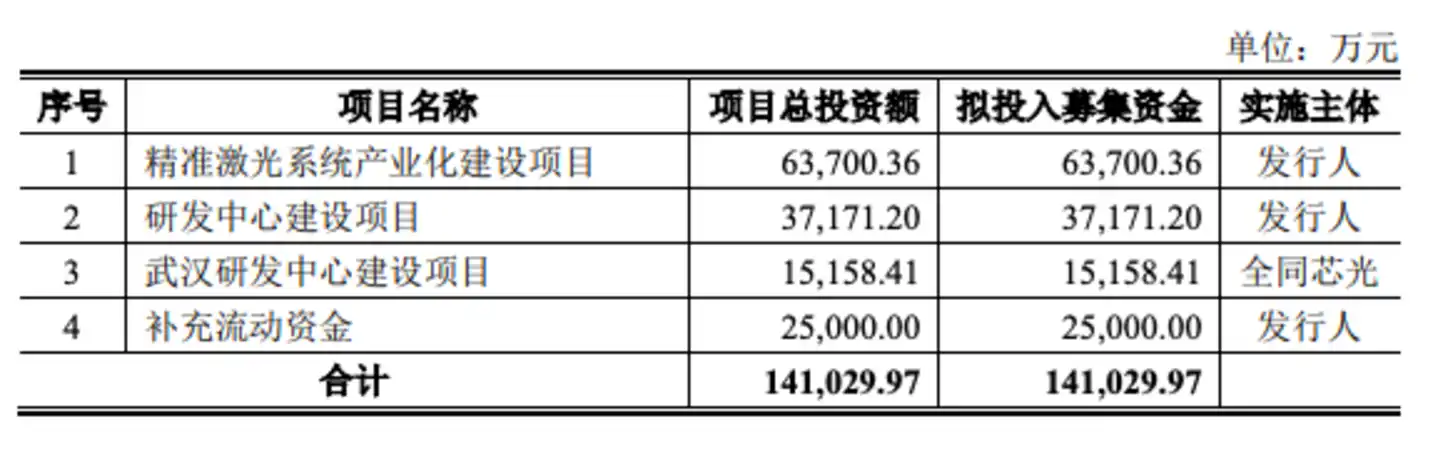
Pinson Laser's proposed fundraising projects are expected to use 1.41 billion yuan of the raised funds; Data source: Prospectus

The small share capital not only pushed up the issue price but also increased the post-listing stock price volatility. Pinson Laser's unrestricted float is only 7.6178 million shares, accounting for 19.04% of the total share capital, corresponding to a float market value of approximately 1.42 billion yuan—this size is also not large within the STAR Market.

At the same time, this makes the subscription threshold quite friendly. The upper limit for online subscription is 2,000 shares, requiring a Shanghai market value of only 20,000 yuan for a full subscription, allowing many retail investors to participate. Consequently, Pinson Laser's lottery winning rate is quite low at only 0.02%.

Pinson Laser's "beauty" refers to its impressive performance.

Pinson Laser's main business is precision lasers, with its core application scenario being the quantum technology field.

In terms of performance, from 2023 to 2025, the company's revenue was 148 million yuan, 292 million yuan, and 418 million yuan respectively, achieving a three-year compound growth rate of 68.2%. During the same period, net profit attributable to shareholders grew from 60.46 million yuan to 159 million yuan, with profit growth largely matching revenue expansion.

Performance growth has also strengthened the company's position in the industry. According to QY Research data, in 2024, Pinson Laser held a 9.21% market share in the global quantum technology laser market and a 16.85% share in the domestic market. In the niche field of precision lasers, Pinson Laser is already the domestic leader.

Furthermore, the company's gross margin has remained stable at a high level between 67% and 70%, indicating that Pinson Laser's growth is driven by genuine demand rather than price competition.

Besides being "small yet beautiful," the valuation premium brought by scarcity is another significant reason why Pinson Laser became the "year's most expensive new stock."

For investors looking to buy into a core hardware player in the quantum technology sector, Pinson Laser is currently almost the only choice in the A-share market. This "one-of-a-kind" scarcity supports the market's acceptance of its high pricing, a logic that has been repeatedly validated on the STAR Market this year.

It's worth noting that Pinson Laser's price-to-earnings (P/E) ratio at issuance is 49.42 times, lower than the industry average P/E ratio (68.04 times). This largely implies that the company's high gross margin has not been fully "priced in."

02 The Road to the Stars and Beyond is Paved with Thorns

Quantum technology is often imbued with "star-reaching" imagination. Whether it's quantum computing, quantum precision measurement, or quantum communication, each direction points toward disruptive technological revolutions. And lasers are indispensable core hardware for these cutting-edge technologies.

But stripping away the conceptual halo, the quantum information laser track where Pinson Laser operates is currently still a niche market dominated by scientific research procurement.

Data from QY Research shows that the global scientific research laser market size in 2024 was approximately $2.147 billion, expected to reach $3.331 billion by 2030, with a compound annual growth rate of less than 8%.

An 8% growth rate might be respectable in the manufacturing sector, but this growth rate clearly cannot support excessively high imaginations.

The reason for the limited market size is straightforward: quantum computing and quantum precision measurement are still mainly in the laboratory stage, with true industrial applications still far off.

Pinson Laser's customer list is quite impressive, covering top-tier quantum research institutions in Europe and America such as Harvard University, University of Colorado, California Institute of Technology, and ETH Zurich.

This client list certainly testifies to the company's technical strength from the side. However, the demand from research institutions is significantly influenced by funding cycles. Orders surge when funding is ample and contract sharply when budgets tighten—a challenge faced by all scientific instrument and equipment manufacturers.

Pinson Laser also frankly admits in its prospectus that if downstream market demand declines or competition increases significantly in downstream application segments, the company may face risks of declining gross margin and operating performance.

Competition from overseas giants is another layer of pressure. The high-end narrow-linewidth precision laser market has long been dominated by overseas manufacturers, with Germany's Toptica and America's Coherent being the traditional powerhouses in this field.

Pinson Laser's technical approach has its own characteristics, adopting a "seed source + fiber amplification + nonlinear frequency conversion + frequency stabilization" architecture, which differs from the traditional schemes of overseas manufacturers. It can achieve narrow linewidth, low-noise laser output across the full spectrum from 177nm to 5000nm. While this route offers advantages in cost and spectral coverage, it still needs time to catch up in terms of brand recognition.

A greater variable lies in the significant uncertainty surrounding the industrialization pace of quantum computing. The industry generally believes that commercial applications for general-purpose quantum computers are at least a decade or more away.

Before that, the primary customers for quantum technology lasers will remain research institutions, with a clearly visible market ceiling. If the industrialization process of quantum computing is slower than expected, Pinson Laser's growth story will need to find new support.

The semiconductor business has been entrusted with high hopes as a second growth curve. Pinson Laser's products have already penetrated semiconductor fields such as wafer fabrication, wafer measurement and inspection, and wafer stealth dicing. From 2023 to 2025, the company's revenue in this field increased from 25.15 million yuan to 104 million yuan.

The semiconductor equipment market is far larger than the scientific research laser market. If Pinson Laser can gain a foothold in the semiconductor field, it would undoubtedly significantly raise the company's business ceiling.

But competition in the semiconductor market is equally fierce. International giants like Coherent and II-VI have deep layouts in the semiconductor laser field. For Pinson Laser to increase its share from 1.98% in the semiconductor sector will be no easy task.

R&D is another test for Pinson Laser. During the reporting period, the company's R&D expenses were 22.12 million yuan, 41.71 million yuan, and 61 million yuan respectively, accounting for 14% to 15% of revenue. This proportion is not low, but the absolute amount pales in comparison to the hundreds of millions of dollars in R&D investment by overseas giants.

It's not hard to see that between the "star-reaching" prospects and revenue lies a long path of industrialization.

For Pinson Laser, focusing on the present is more likely to lead to the shores of the future.

Crypto di tendenza

Domande pertinenti

QWhat are the main factors that made Pinzhun Laser the most expensive IPO of the year?

AThe main factors are its 'small but beautiful' characteristics. 'Small' refers to its small float share, which increases price volatility and makes it accessible to retail investors. 'Beautiful' refers to its impressive financial performance, with revenue CAGR of 68.2% over three years and consistently high gross margins above 67%. Additionally, its scarcity as a core hardware player in the quantum technology sector creates valuation premiums, and its P/E ratio was lower than the industry average, suggesting its high profitability wasn't fully priced in.

QWhat are the primary risks or challenges facing Pinzhun Laser's business in the quantum technology sector?

AThe primary risks include: 1) A limited, niche market dominated by research institutions whose demand is volatile and dependent on research funding cycles. 2) Fierce competition from established international giants like Germany's Toptica and America's Coherent. 3) Significant uncertainty around the industrialization timeline for quantum computing, which is likely more than a decade away, keeping the market's growth ceiling relatively low in the near term.

QHow does Pinzhun Laser plan to expand its business beyond the quantum technology research market?

APinzhun Laser is focusing on the semiconductor sector as its second growth curve. The company has already begun supplying products for wafer manufacturing, measurement/inspection, and stealth dicing. Revenue from this segment grew significantly from 25.15 million yuan in 2023 to 104 million yuan in 2025. The semiconductor equipment market is much larger than the research laser market, offering a substantial opportunity to raise the company's business ceiling.

QWhat is the structure of the global market for quantum technology lasers, and what is Pinzhun Laser's position within it?

AThe global quantum technology laser market is currently a small, research-driven market. According to QY Research data, the global market size was approximately $2.147 billion in 2024. In this niche, Pinzhun Laser has established itself as a domestic leader. In 2024, it held a 9.21% market share in the global market for lasers used in quantum technology and a 16.85% share in the domestic Chinese market.

QWhat is unique about Pinzhun Laser's technical approach compared to its overseas competitors?

APinzhun Laser employs a unique technical architecture consisting of 'seed source + fiber amplification + nonlinear frequency conversion + frequency stabilization.' This differs from the traditional solutions used by overseas competitors like Toptica and Coherent. Pinzhun's approach offers advantages in cost and wavelength coverage, enabling narrow-linewidth, low-noise laser output across the full spectrum from 177nm to 5000nm.

Letture associate

Trading

Spot

Articoli Popolari

Cosa è ₿O₿

Bitcoin Bob ($₿o₿): Pionieristico DeFi Centrato su Bitcoin Attraverso Innovazione Ibrida Layer-2 In un'era in cui l'economia digitale sta evolvendo rapidamente, Bitcoin Bob ($₿o₿) emerge come un progetto rivoluzionario volto a migliorare l'utilità di Bitcoin nel settore della finanza decentralizzata (DeFi). Lanciato ufficialmente a maggio 2024, Bitcoin Bob, noto anche come Build on Bitcoin (BOB), rappresenta una soluzione blockchain ibrida Layer-2 che fonde la rinomata sicurezza e immutabilità di Bitcoin con la programmabilità di Ethereum. Questa iniziativa cerca di colmare un'importante lacuna nell'ecosistema di Bitcoin facilitando l'integrazione di smart contract e applicazioni decentralizzate, mantenendo al contempo i principi fondamentali di fiducia e sicurezza insiti in Bitcoin. Con un sostegno significativo da parte di importanti investitori di venture capital, Bitcoin Bob è posizionato per ridefinire il ruolo di Bitcoin nel panorama DeFi, rendendolo una pietra miliare delle operazioni finanziarie decentralizzate a livello globale. Cos'è Bitcoin Bob, $₿o₿? Alla sua base, Bitcoin Bob è una soluzione blockchain ibrida progettata per migliorare la funzionalità di Bitcoin. L'obiettivo principale del progetto è abilitare la finanza decentralizzata su Bitcoin, facilitando transazioni rapide e senza soluzione di continuità, garantendo al contempo elevati livelli di sicurezza. Bitcoin Bob utilizza tecnologie avanzate, in particolare un'architettura ibrida layer-2 che combina le caratteristiche di sicurezza di Bitcoin con la programmabilità e la flessibilità della Ethereum Virtual Machine (EVM). Questo approccio pragmatico consente al progetto di operare efficacemente senza compromettere i valori fondamentali di Bitcoin, rappresentando un passo monumentale nel colmare il divario tra i tradizionali detentori di Bitcoin e l'emergente ecosistema DeFi. Una delle caratteristiche distintive di Bitcoin Bob è il suo ruolo nel fornire un ambiente a fiducia minimizzata attraverso meccanismi innovativi, come gli optimistic rollups inizialmente basati su Ethereum, che si evolveranno infine verso un'integrazione completa con Bitcoin. Questo sistema ibrido è progettato per garantire che la vasta liquidità presente in Bitcoin non solo venga preservata, ma anche utilizzata efficacemente in vari protocolli DeFi. Chi è il Creatore di Bitcoin Bob, $₿o₿? La forza creativa dietro Bitcoin Bob è il co-fondatore e CEO Alexei Zamyatin, che porta con sé una vasta esperienza e conoscenza dal suo ampio background nel settore delle criptovalute. Zamyatin ha conseguito un dottorato in Informatica ed è stato attivamente coinvolto nello sviluppo di Bitcoin dal 2015. La sua profonda comprensione degli ecosistemi di Bitcoin ed Ethereum gioca un ruolo cruciale nel plasmare la visione e le basi tecnologiche di Bitcoin Bob. Insieme a Zamyatin c'è il co-fondatore Dominik Harz, che ricopre il ruolo di Chief Technology Officer (CTO). Insieme, i due hanno coltivato un team di talenti con una passione condivisa per spingere i confini della tecnologia blockchain, assicurando la posizione innovativa di Bitcoin Bob nel mercato. Chi Sono gli Investitori di Bitcoin Bob, $₿o₿? Bitcoin Bob ha ottenuto con successo il supporto di una serie di importanti investitori e società di venture capital che riconoscono il suo potenziale di trasformare il panorama di Bitcoin. A marzo 2024, il progetto ha completato un robusto round di finanziamento seed da 10 milioni di dollari, guidato da Castle Island Ventures, con una partecipazione notevole da parte di aziende come Coinbase Ventures e Bankless Ventures. Poco dopo, a luglio 2024, Bitcoin Bob ha ottenuto un ulteriore finanziamento strategico di 1,6 milioni di dollari. Questo round è stato co-guidato da Ledger Ventures e ha visto la partecipazione di angel investor provenienti da varie aziende di spicco come BlackRock, Aave e Curve. Il forte sostegno finanziario riflette un riconoscimento a livello di settore dell'approccio innovativo di Bitcoin Bob per sbloccare il potenziale di Bitcoin nello spazio DeFi. Questo finanziamento è cruciale non solo per lo sviluppo continuo del progetto, ma anche per stabilire un incubatore per promuovere applicazioni decentralizzate (dApps) native di Bitcoin, mirate specificamente a soddisfare le esigenze di una base utenti in crescita. Come Funziona Bitcoin Bob, $₿o₿? Le meccaniche operative di Bitcoin Bob sono radicate nella sua architettura ibrida rollup, progettata per combinare i benefici della sicurezza di Bitcoin con la versatilità dell'EVM di Ethereum. Il progetto utilizza un modello di sicurezza a fasi che delinea la sua interazione con utenti e sviluppatori nel seguente modo: Fase 1 – La fase iniziale opera come un optimistic rollup su Ethereum, in cui le transazioni vengono elaborate con una promettente aspettativa di validità, aprendo la strada a futuri sviluppi su Bitcoin. Fase 2 – Man mano che il progetto si evolve, integrerà la finalità di Bitcoin attraverso il Bitcoin Staking, sfruttando il Babylon Network per migliorare la sicurezza. Questo meccanismo richiede ai validatori di bloccare Bitcoin, verificando così le transazioni BOB, il che non solo migliora la sicurezza ma crea anche opportunità di rendimento per i partecipanti. Fase 3 – La visione prospettica per Bitcoin Bob è quella di integrarsi completamente con Bitcoin, utilizzando tecnologie innovative come BitVM e prove a conoscenza zero per facilitare il calcolo off-chain mantenendo l'integrità della sicurezza di Bitcoin. Innovazioni chiave come BitVM2, un protocollo di bridge a fiducia minimizzata co-autore di Zamyatin, sono fondamentali per la funzionalità del progetto, consentendo depositi e prelievi di Bitcoin senza la necessità di una dipendenza estesa dalla rete. Questo consente all'ecosistema di connettersi in modo efficiente con Ethereum e altre catene compatibili, creando un modello di interazione snello ed efficace per utenti e sviluppatori. Cronologia di Bitcoin Bob, $₿o₿ Comprendere l'evoluzione di Bitcoin Bob implica seguire le sue tappe importanti: 2019: Alexei Zamyatin e Dominik Harz fondano una società di ricerca focalizzata su soluzioni blockchain, ponendo le basi per progetti futuri. Marzo 2024: Bitcoin Bob raccoglie con successo 10 milioni di dollari in un round di finanziamento seed, segnando il suo ingresso nel competitivo panorama blockchain. 1 Maggio 2024: Si svolge il lancio ufficiale della mainnet, mostrando le capacità del progetto con una significativa adozione da parte degli utenti e un valore totale bloccato (TVL). Luglio 2024: Il progetto attira un ulteriore 1,6 milioni di dollari in finanziamento strategico per stabilire il suo incubatore, mirato a promuovere innovazioni guidate da Bitcoin. Ottobre 2024: Bitcoin Bob rilascia un “Vision Paper”, dettagliando il suo design ibrido layer-2 e le strategie prospettiche. 2025: Si prevede il lancio delle funzionalità della Fase 2, focalizzandosi sulla finalità di Bitcoin e sui bridge BitVM mirati a migliorare la funzionalità complessiva. Conclusione: Ridefinire il Ruolo di Bitcoin nella Finanza Decentralizzata Bitcoin Bob ($₿o₿) non è solo un altro progetto blockchain; rappresenta un cambiamento di paradigma nel modo in cui Bitcoin può interagire con applicazioni finanziarie più ampie. Combinando meticolosamente la sicurezza di Bitcoin con la flessibilità di Ethereum, Bitcoin Bob mira a rimodellare il panorama DeFi, colmando il divario tra valuta digitale e applicazioni decentralizzate. Con un robusto framework tecnologico, una forte leadership e finanziamenti strategici, Bitcoin Bob è ben posizionato per affermarsi come un attore fondamentale nell'ecosistema delle criptovalute, sbloccando nuove dimensioni di liquidità e utilità per Bitcoin. Man mano che il progetto continua a evolversi ed espandersi, promette di inaugurare una nuova era di innovazione, dimostrando che il potenziale di Bitcoin si estende ben oltre essere un semplice deposito di valore, ma piuttosto come una pietra angolare del futuro panorama finanziario. Mentre il progetto avanza attraverso le sue fasi anticipate, tutti gli occhi saranno puntati su Bitcoin Bob, in particolare riguardo al suo impegno per incorporare principi decentralizzati e garantire che gli utenti possano godere dei pieni benefici di DeFi ancorati a Bitcoin.

97 Totale visualizzazioniPubblicato il 2025.06.30Aggiornato il 2025.06.30

Cosa è ₿O₿

Come comprare O

Benvenuto in HTX.com! Abbiamo reso l'acquisto di O1 exchange (O) semplice e conveniente. Segui la nostra guida passo passo per intraprendere il tuo viaggio nel mondo delle criptovalute.Step 1: Crea il tuo Account HTXUsa la tua email o numero di telefono per registrarti il tuo account gratuito su HTX. Vivi un'esperienza facile e sblocca tutte le funzionalità,Crea il mio accountStep 2: Vai in Acquista crypto e seleziona il tuo metodo di pagamentoCarta di credito/debito: utilizza la tua Visa o Mastercard per acquistare immediatamente O1 exchangeO.Bilancio: Usa i fondi dal bilancio del tuo account HTX per fare trading senza problemi.Terze parti: abbiamo aggiunto metodi di pagamento molto utilizzati come Google Pay e Apple Pay per maggiore comodità.P2P: Fai trading direttamente con altri utenti HTX.Over-the-Counter (OTC): Offriamo servizi su misura e tassi di cambio competitivi per i trader.Step 3: Conserva O1 exchange (O)Dopo aver acquistato O1 exchange (O), conserva nel tuo account HTX. In alternativa, puoi inviare tramite trasferimento blockchain o scambiare per altre criptovalute.Step 4: Scambia O1 exchange (O)Scambia facilmente O1 exchange (O) nel mercato spot di HTX. Accedi al tuo account, seleziona la tua coppia di trading, esegui le tue operazioni e monitora in tempo reale. Offriamo un'esperienza user-friendly sia per chi ha appena iniziato che per i trader più esperti.

793 Totale visualizzazioniPubblicato il 2026.06.19Aggiornato il 2026.06.29

Come comprare O

Discussioni

Benvenuto nella Community HTX. Qui puoi rimanere informato sugli ultimi sviluppi della piattaforma e accedere ad approfondimenti esperti sul mercato. Le opinioni degli utenti sul prezzo di O O sono presentate come di seguito.

活动图片