XRP突然拉升的两大推手:涨势能否延续?关键信号解析

ambcryptoPublished on 2025-07-23Last updated on 2025-07-23

Abstract

随着 XRP 在强劲买入、鲸鱼走势和链上分歧中测试阻力,投机行为不断增加。

关键要点

鲸鱼活动增强了看涨势头,但分配方面的担忧也随之而来。链上活动波动剧烈,RSI 指标超买,可能对 XRP 突破 3.66 美元构成挑战。

价值 7.38 亿美元的2.106 亿瑞波币[XRP]已在未知钱包之间转移,引发人们对巨鲸意图的猜测。

这一发展引发了交易员的争论,他们想知道这是否表明大股东在增持,还是存在隐蔽的分销安排。

虽然此次转移符合更广泛的看涨观点,但其匿名性质引发了人们的谨慎。

结合 XRP 价格在关键阻力位下方持续盘整的情况,这一走势可能会增强购买压力,也可能预示着价格可能出现降温。

XRP 的涨势还会持续吗?

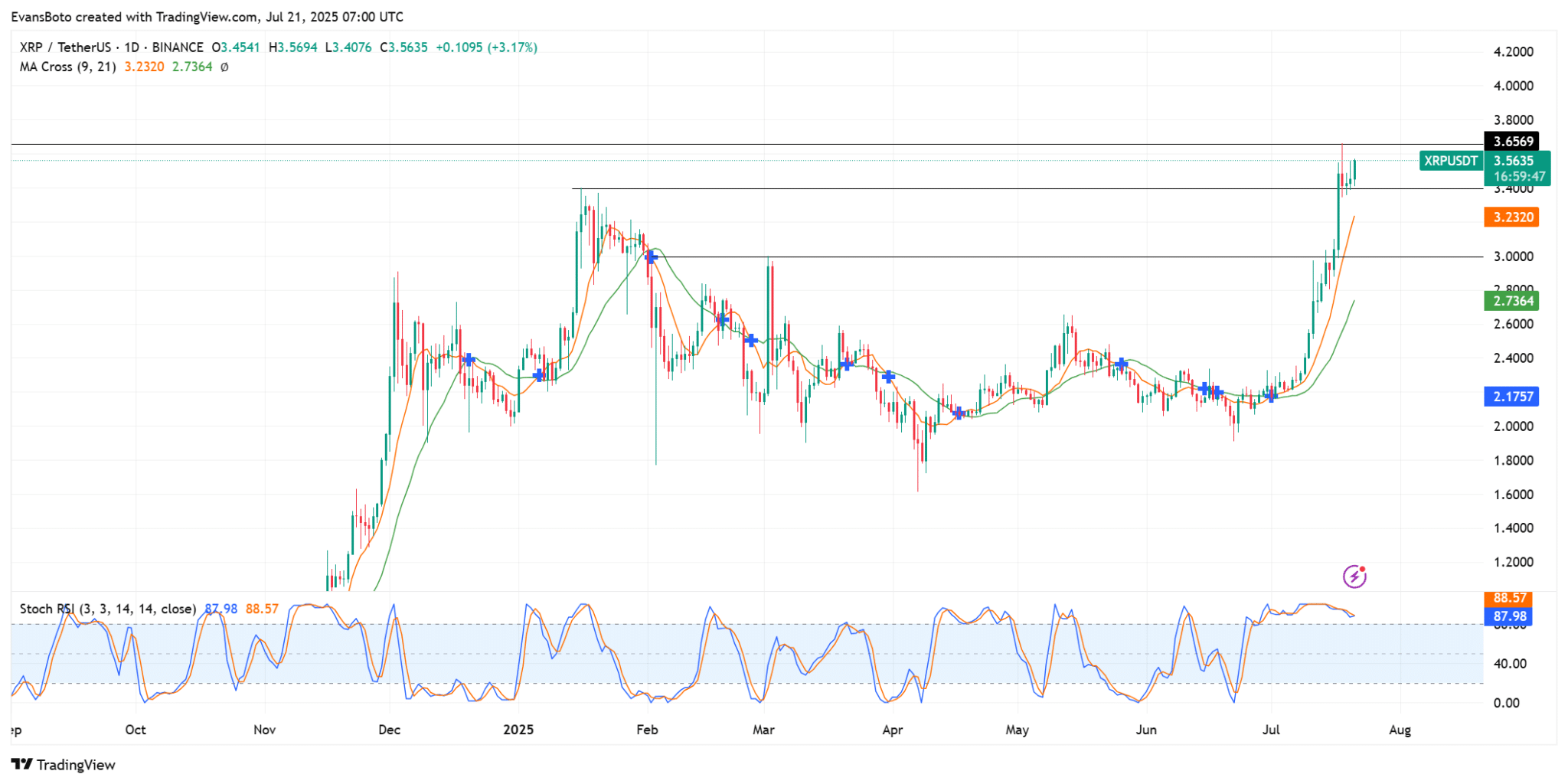
XRP 近期上涨至 3.56 美元,目前徘徊在 3.66 美元附近的关键阻力位下方。此前,XRP 曾突破 2.17 美元的水平,一度上涨逾 60%,随后大幅上涨。

然而,随机 RSI 闪烁超买信号,位于 88 水平之上,暗示看涨势头已耗尽。

此外,价格已开始在阻力位下方盘整,表明市场犹豫不决。

尽管移动平均线仍然向上倾斜,但如果不能令人信服地突破 3.66 美元,可能会导致短期回撤。

因此,接下来几天的收盘价可能将决定多头是否保持控制或失去动力。
XRP 势头的驱动力是什么?

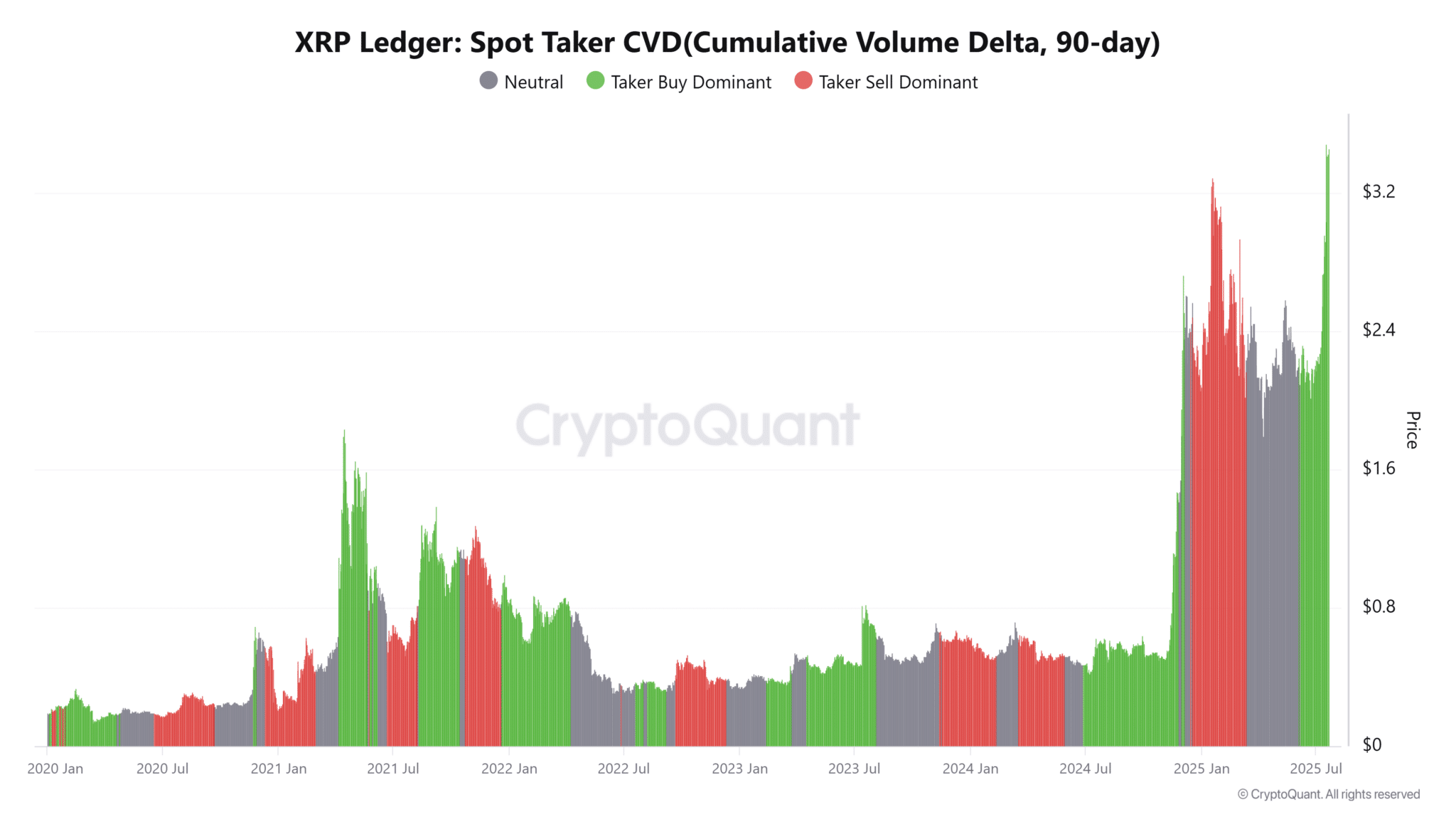
90 天现货接受者 CVD 仍然稳固地处于“接受者买入主导”区域,表明买家继续比卖家更积极地执行市场订单。

这反映出交易员对价格持续上涨的信心不断增强,尤其是在最近几天价格飙升的情况下。

此外,这种购买压力与衍生品数据相一致,强化了市场参与者押注人民币进一步升值的想法。

然而,如果买家过度杠杆化或价格在阻力位停滞,这种信念可能会转变为强制抛售。
XRP衍生品市场正在快速升温。交易量飙升 45.49%,达到 194.1 亿美元,未平仓合约上涨 4.44%,达到 111.5 亿美元。

更值得注意的是,期权交易量跃升 137.69%,期权未平仓合约上涨 28.04%。

这些数据表明投机参与度和杠杆仓位不断上升。虽然这通常会在短期内支撑看涨趋势,但在出现平仓的情况下,也可能放大下行风险。

网络衰落的迹象

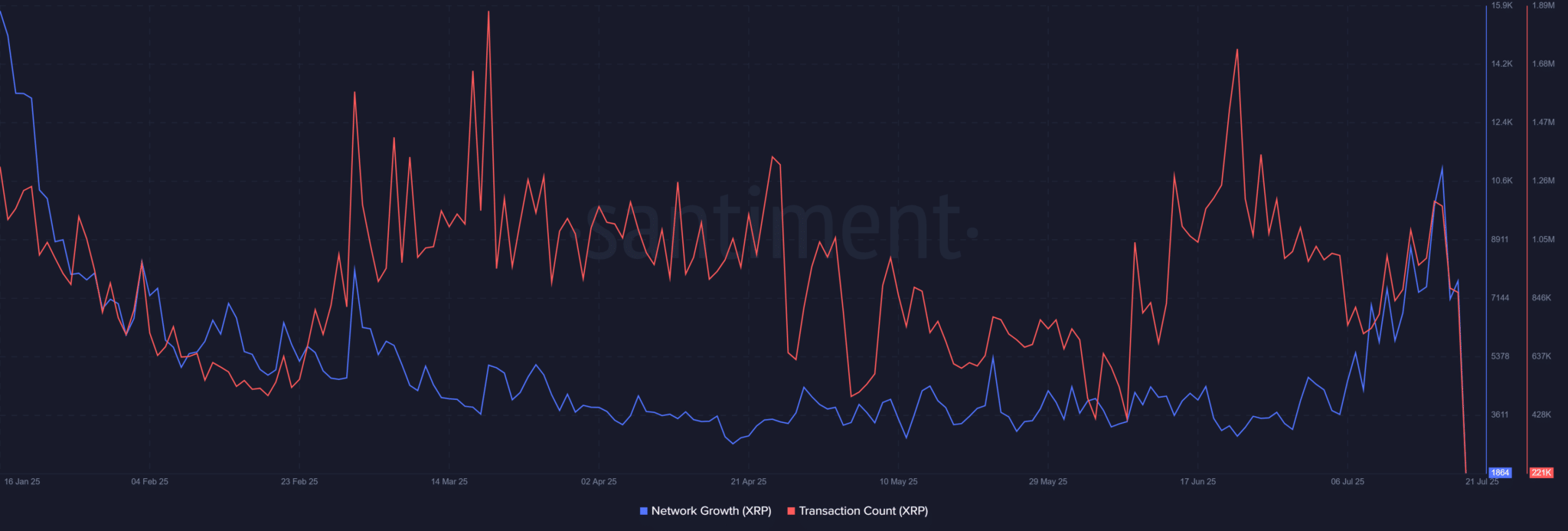
XRP 的链上指标大幅下跌,令人对近期涨势的可持续性产生怀疑。截至发稿时,交易笔数已降至 22.1 万笔,而网络新增地址数骤降至仅 1,864 个。

活跃度和新用户数量的急剧下降削弱了人们对长期需求的信心。尽管价格仍然高企,但基本面使用量的下降表明,市场动能可能正在失去支撑。

因此,除非这些指标反弹,否则 XRP 的反弹可能很快就会面临网络参与度减弱的压力。
低估还是炒作?

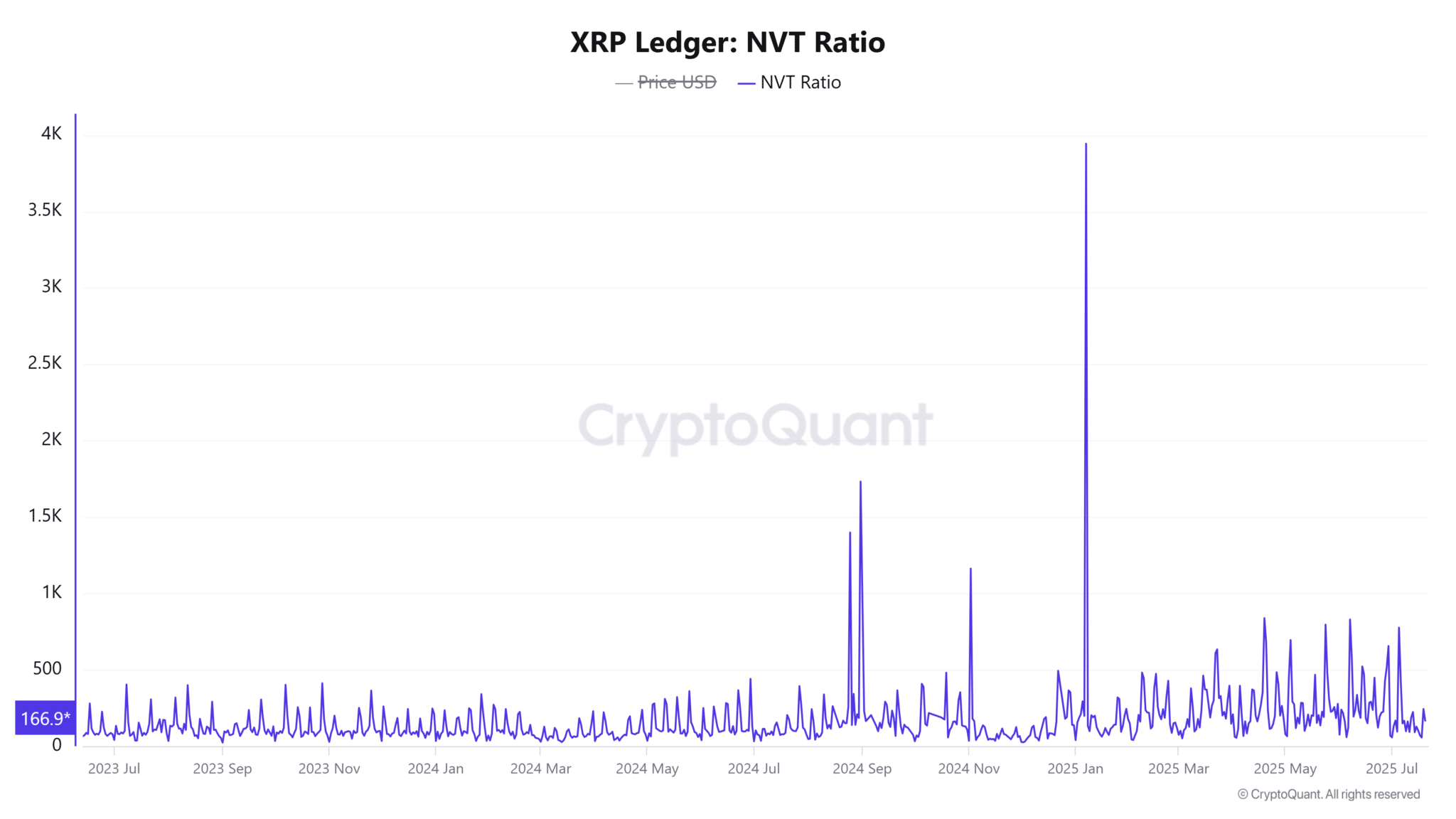
XRP 的 NVT 比率在过去 24 小时内下降了 31.53%,至 166.98,这是一个急剧的下降。

虽然 NVT 下降可能表明交易量超过市值而导致估值过低,但也可能表明短期活动膨胀。

最近交易数量的激增可能是导致这一下降的原因,但如果没有相应的新用户增长,这就引发了人们的担忧。

因此,交易者应该观察这种下跌是否反映了真实的网络价值还是仅仅是投机噪音,因为这将影响 XRP 的长期走势。
XRP 表现出强劲的看涨势头,这得益于接受者的主导地位和衍生品活动的不断增长。然而,3.66 美元附近的阻力位、RSI 超买以及网络增长放缓,都引发了市场谨慎情绪。

XRP 能否继续上涨或面临回调,取决于持续的成交量、突破的确认以及更广泛的市场支撑。目前,价格仍处于关键枢纽位置。

Trending Cryptos

Related Reads

Goldman Sachs' Summary After Silicon Valley Investigation: Agents Enter the Execution Era, AI Competition Shifts to Workflows, World Models Rise

Based on a recent field research in Silicon Valley, Goldman Sachs highlights a key shift in the AI industry: moving from systems that "answer questions" to autonomous AI agents that "execute tasks." Commercial models are transitioning from per-seat subscriptions to usage- and outcome-based pricing. The competition is shifting from raw model capability to mastery over specific business workflows, with value accruing to proprietary data, domain context, and operational expertise. A major hurdle for enterprise Agent deployment is not technical ability but "controllability"—issues of accountability, auditability, and error correction, especially in regulated fields. Workflows with clear rules, verifiable outcomes, and reversible actions (e.g., invoice processing) are being automated first. The model landscape is evolving toward a division of labor. Frontier models (like GPT-4) are expected to handle high-value, high-reliability core tasks, while improving open-source models will likely capture the majority (~90%) of inference tokens for standardized, high-volume tasks due to cost advantages. Finally, attention is moving from Large Language Models (LLMs) to "World Models," which understand physical environments, causality, and dynamic interactions. This shift elevates the importance of proprietary, real-world data (from industrial, scientific, and robotic systems) and could drive a second wave of compute demand. Goldman Sachs projects compute needs could grow ~24x over five years, benefiting cloud and infrastructure providers.

marsbit10m ago

Goldman Sachs' Summary After Silicon Valley Investigation: Agents Enter the Execution Era, AI Competition Shifts to Workflows, World Models Rise

marsbit10m ago

Fidelity Warns: The Boom in AI Agents May Not Be a Feast for Public Blockchains

Fidelity Digital Assets cautions that the anticipated boom in AI agents does not automatically guarantee a corresponding surge in public blockchain adoption or token value. While AI agents that can autonomously perform tasks like payments and data calls could theoretically utilize blockchain for settlement, a significant gap exists between "can use" and "must use." The analysis highlights six key risks. First, many AI agents, especially in corporate settings, may prefer closed, permissioned systems over public blockchains due to needs for speed, cost, compliance, and control. Second, increased on-chain transactions from AI-driven micropayments may not benefit native tokens if fees remain low or if value is captured by stablecoins and payment service providers instead. Third, while AI lowers development costs and increases the number of projects, more code does not equal more economic value and can lead to market oversaturation. Fourth, AI commoditizes coding, making pure technological advantage less of a sustainable moat; competition may shift to brand, liquidity, and user networks. Fifth, AI can also lower the cost of attacks by making vulnerability discovery easier, potentially outpacing security auditing and increasing ecosystem risk. Sixth, institutions may require "controlled blockchain" systems with robust identity, permissioning, and audit trails, conflicting with the permissionless nature of public chains. Ultimately, Fidelity argues against simply equating AI growth with blockchain prosperity. The narrative requires moving from speculation to a concrete analysis of which infrastructures can convert real AI agent needs into sustainable economic value, critically examining each step of the assumed value chain.

marsbit10m ago

Fidelity Warns: The Boom in AI Agents May Not Be a Feast for Public Blockchains

marsbit10m ago

Telegram Introduces WEB-Proxy Technology: Masks Traffic as Regular Website Visits

Telegram has introduced a new experimental WEB-Proxy technology designed to circumvent blocking by disguising messenger traffic as regular, secure website visits. Announced on August 21, 2026, the technology routes MTProxy data through an in-app WebView using HTTPS or WebSocket transport, making the data stream indistinguishable from legitimate web surfing. The core innovation is a multiplexed stream sent through a single WebView session. It uses special frame formats to pack multiple logical Telegram connections into one encrypted channel that externally resembles loading a web page. A server-side relay receives this stream, separates it into individual connections for the standard MTProxy, without decrypting content or knowing final destinations, thus preserving privacy. The WEB-Proxy operates on a standard HTTPS domain that also hosts a public website. The proxy bridge page is only activated by a specific URL parameter derived via HMAC-SHA256 from the proxy configuration; all other requests receive the normal site homepage. This provides reliable cover against automated detection systems. Currently a proof-of-concept, the system includes a desktop implementation, an experimental Android client, and plans for iOS support. The technology represents a shift towards more sophisticated integration with legitimate web infrastructure, complicating filtering systems that must choose between blocking HTTPS traffic entirely or allowing service access. Its long-term value will depend on resilience to adaptive traffic analysis and scalability without performance loss.

cryptonews.ru26m ago

Telegram Introduces WEB-Proxy Technology: Masks Traffic as Regular Website Visits

cryptonews.ru26m ago

MiCA is coming for DeFi vaults, but regulation will be difficult

The European Commission is exploring whether to extend the Markets in Crypto-Assets (MiCA) regulation to cover decentralized finance (DeFi) lending and borrowing, including lending vaults. These vaults, which channel billions into on-chain credit markets, present significant regulatory challenges because their decentralized structure doesn't map neatly onto existing financial frameworks. Their legal status is currently based on non-binding interpretations that they fall outside MiCA and EU fund rules. The article uses Morpho's decentralized lending protocol as an example, illustrating how responsibilities are divided among various participants (owner, curator, allocator, sentinel), making it difficult to identify a single "provider" to regulate. Experts warn that broadly categorizing "DeFi lending" could inadvertently capture vastly different structures. They argue that any regulatory approach should focus on the specific structure and control mechanisms of a vault, rather than using decentralization as a simple dividing line, and that DeFi lending may require a dedicated, carefully crafted framework distinct from traditional finance. The Commission's consultation closes on September 30, 2026. The core challenge for regulators is not just whether to regulate DeFi lending, but how to design rules that distinguish between different forms of on-chain lending and the entities that control them.

cointelegraph2h ago

MiCA is coming for DeFi vaults, but regulation will be difficult

cointelegraph2h ago

Trading

Spot

Hot Articles

What is XRP 2.0

XRP 2.0: A New Frontier in the Cryptocurrency Landscape Introduction to XRP 2.0 In the ever-evolving realm of cryptocurrency, new projects continuously emerge, vying for attention and adoption. One such promising initiative is XRP 2.0, a novel cryptocurrency project designed to leverage advanced blockchain technology and robust encryption methodologies. While the name draws parallels with Ripple’s XRP, it’s crucial to note that XRP 2.0 operates independently, focusing on enhancing transaction security, privacy, and scalability. As the digital financial landscape increasingly embraces decentralized solutions, XRP 2.0 aims to contribute meaningfully to web3 and the overall expansion of crypto projects. What is XRP 2.0? At its core, XRP 2.0 is a cryptocurrency project that aims to create a secure and decentralized digital currency ecosystem. Its foundational technology integrates sophisticated blockchain principles with cutting-edge encryption techniques. The overarching goal of XRP 2.0 is to establish itself as a reliable and efficient platform enabling swift transaction execution while prioritizing enhanced privacy protections for its users. The project is promoted as a solution to many limitations faced by existing cryptocurrencies, proposing a system that can handle a higher volume of transactions with improved speed and privacy. This versatility positions XRP 2.0 as a significant contender in a marketplace riddled with various digital currencies. Who is the Creator of XRP 2.0? The identity of the creator behind XRP 2.0 has been flagged as ‘Wilbur.’ However, comprehensive details regarding Wilbur or their associated entity remain elusive. The anonymity of many cryptocurrency creators is not an uncommon phenomenon in the industry, often designed to maintain a degree of privacy and security. Who are the Investors of XRP 2.0? As of now, specific information related to the investment foundations or organizations supporting XRP 2.0 is not publicly available. In the cryptocurrency sector, the backing by reputed investors can significantly influence a project's credibility and success, yet the transparency regarding the financial supporters of XRP 2.0 has not been established. How Does XRP 2.0 Work? XRP 2.0 stands out by employing a combination of blockchain technology and advanced encryption algorithms that ensures secure and decentralized transactions. Its innovative structure includes unique features designed to foster user engagement and broaden functionalities beyond conventional cryptocurrency transactions. Among these features, XRP 2.0 incorporates AI-powered capabilities, such as text-to-image and text-to-speech functionalities. These additions are designed to enhance the interactive experience for users, promoting broader applicability across various sectors. By bridging technological advancements with user-centered design, XRP 2.0 aims to capture the attention of a diverse range of individuals and enterprises looking to integrate cryptocurrency solutions into their operational frameworks. Timeline of XRP 2.0 Understanding XRP 2.0 requires examining the milestones that have defined its journey thus far: July 23, 2023: XRP 2.0 is introduced as a novel cryptocurrency project, aiming to revolutionize secure and decentralized transaction capabilities in the blockchain domain. September 8, 2023: The launching of another project, XRP20, occurs, marking the emergence of an ERC-20 token on the Ethereum blockchain that remains unrelated to XRP 2.0. November 13, 2023: The XRP Ledger undergoes a significant update with the release of rippled server software version 2.0.0. It is essential to note that this development is disconnected from the XRP 2.0 cryptocurrency project. Key Points About XRP 2.0 To distill the essence of XRP 2.0, several critical factors emerge: Unique Features: The inclusion of features like AI-powered text-to-image and text-to-speech further diversifies the potential applications of XRP 2.0. Blockchain Technology: The framework utilizes advanced blockchain mechanisms and encryption protocols, ensuring a secure and decentralized environment for transactions. Scalability and Privacy: XRP 2.0 prioritizes enhanced privacy protections in transaction processes and the scalability necessary to accommodate a growing user base. No Affiliation with Ripple: Importantly, despite its name, XRP 2.0 does not have any allegiance or collaboration with Ripple’s XRP, distinguishing its operational framework and objectives within the cryptocurrency ecosystem. Conclusion XRP 2.0 represents an ambitious venture into the cryptocurrency sphere, aiming to offer a combination of security, privacy, and efficiency in digital transactions. By integrating sophisticated technologies and user-friendly features, the project sets out to broaden the horizons of what cryptocurrency can achieve in today's digital economy. While the anonymity of its creator and lack of disclosed investors might raise questions for some, XRP 2.0's focus on advanced functionalities and decentralisation enhances its appeal amidst an increasingly crowded crypto market. As the cryptocurrency landscape continues to evolve, XRP 2.0 may yet emerge as a pivotal player in the expansion of secure and scalable blockchain solutions.

1.6k Total ViewsPublished 2024.04.01Updated 2024.12.03

What is XRP 2.0

Discussions

Welcome to the HTX Community. Here, you can stay informed about the latest platform developments and gain access to professional market insights. Users' opinions on the price of XRP (XRP) are presented below.

活动图片