Tokenized RWA Just Flipped The Switch – Onchain Finance Narrative Back On

bitcoinistPublished on 2025-07-13Last updated on 2025-07-14

Abstract

The Real-World Asset (RWA) tokenization market is gaining strength as momentum builds across the crypto sector. With Bitcoin entering price...

Trusted Editorial content, reviewed by leading industry experts and seasoned editors. Ad Disclosure

The Real-World Asset (RWA) tokenization market is gaining strength as momentum builds across the crypto sector. With Bitcoin entering price discovery after breaking past $112K and altcoins showing signs of a sustained recovery, RWA tokens are emerging as one of the most promising sectors within the digital asset space. Recent data reveals that the market cap for RWA tokens has reached $60 billion, supported by rising trading volume and growing institutional interest.

This surge comes as investors increasingly seek exposure to blockchain-backed financial instruments that represent tangible assets, such as bonds, real estate, private credit, and commodities. The appeal lies in the ability to bring traditionally illiquid assets on-chain with greater transparency, efficiency, and accessibility.

With macro tailwinds favoring the development of alternative markets and demand for yield-bearing instruments rising, RWAs are poised to play a defining role in the next phase of crypto adoption. As capital rotates across sectors, many investors are watching the RWA sector closely for signs of explosive growth.

RWA Sector Breaks Out

As the digital asset ecosystem matures, RWAs are emerging as a practical and scalable bridge between traditional finance and blockchain innovation. Stablecoins themselves—backed by fiat currency or US treasury bills—can be viewed as the most widely adopted RWA use case, with trillions in annual settlement volume and growing integration across both DeFi and payment platforms.

According to the Real World Asset Watchlist, a leading media publication tracking tokenized assets, the RWA sector has just broken out from a long consolidation phase. A recently shared chart shows that the market cap has surged past the $60 billion mark, marking a clean technical breakout that signals renewed investor confidence and institutional participation. With rising trading volumes and momentum building across key protocols, the next logical target is the $80 billion milestone.
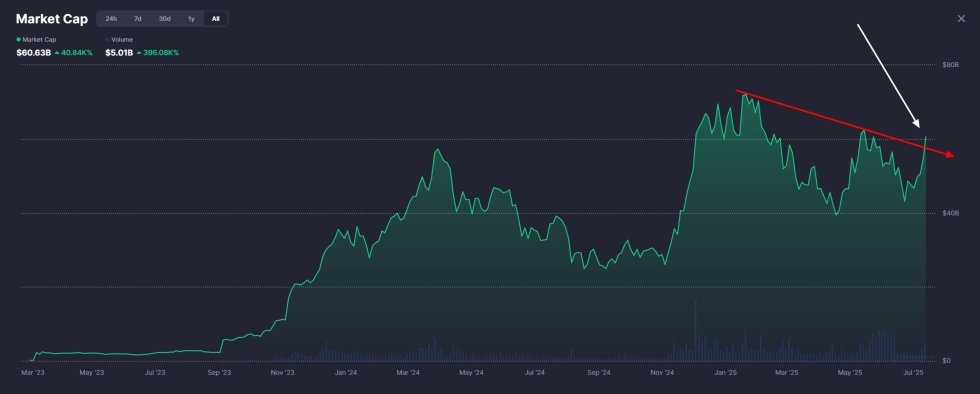
RWA Tokens Market Cap | Source: Real World Asset Watchlist on X

This surge is not only a price-driven movement—it’s underpinned by structural developments, regulatory clarity, and growing on-chain infrastructure that enables secure tokenization, compliance, and real-world adoption.

As capital rotates from highly speculative narratives to more fundamental and yield-generating sectors, RWAs are becoming the centerpiece of the next cycle. The current breakout could serve as a pivotal catalyst, triggering an influx of new products, capital, and participants into the space. If sustained, this could position RWA as one of the primary drivers of crypto’s transition from speculative to institutional-grade finance.

Altcoin Market Cap Surges As Breakout Gains Momentum

The total crypto market cap excluding Bitcoin and Ethereum (TOTAL3) has just posted a decisive weekly breakout, now sitting at $938.6 billion. This move represents an 11.19% gain from the previous week, marking one of the strongest weekly performances of the year for altcoins. Price has convincingly broken above the 50-week moving average (currently at $798B), reclaiming bullish structure and targeting previous cycle highs.
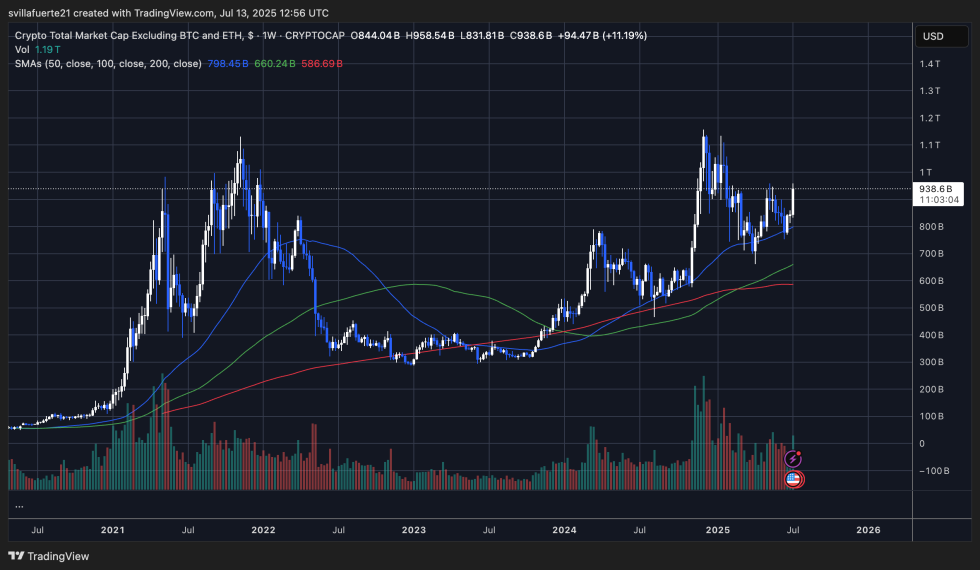
Crypto Total Market Cap excluding BTC and ETH | Source: TOTAL3 chart on TradingView
Crypto total market cap excluding BTC and ETH | Source: TOTAL3 chart on TradingView

This breakout occurs after months of consolidation above the 200-week and 100-week moving averages, both of which acted as key support levels. The surge in volume further confirms the strength of this move, suggesting growing participation from investors rotating capital into the altcoin space as Bitcoin leads the market into price discovery. The chart structure shows a pattern of higher lows, pointing to a potential macro uptrend resumption.

With key narratives like real-world asset tokenization (RWAs), DePIN, and Solana-based meme coin ecosystems gaining momentum, the TOTAL3 breakout could be signaling the start of a broader altcoin season.

Featured image from Dall-E, chart from TradingView

Editorial Process for bitcoinist is centered on delivering thoroughly researched, accurate, and unbiased content. We uphold strict sourcing standards, and each page undergoes diligent review by our team of top technology experts and seasoned editors. This process ensures the integrity, relevance, and value of our content for our readers.

Sebastian's journey into the world of crypto began four years ago, driven by a fascination with the potential of blockchain technology to revolutionize financial systems. His initial exploration focused on understanding the intricacies of various crypto projects, particularly those focused on building innovative financial solutions. Through countless hours of research and learning, Sebastian developed a deep understanding of the underlying technologies, market dynamics, and potential applications of cryptocurrencies. As his knowledge grew, Sebastian felt compelled to share his insights with others. He began actively contributing to online discussions on platforms like X and LinkedIn, focusing on fintech and crypto-related content. His goal was to expose valuable trends and insights to a wider audience, fostering a deeper understanding of the rapidly evolving crypto landscape. Sebastian's contributions quickly gained recognition, and he became a trusted voice in the online crypto community. To further enhance his expertise, Sebastian pursued a UC Berkeley Fintech: Frameworks, Applications, and Strategies certification. This rigorous program equipped him with valuable skills and knowledge regarding Financial Technology, bridging the gap between traditional finance (TradFi) and decentralized finance (DeFi). The certification deepened his understanding of the broader financial landscape and its intersection with blockchain technology. Sebastian's passion for finance and writing is evident in his work. He enjoys delving into financial research, analyzing market trends, and exploring the latest developments in the crypto space. In his spare time, Sebastian can often be found immersed in charts, studying 10-K forms, or engaging in thought-provoking discussions about the future of finance. Sebastian's journey as a crypto analyst and investor has been marked by a relentless pursuit of knowledge and a dedication to sharing his insights. His ability to navigate the complex world of crypto, combined with his passion for financial research and communication, makes him a valuable asset to the industry. As the crypto landscape continues to evolve, Sebastian remains at the forefront, providing valuable insights and contributing to the growth of this revolutionary technology.

Related Reads

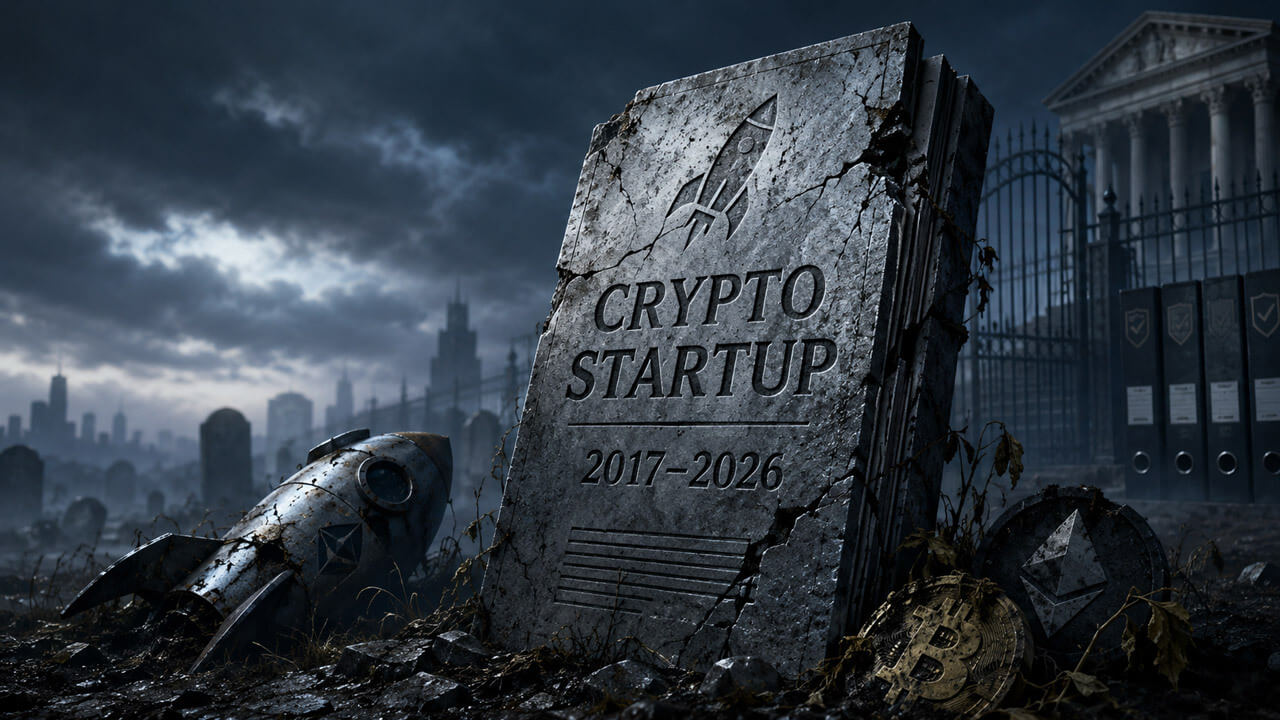
A Decade of Change: The Demise of Crypto Startups

"The Decade-Long Transformation: The Demise of Crypto Startups" The article traces the dramatic evolution of the cryptocurrency industry from its anarchic beginnings to its current highly regulated and institutionalized state. In the early days (circa 2017), launching a crypto startup was remarkably simple: a whitepaper, a GitHub repository, and a Telegram group could attract thousands of retail investors via an Initial Coin Offering (ICO). Founders operated anonymously with near-zero regulatory and financial barriers, enabling rapid, global innovation but also widespread fraud. By 2026, the landscape is fundamentally different. To operate in major markets like the US, EU, and Asia, crypto businesses must now navigate a complex web of regulations akin to traditional finance. Compliance costs are prohibitive: estimates for a US multi-state operation range from $750,000 to $1.2 million in the first three years, with annual costs exceeding $2 million thereafter. Regulations like MiCA in the EU and New York's BitLicense have created high capital and operational hurdles that act as barriers to entry. Simultaneously, venture capital investment has shifted dramatically. Following the collapses of Terra and FTX, funding has concentrated in later-stage, established companies, creating a "barbell market." Early-stage and seed funding has shrunk significantly, while mega-funds like Andreessen Horowitz's $15 billion pool dominate. Most capital now flows to trading platforms, lending infrastructure, and B2B services. This environment favors mergers and acquisitions as the primary path for growth. Companies like Coinbase and Ripple are acquiring firms like Deribit and Hidden Road not for their technology, but for their licenses, banking relationships, and institutional trust—assets far more valuable than code. Distribution channels, compliance, and brand reputation have become the new moats, overshadowing pure technical innovation. The industry's maturation brings benefits: reduced scams, increased institutional participation, and clearer regulatory frameworks. However, it comes at a cost. The low-barrier, experimental ethos that defined crypto's first decade is fading. Entrepreneurs without substantial capital, pre-existing licenses, or institutional connections face immense challenges. Funding for exploratory fields like decentralized social media or novel governance models is drying up. Ultimately, the crypto industry is replicating the consolidation pattern seen in banking and tech after the 2008 financial crisis. While this brings stability and legitimacy, it raises a critical question: in this new, resource-intensive reality, is there still room for the disruptive, from-scratch innovation that gave birth to the sector?

Foresight News32m ago

A Decade of Change: The Demise of Crypto Startups

Foresight News32m ago

Trading

Spot
活动图片