Founder Of $300 Billion Investment Firm Advises 40% Crypto Allocation, Here’s Why

bitcoinistPublished on 2025-07-02Last updated on 2025-07-02

Abstract

Ric Edelman, the founder of Edelman Financial Engines, which is a $300 billion investment advisory firm, made recent interesting comments...

Trusted Editorial content, reviewed by leading industry experts and seasoned editors. Ad Disclosure

Ric Edelman, the founder of Edelman Financial Engines, which is a $300 billion investment advisory firm, made recent interesting comments with his latest recommendation on crypto. In a new whitepaper published through the Digital Assets Council of Financial Professionals (DACFP), Edelman issued a direct call to investors to rethink the traditional 60/40 stock-bond allocation model and increase their exposure to cryptocurrencies from between 10% of their portfolio up to 40%.

Rethinking The 60/40 Portfolio To Crypto

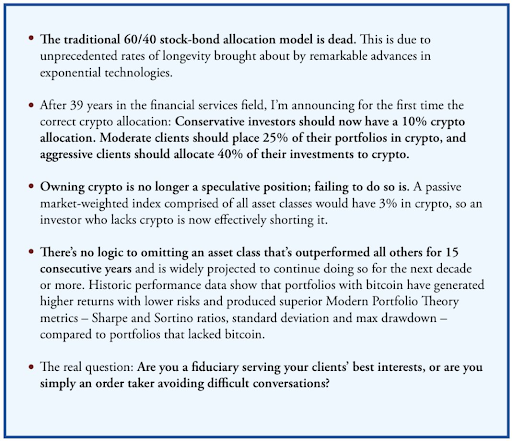
In the whitepaper to investors, Ric Edelman proclaims that the 60/40 stock-bond allocation model is dead and rendered obsolete by longer life spans and technological innovation. Thus, smart investors must adopt strategies that are future-proof and resilient to changes in finance and technology. Cryptocurrencies provide exactly that kind of opportunity for investors.

In Edelman’s opinion, conservative investors should have 10% of their portfolio in cryptocurrencies, moderate investors should place 25% of their portfolios in crypto, and aggressive investors should allocate 40% of their investments to crypto. 
Crypto
Source: Ric Edelman on X

In a recent appearance on CNBC’s Crypto World segment, Edelman justified his outlook, arguing that crypto should now occupy a significant share of the equity allocation portion of portfolios. “Within that huge equity allocation, crypto needs a much bigger role because it’s representing the best investment opportunity of the decade,” he said.

He also noted that it’s no longer about speculation. The speculation lies in not owning crypto at all. In the DACFP paper, he stressed that omitting digital assets is equivalent to shorting the market, especially now that a market-weighted global index would include around 3% crypto exposure by default.

From Skepticism To Aggressive Endorsement

Edelman’s latest recommendations mark a dramatic shift from his earlier views. In his 2021 book, The Truth About Crypto, he advised investors to place only 1% of their portfolios in cryptocurrencies, but that was then. Today, he is urging conservative investors to allocate up to 40% in cryptocurrencies. Interestingly, the financial advisor also advised other financial advisors to up their portfolio recommendations from 2.5% to at least 10%.

This evolution, he explains, is due to the unprecedented transformation crypto has undergone over the past four years since he released his book. According to Edelman, the crypto industry is no longer an experimental sector like it was in 2021. It’s now a core financial asset class. Furthermore, there’s no longer a question as to whether or not the government likes crypto or not and is going to support its development. 

Looking ahead, Edelman’s bullish stance is firmly rooted in long-term projections. While speaking at the Vision conference early last month, he projected that Bitcoin could reach a $19 trillion market cap by 2030. He has also placed a $500,000 price target on Bitcoin, basing his estimate on simple supply-demand math. 

According to him, global investable assets across all classes (stocks, bonds, real estate, cash, and more) amount to about $750 trillion. If just 1% of this capital flowed into Bitcoin, it would equate to $7.5 trillion in inflows. On a per-coin basis, this would push Bitcoin’s valuation to approximately $377,000. Factoring in Bitcoin’s current price, Edelman arrives at a $500,000 target.

Crypto
Overall crypto market cap at $3.26 trillion | Source: TOTAL on Tradingview.com
Featured image from iStock, chart from Tradingview.com
Editorial Process for bitcoinist is centered on delivering thoroughly researched, accurate, and unbiased content. We uphold strict sourcing standards, and each page undergoes diligent review by our team of top technology experts and seasoned editors. This process ensures the integrity, relevance, and value of our content for our readers.

Scott Matherson is a leading crypto writer at Bitcoinist, who possesses a sharp analytical mind and a deep understanding of the digital currency landscape. Scott has earned a reputation for delivering thought-provoking and well-researched articles that resonate with both newcomers and seasoned crypto enthusiasts. Outside of his writing, Scott is passionate about promoting crypto literacy and often works to educate the public on the potential of blockchain.

Trending Cryptos

Related Reads

Tiger Research: Three Strategies for Financial Institutions to Keep Up with the Tokenization Wave

Tiger Research's in-depth report analyzes the strategic choices for financial institutions entering the rapidly growing Real-World Asset (RWA) tokenization market. With the market projected to be worth $25-36 billion and a lack of complete regulatory frameworks in many jurisdictions, institutions face three options: waiting for domestic legislation, using regulatory sandboxes for limited experiments, or moving first into established overseas markets to gain a competitive edge. Tokenization is not magic; it requires meticulous preparation. Before entry, institutions must strategically plan across six core areas: choosing a jurisdiction, obtaining necessary licenses, defining the asset type, targeting the appropriate investor base, selecting settlement currencies, and designing operational requirements like custody and governance. The report outlines two main operational paths. The first is a direct jurisdictional path, establishing a legal presence in mature markets like Hong Kong, Singapore, or the U.S., often leveraging local licensed platforms to accelerate market entry. The second is a chain-native path, using platforms like Ondo or Plume that are built with regulatory compliance embedded, allowing for faster, more flexible market access without being tied to a specific jurisdiction. Ultimately, the report advises against waiting for perfect regulation. The preparation process can take 6-12 months and requires thorough legal review. Using the example of a mid-sized securities firm, it details steps from evaluating existing entities to final execution. The core message is that accumulating real-world operational experience is paramount, as the market is moving ahead and will not wait for latecomers.

Foresight News18m ago

Tiger Research: Three Strategies for Financial Institutions to Keep Up with the Tokenization Wave

Foresight News18m ago

Unitree's IPO Frenzy: The Real Mystery is How It Will Spend the 42 Billion Raised

Unitree, a Chinese robotics company, is set for a public listing after its IPO registration was approved by regulators. The company, which started with quadruped robots and has expanded into humanoids, plans to raise approximately 4.2 billion yuan through its offering. The article traces Unitree's rapid growth from its founding in 2016 to its current status. It highlights key milestones like the 2021 CCTV Spring Festival Gala performance, the 2023 launch of its affordable Go2 robot dog and the H1 humanoid robot, and a series of subsequent product launches. By 2025, the company reported revenue of 1.71 billion yuan, profitability, and sales exceeding 5,500 humanoid robots. As the first publicly-listed humanoid robot company on China's STAR Market, Unitree's main challenges are sustaining growth and deploying its newly raised capital effectively. The humanoid robot sector in China is crowded, with over 140 companies. Competitors include UBTech (focusing on industrial and consumer markets), Fourier, and international players like Tesla Optimus and 1X NEO. The article outlines three critical challenges for Unitree: establishing a strong second product line beyond its quadruped robots, maintaining its price advantage while ensuring quality, and successfully advancing its embodied AI capabilities through partnerships like the one with NVIDIA for the H2 Plus platform. Unitree's likely strategy involves a "developer tools + industry benchmarks" approach: using low-cost models like the R1 and G1 to build developer adoption and volume, leveraging high-end platforms for AI training, and securing pilot projects in sectors like logistics and manufacturing to build case studies. The company's future success hinges on converting its current momentum in shipments and pilot programs into sustainable, large-scale commercial contracts as the broader market evolves.

marsbit1h ago

Unitree's IPO Frenzy: The Real Mystery is How It Will Spend the 42 Billion Raised

marsbit1h ago

Examining the Open USD Partner Lineup: Follow Who's Joining to See Where the Money Flows

**Title: Deciphering the Open USD Partner Roster: Following the Money** The launch of Open USD is notable less for the stablecoin itself and more for its expansive list of over 140 founding partners, which reads like a "who's who" of global finance and tech. This coalition, including asset managers like BlackRock, card networks Visa and Mastercard, banks (BNY Mellon, Standard Chartered, etc.), tech giants (Google, IBM), merchants (Shopify), and crypto firms (Coinbase, Ripple, Aave, MetaMask), signals a strategic shift. The diverse membership reveals that stablecoins are increasingly viewed not as products to compete over, but as shared infrastructure too critical to be left to any single entity. Each partner category has distinct motives. Asset managers like BlackRock seek to manage the large, sticky cash reserves, a lucrative fee-generating opportunity. Merchants like Shopify aim for lower-cost settlement and potential yield on balances. Banks join defensively to retain custody and settlement roles, fearing deposit outflows to stablecoins. Tech companies bet on programmable money for future machine-to-machine commerce. Crypto firms gain mainstream legitimacy and distribution channels. Remarkably, the consortium includes direct competitors (Visa vs. Mastercard, Coinbase vs. Ripple), indicating that the fear of exclusion from this emerging financial layer outweighs competitive rivalries. However, this shared governance could also lead to slow decision-making. The roster's composition is the real message: it represents a collective bet that a widely accepted, consortium-owned stablecoin is preferable to proprietary versions or having none at all. For incumbents like Circle and Tether, this alliance poses a significant threat, as potential clients have collectively chosen to build their own alternative. The absence of major U.S. retail banks (busy with their own tokenized deposit networks) is equally telling. In essence, the partner list maps where the industry believes value and risk will flow in a tokenized dollar future, marking stablecoin's evolution from a product to a utility.

Foresight News2h ago

Examining the Open USD Partner Lineup: Follow Who's Joining to See Where the Money Flows

Foresight News2h ago

Trading

Spot

Hot Articles

Discussions

Welcome to the HTX Community. Here, you can stay informed about the latest platform developments and gain access to professional market insights. Users' opinions on the price of S (S) are presented below.

活动图片