头部 DeFi 项目如何与传统金融融合

tokeninsight_zhPublished on 2025-06-19Last updated on 2025-06-20

本文探讨了三大 DeFi 协议 Uniswap、Aave 和 Maker(Sky)的核心优势,并分析了它们在美国新监管体系下与传统金融(TradFi)融合的潜力

  • 监管转向为 DeFi 与传统金融融合打开大门:新任 SEC 主席 Paul Atkins 推动美国加密监管发生根本转变,明确支持自托管权利,认定质押不构成证券活动,并倡导基于规则的透明监管,推动“创新豁免”等机制,释放 DeFi 与传统金融合作的制度红利。
  • Uniswap 与 Aave 率先具备机构级整合能力:Uniswap 凭借 V4 的“hooks”模块化架构支持合规功能,如实时 KYC/AML、白名单池等,可作为经纪商的后台 DEX 服务,成为 RWA(现实世界资产)交易的链上流动性核心。 Aave 通过许可型借贷池、以 RWA 为抵押的借贷模型、与新型银行合作等方式,积极拓展机构市场,Horizon 项目正致力于构建面向传统资本市场的 DeFi 产品。
  • MakerDAO 面临稳定币监管挑战,正积极寻求应对方案: 已更名为 Sky 的 MakerDAO,其 DAI/USDS 模型在 1:1 储备、许可发行、KYC 等方面可能与 GENIUS 法案存在冲突。可能的应对策略包括提高传统资产的储备比例,并推出合规设计的稳定币(具备冻结功能等监管友好机制),以在新环境下保持稳定币业务的发展空间。

Related Reads

Olympus DAO Myth Reappears? A "Sovereign On-Chain Central Bank" Written with 4000 Lines of Immutable Code

A new project called The Standard Reserve has emerged, branding itself as a "sovereign on-chain central bank." It aims to replicate core central bank functions—currency issuance, money supply adjustment, and reserve accumulation—entirely through 4,000 lines of immutable code, with no human governance. Its core mechanism is a "reflexive monetary policy" based on a single signal: the net ETH flow into or out of the system's sole Uniswap v4 ETH/$STANDARD pool. Sustained net ETH inflows trigger an "expansion" phase, increasing $STANDARD issuance and using protocol fees to buy tokenized gold as a permanent hard reserve. Net outflows (or zero flow) trigger an immediate "contraction" phase, reducing issuance and using fees to buy back and burn $STANDARD. The system involves six key entities: the $STANDARD token (hard-capped at 1 billion), the central Uniswap pool, the Central Bank contract, Charter NFTs (acting as "banking licenses"), Branch units under each Charter (which earn a share of newly minted $STANDARD), and separate Vaults for expansion (buying gold) and contraction (buying back $STANDARD). To participate, users ideally acquire a Founding Charter NFT (initially 1,000 are free via allowlist/public mint). Each Charter comes with one Branch; more can be opened by burning $STANDARD for "expansion permits," increasing revenue share. Retiring a Branch lets users claim accumulated $STANDARD but imposes a dynamic exit fee (higher if many exit simultaneously), with half the fee burned and half distributed to remaining participants. All protocol revenue (from pool fees and Charter auctions) is allocated: 70% to the active Vault (for gold or buybacks), 15% to permanent protocol-owned liquidity, and 15% to the team. The project presents an innovative, game-theoretic model where user actions (expanding Branches by burning tokens or exiting) align with system goals of building reserves or inducing deflation. However, it is fully anonymous, with key parameters undefined and unaudited code, posing significant risks.

marsbit12m ago

Olympus DAO Myth Reappears? A "Sovereign On-Chain Central Bank" Written with 4000 Lines of Immutable Code

marsbit12m ago

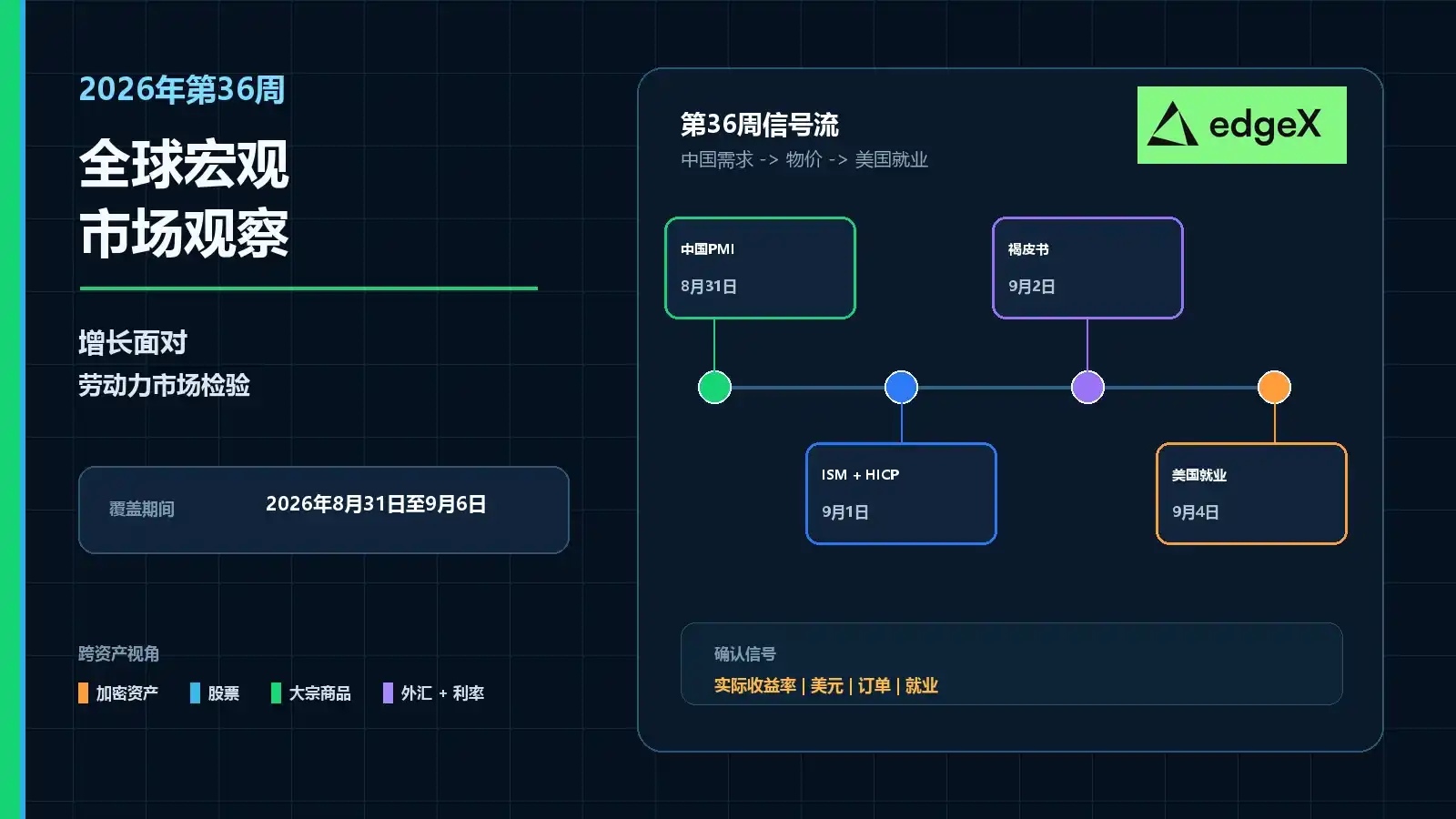
US Jobs, China PMI, and Inflation on Stage: Can Global Growth Maintain Resilience?

**Week 36 Macro Outlook: Key Data to Test Global Growth Resilience** The week from August 31 to September 6 will shift focus from policy discussions to a critical test of global economic activity. The sequence of events is key, starting with China's official August PMI on Aug 31, which will provide early signals on factory orders, services, and employment following July's contraction. The data flow then broadens. On September 1, US ISM Manufacturing PMI and the Eurozone's flash inflation estimate will offer simultaneous checks on demand, prices, and regional divergence. The subsequent US Federal Reserve Beige Book on September 2 adds granular, qualitative evidence on consumer spending, wages, and regional conditions. Australian Q2 GDP and Canadian trade and jobs data will test resilience in other major economies. The week's pivotal event, however, is the US August employment report on September 4. It will decisively influence expectations for interest rates, the US dollar, and broader risk appetite, acting as a final cross-check for the preceding data. The core question for markets is whether global growth can remain resilient. An ideal outcome would combine a rebound in China's PMI, stable US jobs growth, cooling inflation, and signs of a gradual demand slowdown. Conversely, weak Chinese manufacturing, sticky Eurozone prices, and disappointing US non-farm payrolls would create a more complex scenario of reduced corporate confidence and limited room for aggressive monetary easing, increasing pressure on cyclical assets. Investors should monitor the breadth of improvements—such as new orders and employment—rather than headline PMI figures alone. Confirmation across different data points is crucial. A positive combination of steady activity and disinflation could support equities, industrial commodities, and risk assets like crypto. However, if a growth slowdown triggers lower yields, it must be distinguished from a scenario of rising recession risks that would pressure corporate earnings, potentially limiting rallies. The market's final reaction will hinge on whether the week's signals align to either reinforce or challenge the current growth narrative.

marsbit14m ago
US Jobs, China PMI, and Inflation on Stage: Can Global Growth Maintain Resilience?

marsbit14m ago

Trading

Spot
活动图片