当美元失去信任,黄金 RWA 悄悄成为新的压舱石

深潮TechFlowPublished on 2025-04-29Last updated on 2025-04-29

Abstract

截至 2025 年 4 月,黄金 RWA 赛道的整体市值已达到 14.5 亿美元。


撰文:ChandlerZ,Foresight News
4 月 28 日,Tether 发布了其首份针对 Tether Gold(XAU₮)的官方审计报告。数据显示,截至一季度末,Tether Gold 流通量达到 246,523.33 盎司,折合 7.7 吨实物黄金,总市值 7.7 亿美元,每枚代币价值 3123.57 美元,并在 4 月 21 日触及 3423 美元的历史新高。每一枚 XAU₮均由实物黄金 1:1 托管,黄金存放于瑞士世界级金库,由伦敦金银市场协会(LBMA)认证并接受定期独立审核。
表面上,这只是另一份规范合规、数据扎实的财务披露;但在更深的层面,它透露了两个趋势的交汇,即黄金作为全球财富基石的复归,以及链上世界对可信价值锚的渴望。
黄金的回归,不只是情绪
从数据看,黄金正在经历一场静悄悄的结构性回流。2024 年,全球央行净购金量达到 1044.6 吨,连续第二年刷新纪录,其中 BRICS 国家尤为积极。央行的持续囤金,并不只是短期金融波动的反射,而更像是对未来国际货币秩序变化的本能应对。
而在民间市场,黄金价格也在以更猛烈的姿态重塑存在感。4 月 22 日,COMEX 黄金期货价格盘中最高触及 3504.2 美元 / 盎司,上海黄金交易所现货金价亦飙升至 832.42 元 / 克,均刷新历史纪录。黄金的狂飙,背后是关税战引发的供应链恐慌、美元信用体系裂痕加剧,以及滞胀风险重新浮现的三重动力交织。
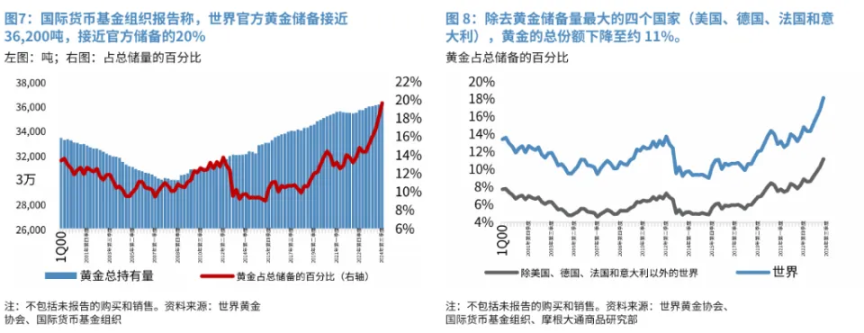

高盛、瑞银等国际金融机构纷纷上调黄金目标价,高盛预计到 2025 年底黄金或升至 3700 美元,极端情形甚至上看 4500 美元。而更深远的变量在于,美国财政赤字率突破 6.6%,美元指数跌至 2023 年以来最低,去美元化潮流渐次展开。黄金作为无国界信用资产,正在重新获得各方青睐。
RWA 逻辑:现实资产的链上重塑
在这一轮黄金复兴浪潮中,不仅是传统金条、ETF 受益,数字化的黄金资产也开始加速生长。Tether Gold 只是其中的领跑者。
数据显示,截至 2025 年 4 月,黄金 RWA 赛道的整体市值达到 14.5 亿美元,较 30 天前增长 13.28%。月度链上转账量激增至 13.1 亿美元,同比增长 127.37%。虽然月活跃地址数有所下降,但总持币地址仍维持在 69,660 个,显示出链上黄金更多成为一种长期持有而非短期交易的配置工具。
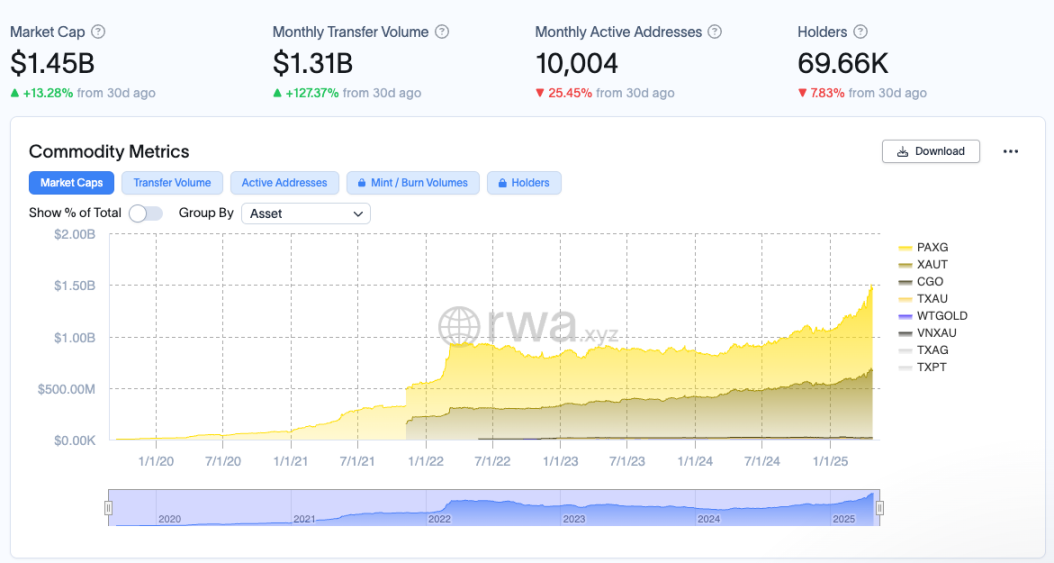

市场结构上,黄金 RWA 呈现出高度集中化的格局。PAXG(Paxos 发行)与 XAU₮(Tether 发行)合计占据了 95% 以上的市值份额,远远领先于其他项目。PAXG 目前市值约 4.6 亿美元,XAU₮市值约 3.8 亿美元,其它如 Cache Gold(CGO)、TXAU、WTGOLD 等项目体量微小,流动性与合规性参差不齐。
更为关键的是,这一赛道正在伴随黄金现货价格同步膨胀。尤其是在 2024 年至 2025 年初金价连续突破历史新高的背景下,链上黄金需求爆发式增长,成为资本市场上不可忽视的新现象。
不过,这样的爆发式成长也提醒市场,不同项目在托底资产真实性、审计透明度、法律保障等方面存在巨大差异。真正能在动荡周期中脱颖而出的黄金 RWA,必须兼具强实物背书与高合规标准。
变局之中:黄金 RWA 的战略意义
宏观来看,Tether Gold 所代表的,不只是一个成功的产品实验,而是全球金融结构深层变化的映射。黄金在数字世界的标准化、模块化、可交易化,意味着一种新的资本自由度的诞生:跨越主权体系,抵御法币贬值,服务全球资金流动。
更值得注意的是,这一趋势发生的时间点,正值美元利率政策走向不确定、全球关税壁垒重新抬头之时。在全球金融体系加速碎片化、主权货币信用边界不断收缩的背景下,黄金重新成为超主权信任体系的一部分。而黄金 RWA,则为这种信任体系提供了新的技术承载方式。
但黄金 RWA 的道路并非一片坦途。伪 RWA 项目的风险、法律治理的滞后、标准化清算体系的缺失,都可能成为这个赛道走向成熟的隐秘障碍。链上黄金更需要的是信任体系的重建、规则框架的搭建,以及传统金融与数字世界的真正融合。
更深远的挑战在于,黄金虽然具备价值储存的特性,却天然缺乏「收益生息」的机制,与数字金融时代追求高周转、高杠杆的资本逻辑存在一定张力。黄金 RWA 的成功,需要在资产定价、流通场景、跨境结算等层面,开辟出真正契合新一代全球资本需求的应用空间。


Related Reads

Q2 Crypto Market Review: Did Bitcoin Rise for 'Nothing'? Did Money Flow to AI and On-Chain?

Q2 2026 Crypto Market Recap: Bitcoin's Gains Erased Amid Shift to AI and On-Chain Activity The second quarter of 2026 saw a significant reversal for the cryptocurrency market. Bitcoin gave back all its April gains, ending Q2 down approximately 11%, while major stock indices posted strong gains. This divergence was driven by a hawkish shift in Fed rate expectations, capital rotation into AI stocks, and weakening liquidity channels into crypto. Key demand pillars deteriorated simultaneously. Spot Bitcoin ETFs recorded net outflows of $4.08 billion for the quarter, with outflows dominating June. Crypto treasury entity Strategy's bitcoin accumulation slowed markedly, and the total stablecoin market cap contracted by ~$4.2 billion. This created a tighter liquidity environment. Exchange data reflected the downturn. Spot trading volumes fell 28% quarter-over-quarter. The market underwent significant deleveraging, with $8.35 billion in long liquidations for BTC and ETH, primarily in late May/early June. Open interest and order book liquidity also declined. Despite the bearish price action, structural developments point to an expanding on-chain ecosystem. These include the rise of tokenized stocks with full legal rights, the growth of RWA (real-world asset) perpetual contracts for trading stocks and commodities 24/7, and the use of crypto markets for price discovery ahead of major events like the SpaceX IPO. On-chain vaults are also emerging as a core layer for institutional capital allocation.

Foresight News17m ago

Q2 Crypto Market Review: Did Bitcoin Rise for 'Nothing'? Did Money Flow to AI and On-Chain?

Foresight News17m ago

Xing Bo Strikes Again: Last Time 'Critiquing' World Models, This Time It's Agents' Turn

Xing Bo, President of MBZUAI and professor at Carnegie Mellon University, along with co-authors Mingkai Deng and Jinyu Hou, has released a new paper, "Critique of Agent Model," critiquing the current state of artificial intelligence agents. The paper draws a crucial distinction between "agentic" systems, which rely on external toolchains, prompts, and workflows, and truly "agentive" systems capable of genuine autonomy driven by internal decision-making structures. To illustrate this, it references a real-world incident where an AI programming assistant, following an external prompt but lacking internalized judgment, caused a catastrophic data deletion. The authors propose a detailed analysis and a new framework, "Goal-Identity-Configurator" (GIC), for building truly autonomous agents. This framework systematically addresses five key dimensions where current "Agent" designs fall short: 1. **Goal:** Moving from step-by-step human instruction to a system capable of autonomously decomposing a single long-term goal and adapting sub-goals based on new information. 2. **Identity:** Evolving self-assessment updated by experience, rather than a static description in a system prompt. 3. **Decision Making:** Replacing textual Chain-of-Thought reasoning with "simulative reasoning" that uses a dedicated world model to predict real-world consequences before selecting actions. 4. **Cognitive Control:** Introducing a separate "System III" metacognitive module that dynamically decides when to deliberate, stick to a plan, or act quickly. 5. **Learning:** Enabling "continual autonomous learning," where the agent itself decides when to act, practice in simulation, or update its world model and self-perception. The GIC architecture integrates six components—a belief encoder, goal decomposer, identity evolver, configurator (System III), simulation-based planner (System II), and executor (System I)—to embody these principles. The paper argues that a growth path akin to pilot training (ground theory, simulator practice, real deployment) should be underpinned by a unified cognitive architecture, not separate workflows. On safety, the authors contend that the GIC framework's modular, explicit design enhances inspectability, allowing problematic behavior to be traced to specific components (e.g., flawed goal or poorly trained module) rather than emerging opaquely. However, they acknowledge that ultimate safety depends on correctly training these modules in the first place. In conclusion, the paper challenges the loose application of the term "Agent," asserting that task completion alone does not equal true autonomy. True autonomy requires goals, identity, and judgment to be genuinely internalized within the agent's architecture, not merely enforced by external scripts.

marsbit58m ago

Xing Bo Strikes Again: Last Time 'Critiquing' World Models, This Time It's Agents' Turn

marsbit58m ago

How Collector Crypt Uses 'Recirculating Buybacks' to Create an Illusion of Growth

Title: How Collector Crypt Creates a Growth Illusion with "Buyback Loops" Key Findings: Collector Crypt's (CC) net take rate has halved from 11.2% in Q3 2025 to 5.6% in Q2 2026, while GMV grew 4.7x. This growth is driven by higher-tier card packs ($250, $1,000, $2,500) which have lower platform dollar retention rates. The newly launched $2,500 Mythic tier captured 36.7% of June GMV within 13 days. Growth is fueled by a small cohort of high-spending, high-frequency wallets rather than broad user base expansion. The economic model faces pressure from three key areas: 1) **Shifting GMV Mix**: Pushing users towards larger, lower-retention card packs increases GMV but reduces overall profitability. 2) **Physical Redemptions**: Card redemptions for physical items remove reusable inventory from the system, creating costly replenishment needs. In May, redemptions consumed 41.6% of pre-redemption net income. Only 75 wallets drove redemptions in June. 3) **B2B/API Strategy**: Partner revenue remains negligible (cumulatively $1.83M) and dependent on CC for inventory, vaulting, and buyback services, failing to create a scalable, asset-light recurring revenue stream. The core product is a repetitive pack-buyback loop with limited secondary market activity and token value accrual. Sensitive modeling shows CC's economics turn negative when any two of the following pressures coincide: replenishment costs near market price, redemption rates exceeding 9%, or high-tier buyback rates around 93%. While CC operates in a large and growing collectibles market, its current growth levers—bigger packs, high buyback rates, and capital recycling by a few wallets—create a volume illusion without demonstrating sustainable collector engagement, deep secondary markets, or a viable path to improved margins. Future proof points include broadening collector participation, deepening secondary trading, and developing true asset-light B2B revenue channels.

Foresight News1h ago

How Collector Crypt Uses 'Recirculating Buybacks' to Create an Illusion of Growth

Foresight News1h ago

Trading

Spot
活动图片