Ethereum Whales Dump 500,000 ETH In 48 Hours: On-Chain Data

bitcoinistPublished on 2025-04-06Last updated on 2025-04-06

Abstract

Ethereum is trading below the $1,900 level as selling pressure continues to mount, raising concerns that the recent downtrend could...

Trusted Editorial content, reviewed by leading industry experts and seasoned editors. Ad Disclosure

Ethereum is trading below the $1,900 level as selling pressure continues to mount, raising concerns that the recent downtrend could extend further. After losing the critical $2,500 support in late February, bulls have struggled to regain control. What began as a minor pullback has turned into a broader correction, disappointing investors who had anticipated a bullish 2025 for ETH.

The failure to reclaim key levels has eroded market confidence, and price action remains weak across both short and mid-term timeframes. Ethereum’s inability to sustain even brief recoveries has only reinforced the bearish sentiment that has gripped the crypto space in recent weeks.

Adding to the negative outlook, new data from Santiment reveals that whales have sold approximately 500,000 ETH over the past 48 hours. This massive distribution by large holders highlights a clear lack of confidence among some of the most influential players in the market — a trend that could weigh heavily on Ethereum’s near-term performance.

As ETH hovers below $1,900, all eyes are on whether bulls can defend remaining support levels, or if continued selling from whales and broader market uncertainty will drive the price further down in the days ahead.

Ethereum Whale Selling Fuels Bearish Outlook

Ethereum is down 55% from its December high, with price action continuing to reflect the broader market’s weakness. The selloff has been sharp and consistent, fueled by growing macroeconomic uncertainty and global instability. The latest wave of volatility was triggered by US President Donald Trump’s renewed tariff threats and unpredictable policy direction, which have spooked financial markets and driven capital away from high-risk assets.

As a result, Ethereum — a key altcoin with deep ties to speculative sentiment — has become one of the hardest-hit major cryptocurrencies. Bulls are struggling to hold support near the $1,800 level, and every attempt to rally has been met with renewed selling pressure. Without a clear shift in trend, ETH remains vulnerable to further downside in the near term.

Adding to the bearish sentiment, top analyst Ali Martinez shared data showing that whales sold 500,000 ETH over the last 48 hours. This massive distribution from large wallets suggests that even experienced market participants are growing increasingly cautious. Such activity tends to precede deeper corrections, particularly when accompanied by weak technicals and broader risk-off sentiment.

Ethereum whales sold 500,000 ETH in 48H | Source: Ali Martinez on X

Unless Ethereum can reclaim key resistance levels and show signs of accumulation, the current trend may continue to favor sellers. As markets digest macro developments, ETH holders are watching closely for any indication that the worst is over — but for now, the pressure remains firmly to the downside.

Ethereum Trades At $1,810 As Bulls Defend Crucial Support

Ethereum is trading at $1,810 after repeated failed attempts to reclaim the $1,900 level. The price continues to face strong resistance, and bullish momentum has significantly weakened in recent weeks. Bulls are now in a critical position, with $1,800 emerging as the most important support level in the current cycle. A decisive breakdown below this mark could trigger a deeper correction, potentially sending ETH as low as $1,550 — a zone not seen since mid-2023.
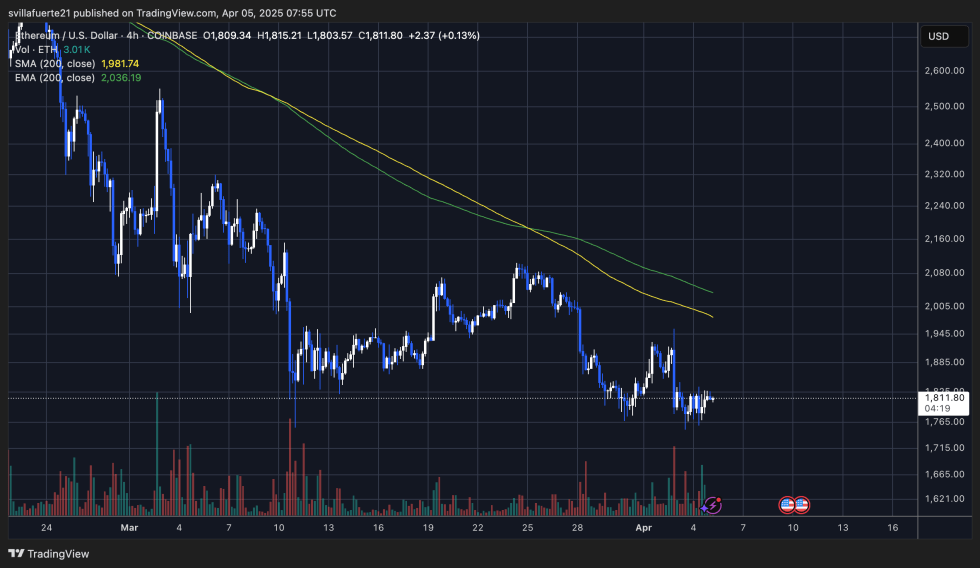
ETH holding above $1,800 | Source: ETHUSDT chart on TardingView

The broader crypto market remains under pressure, and Ethereum’s price action reflects that. Sentiment has been weighed down by macroeconomic headwinds and aggressive selling from whales, adding to the difficulty for bulls to regain control. Still, hope remains if ETH can stabilize and push higher in the coming sessions.

A breakout above the $2,000 level would mark a significant shift in momentum and could spark a strong recovery rally. That level remains the psychological and technical threshold for a potential trend reversal. Until then, Ethereum continues to walk a tightrope between consolidation and further downside, with bulls needing to hold $1,800 at all costs to avoid cascading losses. The next few days will be crucial in determining ETH’s short-term direction.

Featured image from Dall-E, chart from TradingView 

Editorial Process for bitcoinist is centered on delivering thoroughly researched, accurate, and unbiased content. We uphold strict sourcing standards, and each page undergoes diligent review by our team of top technology experts and seasoned editors. This process ensures the integrity, relevance, and value of our content for our readers.

Sebastian's journey into the world of crypto began four years ago, driven by a fascination with the potential of blockchain technology to revolutionize financial systems. His initial exploration focused on understanding the intricacies of various crypto projects, particularly those focused on building innovative financial solutions. Through countless hours of research and learning, Sebastian developed a deep understanding of the underlying technologies, market dynamics, and potential applications of cryptocurrencies. As his knowledge grew, Sebastian felt compelled to share his insights with others. He began actively contributing to online discussions on platforms like X and LinkedIn, focusing on fintech and crypto-related content. His goal was to expose valuable trends and insights to a wider audience, fostering a deeper understanding of the rapidly evolving crypto landscape. Sebastian's contributions quickly gained recognition, and he became a trusted voice in the online crypto community. To further enhance his expertise, Sebastian pursued a UC Berkeley Fintech: Frameworks, Applications, and Strategies certification. This rigorous program equipped him with valuable skills and knowledge regarding Financial Technology, bridging the gap between traditional finance (TradFi) and decentralized finance (DeFi). The certification deepened his understanding of the broader financial landscape and its intersection with blockchain technology. Sebastian's passion for finance and writing is evident in his work. He enjoys delving into financial research, analyzing market trends, and exploring the latest developments in the crypto space. In his spare time, Sebastian can often be found immersed in charts, studying 10-K forms, or engaging in thought-provoking discussions about the future of finance. Sebastian's journey as a crypto analyst and investor has been marked by a relentless pursuit of knowledge and a dedication to sharing his insights. His ability to navigate the complex world of crypto, combined with his passion for financial research and communication, makes him a valuable asset to the industry. As the crypto landscape continues to evolve, Sebastian remains at the forefront, providing valuable insights and contributing to the growth of this revolutionary technology.

Related Reads

Pope Issues First AI Encyclical: 40,000 Words, 10 Key Points, Clarifying AI Anxiety

Pope Leo XIV's historic encyclical "Magnifica Humanitas," released in May 2026, marks the Catholic Church's first major document addressing artificial intelligence. The 40,000-word text moves beyond theological abstraction to confront practical AI anxieties affecting society. It argues that AI is no longer a mere tool but an embedded environment influencing daily decisions in areas like employment, healthcare, justice, and information, often without users' awareness. The encyclical presents ten core concerns. It highlights that the central issue isn't just regulation, but who holds the underlying *power*—control over data, compute, and platforms—often concentrated in private entities. It warns that even developers cannot fully explain AI systems, creating accountability gaps. While AI can simulate human interaction and creativity, it cautions against treating it as a moral agent capable of bearing true responsibility or forming genuine relationships. Key risks identified include AI's role in opaque decision-making for jobs or welfare, the amplification of persuasive disinformation, and the potential for education to focus on tool use over critical thinking. The document stresses that work has value beyond efficiency, and AI should enhance human capabilities, not merely replace roles. It firmly states that irreversible decisions, especially involving life and death, must remain under human judgment. Ultimately, the encyclical frames AI's challenge as anthropological, not just technological. As AI simulates uniquely human capacities like judgment and creation, it forces a re-examination of what makes human action meaningful: our capacity for responsibility, vulnerability, and bearing real consequences. The Pope concludes that technology is never neutral; its development and deployment are shaped by human values and choices, making an inclusive, ethically grounded dialogue essential for its future.

marsbit4m ago

Pope Issues First AI Encyclical: 40,000 Words, 10 Key Points, Clarifying AI Anxiety

marsbit4m ago

Retail Investors' 'Lead Brother' Serenity vs. Newly Minted Stock God Leopold: How Are the Two Top Hunters Mining AI's 'Physical Limits'?

The article profiles two prominent figures, Serenity and Leopold Aschenbrenner, who are gaining attention for their unconventional investment strategies focused on the physical constraints of the AI boom, moving beyond mainstream software narratives. Serenity, an anonymous online trader, advocates a "shiso leaf" theory. He targets small-cap companies with monopolies on critical, overlooked components in the AI hardware supply chain, such as specific semiconductor materials. His deep, technical analysis of bottlenecks in areas like co-packaged optics (CPO) has reportedly yielded massive returns, though his anonymity and focus on illiquid micro-cap stocks pose significant risks for followers. Leopold Aschenbrenner, a former OpenAI researcher, founded a multi-billion dollar hedge fund. His macro thesis argues that physical infrastructure—power grids, land, data centers—is the true bottleneck for AI growth, lagging far behind chip production. Consequently, his fund employs an infrastructure arbitrage strategy: heavily investing in storage and compute infrastructure companies while placing massive bearish bets (put options) against major semiconductor stocks, betting their valuations will correct as physical constraints become apparent. While their methods differ—Serenity drills into microscopic supply chain details, while Leopold takes a macroscopic, infrastructure-focused view—both share a core belief: the real power and investment alpha in the AI era lie in controlling scarce physical resources, not just software. The article concludes by noting the inherent risks in both approaches, such as liquidity issues for micro-caps and timing risks for macro bets, but suggests they signal a broader market re-evaluation of AI's foundational assets.

marsbit9h ago

Retail Investors' 'Lead Brother' Serenity vs. Newly Minted Stock God Leopold: How Are the Two Top Hunters Mining AI's 'Physical Limits'?

marsbit9h ago

Trading

Spot
Futures

Hot Articles

Discussions

Welcome to the HTX Community. Here, you can stay informed about the latest platform developments and gain access to professional market insights. Users' opinions on the price of ETH (ETH) are presented below.

活动图片