Сложность майнинга биткоина обновила исторический максимум

cryptonews.ruPublished on 2024-08-30Last updated on 2024-12-30

В результате очередного перерасчета сложность майнинга первой криптовалюты увеличилась на 1,08%. Показатель достиг рекорда в 109,78 T.
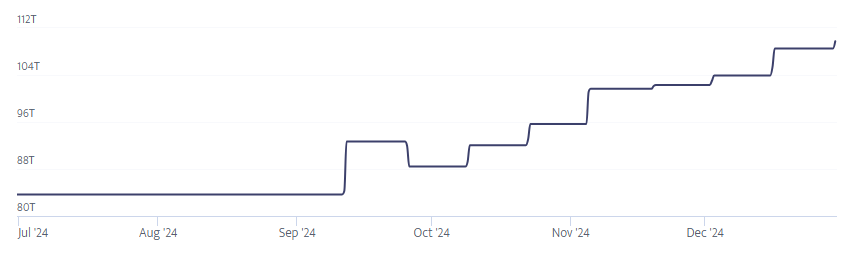
График сложности майнинга биткоина. Данные: Minerstat.

Средний хешрейт за период с предыдущего изменения значения составил 777 EH/s.

Согласно Glassnode, 21 ноября сглаженный показатель семидневной скользящей средней достиг максимума в 780,9 EH/s. После этого он упал к отметке 707,6 EH/s.
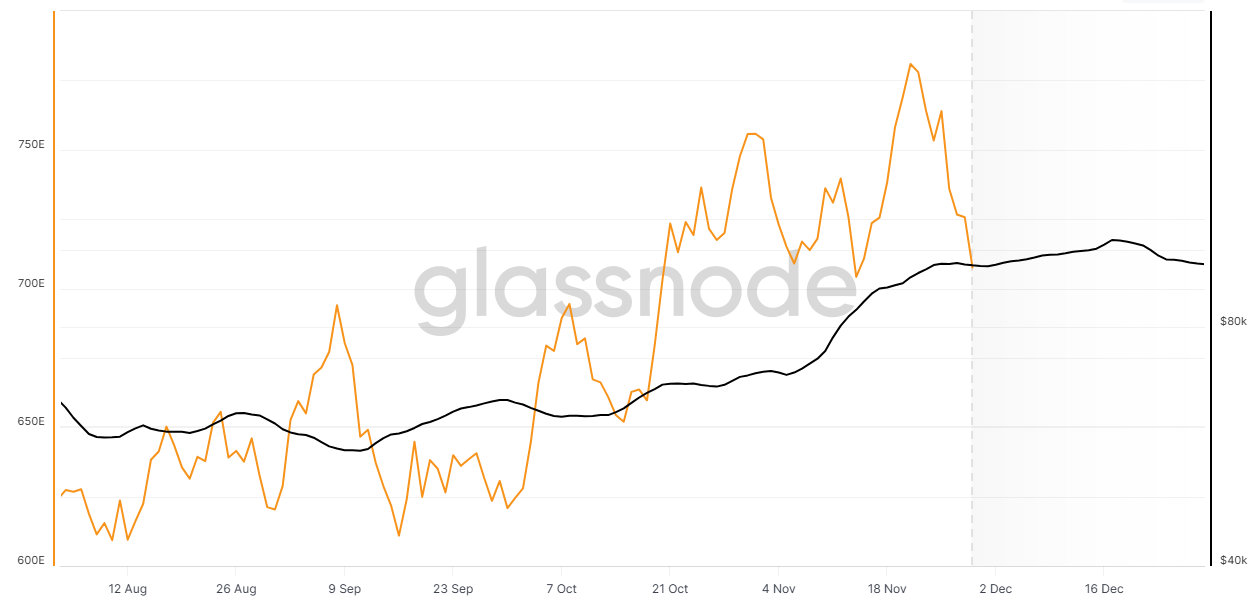
График сглаженного показателя семидневной скользящей средней для хешрейта (оранжевый) и цены биткоина (черный). Данные: Glassnode.

По данным Hashrate Index, за последние 24 часа хешпрайс упал на 2,5% — с $55,7 за PH в сутки до $54,3.
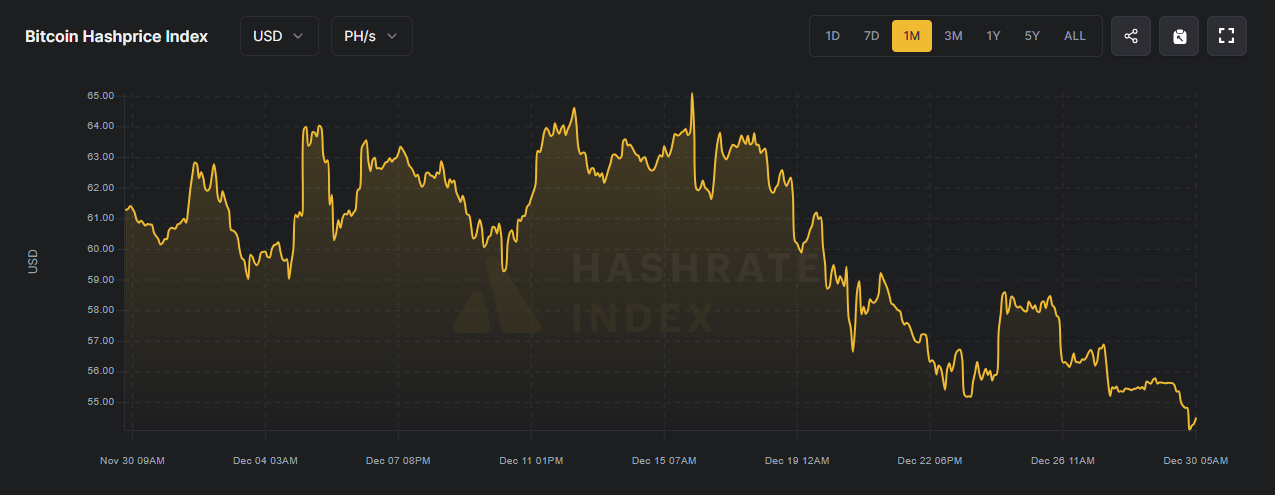
График хешпрайса биткоина. Данные: Hashrate Index.

Согласно The Block, по состоянию на 29 декабря сглаженный показатель семидневной скользящей средней суточной выручки майнеров на фоне ралли биткоина поднялся до $44,12 млн.
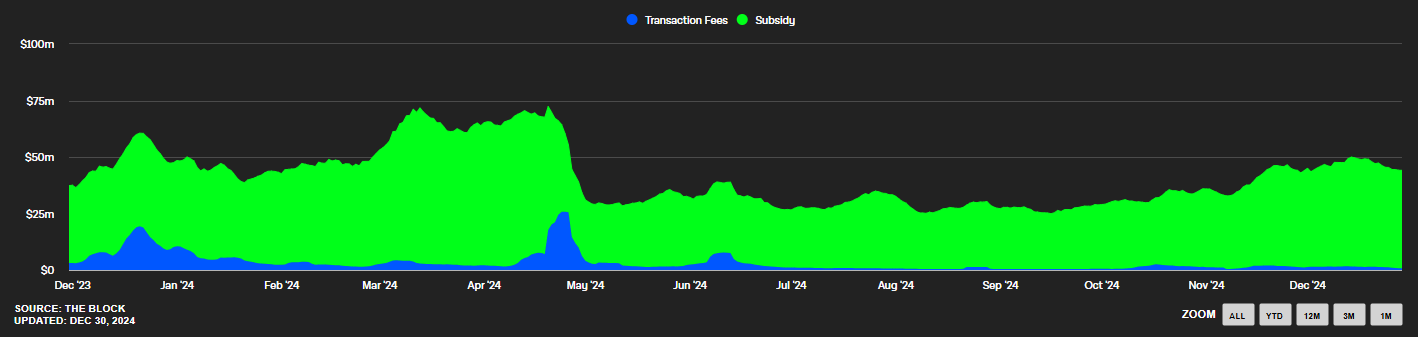
График сглаженной семидневной скользящей средней суточной выручки биткоин-майнеров. Данные: The Block.

Напомним, в течение 2024 года котировки акций майнинговых компаний разошлись с бычьим трендом цены первой криптовалюты.

Related Reads

From 2 Million Monthly Active Users to Zero: Zapper's Demise in the "Maturation" of DeFi

From 2M MAU to Zero: The Demise of Zapper in a Maturing DeFi Landscape On July 8, 2026, Zapper co-founder Seb Audet announced the platform's full shutdown. Once a DeFi star with 2 million monthly active users, $13B in processed transactions, and $16.5M in funding, Zapper's journey ends. Born in 2020 from the merger of DeFiZap and DeFiSnap, Zapper rode the "DeFi Summer" wave. It became essential for users to track complex, multi-protocol yield farming positions across chains. At its peak, it supported 14 chains, 450+ protocols, and 7000+ tokens, with its signature "Zap" feature simplifying multi-step DeFi actions. However, sustainable revenue never materialized. Its primary model—taking small fees from DEX aggregation—faced fierce competition and squeezed margins. Meanwhile, maintaining its extensive, real-time data indexing system was costly. Crucially, the DeFi ecosystem matured, with activity and liquidity concentrating in fewer top protocols. The core demand for a complex, multi-protocol dashboard waned as user behavior simplified. Zapper attempted multiple pivots that failed to gain traction: an NFT-based points system (2021), a social app called Chainchat (2023), and plans for a ZAP token and open protocol (2024). These efforts reflected a persistent "blockchain-native" mindset focused on creating new C端 (consumer) needs rather than addressing existing pain points or bolstering its revenue-generating products. The article contrasts Zapper with DeBank, which successfully narrowed its asset-tracking focus while developing Rabby Wallet—a revenue-stabilizing, competitive product. Zapper's story serves as a cautionary tale for tooling projects: over-immersion in a purist vision, coupled with an inability to adapt business models to market shifts—like the consolidation of DeFi activity—can be fatal, even for once-dominant platforms.

marsbit8m ago

From 2 Million Monthly Active Users to Zero: Zapper's Demise in the "Maturation" of DeFi

marsbit8m ago

Goldman Sachs Bans It, Google Bans It Too: The Gray Zone of Prediction Markets Is Shrinking Fast

Goldman Sachs has updated its personal trading policy, prohibiting employees from trading event contracts on prediction markets involving specific companies (including whether Goldman itself might restructure or initiate acquisitions in a quarter), election outcomes, financial market performance (including Bitcoin prices), macroeconomic data, geopolitical events, and regulatory results for pending M&A deals. Sports and entertainment bets remain allowed. Violations can lead to dismissal or account closure, and the firm may reclaim profits over $200 or donate them to charity. This follows a CFTC case against a Google engineer who allegedly used non-public data to profit $1.2 million on Polymarket. Simultaneously, Google's Chrome Web Store updated its policy, banning extensions that facilitate real-money trading on prediction market outcomes, effective August 1, 2026. While not affecting platforms' websites or mobile apps directly, this restricts a key user access channel. These actions occur amid growing regulatory pressure on prediction markets. The CFTC is investigating Polymarket for alleged misconduct, and a consumer group has filed a lawsuit. Over 30 countries, including Argentina, have blocked access. Despite this, trading volume has hit record highs, and major investments continue, such as ICE's $2 billion stake in Polymarket. The core debate remains whether prediction markets are financial instruments or gambling. CFTC argues for federal oversight as derivatives, while some states seek to regulate them under gambling laws. Multiple fronts—federal probes, political pressure, internal corporate bans, and platform restrictions—are narrowing the operational space for these markets.

Foresight News15m ago

Goldman Sachs Bans It, Google Bans It Too: The Gray Zone of Prediction Markets Is Shrinking Fast

Foresight News15m ago

Tsinghua AI Mathematician Emerges: From Intuition to Theorem, Contributing to an 84-Page Quantum Algorithm Paper

Tsinghua University’s Intelligent Industry Research Institute (AIR) has developed an AI mathematician agent named AIM, designed not just to solve math problems but to actively participate in early-stage research. In a recent study, researchers collaborated with AIM to develop "Sign Embedding Quantum Algorithms," resulting in an 84-page paper on quantum algorithms for matrix equations and functions. The research began with a human researcher's intuition: can rational approximation serve as a design principle for quantum algorithms? AIM helped expand this idea into multiple candidate research directions. Human researchers then filtered and focused on the most promising path. AIM assisted in organizing theorems, generating proof drafts, and performing complexity analysis, while humans maintained oversight, auditing assumptions and refining derivations. This case illustrates a human-AI collaborative workflow: AI rapidly explores and expands research avenues, generates draft materials, and aids in checking derivations; human researchers provide critical judgment on direction, value, and validity. The process emphasizes "high-throughput candidate generation + human value gating + AI-assisted audit and repair + human final integration." The resulting quantum algorithm framework offers a unified approach to several matrix problems, advancing quantum linear algebra under more general conditions. This work suggests AI's role in theoretical research is evolving from task-specific assistance to supporting the entire research lifecycle—enhancing exploration and efficiency while keeping human expertise central to guiding inquiry and ensuring rigor. *Paper & System Links:* - AIM application report: https://arxiv.org/abs/2606.24899 - Quantum algorithm paper: https://arxiv.org/abs/2604.25333 - AIM repository: https://github.com/TheoryFoundry/AIMv2

marsbit1h ago

Tsinghua AI Mathematician Emerges: From Intuition to Theorem, Contributing to an 84-Page Quantum Algorithm Paper

marsbit1h ago

Short-Lived Meme Mania: Can It Be the Icebreaker for Robinhood's RWA Narrative?

Robinhood recently launched its own Layer 2 network, Robinhood Chain, built on Arbitrum and focusing on tokenized stocks, RWA, DeFi, and AI finance. Shortly after launch, a meme coin called CASHCAT, named after an early unused Robinhood brand, surged in popularity, achieving a market cap near $150 million and high daily trading volume. It gained traction through third-party DEXs and launchpads like Uniswap and Noxa.fun, bypassing Robinhood's official listing process. This highlights a key feature of the permissionless chain: even assets not officially approved can achieve significant liquidity and trading activity. While CASHCAT currently dominates the chain's meme coin sector, its high turnover indicates speculative trading. The rapid proliferation of new meme coins risks dispersing liquidity. Meanwhile, the chain's core RWA sector remains relatively small at $12.5 million. CEO Vlad Tenev has expressed that the chain is well-suited for both RWA and meme coins. In the optimistic scenario, meme-driven activity could bootstrap the chain's user base and liquidity for its long-term RWA vision. However, if the meme frenzy fades quickly, the RWA narrative may struggle to gain traction independently. The incident demonstrates that on a permissionless platform, the market itself can create major assets, offering Robinhood a potential new growth avenue beyond its core crypto business as it navigates the long-term development of the tokenized asset market.

Foresight News1h ago

Short-Lived Meme Mania: Can It Be the Icebreaker for Robinhood's RWA Narrative?

Foresight News1h ago

Trading

Spot
活动图片