Cyber Capital 创始人:Ripple 是完全中心化的,请保持警惕

链捕手Published on 2024-12-03Last updated on 2024-12-03

原文来源:Justin Bons X 账号

作者:Justin Bons,Cyber Capital 创始人

编译:Luffy,Foresight News


Ripple(XRP)是中心化且需要许可的网络,这与其高管的说法相反。XRP 通过谎报其去中心化性质来误导投资者,实际上网络完全由基金会控制。

XRP 共识基于 UNL(唯一节点列表),其中受信任的节点由中心化实体(包括基金会)决定。XRP 共识不是基于 PoS 或 PoW,而是基于 PoA(权威证明),但他们声称比比特币和以太坊更加去中心化……

这一切都由 Ripple 自己的文档提供理论支持,你很难找到 XRP 之外的任何研究人员将这种设计称为「去中心化」,然而,他们正在欺骗大众。

但是,用户可以修改自己的 UNL,选择信任谁。这里的语言表达很微妙。真正去中心化的加密货币是「无需信任的」,因为不需要任何「信任」,选择信任谁与无需信任完全不同!

XRP 根本不是无需信任的,更糟糕的是:如果你的 UNL 与网络其余部分重叠不足,你将面临风险。根据 Ripple 的文档:需要 90% 的 UNL 重叠才能防止分叉。

这意味着在实践中,需要获得 XRP 基金会的直接许可才能参与共识,这在区块链设计方面几乎就是中心化的……下面让我们更深入地研究这些 UNL。

我们已经确定 UNL 是 XRP 基金会最终选择的受信任的第三方,随着我们对这些 UNL 的深入研究,这一点得到了进一步证实:很长一段时间内,都只有一个 UNL,即 XRP 基金会管理的 dUNL。

然而,这个列表不是静态的,而是动态的。 XRP 基金会可以在完全中心化的方式下,在没有任何通知的情况下更改验证者列表,踢出任何违反权威的人。

随着时间推移,现在出现了有两个 UNL,即 dUNL 和 XRPLF,它们都由 XRP 基金会直接资助。这增加了对网络的另一层事实上的控制;让我解释一下:

区块链允许彼此不信任的各参与方进行协调,这一切都归功于底层的激励机制(PoS 或 PoW)。然而,XRP 没有区块奖励和激励,它纯粹基于信任,那么不同的 UNL 如何相互协调呢?

XRP 的主张基于这样一种观点,即不同的各方可以自发地围绕新的 UNL 列表组织起来,而无需前面提到的激励机制。显然,这是无稽之谈,因为这正是区块链要解决的问题,新的 UNL 无法实现协调。

如果新的 UNL 无法协调,就意味着基金会拥有事实上的完全控制权,对验证者的控制等于对网络的控制,这像是一个联盟链。

在其他所有区块链中,你都无法选择验证者,因为他们是无需信任且无需许可的,这就是为什么验证者可以匿名,因为它是由加密经济博弈论而不是信任来保障的,这就是 XRP 的根本不同之处。

XRP 根本不是一种加密货币。由于它既不是 PoS 也不是 PoW,它是一种 PoA,否则它还能是什么呢?共识算法需要验证机制,信任是这个系统的基础,因此:XRP 是一种 PoA!
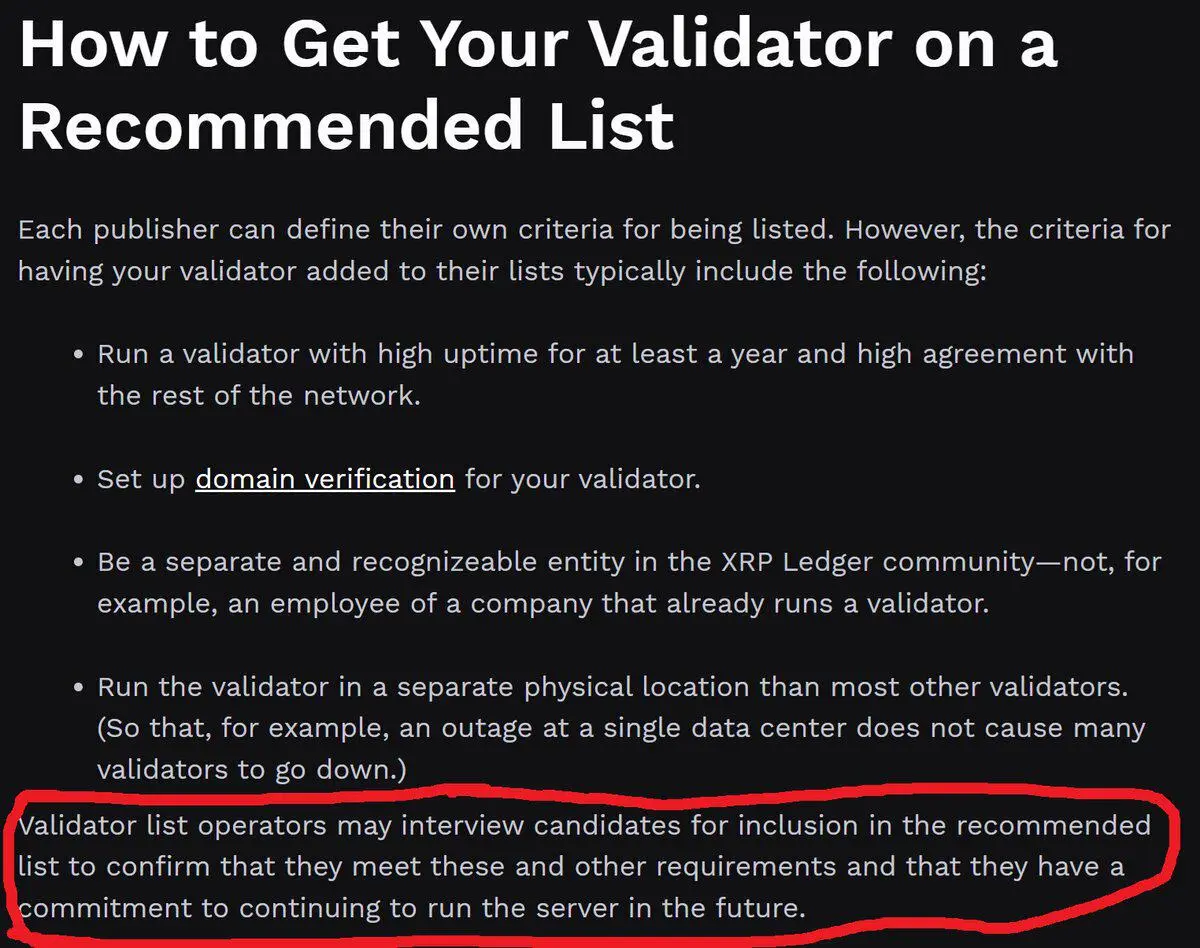
PoA 系统始终有一个中央权威机构来任命验证者。那么,目前有两个「官方」 UNL 列表这一事实又如何呢?这反驳了我关于不同 UNL 无法协调的断言。这就是事情开始变得真正疯狂的地方:

我仔细检查后发现,所有 UNL 实际上是完全相同的,使用相同的验证器集,进一步证明基金会实际上完全控制了 XRP 网络!

这张截图是 2 年前的,但我确认现在情况仍然如此,这证明新的 UNL 无法相互协调。从而基金会的列表成为事实上的列表,因为所有 UNL 都必须遵守,否则就有被分叉的风险。

这也允许基金会在被迫的情况下进行审查,因为他们拥有如此高程度的控制权。这与加密货币的运作方式截然不同,也解释为什么只需要 20% 的验证者就可以停止网络……

运行受信任的验证器也没有任何奖励。与 PoW 或 PoS 不同,其中攻击成本反映了对矿工 / 质押者的区块奖励。这就是为什么去中心化衡量标准与区块奖励高度相关的原因。在 XRP 上,这种去中心化衡量标准为零。

我从早期就开始研究 XRP,我清楚地记得人们认识到了去中心化的权衡。随着社区和领导层的主张变得更加极端,这种情况逐渐发生了变化,我这样说并不是为了贬低投资者,而是为了赋予他们权力。

帮助打破 XRP 回音室并停止成为他人的退出流动性。XRP 的预挖矿率高达 99.8%,这使其成为有史以来最不公平的分配之一,因为没有创建新的 XRP,所有新流通的 XRP 都是从创始人那里购买的。

我一直对早期关于 Ripple 去中心化的讨论很感兴趣,假装 XRP 无需许可并不是正确答案,真正的解决方案在于用 PoS 来取代 UNL 列表,将 XRP 转变为更传统的去中心化区块链。

他们也可以坦白地承认事实就是事实,我不会对此提出异议。但是,用谎言来吸引无知的散户投资者是错误的,这是我们作为一个行业需要划清界限并自我监管的地方!

XRP 目前也许可以贿赂或欺骗 SEC,但他们无法欺骗我们这些加密货币原住民。无论反驳有多复杂和深入,这不会改变一些简单的事实:XRP 现在是完全许可和中心化的。

如果你真的关心 XRP,请认真对待。因为在这篇批评贴文中存在可以帮助 XRP 取得成功的方案:坦白自己的中心化,或是转向去中心化。真相让我们自由,离开 XRP 或施加压力以求改变,没有什么是无法挽回的。


Related Reads

Behind Robinhood's Launch of Its Own Chain, the Beautifully Packaged "Tokenized Stocks" Still Have No Equity Rights

Robinhood has launched "Robinhood Chain," an Ethereum-based Layer 2 built with Arbitrum technology, and introduced "Stock Tokens." This article clarifies that these tokens are not actual on-chain equity. They are tokenized debt securities issued by Robinhood Assets Jersey Limited, offering economic exposure to reference stocks or ETFs but lacking direct ownership, voting rights, or other shareholder privileges. The legal structure is conservative, relying on traditional financial intermediaries, custody, KYC/AML controls, and specific jurisdiction rules, even though the tokens are transferable on-chain. The move is part of Robinhood's broader strategy to evolve from a retail brokerage into a global financial ecosystem, integrating services like banking, retirement, crypto, and DeFi. Robinhood Chain aims to provide a programmable settlement layer, making financial products more portable and accessible while masking underlying complexity. However, the "brokerage chain paradox" lies in balancing a simple user interface with the intricate, regulated reality of the wrapped assets. The success of this model depends on users and regulators accepting this structured approach without misunderstanding the tokens as direct stock ownership. Key components supporting this strategy include the Bitstamp acquisition (expanding institutional crypto capabilities), the Robinhood Wallet (bridging brokerage and self-custody), the Robinhood Earn program (integrating DeFi lending), and the Lighter perpetual contracts platform. While ambitious, the initiative is still early, facing challenges in achieving liquidity, developer adoption, and regulatory clarity across jurisdictions.

marsbit5m ago

Behind Robinhood's Launch of Its Own Chain, the Beautifully Packaged "Tokenized Stocks" Still Have No Equity Rights

marsbit5m ago

Strategy's Accounting Gimmick: The Cap on BTC Sales Far Exceeds $1.25 Billion

The article, originally from Bankless, discusses how MicroStrategy's (MSTR) recent Bitcoin (BTC) sales reveal a much larger potential selling capacity than the widely reported $1.25 billion "reserve-building" cap. On July 7, MicroStrategy disclosed a sale of 3,588 BTC (~$216M) to pay dividends for its STRAT (STRC) preferred shares and replenish its USD Reserve. Crucially, the company stated this sale did not count against its stated $1.25 billion "reserve-building capacity." The analysis explains that MicroStrategy's "BTC Monetization Plan," part of its broader "Digital Credit Capital Framework," actually outlines three main purposes for selling BTC, only one of which has the $1.25B cap: 1. **Building the USD Reserve** (capped at $1.25B). 2. **Covering preferred share/ debt costs** (replenishing the reserve after payments). 3. **Funding buybacks** (up to $10B for preferred shares and $10B for MSTR common stock). The key nuance is the accounting distinction between "building" the reserve (selling BTC before making payments) and "replenishing" it (selling BTC after using reserve funds for payments). While functionally the same—converting BTC to cash for obligations—only "building" counts against the publicized $1.25B limit. This means sales for "replenishing" and the $20B+ buyback pool allow for total potential sales exceeding $30B. The article frames this as part of MicroStrategy's shift from a simple "buy and hold" Bitcoin narrative to an "active capital management" model, where BTC becomes a balance-sheet tool to manage pressures between its common stock, preferred shares, dollar reserve, and Bitcoin holdings. This creates complex trade-offs and potential conflicts of interest. The conclusion warns investors that the $1.25B figure is not a total sales ceiling. Understanding terms like "build," "replenish," and "repurchase" in MicroStrategy's disclosures is now critical, as the company navigates a new, more complex role as an actively managed entity rather than a passive Bitcoin accumulator.

Odaily星球日报20m ago

Strategy's Accounting Gimmick: The Cap on BTC Sales Far Exceeds $1.25 Billion

Odaily星球日报20m ago

The Networking Game in Silicon Valley's Elite Circles: Those with Connections Get $50 Million, While the Truly Talented Can't Raise Money?

"Silicon Valley's Meritocracy to Relationship Game: How Networks Now Trump Talent." The article argues that Silicon Valley has shifted from a meritocracy to a "kingmaker" system where connections and background outweigh true ability. Key factors driving this change include: 1. **AI-Distorted Expectations:** Unprecedented growth curves (e.g., Anthropic) have led VCs to seek only "sure things" or pattern-match against past successes. 2. **Capital Concentration:** LP funds are concentrated in a few large, multi-stage funds, pushing VCs to overpay for hot deals to secure capital. 3. **VC Professionalization:** The industry has become a standardized career path, attracting conformist "NPCs" rather than independent thinkers. The long IPO timeline incentivizes safe, consensus bets for career advancement over risky, fund-returning outliers. This consensus capital fuels consensus founders. Startups are now a standard career option, with accelerators pressuring uniform ideas (e.g., 81% AI). Founders from elite schools (Stanford, OpenAI) easily raise millions based on pedigree, not proof. Large funds preemptively back "centrally cast" teams with $10-50M war chests to dominate categories, sidelining outsiders. The "kingmaker" strategy has downstream effects: it encourages aggressive, sometimes fraudulent, revenue reporting and allows founders to sell significant secondary shares early, attracting grifters. The author predicts a mean reversion. History shows the hottest trends rarely produce the most valuable companies. They advocate backing underestimated outsiders with "a chip on their shoulder" over anointed insiders, believing true meritocracy will ultimately win. "Those chasing the herd are set up for slaughter."

marsbit36m ago

The Networking Game in Silicon Valley's Elite Circles: Those with Connections Get $50 Million, While the Truly Talented Can't Raise Money?

marsbit36m ago

From 2 Million Monthly Active Users to Zero: Zapper's Demise in the "Maturation" of DeFi

From 2M MAU to Zero: The Demise of Zapper in a Maturing DeFi Landscape On July 8, 2026, Zapper co-founder Seb Audet announced the platform's full shutdown. Once a DeFi star with 2 million monthly active users, $13B in processed transactions, and $16.5M in funding, Zapper's journey ends. Born in 2020 from the merger of DeFiZap and DeFiSnap, Zapper rode the "DeFi Summer" wave. It became essential for users to track complex, multi-protocol yield farming positions across chains. At its peak, it supported 14 chains, 450+ protocols, and 7000+ tokens, with its signature "Zap" feature simplifying multi-step DeFi actions. However, sustainable revenue never materialized. Its primary model—taking small fees from DEX aggregation—faced fierce competition and squeezed margins. Meanwhile, maintaining its extensive, real-time data indexing system was costly. Crucially, the DeFi ecosystem matured, with activity and liquidity concentrating in fewer top protocols. The core demand for a complex, multi-protocol dashboard waned as user behavior simplified. Zapper attempted multiple pivots that failed to gain traction: an NFT-based points system (2021), a social app called Chainchat (2023), and plans for a ZAP token and open protocol (2024). These efforts reflected a persistent "blockchain-native" mindset focused on creating new C端 (consumer) needs rather than addressing existing pain points or bolstering its revenue-generating products. The article contrasts Zapper with DeBank, which successfully narrowed its asset-tracking focus while developing Rabby Wallet—a revenue-stabilizing, competitive product. Zapper's story serves as a cautionary tale for tooling projects: over-immersion in a purist vision, coupled with an inability to adapt business models to market shifts—like the consolidation of DeFi activity—can be fatal, even for once-dominant platforms.

marsbit1h ago

From 2 Million Monthly Active Users to Zero: Zapper's Demise in the "Maturation" of DeFi

marsbit1h ago

Trading

Spot
活动图片