В Bernstein связали ралли биткоина с ростом шансов на победу Трампа

cryptonews.ruPublished on 2024-10-15Last updated on 2024-10-15

  • В Bernstein объяснили рост бычьих настроений отрывом Дональда Трампа от Камалы Харрис в президентской гонке.
  • В Standard Chartered отметили перспективы возврата биткоина к ATH до выборов в США.

Скачок цены биткоина обусловлен повышением шансов представителя от республиканцев Дональда Трампа занять кресло президента. К такому выводу пришли в Bernstein, пишет The Block.

Специалисты обратили внимание на высокую корреляцию первой криптовалюты с вероятностью бывшего главы Белого дома одержать победу над соперницей от демократов Камалой Харрис.

Согласно Polymarket, шансы на подобный исход подскочили до 56,6%. В последний раз столь высокое значение наблюдалось в конце июля.
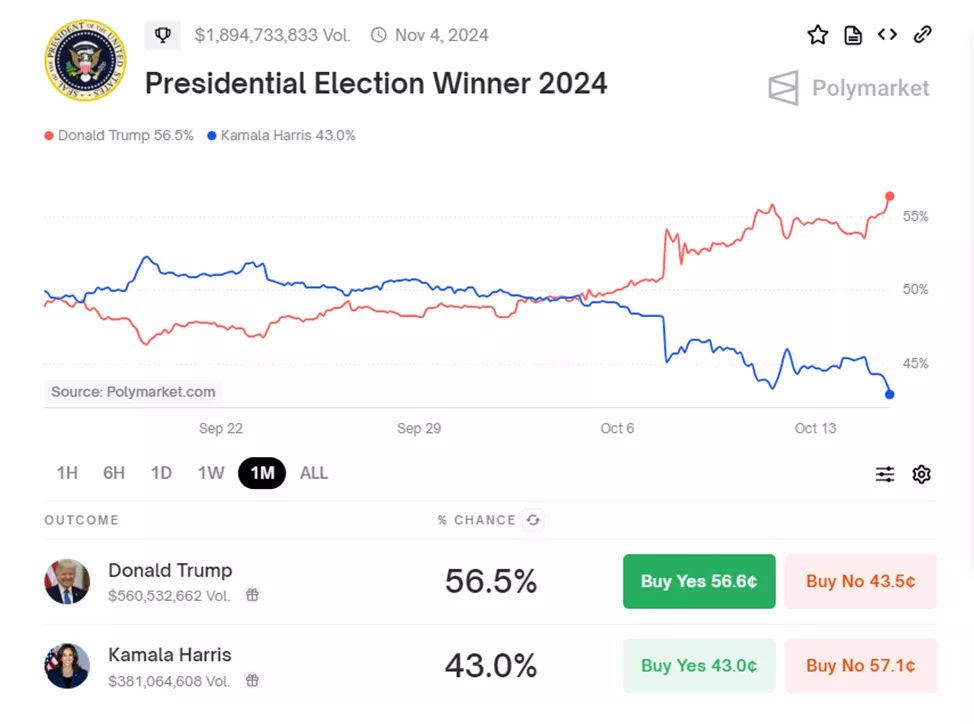
Данные: Polymarket.

«Несмотря на то, что оба кандидата заявляют о поддержке цифровых активов, ставки на криптовалютном рынке сильнее на фоне успехов Трампа в президентской гонке», — прокомментировали специалисты.

Аналитики указали на 78% шансы на победу республиканцев в Сенате и 39% вероятность получения ими большинства в обеих палатах Конгресса.

По их мнению, акции MicroStrategy являются ведущим индикатором потенциального «бычьего» прорыва. С начала года ценные бумаги биткоин-компании подорожали на 191%, в то время как цифровое золото — на 55%.

«MicroStrategy воспользовалась минимумами, выпустив акции и конвертируемый долг, чтобы пополнить резервы в первой криптовалюте, и была вознаграждена за это», — говорится в обзоре.

Курс акций компании достиг пика в марте этого года перед многомесячной фазой коррекции. В отличие от биткоина, котировки уже вышли из боковика и продолжают ускоряться, пояснили эксперты.

Ранее в Bernstein спрогнозировали рост цены цифрового золота к $80 000-90 000 в случае победы Трампа. Смена Джо Байдена на Харрис приведет к откату к $40 000, не изменив долгосрочные позитивные перспективы, добавили аналитики.

Мнение Standard Chartered

В Standard Chartered отметили перспективы возврата биткоина к ATH до выборов в США.

В качестве драйверов специалисты назвали:

  • рост шансов Дональда Трампа на победу;
  • значительный приток средств в спотовые биткоин-ETF;
  • возросшую активность в колл-опционах.

Эксперты обратили внимание на увеличение крутизны кривой гособлигаций США. По их мнению, это является сигналом усиления волатильности рынка и спроса на альтернативные активы вроде биткоина.

Аналитики также отметили потенциал получения MicroStrategy нового потока доходов в виде кредитования в первой криптовалюте. К настоящему моменту компания приобрела 252 220 BTC, включая 7420 BTC в сентябре.

MicroStrategy может стать «биткоин-банком, с продуктами рынка капитала, включая обыкновенные, конвертируемые, привилегированные акции и инструменты с фиксированной доходностью».

Benchmark: MicroStrategy запустит кредитование в биткоине

Согласно Standard Chartered, экосистема цифровых активов становится все более интегрированной в TradFi.

Растущая легитимность наряду с благоприятными политическими событиями может стать попутным ветром для биткоина в ближайшие месяцы. В сценарии проигрыша Трампа, «более широкая тенденция к принятию криптовалют останется неизменной».

Напомним, CEO BlackRock Ларри Финк выразил уверенность в росте стоимости цифрового золота.

Институционалам тут не место. Каков реальный вклад биткоин-ETF в крипторынок

Related Reads

IOSG: Q-Day Countdown, Will Quantum Computing End Cryptocurrency?

IOSG: The Q-Day Countdown – Will Quantum Computing End Cryptocurrency? This analysis explores the looming threat quantum computing poses to blockchain technology. Quantum computers, leveraging Shor's algorithm, could theoretically break the elliptic curve cryptography (ECC) underpinning cryptocurrencies like Bitcoin and Ethereum. The article outlines a hypothetical "Q-Day" scenario where exposed public keys from dormant assets are compromised, leading to fund theft and a deep governance crisis. The core risk is not the complete erasure of blockchains but a systemic reset of public-key cryptography. Bitcoin faces significant challenges due to its "code-is-law" ethos and the immense social consensus required for migration. Its primary vulnerability lies in legacy UTXOs with publicly exposed keys. Ethereum's path involves a more complex, full-stack cryptographic agility upgrade across execution, consensus, and data layers. The industry has a limited "engineering comfort window" of 5-8 years to coordinate a migration to post-quantum cryptography (PQC), such as lattice-based or hash-based signatures. While the existential threat is often overstated, the real bottleneck is the immense coordination required across protocol developers, node operators, wallet providers, exchanges, and custodians. Market repricing of crypto assets may occur well before an actual Q-Day if quantum hardware roadmaps accelerate or regulatory pressure mounts. The article concludes that quantum computing is not a doomsday weapon but a severe stress test for blockchain's foundational security model and governance structures.

marsbit15m ago

IOSG: Q-Day Countdown, Will Quantum Computing End Cryptocurrency?

marsbit15m ago

Why 2026 could redefine Ethereum, Solana, Base and Avalanche

Blockchain infrastructure is undergoing a major coordinated transformation, driven by institutional demand for reliability, compliance, and predictable settlement. Over $30 billion in Real-World Assets (RWA) on-chain has exposed network weaknesses. Major blockchains are responding with foundational upgrades, moving beyond incremental speed improvements. Ethereum's "Glamsterdam" upgrade, planned for H1 2026, will significantly increase gas limits and introduce features like PBS (pre-blocked state) for enhanced settlement and parallel execution. Solana's "Alpenglow," targeting a mainnet launch in H2 2026, focuses on reducing finality time dramatically and freeing network resources to improve reliability. Beyond speed, compliance is critical. Base's "Beryl" upgrade in Q3 2026 will introduce a standardized, regulatory-compliant token framework (B20). Avalanche's "Octane" upgrade aims to boost transaction processing and reduce costs for enterprise applications. Even Bitcoin is evolving with the potential activation of OP_CAT by late 2026/early 2027. The competition is shifting. While technical upgrades are widespread, institutions will ultimately allocate capital based on proven execution, operational resilience, and regulatory compatibility during market stress. Ethereum currently leads in tokenized assets, while networks like Base and Solana are strengthening their institutional offerings. The blockchain that best delivers reliable, compliant, and uninterrupted service is poised to attract the greatest share of future institutional capital.

ambcrypto53m ago

Why 2026 could redefine Ethereum, Solana, Base and Avalanche

ambcrypto53m ago

Tiger Research: Take RWA Tokenization Overseas First

This article discusses the strategic choices facing financial institutions in jurisdictions lacking mature regulatory frameworks for Real-World Asset (RWA) tokenization. With the market growing rapidly, institutions must choose between waiting for local legislation, using regulatory sandboxes, or—the recommended priority—expanding into overseas markets to gain early experience. Successfully launching cross-border RWA tokenization requires meticulous preparation across six key areas: establishing an overseas base (e.g., Hong Kong, Singapore, the U.S.), securing necessary licenses, defining the tokenized asset (with bonds being simpler than non-standard assets), defining the target investor scope, deciding on settlement currencies/payment flows, and designing operational requirements like custody and on-chain governance. The article outlines two primary strategic paths: a direct "onshore" path and a "native on-chain" path. The direct path involves setting up a legal entity and obtaining licenses in a mature jurisdiction like Hong Kong, Singapore, or the U.S., leveraging existing platforms (e.g., DigiFT, Securitize) for efficiency. The alternative native on-chain path involves partnering with compliant, decentralized platforms (e.g., Ondo, Plume Nest) that use structures like offshore SPVs to facilitate tokenization and access DeFi liquidity, offering speed and broader reach but with greater structural complexity. The core argument is that institutions should not wait for perfect domestic regulation. A detailed hypothetical case study illustrates the multi-step, 6-12 month process of launching an overseas tokenized bond. The key takeaway is that the essence of a tokenization business lies not in the technology but in successfully executing the entire sales and operational process. The market is moving forward, and the time to act is now.

marsbit1h ago

Tiger Research: Take RWA Tokenization Overseas First

marsbit1h ago

Trading

Spot
活动图片