Биткоин застыл на уровне $61 000 в ожидании речи председателя ФРС

cryptonews.ruPublished on 2023-08-23Last updated on 2024-08-23

Рынок криптовалют замер в ожидании ключевого макроэкономического события недели. Курс биткоина вернулся к отметке $61 000 накануне ежегодного симпозиума Федеральной резервной системы США в Джексон-Холе.
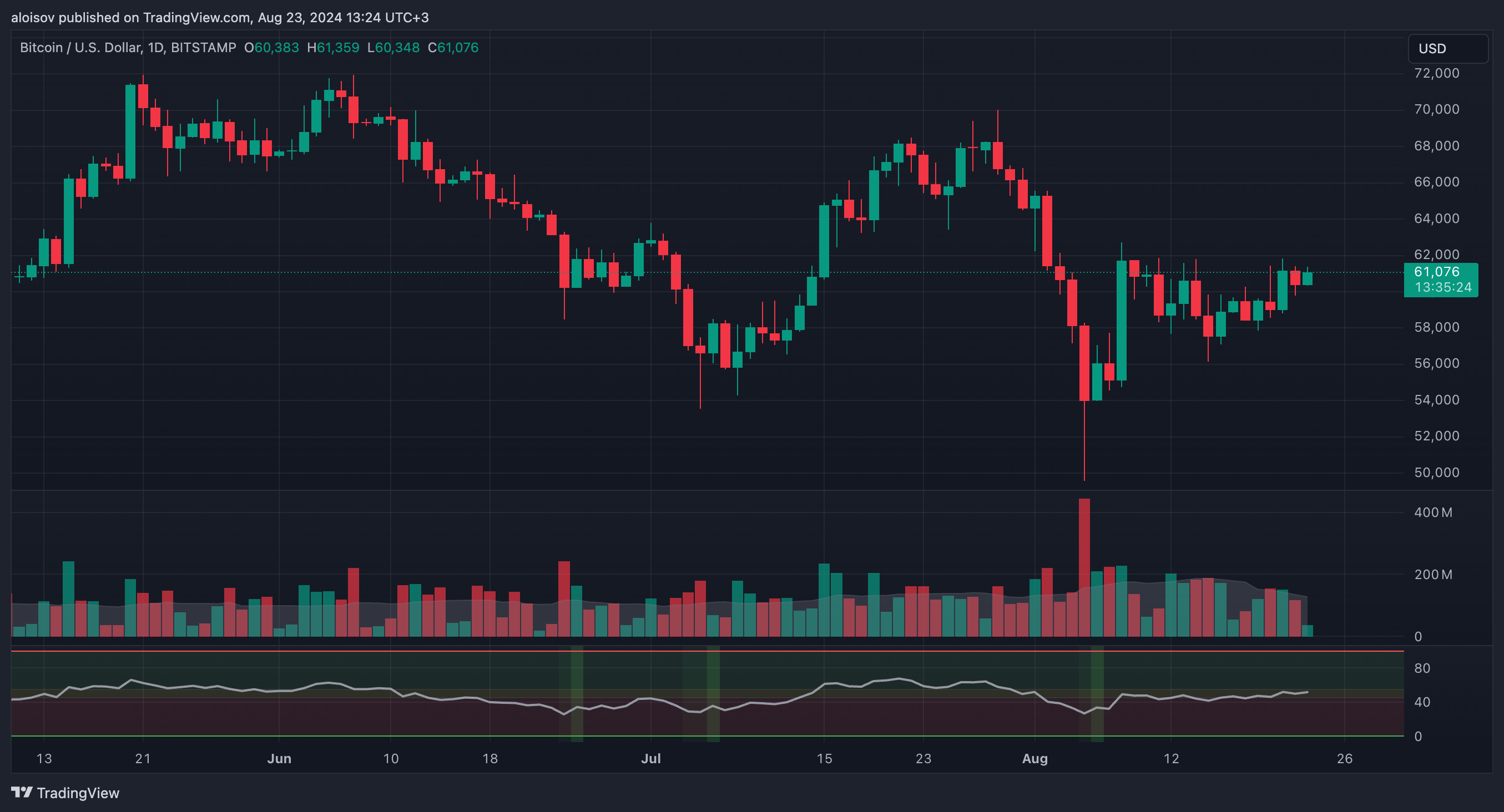
1-дневный график BTC/USD. Источник: Bitstamp/TradingView

Выступление Пауэлла как ключевой фактор

Главное внимание участников рынка приковано к речи председателя ФРС Джерома Пауэлла (Jerome Powell), запланированной на 17:00 по московскому времени. Трейдеры внимательно следят за сигналами о возможном смягчении денежно-кредитной политики.

По данным скринера инструмента Fedwatch Чикагской товарной биржи, рынок по-прежнему оценивает вероятность снижения процентных ставок в сентябре как 100%. Это может стать мощным бычьим фактором для криптовалют и других рисковых активов.

«Вопрос уже не в том, будет ли ФРС снижать ставки, а в том, на сколько — на 25 или 50 базисных пунктов в сентябре», — отметили аналитики The Kobeissi Letter.

Согласно последним данным инструмента FedWatch от CME Group, наиболее вероятным сценарием считается снижение ставки на 0,25%.
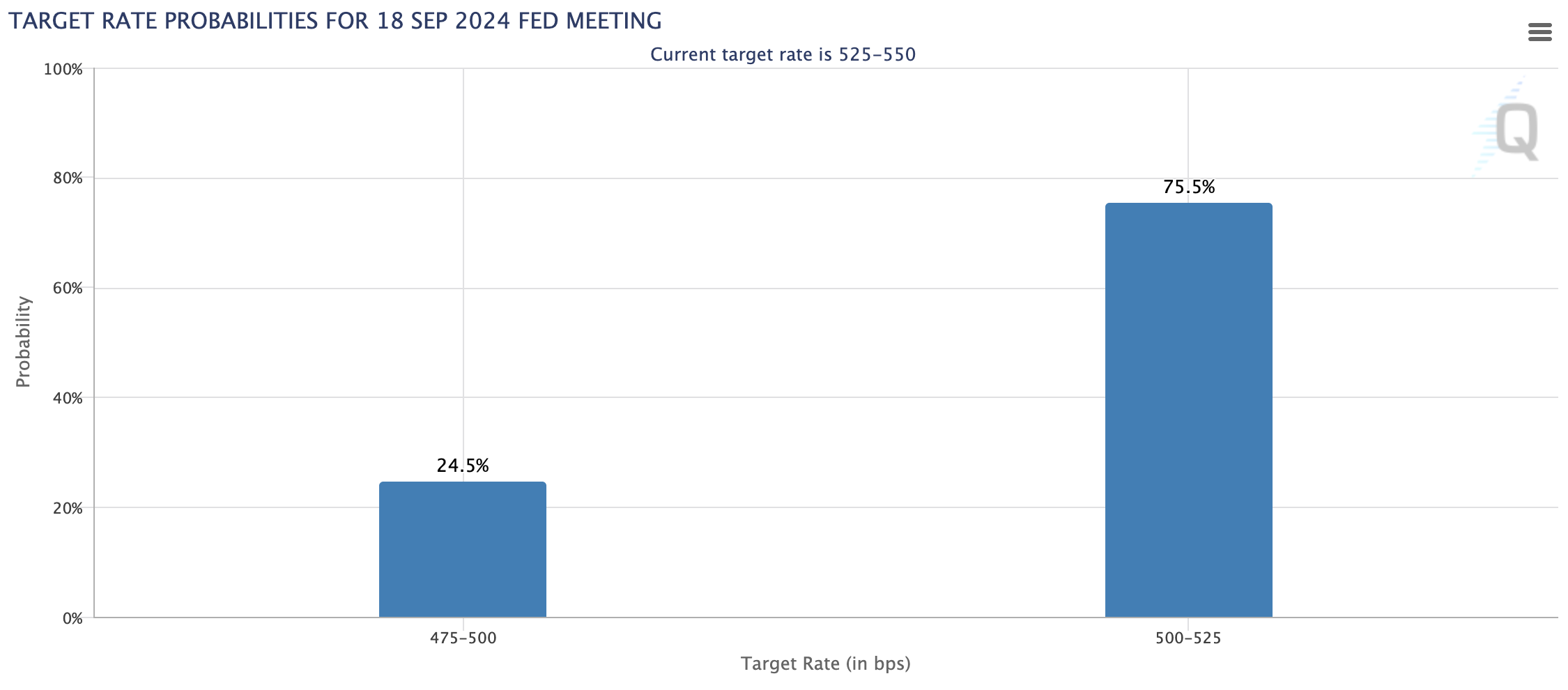
Вероятность снижения ставок ФРС США в сентябре. Источник: Fedwatch

Влияние снижения ставок на биткоин

Несмотря на то, что снижение ставок обычно способствует росту ликвидности на рынке рисковых активов, исторические данные показывают, что реакция курса биткоина может быть неоднозначной.

Трейдер Люк Мартин (Luke Martin), анализируя поведение BTC во время последнего цикла снижения ставок в 2019 году, отметил:

«В прошлый раз, когда ФРС снижала ставки в 2019 году, это совпало с небольшим снижением цены. Затем последовал крах из-за Covid, снижение ставок до нуля и бычий рынок, подпитываемый печатным станком».
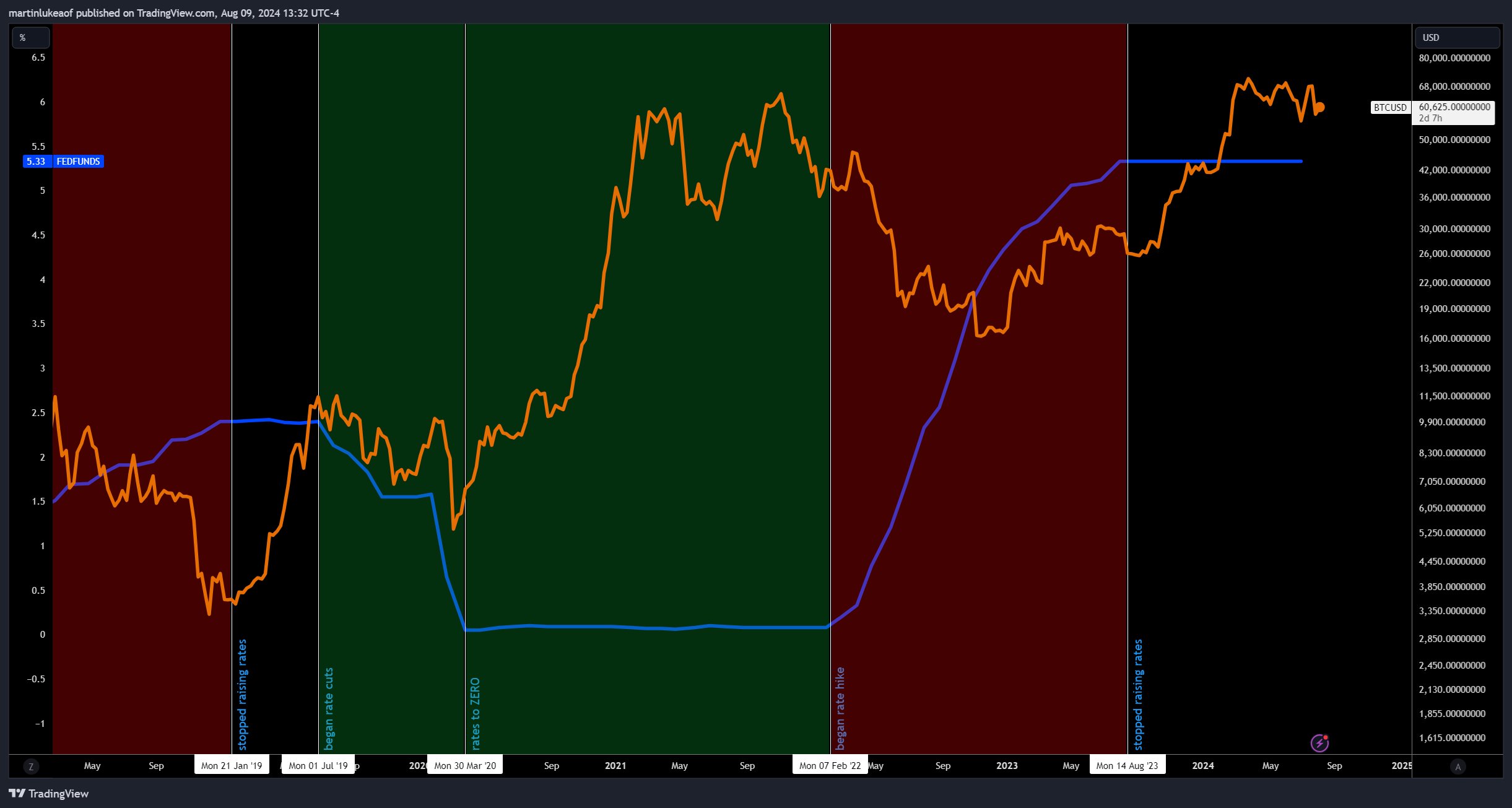
Сравнение курса биткоина с уровнем ставок ФРС. Источник: Люк Мартин

Техническая картина BTC

Курс BTC/USD продолжает двигаться в узком диапазоне с ключевым уровнем сопротивления около $62 000. По данным CoinGlass, на уровне $61 435 сформировался дополнительный блок ликвидности по заявкам на продажу.
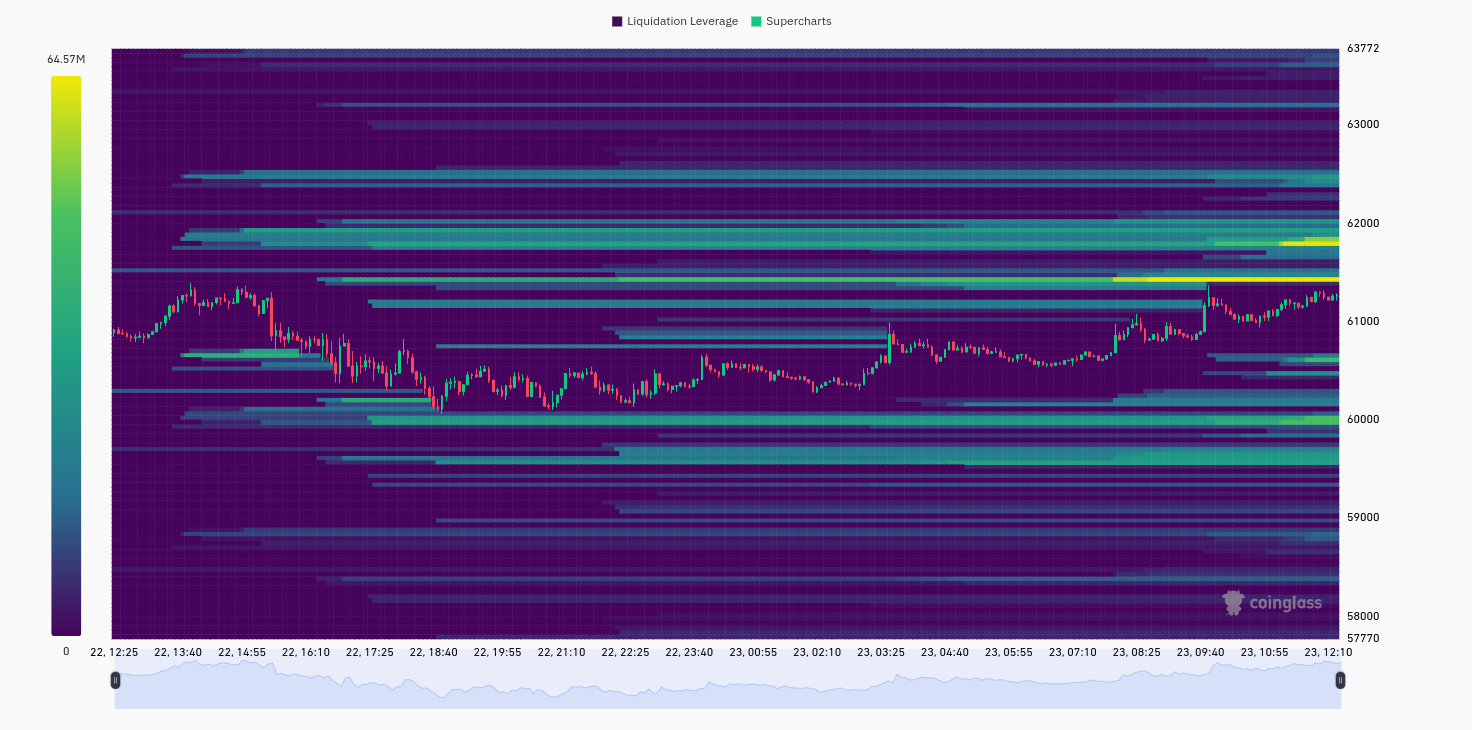
Карта ликвидаций позиций по биткоину. Источник: CoinGlass

«Текущая ситуация на рынке биткоина не указывает на чрезмерно оптимистичные настроения трейдеров или избыточное использование заемных средств для открытия длинных позиций», — прокомментировал ситуацию создатель аналитического ресурса Checkonchain, известный под псевдонимом Checkmate.

На 4-часовом графике BTC/USD пытается преодолеть сопротивление в виде 200-периодной экспоненциальной скользящей средней (EMA200). Популярный трейдер Elja прогнозирует:

«Закрепление выше этого уровня приведет к росту биткоина до $64 000-$65 000. Если произойдет откат, ожидайте консолидации».
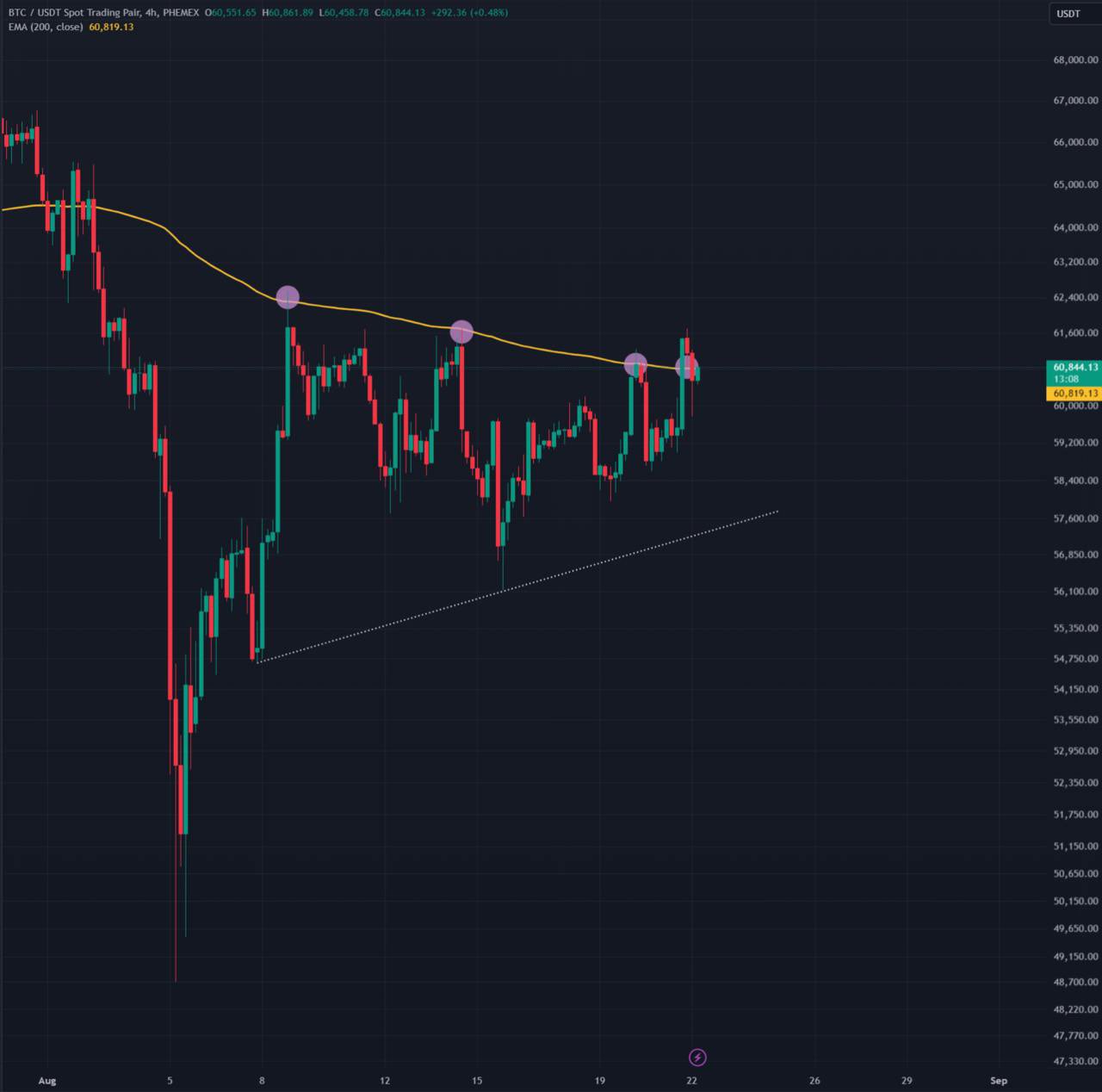

4-часовой график BTC/BUSDT и EMA200. Источник: Elja

Related Reads

Introduction to the Concept of World Models: A Story from Psychology to the Main Battlefield of AI

**World Models: From Psychology to AI's Core Concept** "World model" is a trending but often confusing term in AI, describing a system that allows machines to internally simulate, predict, and rehearse potential outcomes before taking real-world action—like a mental "sandbox." While definitions vary—Yann LeCun emphasizes physical understanding, OpenAI's Sora is a video-based "world simulator," Google DeepMind's Genie 3 creates interactive 3D environments, and companies like Alibaba and Tesla focus on practical applications—the core goal is consistent: reduce reliance on vast real-world data by creating an internal, predictive model for safer and more efficient AI. The concept has deep roots, tracing back to psychologist Kenneth Craik (1943). In AI, it was revitalized by researchers like David Ha and Jürgen Schmidhuber (2018). Major technical approaches include: 1) generative video models (e.g., Sora) for visual realism; 2) abstract predictive models (e.g., LeCun's JEPA) for efficiency and physical reasoning; and 3) explicit 3D simulators (e.g., NVIDIA Omniverse) for precision. Fei-Fei Li proposes a classification based on the AI action loop: renderers (output observations), simulators (output world states), and planners (output actions). The emerging "World Action Model" (WAM) paradigm aims to unify future prediction and action generation. An industry framework is forming: upstream (data, compute, sensors), midstream (general and vertical platforms), and downstream applications (autonomous driving, robotics, gaming, etc.). Autonomous driving is currently the most mature use case. The current lack of a unified definition reflects the field's early, dynamic stage, similar to past tech revolutions. Different approaches—focusing on pixels, physics, or behavior—represent parallel explorations of how best to compress and understand the world. This diversity, while seemingly chaotic, signals that world models have moved from an academic idea to a critical industrial battleground, ultimately aiming to give machines the ability to understand, imagine, and reason about the world.

marsbit26m ago

Introduction to the Concept of World Models: A Story from Psychology to the Main Battlefield of AI

marsbit26m ago

Building the Bright Path While Secretly Crossing Chencang: Is Walsh Paving the Way for a September "Rate Cut"?

The title "Building the Plank Road Openly While Secretly Crossing at Chencang: Is Walsh Paving the Way for a September 'Rate Cut'?" suggests Federal Reserve Chair Kevin Walsh's hawkish stance may be a deliberate smokescreen. Academy Securities analyst Peter Tchir argues in a report that markets, currently pricing a 75% chance of a September hike, are missing a potential path to a September rate cut that Walsh himself might be quietly preparing. Tchir posits that Walsh's hawkish rhetoric aims to suppress long-term yield risks (with the 10-year Treasury yield falling recently) while creating room for a narrative shift based on upcoming data. The potential political endgame, according to this view, could be rate cuts in September and October, ahead of the midterm elections. This hinges on a political logic where the Trump administration's preference for lower rates remains unchanged. A core part of Tchir's argument involves redefining inflation metrics. He contends the Fed under Walsh may deprioritize the PCE index, criticizing its lagging components like Owners' Equivalent Rent (OER). Instead, he points to alternative, more real-time indicators like the New Tenant Repeat Rent Index (NTRR) and the Truflation daily index, which shows core inflation around 1.45%. He suggests the Fed could shift its data narrative to justify policy easing. Furthermore, Tchir downplays AI-driven inflation fears. He argues that consumer price sensitivity, evidenced by negative market reactions to price hikes (e.g., Apple), contradicts persistent inflation narratives. He also separates AI/data center spending—which he sees as relatively rate-insensitive—from broader consumer affordability issues, implying rate hikes are misdirected. Based on this analysis, Tchir sees a re-pricing of rate cut expectations as likely, creating opportunities in short-duration Treasuries. He maintains a neutral-to-slightly-bullish view on the long end of the yield curve. For equities, he recommends a significant overweight in energy (especially global nuclear assets) and, within defense/security themes, an overweight in biotech/pharma versus an underweight in semiconductors, expressing caution on AI/data center valuations.

marsbit52m ago

Building the Bright Path While Secretly Crossing Chencang: Is Walsh Paving the Way for a September "Rate Cut"?

marsbit52m ago

"King of Shilling" Hayes Strikes Again, This Time Setting His Sights on Deribit

On June 29, BitMEX co-founder Arthur Hayes acquired approximately 6.16 million SYN tokens via OTC platform Flowdesk, valued at around $2.2 million. Subsequently, Hayes publicly endorsed SYN on X, calling it one of the most asymmetric investments he's seen since HYPE and declaring it time for an on-chain options DEX to challenge industry leader Deribit, naming Hypercall as that challenger. The article details the evolution of the Synapse Protocol, originally launched in 2021 as a cross-chain messaging and liquidity network. While its TVL peaked above $1 billion during the last bull market, it has since declined. The protocol's team has since built Hypercall, an on-chain options trading platform on Hyperliquid's HyperEVM, which supports trading options on "any asset" with features like 24/7 trading and defined risk limited to the premium paid. Deribit, founded in 2016, is highlighted as the dominant centralized crypto options exchange, commanding roughly 85% market share in BTC and ETH options. Its strengths include deep liquidity and professional tools, though it faces critiques over custody risk, KYC requirements, and regulatory uncertainty. The analysis suggests Hypercall's potential lies in decentralization, permissionless access, and transparency, potentially carving a niche in DeFi-native and emerging asset options. However, it faces significant challenges competing with Deribit's established network effect and liquidity depth. The piece concludes by noting Hayes's recent and mixed "call" history, referencing his previous promotion and subsequent sale of HYPE, as well as a controversial price target report for CARDS from his family office, Maelstrom, which was followed by a significant price drop for the asset. This activity has drawn criticism, with some accusing Hayes of creating exit liquidity for his followers.

Foresight News1h ago

"King of Shilling" Hayes Strikes Again, This Time Setting His Sights on Deribit

Foresight News1h ago

Trading

Spot
活动图片