Analyst Coverage – Maple Finance and the Evolving Onchain Lending Market

Token TerminalPublished on 2024-07-14Last updated on 2024-08-23

Analyst coverage – Research from analysts using Token Terminal

This research piece has been authored by Victor Adeleke from Maple Finance.

Victor is Community Lead at Maple Finance where he focuses on growth strategy and communications for Syrup protocol. Previously, Victor worked as Research Manager at BECO Capital, a Web2/Web3 venture fund focused on the MENA region. Victor’s background in research includes analysis of private market investments at CB Insights and in marketing and consumer behavior while attending the Wharton School at the University of Pennsylvania.

Maple Finance is a DeFi lending protocol, facilitating secured lending for institutions. The team consists of experienced engineering, fintech, and traditional finance executives, who leverage a deep understanding of the secured lending business and smart contract infrastructure to create new opportunities for lenders and borrowers.

Maple: https://maple.finance/
Blog: https://maple.finance/category/all
X (Twitter): https://x.com/maplefinance
Victor’s LinkedIn: https://www.linkedin.com/in/victoradeleke/
Victor’s Twitter: https://x.com/VictorAdeleke_

Executive Summary

  • Token Terminal data reveals market dominance and a concentration of liquidity around Aave in the DeFi lending sector, with competing DeFi protocols experiencing growth challenges in comparison.
  • In contrast, Maple, a DeFi lending protocol that facilitates direct lending to crypto-native institutions, has experienced substantial growth in active loans, pointing to growing institutional demand for onchain credit.
  • Maple’s newest product, Syrup, will provide this diversified source of yield for the wider DeFi ecosystem.

Introduction

Maple Finance’s institutional debt market matches lenders with high-yield credit opportunities backed by overcollateralized loans.

Founded in 2020, Maple has introduced multiple product offerings alongside its core direct lending product, including tokenizing US Treasuries to provide ‘real-world’ yield to onchain protocols. Today, the company is introducing Syrup - a DeFi protocol granting permissionless access to its institutional debt market.

While Maple is a relatively small player in the wider DeFi lending ecosystem, Token Terminal data reflects a growth story that reveals rising institutional demand for onchain credit.

The larger ecosystem

A quick look at the twenty largest protocols in the DeFi lending ecosystem over the last six months reveals high concentration of active loans on Aave. Aave has facilitated more than 60% of active loans at the time of writing - followed by MakerDAO (dba Spark Protocol - 13%), Morpho Labs (9%), and Compound (7%).

In contrast, Maple Finance’s $119.9M in active loans represents just under 1% of the total active loans among leading protocols.
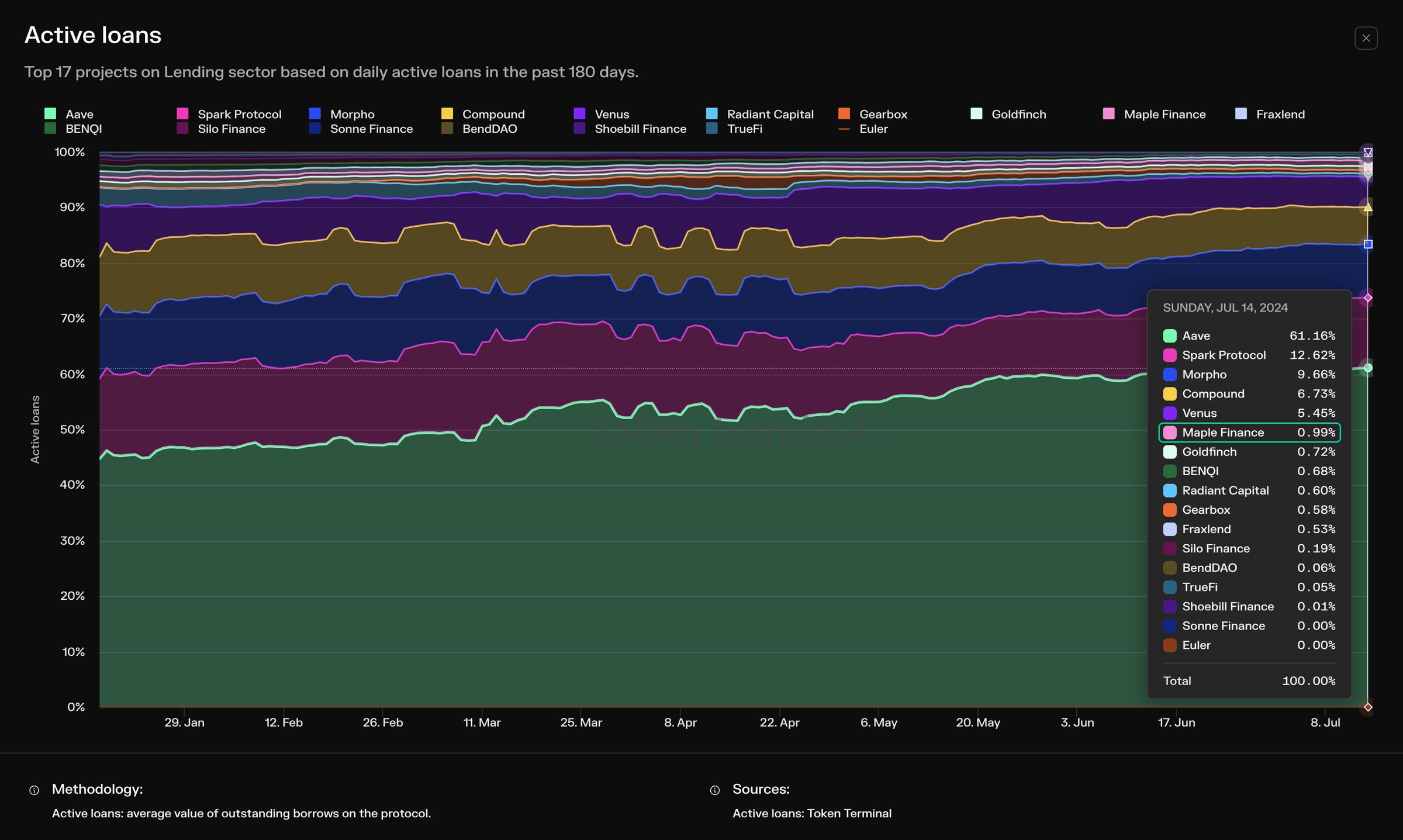
Top projects in the Lending market sector based on daily active loans in the past 180 days, by %-share.

TVL figures reflect a similar disparity. This growing concentration of liquidity is also supported by Aave’s interoperability with several DeFi ecosystems across multiple chains.
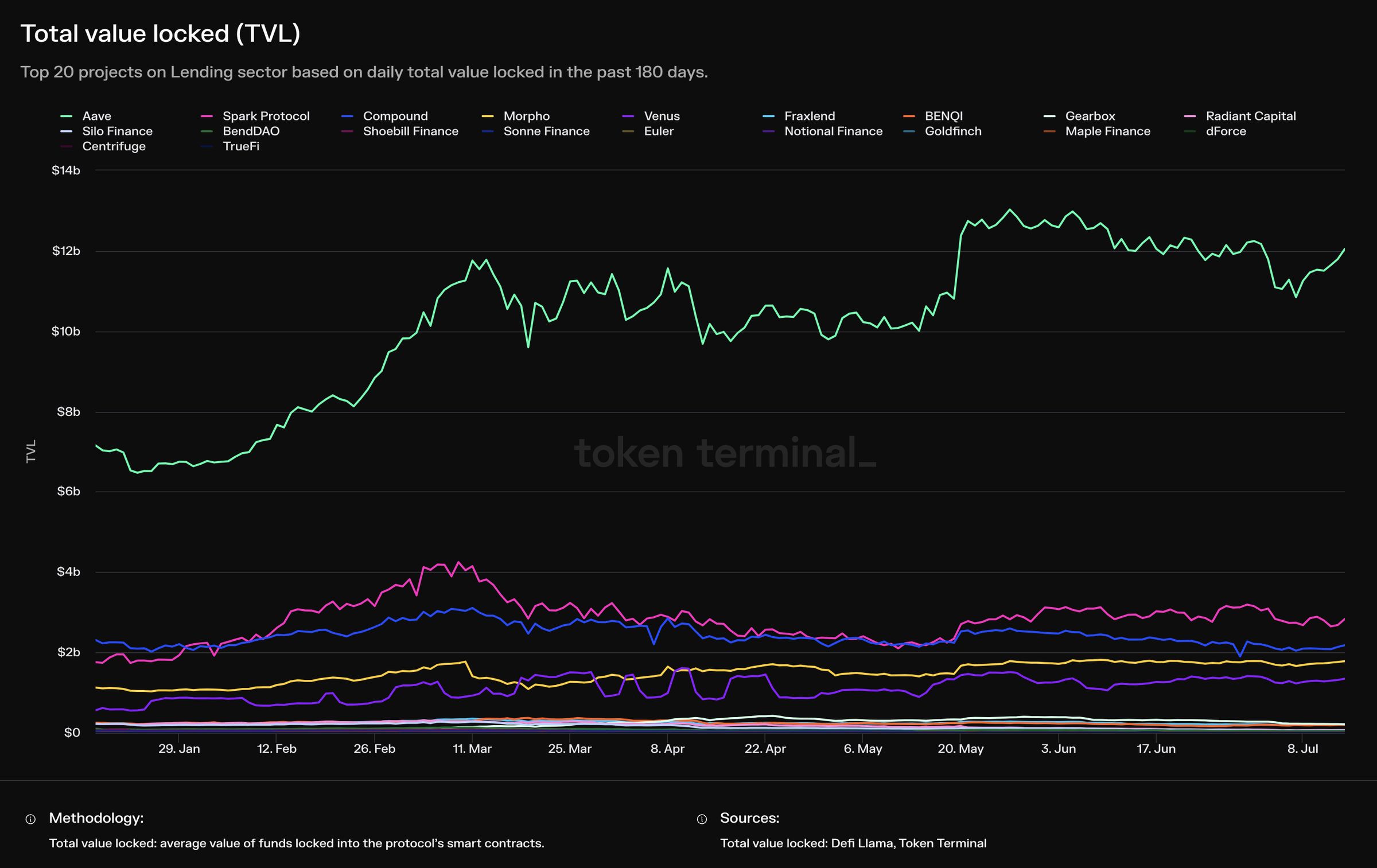
Top projects in the Lending market sector based on daily total value locked (TVL) in the past 180 days.

A Shifting Landscape

Digging into Token Terminal data reveals two important trends in the DeFi lending sector:

  • Growth in active loans to retail borrowers concentrating on Aave
  • Growth in active loans to institutional borrowers concentrating on Maple

While Aave’s active loans (visualized below) grew 2x over the last six months, many of its closest competitors have only experienced mild growth or declined precipitously.
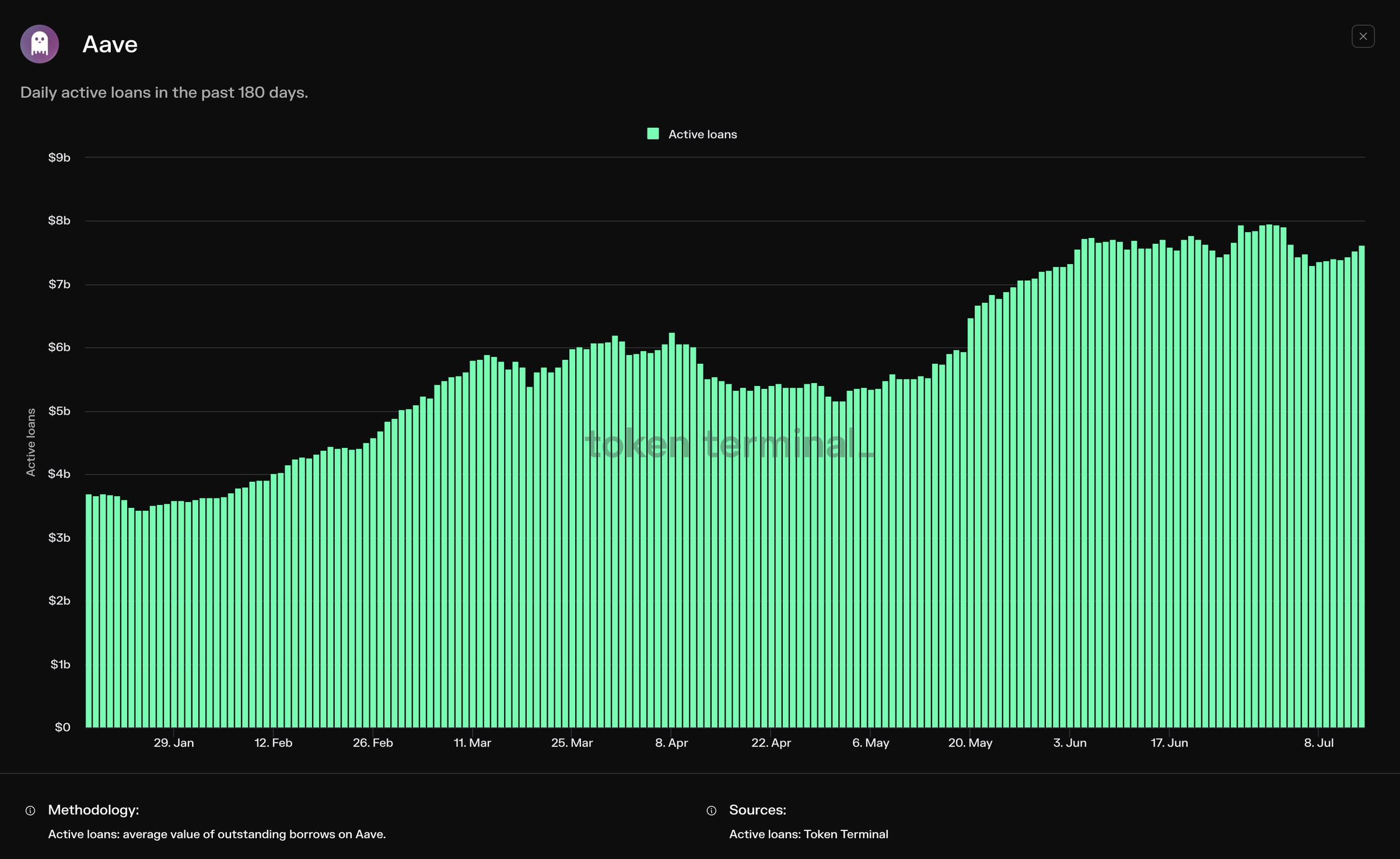
Daily active loans on Aave in the past 180 days.

To illustrate further, seven of the twenty largest lending protocols experienced double-digit percent declines in active loans over the last 30 days.
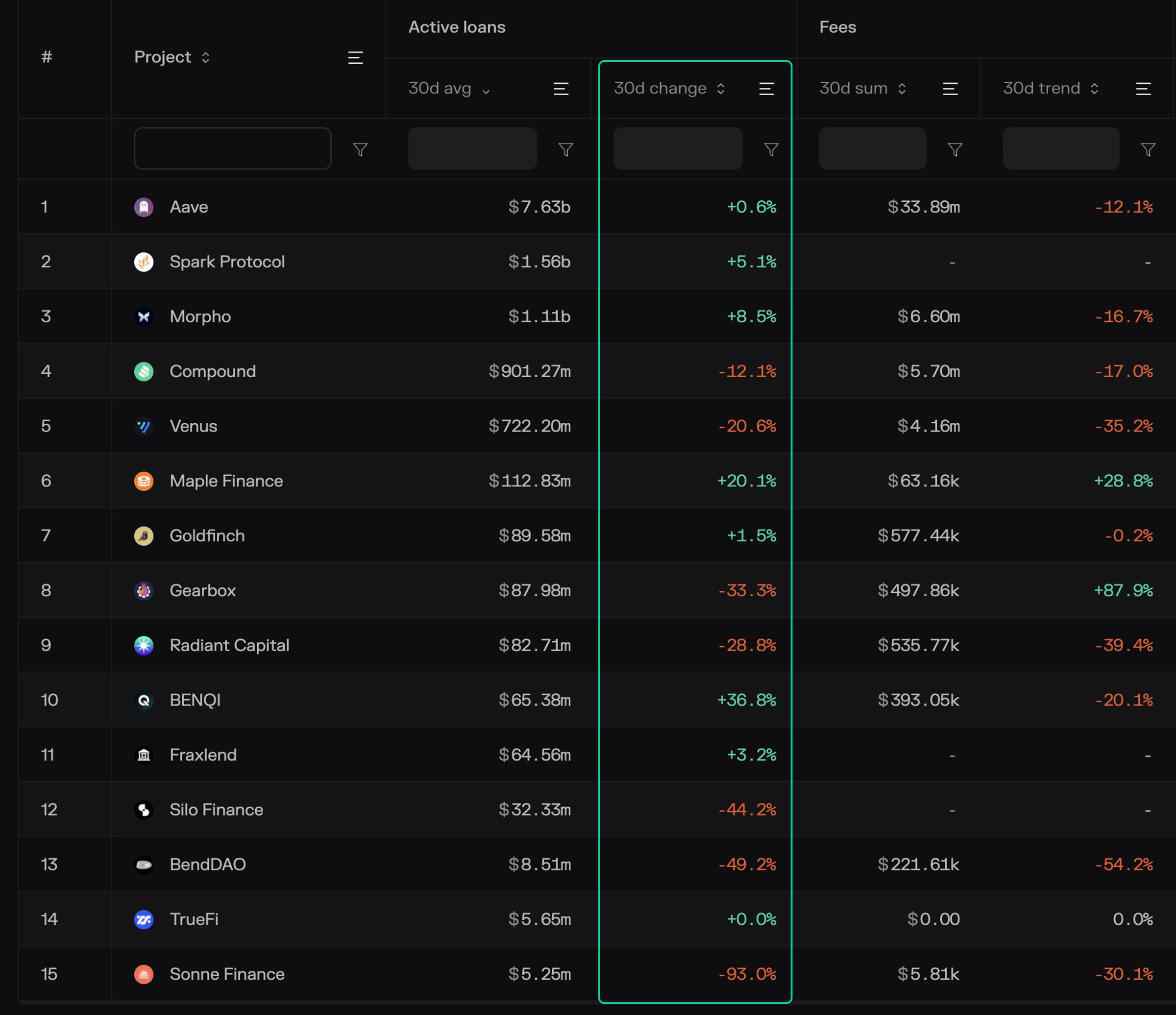
30-day change in active loans for top projects in the Lending market sector.

Meanwhile, Maple has experienced nearly 2x growth in active loans during the same six-month period (see below). Notably, these loans are overcollateralized loans to institutions, rather than to retail borrowers.
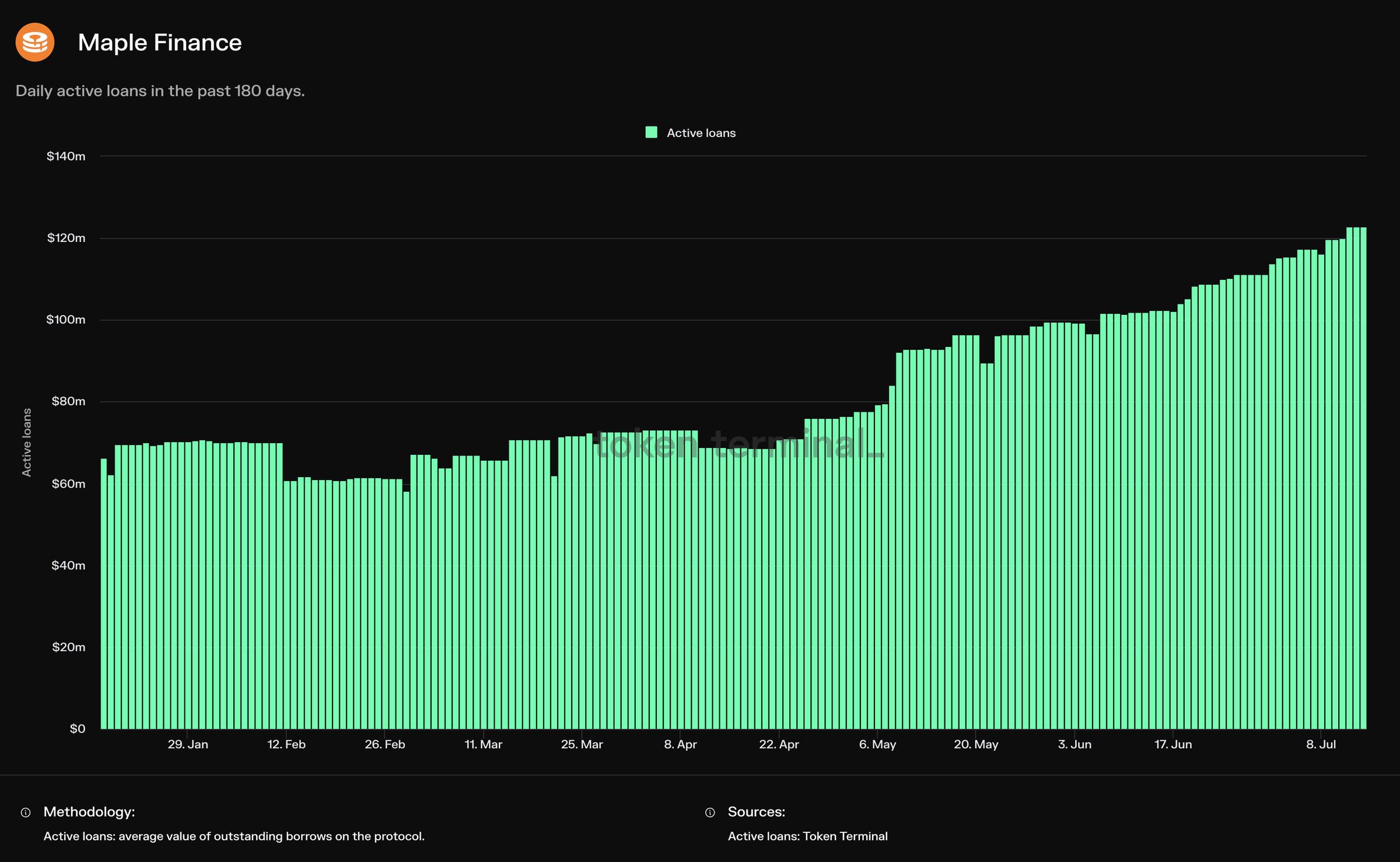
Daily active loans on Maple in the past 180 days.

Further, the protocol’s 20% growth in active loans over the last 30 days outpaced all of the 20-largest lending protocols in DeFi.

Growth in Maple’s debt marketplace, with accredited investors offering dollar stablecoin deposits on one side and institutional borrowers depositing crypto collateral on the other, signals that both institutional borrowers and high net-worth individuals are attracted to the prospect of crypto-native liquidity and yield. As such, Maple TVL has risen demonstrably, reaching $276M at the time of writing - a 3x increase over the last six months.

A substantial share of the growth in TVL comes from Maple’s High Yield Secured pool (consisting of loans backed by select altcoins) and Blue Chip Secured pool (consisting of loans backed by BTC and ETH).

As DeFi natives seek this alternative form of yield, Syrup protocol has also contributed to growth in Maple TVL. Syrup leverages the same smart contract infrastructure and network of institutional borrowers as Maple, which for the past year has consistently produced higher yields than comparable protocols (such as Aave v3 USDC) and offers both diversification and sustainability in the DeFi lending market.

During its early access period, Syrup reached $25M in TVL in less than one month and currently offers more than 18% APY on USDC deposits (compared to 5-7% for USDC deposits on Aave v3).

Leading up to the launch of the SYRUP token, Syrup is also offering rewards to lenders, known as Drips.


Conclusion

Overall, the DeFi lending market data reflects a confluence of trends: a liquidity moat around the largest lending protocol, stagnation or decline in TVL for protocols with a similar offering, and the early signs of interest in onchain credit from tier-1 institutional borrowers.

Maple is expected to continue playing a role in meeting this institutional demand through its secured lending product and passing on this yield to DeFi natives through Syrup.


Analyst’s Disclosure: Author(s) may own cryptoassets named in this article and/or are core contributors to the project(s) being covered.

The authors of this content, or members, affiliates, or stakeholders of Token Terminal may be participating or are invested in protocols or tokens mentioned herein. The foregoing statement acts as a disclosure of potential conflicts of interest and is not a recommendation to purchase or invest in any token or participate in any protocol. Token Terminal does not recommend any particular course of action in relation to any token or protocol. The content herein is meant purely for educational and informational purposes only, and should not be relied upon as financial, investment, legal, tax or any other professional or other advice. None of the content and information herein is presented to induce or to attempt to induce any reader or other person to buy, sell or hold any token or participate in any protocol or enter into, or offer to enter into, any agreement for or with a view to buying or selling any token or participating in any protocol. Statements made herein (including statements of opinion, if any) are wholly generic and not tailored to take into account the personal needs and unique circumstances of any reader or any other person. Readers are strongly urged to exercise caution and have regard to their own personal needs and circumstances before making any decision to buy or sell any token or participate in any protocol. Observations and views expressed herein may be changed by Token Terminal at any time without notice. Token Terminal accepts no liability whatsoever for any losses or liabilities arising from the use of or reliance on any of this content.

Stay in the loop

Join our mailing list to get the latest insights!

Email
Sign up

Related Reads

Former SpaceX Engineer Reconstructs Financial Execution System Using First Principles

Former SpaceX engineer Lex Li applies "First Principles Thinking" to financial infrastructure with Plan Execution Lab, recently raising angel funding at a $50M post-money valuation. The team argues that the core function of finance is capital allocation, and the critical gap is not in trading but in execution, which remains highly manual and fragmented. While assets, liquidity, and settlement have migrated on-chain, execution workflows (monitoring, risk management, liquidity coordination) are still human-native. In an era of accelerating AI agents, strategy decay is rapid, shifting the competitive edge from having the best strategy to having the most robust execution network. Plan Execution Lab introduces two core components: 1. **PlanX**: A Financial Execution Protocol designed as infrastructure for the migration from CEX to DEX, providing on-chain execution capabilities, liquidity access, risk management, and capital orchestration. 2. **Xgent**: An Autonomous Financial Runtime. Users define investment intents, risk preferences, and constraints; Xgent automatically constructs an execution graph, verifies it, and handles ongoing execution and optimization—streamlining the process from Intent to Autonomous Execution. The long-term vision is to create the "Bloomberg Terminal for Autonomous Finance"—a shared operating environment and execution network built collectively by participants like execution nodes, liquidity providers, and autonomous agents. The future of finance, they contend, belongs not to isolated algorithms but to open, collaborative execution networks.

marsbit13m ago

Former SpaceX Engineer Reconstructs Financial Execution System Using First Principles

marsbit13m ago

Former SpaceX Engineer Reconstructs Financial Execution System from First Principles

Plan Execution Lab, a financial infrastructure project founded by former SpaceX engineer Lex Li, has raised angel funding at a $50M post-money valuation. The startup is applying "first principles thinking" from Li's SpaceX experience to rethink financial market execution. Their analysis posits that while assets, liquidity, and settlement have moved on-chain, the execution layer remains fundamentally human-dependent and fragmented. In the era of AI Agents, strategy advantages decay rapidly, shifting the competitive edge from isolated algorithms to robust **execution networks**. Plan Execution Lab's solution is a two-part system: **PlanX**, a Financial Execution Protocol designed to facilitate the migration from centralized exchanges (CEX) to on-chain markets by providing core on-chain execution capabilities; and **Xgent**, an Autonomous Financial Runtime. Xgent allows users to define investment goals and constraints, then autonomously constructs and manages the execution logic—moving from **Intent to Execution Graph to Verification to Autonomous Execution**. The long-term vision is to create the "Bloomberg Terminal for Autonomous Finance"—an operating environment not for humans, but for agents and execution nodes. The future financial system, they argue, will be a collaborative network built by diverse participants contributing execution capabilities, not secret strategies. The core competition will shift to who builds the most powerful and adaptive execution network.

链捕手14m ago

Former SpaceX Engineer Reconstructs Financial Execution System from First Principles

链捕手14m ago

First Long-Horizon Doc2Repo Training Dataset: Code Agents Move Beyond Bug Fixing and Begin Creating Repositories

With the advancement of LLM Code Agents, the research focus is shifting towards long-horizon, real-world tasks, moving beyond simple bug fixes to full repository generation. To address this, researchers from Renmin University of China introduced the DeNovoSWE dataset. This dataset focuses on long-term software engineering tasks, specifically the "document-to-repository" challenge—generating an entire, executable code repository from a task description. The DeNovoSWE construction method employs a Divide & Conquer approach. It breaks down target repositories into core capabilities and uses a multi-agent Draft-Critic-Repair workflow to automatically generate high-quality, evaluation-aligned task documents. The dataset also implements difficulty-aware filtering to balance quality and diversity. The result is a high-quality, anti-leakage dataset of 4,818 instances. Experiments show that models trained on DeNovoSWE achieve significant improvements in long-horizon repository generation. For instance, Qwen3-30B-A3B-Instruct's performance on the BeyondSWE-Doc2Repo benchmark increased from 5.8% to 47.2%, and on NL2RepoBench from 4.3% to 23.0%. Similar gains were observed with stronger backbones, demonstrating that dedicated long-horizon training data is crucial for advancing Code Agents from maintainers to architects capable of planning and building complete software projects from scratch.

marsbit29m ago

First Long-Horizon Doc2Repo Training Dataset: Code Agents Move Beyond Bug Fixing and Begin Creating Repositories

marsbit29m ago

Even CZ Praised Hyperliquid as 'Awesome', But Its Biggest Moat Might Also Be Its Biggest Risk

In an episode of Galaxy Brains, Binance founder CZ praised Hyperliquid as "awesome" but clarified that while its product is strong, Binance cannot compete in its specific niche due to Hyperliquid's no-KYC, decentralized model. CZ noted he would not personally operate such a model, highlighting the inherent legal and compliance risks tied to its access advantage. The discussion underscores a core market structure conflict: on-chain perp platforms like Hyperliquid thrive on open, low-barrier access, which regulated exchanges like Binance cannot replicate without abandoning their global compliance posture. However, this very advantage makes Hyperliquid a clear target for regulatory scrutiny. The UK FCA has already issued a warning against Hyperliquid for potentially offering unauthorized services to UK users, framing it as a financial services provider rather than neutral infrastructure. Historical cases like the CFTC's action against bZeroX and Ooki DAO further illustrate that regulators may pursue decentralized structures if they facilitate leveraged trading for retail users without proper controls. Meanwhile, regulated venues like Cboe are developing US-compliant "continuous futures" that mimic perpetual exposure, narrowing the product gap. Hyperliquid's long-term edge may increasingly hinge on its access model—the very feature most exposed to regulatory pressure. The key question is whether its "access premium" can withstand escalating legal challenges as on-chain perps gain mainstream attention.

marsbit47m ago

Even CZ Praised Hyperliquid as 'Awesome', But Its Biggest Moat Might Also Be Its Biggest Risk

marsbit47m ago

Trading

Spot
Futures
活动图片