Q2矿业公司研报:为何大矿商融资需求猛增?

币界网Published on 2024-08-16Last updated on 2024-08-16

币界网报道:

来源:BlocksBridge Consuling;编译:邓通,

到目前为止,已有 13 家在美国上市的矿业公司公布了其第二季度的收益,揭示了一个共同的主题:对现金流的需求并没有放缓。根据 TheMinerMag 的计算,这种紧迫性是由比特币哈希价格的状态所驱动的,在减半后,比特币哈希价格并没有产生有意义的现金流。为了缓解这种情况,一些公司也再次转向债务融资。

13 家公司中的 9 家——Bitdeer、Bitfarms、Cipher、CleanSpark、Core、HIVE、Marathon、Riot 和 Terawulf——在第二季度通过各种股票发行计划共筹集了 12.5 亿美元。Iris Energy 尚未公布其收益,但据报道,其在第二季度通过市场发行筹集了 4.58 亿美元。

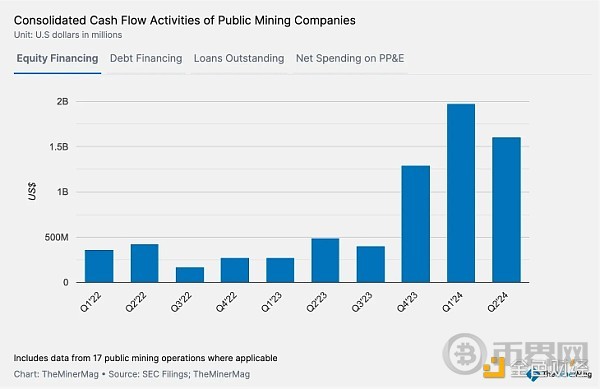
基于此,TheMinerMag 的仪表板显示,自减半以来的第一季度,大型矿业公司通过股权融资筹集了超过 16 亿美元,到目前为止,第三季度又筹集了 5.3 亿美元。

AcrY5MAOPKqpa0vaST0HzvRxqvb3tZkaFBqQPOgq.jpeg

虽然这一数字没有打破第一季度矿业上市公司通过股票发行筹集近 20 亿美元的记录,但值得注意的是,自第二季度以来,可转换票据和资产支持贷款再次增加。

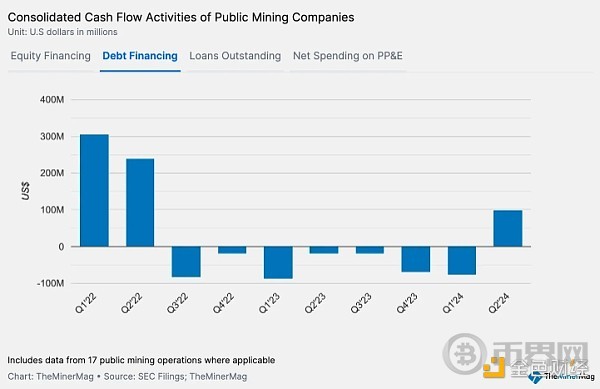
根据 TheMinerMag 的仪表板,自 2022 年熊市开始以来,在 Luna 崩盘期间,上市公司的债务融资总额一直为负值,这表明它们在过去两年中努力去杠杆。

虽然许多公司在第二季度继续去杠杆化,但它们的债务融资总额却转为正值,因为 Hut 8 没有通过股票发行筹集任何资金,而是通过 Coatue 票据获得了 1.5 亿美元的收益。

AkrkVSny32zSCDThp3fjgfv1a0xWOGS3uxyVh0zx.jpeg

此外,在过去一周,我们看到 Marathon 和 Core Scientific 发行了总额为 7 亿美元的可转换票据。在 Core 的案例中,新的可转换票据是债务重组努力的一部分,用较低利率的票据取代现有债务。对于 Marathon 来说,可转换票据主要用于从市场上购买更多比特币。CleanSpark 在其第二季度文件中披露,它已与 Coinbase 达成信贷协议,以比特币作为抵押品。Canaan 表示,它在第二季度承诺了 530 比特币,以获得为期 18 个月、总额为 1920 万美元的定期贷款。

考虑到比特币的哈希值低至 43 美元/PH/s(这是在今天调整了 4.2% 的难度之后),这几乎令人惊讶。

Related Reads

Lowering Expectations for BTC's Next Bull Market

The author, Alex Xu, explains his decision to significantly reduce his Bitcoin holdings (from full to ~30% of his portfolio) during the current bull cycle, citing a lowered long-term outlook for BTC's price appreciation in the next cycle. He outlines six key reasons for this reduced expectation: 1. **Diminished Growth Drivers:** The narrative of exponential user adoption has largely played out with institutional ETF adoption. The next major growth phase—adoption by sovereign national reserves or central banks—seems unlikely in the near future. 2. **Personal Opportunity Cost:** More attractive investment opportunities have emerged in other assets, such as undervalued companies. 3. **Industry-Wide Contraction:** The broader crypto industry is struggling, with most Web3 business models (SocialFi, GameFi, DePIN) failing. This overall萧条 (depression) reduces the fundamental demand and consensus for Bitcoin. 4. **Strain on Major Buyer:** MicroStrategy, a major corporate buyer of BTC, faces rising financing expenses for its debt, which could slow its purchasing rate and create significant marginal pressure on the market. 5. **Increased Competition from Gold:** The emergence of "tokenized gold" has closed the functional gap (portability, divisibility) between physical gold and Bitcoin, offering a strong competitor in the non-sovereign store-of-value space. 6. **Security Budget Concerns:** The block reward halving continues to exacerbate the long-standing issue of funding Bitcoin's network security, with new fee source explorations like Ordinals and L2s largely failing. The author's decision to hold a significant (though reduced) position reflects a cautious, not bearish, outlook. He remains open to increasing his exposure if the fundamental reasons for his skepticism change or if new positive catalysts emerge.

marsbit31m ago

Lowering Expectations for BTC's Next Bull Market

marsbit31m ago

Can Iran 'Control' the Strait of Hormuz?

Iran has announced a comprehensive plan to assert control over the strategic Strait of Hormuz, a critical global oil shipping chokepoint. The proposed measures include requiring all vessels to obtain Iranian permission for passage, imposing fees for security, environmental protection, and navigation management—preferably paid in Iranian rials—and absolutely banning Israeli ships. Vessels from countries deemed hostile by Iran’s top security bodies may also be barred. Analysts suggest Iran’s motives are multifaceted: increasing pressure on the U.S. and Israel by leveraging control over oil transit to influence global prices and inflation; creating a new revenue stream, potentially exceeding $7.7 billion annually, to counter Western sanctions and support postwar reconstruction; and using transit permissions as bargaining chips in future negotiations, notably with the U.S. However, the plan faces significant practical and diplomatic challenges. Enforcing comprehensive interception and fee collection in the busy waterway, patrolled by international military forces, would be difficult. The U.S. has already countering with a blockade of Iranian ports and threats to intercept any ship paying fees, potentially strangling Iran’s oil exports and fee revenue. Broad international opposition, led by European and Gulf states, and legal controversies further complicate implementation. The proposal may ultimately serve more as a negotiating tactic than a feasible policy, with its execution remaining highly uncertain.

marsbit1h ago

Can Iran 'Control' the Strait of Hormuz?

marsbit1h ago

Trading

Spot
Futures
活动图片