从1000到1亿美元,你需要做对这些事

Web3动向Published on 2024-01-30Last updated on 2024-01-30

Abstract

随着整个行业市值的膨胀,大家的财富规模应该也经历了变动。在个人财富增长的旅程中,哪个阶段是您认为最为艰难的?并请分享是什么原因让这一阶段变得如此挑战。
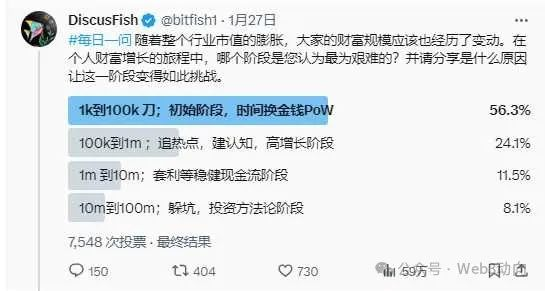
随着整个行业市值的膨胀,大家的财富规模应该也经历了变动。在个人财富增长的旅程中,哪个阶段是您认为最为艰难的?并请分享是什么原因让这一阶段变得如此挑战。

之前微博炸了,搬运下 N 年前在微博上写给新手的建议:在区块链行业如何从 1000 刀的本金赚到 1 亿刀?

10 万美元以内: 多学习,多动手

刷核心赛道 DeFi 项目的空投;

刷热门 NFT 项目的白名单 mint;

此阶段需要花费大量时间获取信息,分析研究判断潜力项目,执行力一定要强,坚持不懈薅羊毛。

10 万美元 -100 万美元

不要杠杆炒币,不要玩合约;

在新的公链和 L2 上,按照时光机法则找到潜力的项目,低价获取筹码;

找到属于你的十倍币。

100 万美元 -1000 万美元

选择你的币本位 BTC 或者 ETH 等,深入研究;

适当交易,不要做空,不要做空,不要做空!

灵活使用低杠杆的 DeFi 借贷协议,提高资金利用率,可以使用类似 dydx 这样的平台,交易同时获取到 token 奖励。

多观察,多套利, 坚持币本位,追求币本位的增长;

不要贪图参与每一个热点,赚每一分钱,通过套利 staking 等获取稳定现金流;

心态稳定,淡然处之,财富水平能否突破,剩下交给时间和行业发展。

1000 万美元 -1 亿美元

一旦资产超过一个小目标,改善下家人生活,多读书多健身,改变下个人认知和圈层;

拿住核心资产不踩大坑的前提下,追求低风险稳定增值和良好的现金流;

不要玩合约,不要创业,注意避免入坑;

保持一定的币本位资产不踏空;

保持一定的稳定币资产获取稳定的现金流。同时应对生活中突发情况,暴跌时候也可以有子弹抄底;

拿 10-15% 资产投投自己看好的赛道,让自己有事可做,同时也能防止自己手贱。

我刚入圈的时候就反复看过神鱼的这篇《在区块链行业如何从1000刀的本金赚到1亿刀》,还存在了手机相册里,那时候我刚读研一,带入币圈的本金不到五万元,今天看到这条推特还是挺感慨的。这几天有很多朋友都分享了财富增长的经验,我也斗胆借此机会讲讲自己的看法。

首先最重要的一点,我认为是找到自己擅长或是感兴趣的赛道,当然能两者兼得是最完美的。例如你组织能力强或者动手能力强就去撸空投,对游戏数值和策略比较了解就去研究链游,擅长估值分析和投研就去炒山寨,币圈的赛道非常多,吃透其中一条对绝大部分人而言已经足够。高倍合约等杠杆率太高的方式我是从来不碰的,也不建议大家接触。

对我自身而言,比较强的能力是快速地获取信息、分析决策并且执行操作,同时我对市场热点也有不错的敏感度,所以自然而然地选择了链上一级这条赛道,现在也有很多人称其为1.5级。它的定义很广泛,例如NFT、土狗币、铭文等其实都可以纳入,核心是在相对早期的阶段接触项目,从而获得成本较低的筹码,但又不同于私募等回报周期通常较久的形式。

链上一级的优缺点都很鲜明,在对项目大致判断正确的前提下,这种玩法具有极高的盈亏比,但也正因为接触项目处于早期,又带来了更大的不确定性和风险。从收集信息、做出分析再到执行操作这三个步骤,每一步的失误都可能带来结果的巨大差异。接下来更具体地分享我的经历,以下单位为CNY。

1万~10万:以小博大、见好就收

可以泛指所有在币圈没有投入较大本金的情况,对小资金来说,追求年化几个点的稳定收益没有太大意义,平时大家也总打趣说“是来币圈翻身的,不是翻倍的”,所以这一阶段要尽量寻找潜在倍数高、前期投入小的项目,我在21年的时候是参与BSC上的土狗币,同样道理但更符合当下币圈生态的例如铭文新协议、SOL土狗币等,或者一些投入成本较小的撸毛项目,殊途同归。

一些朋友可能认为资金少所以一定要死拿到百倍千倍才卖,但是我有不同看法,小资金意味着低容错率,在这一阶段更重要的是获利出本,及时止盈,只要你的路径是对的,一定可以把雪球越滚越大。那些靠拿住一个币暴富的故事往往是幸存者偏差,新闻稿可以从1000个人中选出一个成功者大书特书,而不会提及剩下的999个失败者。

10万~100万:对所在的赛道有一定的深度了解

2021年年底的时候我发现只要持有几个平台的代币就可以获得打新额度,而这些打新项目通常开盘就有几十倍,所以我把大部分资金用于买入GAFI、Redkite、Poolz等平台的代币,剩下的就是不断参与打新并在开盘不久后卖出,而这种造富效应又带动平台币价上涨,又吃又拿,我在进圈三个多月的时候赚到了第一个一百万。

时至今日,信息传播的速度越来越快,这种简单粗暴的左脚踩右脚已经很难持续下去,而且质量不错的项目通常都会选择有各类筛选和风控机制的打新平台。不过如果把我那段经历背后的逻辑抽象出来,那么依然是通用的,也就是在自己最熟悉的赛道经过钻研后找到一些存在信息差的机会,投入适当的仓位,静待开花结果。

100万~1000万:深度、宽度和高度

客观来说,个人资产超过千万在国内已经远超绝大部分人了,所以没必要把这当做一个很大的目标或者压力,一切平常心看待。

想要度过这一阶段,我总结了三种方式,分别对应深度、宽度和高度,做到其一即可。第一个是把资金容量足够的机会研究透,第二个是在自己所处赛道形成规模化,第三个是早于大部分人看到了引领市场的赛道。

先说深度,单项目千万收益听起来很夸张,大家听闻比较多的应该是Blur第二季空投名列前茅的几位大哥。当然,刷Blur毕竟对技术、资金量都有要求,时间周期也长达几个月,很多人可能根本没有意识到更夸张的是去年10月的NFT碎片化平台代币FLC、去年12月的BTC NFT节点猴和今年1月的BTC二层代币SAVM,都是能在1周甚至1天内将100万转化为1000万的项目,对于分析足够透彻并且敢上仓位的人是实实在在可以做到的,而这还仅仅是短短过去3个月内的部分机会而已。

再说宽度,也就是在自己擅长的赛道形成规模化,可以是通过铺人力和高效的组织管理形成的,对应的机会例如Sui打新,也可以是借助代码和工具实现的,例如NFT图狗早期大部分人还在前端手搓的时候,用脚本合约批量Mint就是降维打击,收益也是成倍增长。不过宽度的扩张是存在边际效益的,一方面是每个项目的资金容量都有限,利润并不是完全跟随规模的扩大而扩大,另一方面是随着某个赛道上扩大规模的玩家越来越多,财富效应就逐渐被稀释了。

最后是高度,通过精准的判断和敏锐的嗅觉在极早期介入某个赛道的龙头标的,然后充分享受赛道扩大的胜利果实,随风起舞,例如21年的链游和今年的铭文。这也是我个人认为难度最大的一种方式,因为不仅要求有极强的判断力,更需要敢为天下先的勇气,某个赛道在极早期的时候要么无人问津,要么备受嘲讽,能在这种情况下耐得住寂寞的投资者才能守得云开见月明,我想只要见证过PEPE、ORDI和TIA发展历程的朋友都深有体会,正是这3个曾经被百般嫌弃的标的开启了2023年的Meme、铭文和模块化这三大标志性叙事。

这也引出了另一个重要话题,就是赛道的选择,一般情况下在币圈还是得追逐热点,玩新不玩旧,两个各方面水平相同的人,假如在2023年的下半年一个选择了NFT赛道,另一个选择了铭文赛道,他们最终的收益率肯定是云泥之别,大部分人最终所能拿到的结果还是依托于市场的红利,要学会顺势而为。

此外,在这个阶段还可以适当扩大一下自己的接触面,敢于拿小仓位试错各个赛道,说不定收获的经验在日后就成了宝贵的财富。也可以分配一定比例的资金去参与各类相对稳定的打新机会,给自己配置安全垫的同时也一定程度形成了现金流。

最后就是做好风险控制和仓位管理,尤其在牛市,账面财富其实分文不值,没有落袋为安之前都是虚的,有太多牛市风光一时熊市回撤严重甚至倾家荡产的例子,不多赘述。

1000万~1亿:

还在摸索,争取早日再做分享,希望与大家顶峰相见。

Trending Cryptos

Related Reads

Weekly Editor's Picks (0613-0619)

Weekly Editor's Picks (0613-0619): Market Insights & Analysis This weekly digest curates in-depth analysis often lost in the information flow, focusing on key insights across macro trends, investment, and technology. **Macro & Geopolitics:** With the Strait of Hormuz reopening and military conflict shifting to negotiation, markets are pivoting from "war shock" to "supply restoration." Trades include shorting crude risk premiums, longing airlines/tourism, Asian energy importers, and bond duration, while shorting inflation expectations. LNG, fertilizer, and chemical chains are also being repriced. **Investment & VC:** Ray Dalio advises against betting on concentrated AI giants dominating indices, advocating for diversified portfolios of high-quality, low-correlation assets instead. Analysis covers the 4-year crypto cycle, predicting the core surviving product by 2029 will be asset trading markets. Current BTC metrics suggest a potential bottoming zone, presenting a patient accumulation window. SpaceX's high-profile IPO at a $2.1T valuation faces scrutiny over fundamentals, with key watchpoints being its likely inclusion in the Nasdaq index and Q2 earnings. Concerns are raised about potential "gamma squeeze" and systemic risks if its narrative-driven valuation gets amplified by passive index funds. Robinhood (HOOD) is noted for breaking its high correlation with crypto, bolstered by its stock trading and new underwriting business. **Web3 & AI:** A warning highlights ~$1.8T in off-balance-sheet AI infrastructure commitments (purchase commitments, leases) as a potential systemic risk if AI monetization lags. AI models are being used for World Cup predictions, adding a new layer for betting markets. A cost breakdown of a $20 AI subscription reveals the supply chain from model companies to cloud, GPUs, and power. **Prediction Markets:** The emergence of prediction market "concept stocks" is noted, with Robinhood developing its own platform, Rothera, signaling a shift from market competition to a "channel war" for user access. **CeFi & DeFi:** The SpaceX IPO tested perpetual contract mechanisms for pre-IPO assets, highlighting challenges in handling corporate actions like stock splits on-chain. The de-pegging of STRC (Strategy's preferred share) to ~$89 reflects market concerns over MicroStrategy's capital structure and BTC-backed leverage model. BlackRock's covered-call Bitcoin ETF (BITA) offers yield but caps upside, appealing to yield-seeking institutions. **Ethereum:** An opinion piece argues Ethereum's core strength is its vast developer community and composability, solidifying its role as the default operating system for the financial internet. **Weekly Hot Topics:** Include the US-Iran deal reopening the Strait of Hormuz, Fed's hawkish hold, Anthropic restricting model access, SpaceX acquiring Cursor, and a humorous stock surge for "Liuliumei" due to its "LLM" ticker.

marsbit4m ago

Weekly Editor's Picks (0613-0619)

marsbit4m ago

Alliance's Co-Founder's Letter to Entrepreneurs: Written on the Occasion of Cursor's $60 Billion Sale

In this letter to entrepreneurs, Alliance reflects on the success of Cursor's $60 billion sale to Elon Musk, using it as a case study to counter the misconception that opportunities in crowded fields like AI or crypto are exhausted. The piece argues that great companies like Cursor, Stripe, Figma, and Shopify are not built by geniuses with perfect ideas, but by founders who start with a non-consensus belief about the future and build for years before that future becomes obvious to everyone. They identify long-term shifts, find overlooked entry points, and execute relentlessly. The framework for success involves: 1. **Identifying your place in the technology cycle**: Early-stage opportunities focus on making new tech usable for power users (e.g., Coinbase, Cursor). Later-stage opportunities involve finding the "yin" to an existing "yang"—the blind spots of first-generation players (e.g., Stripe vs. PayPal, Figma vs. Adobe). 2. **Cultivating unique insights**: Immerse yourself deeply in the market. Use every product, talk to users, and build an audience. Insights will emerge naturally from deep engagement. 3. **Finding a "hair-on-fire" problem**: Look for a 10x improvement or a severe, urgent pain point. The strongest signal is people already building clumsy workarounds. 4. **Building a focused MVP**: Don't just add features because you can. Ask why users would abandon their current tool for yours. The best startups rarely force new behaviors; they improve familiar workflows with drastically lower friction. 5. **Winning a distribution channel**: Distribution is often the moat. Before product-market fit, achieve channel-market fit. Find where your customers are and build an engine to reach them, even through unscalable, manual efforts initially. 6. **Persistence**: The final, unteachable ingredient is resilience. Success stories like Cursor, Airbnb, and Nvidia involved years of grinding, rejection, and perseverance when the path forward seemed unclear. The conclusion is that there is no secret. Most people fail to consistently execute these steps over the long term. The few who do build the companies that define the next era. The world is yours to create.

链捕手9m ago

Alliance's Co-Founder's Letter to Entrepreneurs: Written on the Occasion of Cursor's $60 Billion Sale

链捕手9m ago

Crypto Miners' Big AI Gamble: Valuations Enter Differentiation Stage, Comeback Fight Proves Tough

Crypto Mining Firms' AI Bet: Valuation Divergence and a Challenging Transformation Facing declining profitability in crypto mining, mining companies are pivoting to AI infrastructure, capitalizing on their existing power resources, land, and data center expertise to offer GPU compute power. This transition narrative has boosted their stock prices significantly, with firms like Hut 8 and Bitfarms seeing gains over 100% year-to-date, far outpacing Bitcoin. This has led to a market valuation split, with pioneers like CoreWeave reaching a $62.8B market cap, while others remain below $5B. The market currently prioritizes growth potential over short-term profits, which remain under pressure due to heavy capital expenditures for AI build-outs and crypto asset volatility. However, the transformation is a high-stakes gamble. Bitcoin mining profitability is shrinking, with the average production cost around $63,707 and miner margins contracting. While AI offers a more lucrative long-term path, it requires massive investment—estimated at a $500B near-term funding gap. Success now hinges on execution: delivering on contracted power capacity, securing quality tenants like major cloud providers, and managing the immense financial burden. The valuation focus is shifting from mere power capacity to project delivery, future cash flows, and tenant quality, making this a difficult but critical turnaround attempt.

链捕手18m ago

Crypto Miners' Big AI Gamble: Valuations Enter Differentiation Stage, Comeback Fight Proves Tough

链捕手18m ago

Analysis of the Latest Portfolio Adjustment by the "Top Player" in the U.S. Stock Market: $9 Billion Short on NVIDIA, Shifting Focus to Power and Memory Sectors

AI investor Leopold Aschenbrenner has made a significant portfolio shift, taking a $9 billion nominal short position against top AI infrastructure stocks like NVIDIA, ASML, and Oracle. Simultaneously, he is redirecting capital towards what he sees as the next critical bottlenecks in the AI boom: power, memory, and data center networking, alongside private investments in AI model companies like Anthropic. This move is interpreted not as a call that the AI bubble has burst, but as a rotation within the infrastructure stack. The analysis highlights NVIDIA's recent $25 billion bond issuance as a potential signal, questioning why a cash-rich company would seek external debt despite high profits and increased dividends/buybacks. The core investment thesis is that the initial, crowded "picks and shovels" trade in semiconductors is maturing. The next wave of capital is expected to flow into the physical and logistical constraints of AI expansion: electricity supply, memory chip capacity, data center construction, and enabling technologies like optical networking (fiber) for high-bandwidth communication, where copper remains crucial for short distances. Aschenbrenner's substantial (approx. 20% of fund) private stake in Anthropic is noted as a key part of his strategy—investing directly in the "mine" (AI models) rather than just the "shovels." The discussion concludes that while certain segments may be overvalued, the overarching AI infrastructure demand driven by real product usage remains robust. The most promising long-term investments are seen in essential, non-sexy infrastructure—particularly energy and power companies—whose demand is viewed as a global constant irrespective of AI's cyclicality.

marsbit39m ago

Analysis of the Latest Portfolio Adjustment by the "Top Player" in the U.S. Stock Market: $9 Billion Short on NVIDIA, Shifting Focus to Power and Memory Sectors

marsbit39m ago

BIT Research: Liquidity is Disappearing, Will Bitcoin Replay the Bottoming Pattern of 2022?

The crypto market is currently in an adjustment phase driven by policy expectations and liquidity shifts. Despite a brief rebound fueled by geopolitical easing and SpaceX's strong IPO performance, unexpectedly hawkish signals from new Fed Chair Kevin Warsh have removed anticipated easing support. Concurrently, stablecoin liquidity is shrinking, with insufficient new capital inflows, pushing the market into a typically quiet summer period. Pricing lacks catalysts for a sustained rally. Daily trading volume has significantly contracted, stablecoin growth has slowed markedly, and the supportive effect of Strategy's (formerly MicroStrategy) STRC preferred stock-financed Bitcoin purchases is fading. Amid policy uncertainty, seasonal weakness, and liquidity contraction, Bitcoin faces near-term downward pressure. Warsh's hawkish pivot and refusal to provide a clear policy outlook have increased risk premiums, historically unfavorable for Bitcoin. Technically, the trend remains bearish below $73,700, with $62,446 as critical support. A break below could accelerate declines, though a prolonged consolidation phase, similar to 2022's bottoming process, is possible. Liquidity is a core constraint. Current daily volume is around $500 billion, roughly 25% of the peak during the July-Oct 2025 rally. The 12-month growth rates for USDT and USDC have fallen to ~20%, with 6-month growth near zero, indicating weak new inflows. Bitcoin ETF and Strategy-driven inflows have also weakened, with a 30-day rolling net outflow. With inflation at 4.2% above the Fed's target, combined hawkish policy, seasonal factors, and liquidity shortages challenge Bitcoin's ability to hold above $60,000. However, this adjustment phase may be forming a cyclical low this summer, potentially setting the stage for the next bull cycle.

marsbit1h ago

BIT Research: Liquidity is Disappearing, Will Bitcoin Replay the Bottoming Pattern of 2022?

marsbit1h ago

Trading

Spot
Futures

Hot Articles

What is $BITCOIN

DIGITAL GOLD ($BITCOIN): A Comprehensive Analysis Introduction to DIGITAL GOLD ($BITCOIN) DIGITAL GOLD ($BITCOIN) is a blockchain-based project operating on the Solana network, which aims to combine the characteristics of traditional precious metals with the innovation of decentralized technologies. While it shares a name with Bitcoin, often referred to as “digital gold” due to its perception as a store of value, DIGITAL GOLD is a separate token designed to create a unique ecosystem within the Web3 landscape. Its goal is to position itself as a viable alternative digital asset, although specifics regarding its applications and functionalities are still developing. What is DIGITAL GOLD ($BITCOIN)? DIGITAL GOLD ($BITCOIN) is a cryptocurrency token explicitly designed for use on the Solana blockchain. In contrast to Bitcoin, which provides a widely recognized value storage role, this token appears to focus on broader applications and characteristics. Notable aspects include: Blockchain Infrastructure: The token is built on the Solana blockchain, known for its capacity to handle high-speed and low-cost transactions. Supply Dynamics: DIGITAL GOLD has a maximum supply capped at 100 quadrillion tokens (100P $BITCOIN), although details regarding its circulating supply are currently undisclosed. Utility: While precise functionalities are not explicitly outlined, there are indications that the token could be utilized for various applications, potentially involving decentralized applications (dApps) or asset tokenization strategies. Who is the Creator of DIGITAL GOLD ($BITCOIN)? At present, the identity of the creators and development team behind DIGITAL GOLD ($BITCOIN) remains unknown. This situation is typical among many innovative projects within the blockchain space, particularly those aligning with decentralized finance and meme coin phenomena. While such anonymity may foster a community-driven culture, it intensifies concerns about governance and accountability. Who are the Investors of DIGITAL GOLD ($BITCOIN)? The available information indicates that DIGITAL GOLD ($BITCOIN) does not have any known institutional backers or prominent venture capital investments. The project seems to operate on a peer-to-peer model focused on community support and adoption rather than traditional funding routes. Its activity and liquidity are primarily situated on decentralized exchanges (DEXs), such as PumpSwap, rather than established centralized trading platforms, further highlighting its grassroots approach. How DIGITAL GOLD ($BITCOIN) Works The operational mechanics of DIGITAL GOLD ($BITCOIN) can be elaborated on based on its blockchain design and network attributes: Consensus Mechanism: By leveraging Solana’s unique proof-of-history (PoH) combined with a proof-of-stake (PoS) model, the project ensures efficient transaction validation contributing to the network's high performance. Tokenomics: While specific deflationary mechanisms have not been extensively detailed, the vast maximum token supply implies that it may cater to microtransactions or niche use cases that are still to be defined. Interoperability: There exists the potential for integration with Solana’s broader ecosystem, including various decentralized finance (DeFi) platforms. However, the details regarding specific integrations remain unspecified. Timeline of Key Events Here is a timeline that highlights significant milestones concerning DIGITAL GOLD ($BITCOIN): 2023: The initial deployment of the token occurs on the Solana blockchain, marked by its contract address. 2024: DIGITAL GOLD gains visibility as it becomes available for trading on decentralized exchanges like PumpSwap, allowing users to trade it against SOL. 2025: The project witnesses sporadic trading activity and potential interest in community-led engagements, although no noteworthy partnerships or technical advancements have been documented as of yet. Critical Analysis Strengths Scalability: The underlying Solana infrastructure supports high transaction volumes, which could enhance the utility of $BITCOIN in various transaction scenarios. Accessibility: The potential low trading price per token could attract retail investors, facilitating wider participation due to fractional ownership opportunities. Risks Lack of Transparency: The absence of publicly known backers, developers, or an audit process may yield skepticism regarding the project's sustainability and trustworthiness. Market Volatility: The trading activity is heavily reliant on speculative behavior, which can result in significant price volatility and uncertainty for investors. Conclusion DIGITAL GOLD ($BITCOIN) emerges as an intriguing yet ambiguous project within the rapidly evolving Solana ecosystem. While it attempts to leverage the “digital gold” narrative, its departure from Bitcoin's established role as a store of value underscores the need for a clearer differentiation of its intended utility and governance structure. Future acceptance and adoption will likely depend on addressing the current opacity and defining its operational and economic strategies more explicitly. Note: This report encompasses synthesised information available as of October 2023, and developments may have transpired beyond the research period.

401 Total ViewsPublished 2025.05.13Updated 2025.05.13

What is $BITCOIN

Discussions

Welcome to the HTX Community. Here, you can stay informed about the latest platform developments and gain access to professional market insights. Users' opinions on the price of BTC (BTC) are presented below.

活动图片