Ethereum has been on quite the journey, from splitting to creating its market presence within a few years. And now, they are looking at saving electricity and other concerns put forth by analysts with their latest validation protocol. The cryptocurrency supports several blockchain networks through its layers-2 services and validations.
With all these facts combined together, ETH could very well dethrone Bitcoin as the number 1 largest cryptocurrency network.
Surprisingly, after all these achievements, one must wonder why Ethereum has been falling since November 2021 after hitting a new high. The reason is that the price is based on speculation about a protocol that will be launched in the future. Unfortunately, the actual date for the protocol has not been announced yet, so people are selling their ETH in anticipation of the lower price.
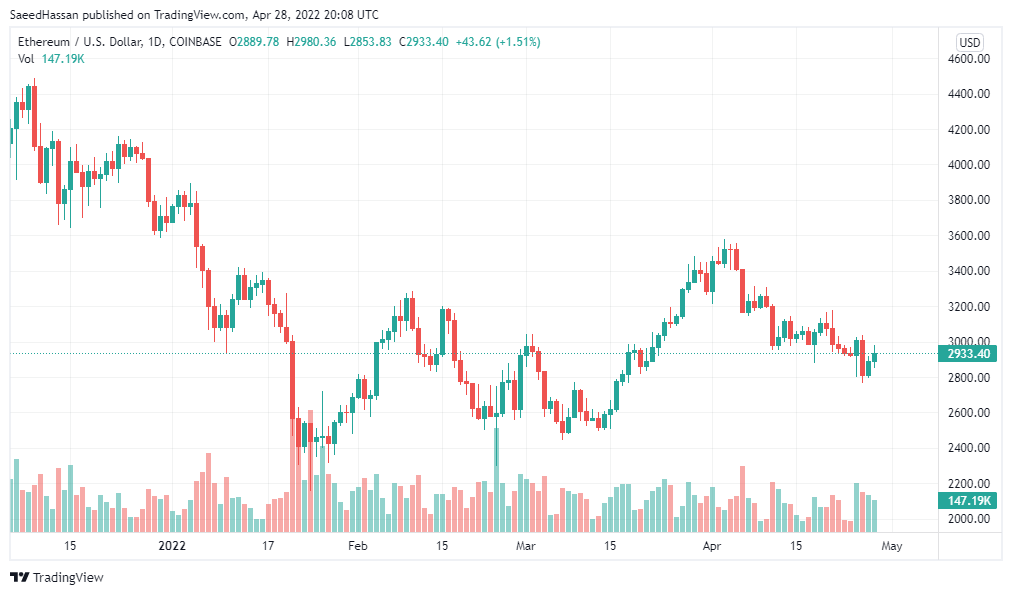
ETH showing an upward trend with a 1.5% gain | Source: ETH/USD chart from Tradingview.com With its current market capitalization, ETH is 10 times larger than Solana and close to 45% of BTC’s value. According to technical insights, there are strong supply and demand zones in the market because people want to buy things for less. FOMO (fear of missing out) has been a major driving force behind cryptocurrency prices.
Ethereum Price Analysis
ETH’s price trend has repeatedly beaten expectations, but because it is currently trading below the 200-day moving average (DMA) curve, there is a negative sentiment in the short term.
With the crypto market still uncertain, buyers have made various attempts to breach Ethereum’s $3,600 level. But the 200-day moving average is slowly dropping. So if Ethereum surpasses this average, there could be a significant price movement to new high levels.
ETH is in high demand at $2,400 levels, and there is a good chance that demand will increase even more in the coming days. The only resistance stopping it from going even higher is $3,200 to $3,600, preventing further growth.
Since April 2022, the candlestick pattern when ETH 200 DMA failed to cross-resistance has a profit booking in free fall, stability, and more profitability bookings. On April 26, 2022, the crypto market experienced a 6% collapse. This seems to be due to concerns about the influence of Elon Musk on the crypto market.
The ETH price decreased by 22% in April. The buying strength indicated by the RSI indicator has reduced by 66%. For the last six months, transaction volumes have remained the same, with spikes but average out at similar levels. ETH has a few milestone prices to surpass for the short term. However, before investing in Ethereum, traders should read more about the ETH’s future price momentum and explore market sentiments.
The price trend for ETH has been strong for most of this year, but declining demand seems to be weakening. Unfortunately, this decline cannot be identified by looking at its historical data. So one must assess that prices above $4,000 will lead Ethereum upward while values below $2,500 drag them down further.