[Featured Research]Compete With Optimism? Coinbase is launching BASE

Delphi Digital2023-02-25 tarihinde yayınlandı2023-02-27 tarihinde güncellendi

Özet

Coinbase is launching BASE, an attempt to bridge their users to the crypto ecosystem

In 2016, Coinbase CEO Brian Armstrong wrote his "Master Plan" for a global open financial system.

Today, Coinbase is home to 110 million users with $80 Billion in assets on the platform.

Coinbase is launching BASE, an attempt to bridge their users to the crypto ecosystem 🧵⬇️
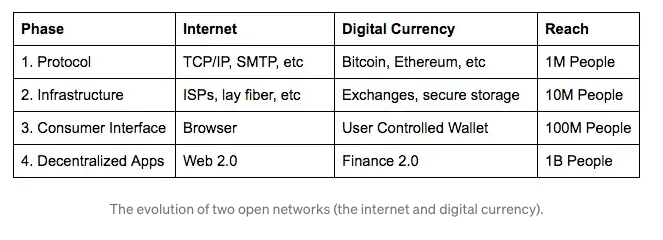
1/ The master plan has 4 parts:

1. Develop the protocols

2. Build an exchange

3. Build interfaces for dApps

4. Build dApps to power an open financial system

BASE falls in between stages 3 & 4, and no player is better suited than Coinbase to achieve this mission.
2/ To understand BASE, you need to first understand

@optimismFND

.

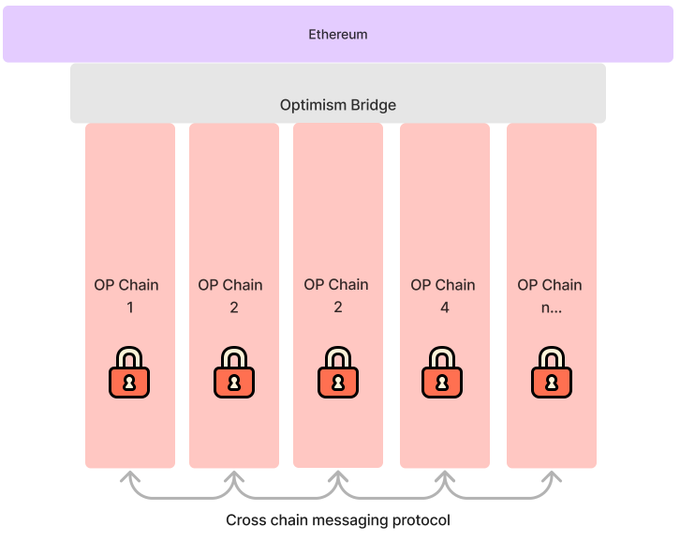
Optimism aims to be a Super-Chain, where the OP codebase is forked to create new chains that are configured to optimize for different use cases.

"OP-Chains" are seamlessly interoperable with each other.
3/ BASE is a fork of the OP codebase.

The chain itself will be permissionless, allowing anybody to deploy on it.

While Coinbase will build infrastructure and applications on top of BASE, it invites anybody to build and deploy on BASE to tap into 100 million verified users.
4/ Coinbase aims to leverage the infrastructure and applications built on BASE as a way to bridge the gap between their retail user base and the crypto economy.

They don't want to keep their users on an island, but rather provide a bridge towards decentralized applications.
5/ The goal is to offer their user base of more than 100,000,000 verified users with a safe and intuitive interface towards the crypto economy.

They want to create a default experience for anybody to go on-chain.

They are evolving from an exchange to a web3 gateway.

6/ There is no plan for a $BASE token.❌

Coinbase doesn't need a token to incentivize usage of its chain. It already has a colossal user base.

Ethereum will be the native gas token of BASE, with account abstraction enabling users to pay transaction fees with any coin they want.

7/ Coinbase and Optimism have been working together for more than a year and contributed heavily to the development of EIP-4844.

EIP-4844 aka “Proto-Danksharding” can decrease L2 transaction fees by 10-100x.

8/ BASE is being built on Optimism for 3 reasons:

1. Synergy built from EIP-4844 development

2. EVM being the “path of least resistance”

3. OP's codebase enabling a fast path to launch

Coinbase is now an OP stack core contributor and is running a joint roadmap with Optimism.

9/ The OP stack provides standardized, open-source modules for Layer 2 chains to provide shared security, composability and coordinated sequencing of transactions.

BASE being built into the OP stack opens up all applications built on Op-Chains to Coinbase's retail user base.
10/ There is no player better suited than Coinbase to onboard billions of users to the crypto economy.

BASE is Coinbase's Master Plan.

İlgili Okumalar

Deciphering the Ethereum Foundation's New Structure: Reaffirming Self-Sovereignty Amid Institutionalization Trends

Summary: The Ethereum Foundation (EF) has announced a major restructuring, laying off 20% of its staff and introducing a new five-layer operational framework. This move aims to clarify the EF's mission and reaffirm Ethereum's core principle of self-sovereignty amidst growing institutionalization in the crypto space. The five layers are: 1. **Protocol Layer**: Focuses on maintaining Ethereum's foundational "CROPS" values—Censorship-resistant, Robust, Open, Private, and Secure. This involves core technical work like secure hard forks and mitigating toxic MEV. 2. **Access Layer**: Ensures users can practically exercise self-sovereignty through actions like reading the chain and making transactions. A key principle is the "zero option," meaning a trusted, non-intermediated path must always exist as an alternative to any centralized service. 3. **User Layer**: Bridges the protocol and access layers by grounding EF's work in the real needs of users and organizations. This is seen as crucial for moving beyond a purely research-driven approach and ensuring development effectively serves the ecosystem. 4. **Community Layer**: Responsible for building and maintaining consensus around Ethereum's core values both internally and externally. This involves guarding against centralization, upholding technological neutrality, and preventing short-term commercial interests from undermining CROPS principles. 5. **Institutional Layer**: Manages EF's engagement with institutions, but with the precondition of self-sovereignty. The goal is not to make it easier for institutions to control users, but to demonstrate how Ethereum's technology can enable better integrations. The article argues that while institutional adoption brings legitimacy, it also risks diluting crypto's foundational ethos of decentralization. The new structure represents EF's effort to navigate this tension, upholding its core mission while actively engaging with a broader, more complex ecosystem.

marsbit7 dk önce

Deciphering the Ethereum Foundation's New Structure: Reaffirming Self-Sovereignty Amid Institutionalization Trends

marsbit7 dk önce

OpenRouter: How Did This 'AI Model Relay Station' Achieve a $10 Billion Valuation?

OpenRouter: The Model Router Building a $10B+ Company This article explores OpenRouter, a platform that aggregates access to over 400 AI models from 70+ providers (like OpenAI, Claude, Gemini) through a single API. It has grown into a unicorn with a $1.3B valuation by 2026, processing massive scale—reaching 100 trillion tokens monthly. Its core value isn't just being a "model supermarket." For developers building real-world AI applications, managing multiple models for different tasks (e.g., cheap models for titles, powerful ones for long articles) is complex. OpenRouter acts as a critical "model scheduling layer," handling routing, failover between providers, cost optimization, and enterprise features like zero-data-retention policies and budget controls. OpenRouter's business model is a "toll fee": it charges a small platform fee (5.5%) on purchased credits while passing model costs directly to users. Its revenue scales with the tokens flowing through its system, which saw explosive growth as AI apps evolved. Key growth drivers include: 1) The explosion of specialized models, increasing choice complexity; 2) AI apps shifting focus from performance to cost optimization; 3) The rise of AI agents that require more reliable, multi-step model calls. However, risks remain. Large enterprises or cloud providers (AWS, Google Cloud) could build similar internal gateways. Its position between model suppliers and developers could also create future tension over pricing and data control. To stay ahead, OpenRouter must deepen its enterprise features and prove it's more than just a request forwarder.

marsbit27 dk önce

OpenRouter: How Did This 'AI Model Relay Station' Achieve a $10 Billion Valuation?

marsbit27 dk önce

Bitcoin Falls Below $60,000 Again; After 20 Months, We've Reached a New Low

Bitcoin Drops Below $60,000, Hitting a 20-Month Low Bitcoin fell below the key $60,000 psychological level again, reaching a low of $59,023—its lowest point in approximately 20 months, dating back to October 2024. While it later recovered slightly to around $60,600, this marks its third significant breach of $60,000 this year. The downturn is attributed to two primary factors. First, U.S. spot Bitcoin ETFs are experiencing their longest streak of net outflows since launch, with nearly $5.94 billion withdrawn over 30 days. This creates sustained selling pressure as Authorized Participants sell Bitcoin to meet redemptions. Second, shifting macroeconomic expectations are adding pressure. Strong U.S. job data and hawkish remarks from Fed officials have increased market pricing for potential rate hikes, reversing the earlier liquidity-driven bullish sentiment and prompting a shift away from risk assets like Bitcoin. Analyst views are mixed. 21Shares maintains a bullish long-term outlook, expecting prices to recover towards $100,000, citing historical post-halving cycles and substantial ETF holdings as a base. In contrast, Arthur Hayes predicts a potential bottom around $40,000 within six months due to persistent Fed hawkishness. CryptoQuant suggests, based on on-chain data, that the market may not find a bottom until prices fall below the average investor cost basis around $53,000, potentially extending the bearish phase into late 2026 or early 2027. The immediate focus is on upcoming U.S. inflation data and Fed signals. Lower-than-expected CPI could offer relief, but confirmation of sticky inflation or continued ETF outflows may lead to further downside pressure. Bitcoin's ability to hold above $60,000 remains a critical test for the near-term market direction.

Odaily星球日报1 saat önce

Bitcoin Falls Below $60,000 Again; After 20 Months, We've Reached a New Low

Odaily星球日报1 saat önce

İşlemler

Spot
Futures
活动图片