Dash Launches ZK-Privacy Based on Zcash

cryptonews.ruPubblicato 2026-07-30Pubblicato ultima volta 2026-07-30

Introduzione

Dash has launched ZK-based privacy features built on Zcash's Orchard protocol. This is now integrated directly into the Dash Platform's consensus (v4.0.0), providing a native, non-custodial privacy model alongside the existing CoinJoin system. It offers optional confidentiality, hiding sender, receiver, amount, and balance within a shielded pool. The implementation adapts Zcash's Orchard protocol (using Halo 2 without a trusted setup) to Dash Platform, handling state transitions, GroveDB storage, fees, and wallet sync. A critical double-spend vulnerability discovered in Orchard prior to release was patched using updated libraries, with Dash adding a SumTree structure for extra security. Users can privately transfer Platform Credits (pegged 1:100 billion to DASH) and move funds to/from the main Dash Core chain. Wallet synchronization, which is required to detect incoming private transactions, took about 21 seconds in testing, noted as significantly faster than a comparable Zcash wallet. Future plans include extending shielded pools to native Platform tokens and NFTs, aiming to combine ZK-privacy with token issuance and direct exchangeability with Dash. Mobile wallet support for the new feature is expected soon.

In February, we wrote about Dash's plans to integrate Orchard. At that time, it was about a future release and the prospect of private user tokens.

Now the first part of the plan has been implemented: in Dash Platform v4.0.0, shielded operations have become part of the consensus. This is not an external mixer, not a custodial service, and not an experimental smart contract — privacy is built directly into the protocol.

For Dash, historically associated with CoinJoin, this is not a replacement for the old mechanism, but a second model of privacy. CoinJoin continues to work on the main network, while Platform uses ZK-proofs instead of mixing rounds with multiple participants. This approach is better suited for fast mobile wallets. At the same time, regular Dash transactions remain transparent: confidentiality is optional.

The shielded pool hides the balance, sender, recipient, and transfer amount within the pool. The network verifies that funds exist, belong to the sender, and are not double-spent, but does so without revealing the operation's contents.

A user can deposit credits into the pool from a transparent Platform address, conduct a private transfer, and return the funds back. For DASH holders, two other routes are more important: ShieldFromAssetLock sends funds to the shielded pool directly from Core, and ShieldedWithdrawal withdraws them to a specified Core address. To avoid linking the withdrawal to previous activity, the wallet must use a new address.
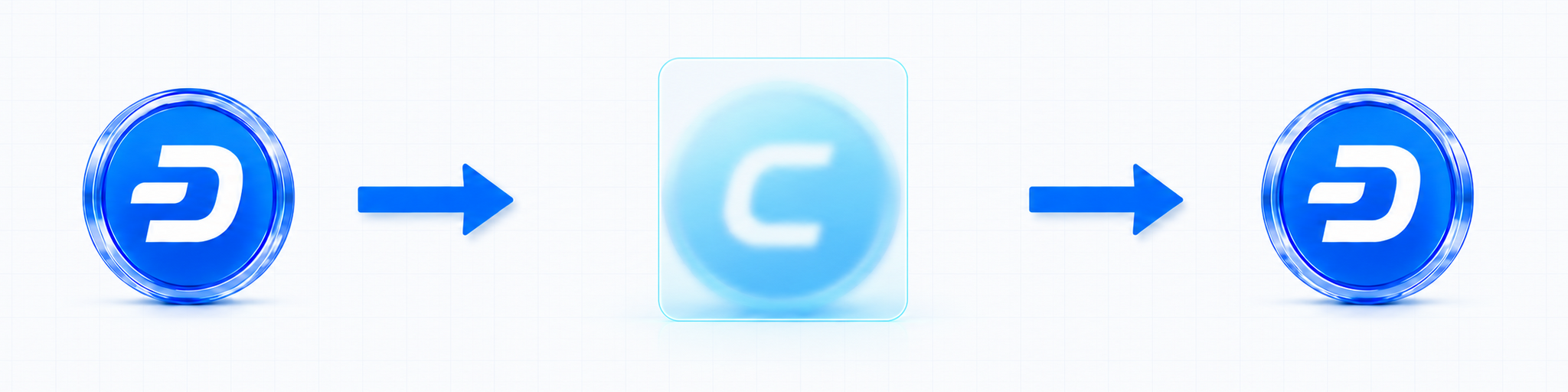
Platform Credits are the internal accounting unit of Dash Platform, linked to Dash by a fixed ratio: one Dash corresponds to 100 billion credits.

How the Privacy Works — Without Unnecessary Math

Dash did not create a new ZK-scheme from scratch. The implementation is based on Orchard, Zcash's shielded protocol built on Halo 2 without a trusted setup. Dash's engineering work involved adapting it to Platform: custom state transitions, storage in GroveDB, fees, wallet synchronization, and the route back to Core.

Shortly before the release, a critical vulnerability was discovered in Orchard, potentially allowing double spending within the pool. The Zcash team fixed the proof scheme, and the Dash Core Group updated its implementation to the revised libraries even before the release of Platform 4.0. An additional layer of control in Dash is provided by SumTree: this structure stores and verifies the pool's state, preventing hidden inflation from going unnoticed.

One of the main problems with shielded systems is wallet synchronization. To detect incoming funds, the application receives encrypted notes and locally checks which ones its key can decrypt. The server does not learn which transfers belong to the user.

In the test version of the application, we created a new wallet and started synchronization: it took about 21 seconds, which is significantly faster than synchronizing the Zodl wallet for ZCash.

The release of mobile wallets supporting the new technology is expected soon.

Currently, the pool only works with Platform Credits. However, Dash has already announced plans to add separate shielded pools for native Platform tokens.

Private user assets are not a new concept. Dash's strength lies in the specific combination of capabilities: ZK-privacy, token and NFT issuance, and the ability to exchange created assets for Dash and back. Thanks to this, each asset gains a direct link to the already established coin, and through it — to the external market.

end-content

Crypto di tendenza

Domande pertinenti

QWhat is the main news about Dash mentioned in the article?

ADash has launched ZK-privacy (shielded operations) built directly into its protocol, specifically in Dash Platform v4.0.0, based on Zcash's Orchard protocol.

QHow does the new shielded privacy model in Dash Platform differ from its previous CoinJoin method?

AThe new model uses Zero-Knowledge (ZK) proofs for privacy, making it better suited for fast mobile wallets. It is built directly into the protocol, unlike CoinJoin which is a mixing service in the main network. Both models coexist, with the new shielded pool offering optional privacy for Platform Credits.

QWhat are the two new transaction routes mentioned for DASH holders to interact with the shielded pool?

AThe two new routes are 'ShieldFromAssetLock', which sends funds into the shielded pool directly from Dash Core, and 'ShieldedWithdrawal', which withdraws funds from the shielded pool to a specified Dash Core address.

QWhat was a key security issue addressed before the launch of Dash Platform v4.0.0?

AA critical vulnerability was discovered in the Orchard protocol that could potentially allow double-spending within the shielded pool. The Zcash team fixed the proof scheme, and the Dash Core Group updated its implementation to the patched libraries before release.

QWhat future development for Dash Platform's shielded pools is announced in the article?

ADash announced plans to add separate shielded pools for native tokens on the Dash Platform, enabling private user-created assets like tokens and NFTs with a direct link to the DASH cryptocurrency and the external market.

Letture associate

Strategy's Loss in the Second Quarter Reaches $8.22 Billion Amid Bitcoin Decline

Strategy, the largest corporate holder of Bitcoin, reported a net loss of $8.22 billion for the second quarter. This loss was primarily driven by an $8.32 billion unrealized loss on its Bitcoin holdings due to a decline in the asset's price during the period. Despite these paper losses, the company increased its Bitcoin holdings to 843,775 BTC, a 25% growth since the start of the year. As part of a new monetization strategy, Strategy sold approximately $218.4 million worth of Bitcoin, mainly to fund dividends for preferred shareholders, with $216 million of that sold after Q2 ended. The company also built a $3.75 billion cash reserve, which it claims is sufficient to cover over two years of dividend and interest payments, aiming to insulate itself from Bitcoin's volatility while meeting obligations. Following the earnings release, Strategy's stock (MSTR) rose 4.7% in regular trading but corrected slightly after-hours. This pattern reflects how the company's accounting results are heavily tied to Bitcoin's price swings, even as its long-term strategy remains unchanged. The report indicates that Strategy is maintaining its core strategy of accumulating Bitcoin while building a financial buffer. This quarterly loss follows a recognizable pattern, with the company posting significant unrealized losses in previous quarters (e.g., $12.4 billion in Q4 2025 and ~$12.5 billion in Q1 2026) due to fair-value accounting. A key technical shift is its new monetization program, which introduces periodic selling pressure on the market, transitioning Strategy from a pure accumulator to a participant that occasionally adds supply. A critical question remains: how long can the cash reserve cover dividend obligations if a Bitcoin price downturn persists beyond two years?

cryptonews.ru18 min fa

Strategy's Loss in the Second Quarter Reaches $8.22 Billion Amid Bitcoin Decline

cryptonews.ru18 min fa

Will Terrorist Durov Ban Russian Officials?

Telegram founder Pavel Durov publicly reacted to being labeled a "terrorist" by Russian authorities, stating the designation came after he refused demands for mass surveillance and censorship on the platform. In a Telegram post, he highlighted that this status formally bans him from "publishing information online." Durov concluded with a statement widely circulated: Russian officials "clearly don't understand who can ban whom on the internet." This remark suggests Durov could potentially restrict official Russian government and officials' channels on Telegram, which continue to operate on the platform despite its formal blocking in Russia. The situation parallels previous, slow-moving state directives, like switching officials to domestic cars, contrasted with the current push to migrate all government communication to the Russian-made messenger MAX by 2030. However, reports indicate many officials still use Telegram via workarounds, fearing surveillance on MAX, while alternatives like BiP and KakaoTalk recently became inaccessible in Russia without a VPN. Durov has not specified any immediate actions against state channels. His statement is an initial response, with further developments depending on the authorities' reaction. The dynamic differs from 2020 when Russian regulators lifted a block on Telegram; now, Durov implies control from within the platform itself over the official accounts that persisted through that earlier blockade.

cryptonews.ru18 min fa

Will Terrorist Durov Ban Russian Officials?

cryptonews.ru18 min fa

DeepSeek V4 Official Version Arrives, New Capabilities Emerge, Value-for-Money King Enters the Fray

On July 31st, DeepSeek officially launched the public API beta for its DeepSeek-V4-Flash model. A key highlight is its performance on multiple Agent benchmark tests, reportedly nearing or even surpassing the level of the V4-Pro preview version from three months ago. Notably, the Flash model achieves this with significantly smaller scale (130B active parameters vs. Pro's 490B), suggesting that post-training optimization and data quality may be as crucial as raw model size. DeepSeek emphasized that the V4-Flash-0731 uses the same model architecture and size as its preview version, with improvements attributed solely to "re-trained post-training." The update also marks the official debut of DeepSeek's self-developed Agent framework, "Harness." The move signals DeepSeek's strategic push to position its cost-effective Flash model as a competitive base for Agent applications—scenarios requiring autonomous planning, tool usage, and complex task execution—where inference speed and cost are critical. By natively supporting OpenAI's Responses API format and adapting for code-generation scenarios, DeepSeek aims not just to be a cheaper alternative but to establish its own ecosystem in the Agent era. This release follows DeepSeek's record-breaking ~$50 billion fundraising round roughly two months prior, underscoring market confidence in its technology and commercialization prospects. The company is reportedly preparing for another funding round at a valuation of approximately $71 billion. The Flash model's advancement represents a step in fulfilling the high expectations that come with this valuation, setting the stage for the impending release of the V4-Pro official version and intensifying competition in the global Agent landscape.

marsbit22 min fa

DeepSeek V4 Official Version Arrives, New Capabilities Emerge, Value-for-Money King Enters the Fray

marsbit22 min fa

Trading

Spot

Articoli Popolari

Come comprare DASH

Benvenuto in HTX.com! Abbiamo reso l'acquisto di DASH (DASH) semplice e conveniente. Segui la nostra guida passo passo per intraprendere il tuo viaggio nel mondo delle criptovalute.Step 1: Crea il tuo Account HTXUsa la tua email o numero di telefono per registrarti il tuo account gratuito su HTX. Vivi un'esperienza facile e sblocca tutte le funzionalità,Crea il mio accountStep 2: Vai in Acquista crypto e seleziona il tuo metodo di pagamentoCarta di credito/debito: utilizza la tua Visa o Mastercard per acquistare immediatamente DASHDASH.Bilancio: Usa i fondi dal bilancio del tuo account HTX per fare trading senza problemi.Terze parti: abbiamo aggiunto metodi di pagamento molto utilizzati come Google Pay e Apple Pay per maggiore comodità.P2P: Fai trading direttamente con altri utenti HTX.Over-the-Counter (OTC): Offriamo servizi su misura e tassi di cambio competitivi per i trader.Step 3: Conserva DASH (DASH)Dopo aver acquistato DASH (DASH), conserva nel tuo account HTX. In alternativa, puoi inviare tramite trasferimento blockchain o scambiare per altre criptovalute.Step 4: Scambia DASH (DASH)Scambia facilmente DASH (DASH) nel mercato spot di HTX. Accedi al tuo account, seleziona la tua coppia di trading, esegui le tue operazioni e monitora in tempo reale. Offriamo un'esperienza user-friendly sia per chi ha appena iniziato che per i trader più esperti.

317 Totale visualizzazioniPubblicato il 2024.12.13Aggiornato il 2026.06.02

Come comprare DASH

Discussioni

Benvenuto nella Community HTX. Qui puoi rimanere informato sugli ultimi sviluppi della piattaforma e accedere ad approfondimenti esperti sul mercato. Le opinioni degli utenti sul prezzo di DASH DASH sono presentate come di seguito.

活动图片